To avoid these ads, REGISTER NOW!

Heater gas connection.

Kylersk

Member
Joined
Sep 30, 2020
Messages
22
Location
MN
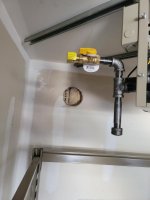
I ran CSST to my furnace room. I'm planning on adding a T fitting after the gas regulator in the basement. I only have one gas appliance and thats the home furnace.

I've mocked up the black pipe connection to the garage heater.


Comments? Suggestions?


attachment.php


attachment.php
 

Attachments

  • 20201005_152741.jpg
    20201005_152741.jpg
    48.3 KB · Views: 238
Last edited:
To avoid these ads, REGISTER NOW!

dcg9381

Well-known member
Joined
Jun 20, 2018
Messages
11,660
Location
Austin, TX
Dont really understand the question. Can you "T"? Sure.
Other comments - pressure test. Over what is required. Leave for days before deciding "done".
 
OP
K

Kylersk

Member
Joined
Sep 30, 2020
Messages
22
Location
MN
Where would I pressure test from? After the csst and prior to the heater shutoff? Basically, just testing the CSST line?
 

HoosierBuddy

Well-known member
Joined
May 9, 2006
Messages
2,918
Location
Southern Indiana
What did the training book from the CSST manufacturer say to do at the appliance? You should probably study that and do what they recommend. Same thing on the pressure test.
 

BD1

Well-known member
Joined
Mar 18, 2007
Messages
4,602
Location
north side
Normally a black union is installed between the shutoff valve and the elbow.
I would also install a shutoff valve at tie in point.
With the amount of joints, I would test with existing gas. A spray bottle with Dawn and water is my favorite. Mix heavy for soap.
I would spray entire fitting. Unless material was purchased from pipe supplier yours are probably made in China. They can have a sand hole in them. Unlikely, but I would soap everything and you can use a 1" wide cheap paint brush to form a ring by threads .Brush soap toward fitting hub.


Sent from my iPhone using Tapatalk
 
OP
K

Kylersk

Member
Joined
Sep 30, 2020
Messages
22
Location
MN
Thanks. The inspector wants to see a 24 hour pressure test. Big Maxx says to pressure test prior to the external shut off valve. If that's the case, then all I'm really testing is the CSST line from basement to garage. Which is about 15'.
 

BD1

Well-known member
Joined
Mar 18, 2007
Messages
4,602
Location
north side
The reason manufacturer sayvto test to shutoff is to protect gas valve inside unit.
If you want to make inspector happy, add the union between the manufacturers thread and the bull of tee. That's the center of the. So you would have a ****** from tee to one side of union and other side of union to their thread.
So you can test from that tee to basement valve.
Usually the new piping is tested before being tied into main. You don't want to subject existing piping to excessive pressure. Natural gas pressure is only around 7". One pound natural gas is around 27".
What pressure does he want you to test at ?
Some will ask for 5 to 10 pounds.
They normally like to see a low pressure gauge like 0 to 20 pounds for testing.
That will provide a better test.


Sent from my iPhone using Tapatalk
 
OP
K

Kylersk

Member
Joined
Sep 30, 2020
Messages
22
Location
MN
He wants 25#. Then he said most just put it at 30#. That seems high?
 

BD1

Well-known member
Joined
Mar 18, 2007
Messages
4,602
Location
north side
Yes sir considering you only have ounces of pressure on system. I would ask how much pressure is on existing piping. Like I said, usually it's only 7" to 9" of pressure.
Typically, many engineers require 1 and a 1/2 times working pressure.
On the commercial jobs they would require 25 pounds for 24 hours or longer depending when they returned to job.
A typical city residence sometimes would ask for 25 pounds for 15 minutes.
Gas company shows up, we pump up to 25 pounds and they would sit and watch for 15 minutes.


Sent from my iPhone using Tapatalk
 
OP
K

Kylersk

Member
Joined
Sep 30, 2020
Messages
22
Location
MN
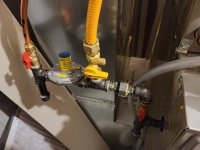
Added the T in the basement. After looking at it, should the T be after the Union? I assume there is a union inside the furnace after that shut off.
attachment.php
 

Attachments

  • 20201006_195655.jpg
    20201006_195655.jpg
    115.9 KB · Views: 83
Last edited:
To avoid these ads, REGISTER NOW!

BD1

Well-known member
Joined
Mar 18, 2007
Messages
4,602
Location
north side
The new tee in basement should have a valve going to New heater.
I would add union in the valve going to heater. This way you can leave shutoff closed and plug union for testing .
With 25 pounds of test pressure you don't want to expose existing piping or heater to that pressure. Only test the new stuff.
Inexpensive valves may leak through.
Valves should be rated WOG. Water, Oil, or Gas.


Sent from my iPhone using Tapatalk
 
OP
K

Kylersk

Member
Joined
Sep 30, 2020
Messages
22
Location
MN
The new tee in basement should have a valve going to New heater.
I would add union in the valve going to heater. This way you can leave shutoff closed and plug union for testing .
With 25 pounds of test pressure you don't want to expose existing piping or heater to that pressure. Only test the new stuff.
Inexpensive valves may leak through.
Valves should be rated WOG. Water, Oil, or Gas.

The yellow line is the one going to garage heater, it has a shut off. I need to buy another shut off (they are WOG and rated for a max 600PSI) for inside the garage prior to the union I installed.
 
Last edited:

BD1

Well-known member
Joined
Mar 18, 2007
Messages
4,602
Location
north side
Sounds good. Just expose new piping to the test.


Sent from my iPhone using Tapatalk
 
OP
K

Kylersk

Member
Joined
Sep 30, 2020
Messages
22
Location
MN
Yeah, spoke to the inspector. He's more concerned with the new pipe run than the black pipe. Pressure test the new run and soap test the black pipe connections.
 

dfiler2

Well-known member
Joined
Dec 15, 2014
Messages
2,858
Location
NW Minnesota
Added the T in the basement. After looking at it, should the T be after the Union? I assume there is a union inside the furnace after that shut off.
attachment.php

I've never seen a regulator installed inside the home, turns out they can be installed inside as long as they are vented. At least around here, maybe your area is different or maybe that's not a regulator?

If a LP gas regulator is installed inside a building, it must be vented to the outside atmosphere using copper tubing (vent extension). The vent extension must terminate at a point at least 3 feet from any opening back into the building.
 
To avoid these ads, REGISTER NOW!
Top Bottom