That could happen... you'd be crazy to not insulate them a bunch of times over. Lots and lots of tape, plus rubber tape or shrink wrap. I used shrink wrap, then about 1/4 of a roll of 33+ tape. The 33+ tape pretty much seals to itself and makes a solid coating.
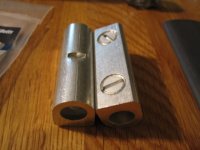
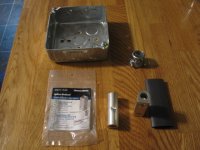
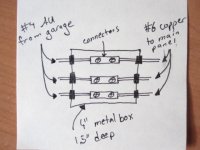
The set screw barrel splice kits come with a pre-cut piece of heat shrink tubing, and make a UL compliant splice using everything included.
The advantage to something like that, is that the splice stays very small.
I would be more comfortable adding about two layers of Scotch 88 on top of that (33+ is just as good, I just happen to prefer the feel of 88, but you should never use an inferior tape for insulation purposes) too.
Split bolts are another story. They have edges and corners that can pierce the tape over them.
The traditional method of taping would be to first wrap them in a layer of friction tape to cover any sharp edges, then two layers of rubber self-sealing insulating tape that extends onto the wire, then a cover layer in either friction tape or electrical tape, to protect the rubber layer from damage.
Covering in about 1/3 roll of Scotch premium tape (33+ or 88) would be an acceptable alternative.
All said and done, you'll end up with a golf ball sized splice, or larger.
Back to the issues with the actual connections:
Yes indeed, you must use a well fitting screwdriver for the set-screws. A Craftsman cabinet screwdriver is simply NO GOOD. Proper screwdrivers will be hollow ground with parallel faces. Basically a gunsmithing screwdriver in design. I use Wera insulated screwdrivers (insulated, because it's what I have).
Use the wrong screwdriver, and you may damage the aluminum.
The screw should "squeak" when it gets tightened right. That's the sound of the screw jumping forward in ever so tiny increments because of high static friction. If it doesn't make the sound, it is more likely to back out.
It is important to select the smallest barrel that fits the wire being used. Larger or lugs will leave space around the wire that the set-screw must pass through, leaving less thread engagement for the screw, and more room for the individual strands to wiggle out from under the screw. This is also an issue if the strands in the wire are fine. Thicker strands hold up fine under a screw. If it fits well, it makes for an excellent connection.
Now, about split bolts. The nut only contacts threads on about 1/2 of the full circle, so it is very easy for the threads on one side to jump. With copper, it is bad enough, but with aluminum it is downright scary to me. The total thread engagement is less than with that tiny set-screw, believe it or not.
This really requires careful preparation, and a torque wrench.
Previously, i've only seen all aluminum split bolts rated for co/alr.
The tin plated copper split bolts that I knew of were not rated for aluminum wires. I see now that some are indeed rated AL9CU. I'll admit freely, aluminum is not my thing. I avoid it like the plague.
Ok, that sounds like it may be a good option too then, but while the plating may take care of the corrosion issues, it doesn't fix the thermal expansion/contraction issues that can cause the bolt to loosen.
The spacer bar is designed to prevent galvanic corrosion. This is only an issue in wet locations (the outdoor box in question would fall into this category though, as would an overheat triplex install, etc.).
But all said and done, I would still recommend a set-screw connection in a pre-made split kit, before I told a do-it-yourselfer to grab split bolts. Even if they can be made to work just fine, they're not nearly as simple to get right.




 Oh yea and a big flash