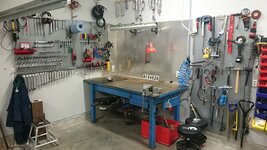
Finally built my new work bench/fab table. I picked up the plate as surplus a few years back, and finally had the time to turn it into a table.
Here's some details:
-1" thick 4x8 Hardox 500 top
-6" pipe legs
-5" channel sub frame
-32" high
-1600 lbs
-Wilton C3 (another 200 lbs!)
Still need to burn holes to bolt down the vise, and radius the corners a bit. I will probably add some large triangular gussets between the legs and subframe at a later date, but I needed it for a few projects, so it will be put to work as-is for now.
This will be a general pupose work bench and welding table. I have used many benches in welding and heavy equipment shops in my career, and this style bench is what works best for me - simple, sturdy, and heavy.
For the work I want to do with this table, I need versatility:
-No grid holes for clamps; maybe I'll be tearing down a transmission and don't want small parts falling through.
-Low enough for heavy hammering and manuevering large parts.
-Simple enough to be modified as needed; I often weld jigs or stands to a bench for unique jobs.
-Strong enough to support extremely heavy machine components.
-Enough mass to resist moving when used for holding parts during assembly/disassembly.
Here's some things you typically won't see on workbenches used daily in heavy equipment shops:
-Receiver tubes for vises - too much slop, and puts the vise too far from table.
-Holes all over the top for clamps and jigs - fine for a specialty fab shop, but for a general purpose bench, I prefer to tack the project down if needed.
-Caster wheels. Having your bench start rolling while torquing or prying on something is incredibly frustrating.
Here's some details:
-1" thick 4x8 Hardox 500 top
-6" pipe legs
-5" channel sub frame
-32" high
-1600 lbs
-Wilton C3 (another 200 lbs!)
Still need to burn holes to bolt down the vise, and radius the corners a bit. I will probably add some large triangular gussets between the legs and subframe at a later date, but I needed it for a few projects, so it will be put to work as-is for now.
This will be a general pupose work bench and welding table. I have used many benches in welding and heavy equipment shops in my career, and this style bench is what works best for me - simple, sturdy, and heavy.
For the work I want to do with this table, I need versatility:
-No grid holes for clamps; maybe I'll be tearing down a transmission and don't want small parts falling through.
-Low enough for heavy hammering and manuevering large parts.
-Simple enough to be modified as needed; I often weld jigs or stands to a bench for unique jobs.
-Strong enough to support extremely heavy machine components.
-Enough mass to resist moving when used for holding parts during assembly/disassembly.
Here's some things you typically won't see on workbenches used daily in heavy equipment shops:
-Receiver tubes for vises - too much slop, and puts the vise too far from table.
-Holes all over the top for clamps and jigs - fine for a specialty fab shop, but for a general purpose bench, I prefer to tack the project down if needed.
-Caster wheels. Having your bench start rolling while torquing or prying on something is incredibly frustrating.


 I won't ask what that 1" sheet costs.


 Mine is 1/2” by 4x8 and serves me similar to what you need, as a tear down table and welding table. I installed salvaged drawer sets under it for various metal working tools. The center table is a 1/4” steel pullout mobile table about 32x30 and comes in very handy for additional work surface and storage for metal drops.