To avoid these ads, REGISTER NOW!

Helicoil bottoming question

crazybrit

Well-known member
Joined
May 29, 2013
Messages
341
Location
Portland, OR
I've luckily never had to repair a thread. Today despite using correct torque (8NM) I managed to strip one of the M6x1.0 threads on an motorcycle (Aprilia) clutch cover. I'm pretty sure it's magnesium.

The bolt length is 20mm and the clutch cover depth is 13mm. I tried a longer bolt (25mm) and it bottomed out in the case with about 5mm of thread exposed so the 20mm bolt is close to the maximum length.

So I'm looking at a 7mm max length insert and I suspect I'll need a bottoming tap.

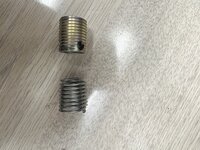
Helicoil sells a kit 5546-6 but the tap isn't bottoming and the inserts are the 1.5x width (9mm). Their 6mm insert is 1084-6CN060 but I'd still need a tap.

Looking at the Helicoil catalog it seems to imply that the 1x diameter length inserts (6mm) needs a 15mm hole for a plug tap and 10mm hole for a bottoming tap. If so this seems a problem but I could easily be misunderstanding.

Since I've never done this before I thought I'd pause and ask for some advice.

Also I see 91732A635 at McMaster Carr for the 6mm insert and 91709A533 is the corresponding bottoming tap. However the installation and breakoff tools are pretty spendy ($108 and $87). The insertion tool seems to be keyed to the final thread diameter so I assume you could use the Helicoil installation tool with these McMaster inserts and tap. Also I watched a video where they broke the tang off manually.
 
To avoid these ads, REGISTER NOW!

WILD-BILL

Well-known member
Joined
Dec 10, 2011
Messages
873
Location
Brook Park Oh
For shallow holes needing a bottom tap I have just bought an extra heli coil tap for that size and grind it to a bottoming profile.

Any extra "threads" from the heli coil sticking up out of the hole are easily ground down with a right angle DA or flap disc. Just be careful no to mar the original surface if it is a gasket mating area.

I've always broken the tangs manualy.
 

paulsomlo

Well-known member
Joined
Jul 16, 2013
Messages
3,866
Location
Northern Colorado
I've luckily never had to repair a thread. Today despite using correct torque (8NM) I managed to strip one of the M6x1.0 threads on an motorcycle (Aprilia) clutch cover. I'm pretty sure it's magnesium.
That seems to be a common theme - a torque wrench, a non-ferrous casting, and stripped threads. In those situations, I trust my wrist.
 
OP
C

crazybrit

Well-known member
Joined
May 29, 2013
Messages
341
Location
Portland, OR
For shallow holes needing a bottom tap I have just bought an extra heli coil tap for that size and grind it to a bottoming profile.

Any extra "threads" from the heli coil sticking up out of the hole are easily ground down with a right angle DA or flap disc. Just be careful no to mar the original surface if it is a gasket mating area.

I've always broken the tangs manualy.

thanks a buddy has two 6mm heli taps so he's going to loan me them and I'll just grind one down. I wasn't sure if any excess insert could be ground off, thanks for confirming.

drill spec is 1/4 so I'll use a 6mm and then finish with a 1/4 end mill. this should allow me full depth vs a 1/4 drill bit. i'm going to take the inner case off so I can do it on the mill, rather than trying to free drill the outer cover on-bike.

That seems to be a common theme - a torque wrench, a non-ferrous casting, and stripped threads. In those situations, I trust my wrist.

odd, my buddy with the heli coil kits said the same thing :)
 

Rusted Nut

Well-known member
Joined
Dec 11, 2022
Messages
1,802
Location
PNW
Is there sufficient width on the clutch case boss for the helicoil? If not, you could weld the hole up, the drill and tap for an OEM screw. That would be my preferred method, done it on other bikes like that. I can’t remember exactly what an Apilia clutch care looks like though.
 
OP
C

crazybrit

Well-known member
Joined
May 29, 2013
Messages
341
Location
Portland, OR
Is there sufficient width on the clutch case boss for the helicoil? If not, you could weld the hole up, the drill and tap for an OEM screw. That would be my preferred method, done it on other bikes like that. I can’t remember exactly what an Apilia clutch care looks like though.

Case is magnesium AFAIK.

Room is a concern. The drill spec is 1/4" plus whatever the tap removes which isn't obvious (as tap is marked 6mmx1.0). According to Helicoil spec sheet the OD of the 6mm insert is 7.4-7.95mm. I'd prefer it be on the lower end of that range.

Drilling/tapping for M7 is an option but it's such an odd size and there at 5 bolts total. I don't like having one a diff size.

img.jpg
 
Last edited:

RoninB4

Well-known member
Joined
Jul 22, 2020
Messages
3,491
Location
Under My House
-Others may disagree with me but I've seldom had luck with Heli-Coil inserts for fasteners that get removed periodically. Despite using the proper installation tools and methods the insert tends to back out with the fastener after a few in/out cycles. They work ok for repair if you don't remove the fastener but don't lock onto the wall of the hole as advertised. I've had better results with either a Keensert, Time-Sert, or a couple of other unidentified threaded inserts used in industrial applications. Selection of the insert can largely depend upon the available room, careful measuring will be required here as it doesn't look like there's much room for some of the inserts. The Time-Sert also has a shoulder to set it flush and that may not work well here. The Keensert type with the locking keys work well if there's no risk of break-out and the locking keys prevent the insert from backing out.

Wild Bill brings up a good point in not marring the top surface if a gasket is used (likely) to contain fluid. With any of the white metals (aluminum, magnesium, zinc die-cast) that get a fastener I seldom use a torque setting, prefer to use blue Loctite (removeable) or purple (small screws) and my wrist-o-meter. If the mating surfaces are flat, a minimum amount of torque seals the mating surfaces and the Loctite holds the fastener in place. More torque doesn't get a better seal, just deformation in this case. I think the OP is right to do this on the mill, free hand drilling doesn't always produce good results. Hope this helps, good luck.
 

n8n

Well-known member
Joined
Mar 11, 2014
Messages
3,607
Location
Curtis Bay, MD
I have in the past cut helicoils with a Dremel and cutoff tool before inserting with success (Cannondale bike frame rack bosses, narrower than the standard helicoils in that size) I just cut however many coils off made it work. This was 10 years ago, no problems.

I also would make your own bottoming tap if you have two, and agree, a small screwdriver or punch breaks the tang nicely.

I usually use red Loctite on the coil when inserting to prevent issues with it coming out in the future.
 

Ricky Joe

Well-known member
Joined
Sep 15, 2013
Messages
2,452
Location
Roanoke, Va.
Triggered memory: when I was young I had a 1941 Harley-Davidson overhead valve motorcycle. When I bought it, it was in pieces and missing the rear head. I found a head, but could not find the odd thread head bolts. I can’t remember if I had some of the head bolts, but I helicoiled the ones I didn’t have to a standard thread. I might have done that to all five. Kids!
 

JSGAuto

Well-known member
Joined
Aug 29, 2009
Messages
737
Location
Northern NJ
The extra length is also because the helicoil should be installed 1-2 threads below the surface. So, if they are installed on the shallow side, you will also reduce the depth needed.
 

decableguy2000

Well-known member
Joined
Nov 4, 2012
Messages
651
I use Time Serts for m5 and m6 holes in magnesium chain saw cases. You could maybe get away with a m6 STI bottoming tap for the Heli-coils.
 

Rusted Nut

Well-known member
Joined
Dec 11, 2022
Messages
1,802
Location
PNW
Case is magnesium AFAIK.

Room is a concern. The drill spec is 1/4" plus whatever the tap removes which isn't obvious (as tap is marked 6mmx1.0). According to Helicoil spec sheet the OD of the 6mm insert is 7.4-7.95mm. I'd prefer it be on the lower end of that range.

Drilling/tapping for M7 is an option but it's such an odd size and there at 5 bolts total. I don't like having one a diff size.

img.jpg

Magnesium huh? I guess that rules out welding it. Looking at the photo, I’d try tapping existing hole for a slightly larger bolt. If you don’t want a mis-fit, you could tap the others too. I’d be afraid a helicoil/timesert would not leave sufficient parent material on the case. Maybe JB Weld? Fill the the hole with JB, drill and tap. There is not much oil pressure in there, might work. I’ve always thought JB Weld as a bit hokey, but I think I’d give it go here first.
 
Last edited:

rustyzman

Well-known member
Joined
May 7, 2015
Messages
772
Location
Chicagoland
I have installed 10's of thousands of helicoils at work. I agree with RoninB4 that they are great to repair a thread and/or provide a strong mechanical fastening joint, but should not be used in instances where the bolt will be removed and reinstalled multiple times. There are two main types of helicoil style inserts as well. Tang driven and tangless. Tangless has no lower tang to remove and can be a better choice for shallow blind holes. Same tap drill size and taps used, but a different installation tool.

These also break down into locking and non-locking. The locking feature is for holding the bolt in place though, not holding the helicoil inside the hole.

Helicoil, Recoil and KATO all have sets and versions available.

Since you have to drill the oversized hole anyway, Personally I would just redrill and tap for M8-1.25 on this one hole, or all around if you prefer. That will essentially be the same size as the STI tap anyway and you gain a slightly coarser thread. 1.0 is a very fine thread for a casting and will tend to pull out easily. The coarser thread will hold up slightly better. Very careful tightening is required no matter what. Skip the torque wrench on this, go by feel and use the minimum torque required to seal the case. Normal, easy to purchase screw size as well (mcmaster has lots of choices).

If you have it available, this is a mill job. They can be done by hand, but on a soft metal with little room for error, there is a very good chance of damage/problems.

Timeserts and Keenserts are awesome designs, but I suspect the necessary hole size will be too great on that thin casting and the driven anti-rotation tangs might cause issues in this particular case.
 

Firebrick43

Well-known member
Joined
May 12, 2015
Messages
13,998
Location
West central Indiana
Timeserts and Keenserts are awesome designs, but I suspect the necessary hole size will be too great on that thin casting and the driven anti-rotation tangs might cause issues in this particular case.
While keensert is a larger insert timeserts are just as thin and will fit in the same place as helicoil and don’t **** on so many levels like helicoils
 
OP
C

crazybrit

Well-known member
Joined
May 29, 2013
Messages
341
Location
Portland, OR
Thanks for all the replies.

I don't want to drill and tap to a different size.

I got the phone# for the helicoil tech support rep. I'll call him on Monday.

On the website for the locking/tangless it says "High reusability factor due to the exclusive Heli-Coil® Resilient Screw-Lock which permits frequent removal and reassembly of bolt without appreciable loss of torque". Which is what rustyzman I think is referring to.

If the helicoil backs out I'm fine as long as I can install a new one. I'll ask the rep for their advice for this application. I'll ask Timesert also.
 
Last edited:
OP
C

crazybrit

Well-known member
Joined
May 29, 2013
Messages
341
Location
Portland, OR
While keensert is a larger insert timeserts are just as thin and will fit in the same place as helicoil and don’t **** on so many levels like helicoils

My concern is the collar on the timesert. Also I see they recommend a 6mm deeper hole than insert though it varies based on insert diameter.

The issue here is the shallow depth of the hole (7mm) and the lack of material around the hole.

I'll ask Timesert for their advice also.
 
To avoid these ads, REGISTER NOW!

rustyzman

Well-known member
Joined
May 7, 2015
Messages
772
Location
Chicagoland
How often does this cover need to come off?
Can you drill the hole deeper without compromising the case integrity?

Usually the issue with disassembly and reassembly multiple times is that eventually the insert comes out with the screw. Normally if you can just put a new one in, it is just a minor inconvenience.

The reality that I have seen, particularly in soft metals, is that when it does comes out, damage to the item tends to occur and putting in a new insert can become challenging or impossible.

I did not realize that the timeserts were that thin, I thought they were thicker. Must have been thinking of the Big-Serts.

the extra depth requirement appears to be for tap and insert driver. If those can be shortened, then you can possibly use either a 5mm insert or a longer one that you can mill off at the end.
 

WWheeler

Well-known member
Joined
Jun 23, 2015
Messages
4,105
Location
Middleofnowhere USA
I've been using helicoils since the late 80s and almost all are have been in instances where the fastener will be removed and replaced over and over and I've never had an issue. Not even using the knockoff sets sold under various names in an always red metal case that come with 200+ pieces. I've been through a few of those sets now and have yet to have had an issue with any of my thread repairs. I almost always set them with red loctite and the repair seems to be much stronger than whatever it was that was stripped originally. The only other style of thread repair I've ever done were for spark plug threads and for those I use a Lisle kit. Never had a problem with those either.
 

CapriMikeC

Well-known member
Joined
May 31, 2019
Messages
417
Location
AZ

Attachments

  • MS33537E.pdf
    1.4 MB · Views: 1

vssjim

ALLIANCE MEMBER
Joined
Aug 5, 2007
Messages
2,713
Location
McLean Va.
as you stated above either buy a heli-coil bottoming tap or make one and i use end nippers to shorten inserts one or half a turn at a time
 

gizardlizard

Well-known member
Joined
Aug 29, 2019
Messages
726
Location
Madison, WI
Heli coils ****. Cool idea back in the day but far better options now days. You can rip a Heli coil out of a tapped hole like a spring. So many solid inserts available that so much better. Recently start using tuff threads and love them.
 

CapriMikeC

Well-known member
Joined
May 31, 2019
Messages
417
Location
AZ
Heli coils ****. Cool idea back in the day but far better options now days. You can rip a Heli coil out of a tapped hole like a spring. So many solid inserts available that so much better. Recently start using tuff threads and love them.

Gee, have you informed the aerospace industry that? They must all be morons for still putting then in their designs. :unsure:
 

F-22

Well-known member
Joined
Jan 23, 2022
Messages
1,830
I think there's a big difference in helicoil quality, the chinese have poor QC and aren't nearly as good as a high end one (e.g. the ones sold by wurth seem to work well for me). I always use green loctite on the helicoil to keep it in place, and it seems to work out fine for now.
 

gizardlizard

Well-known member
Joined
Aug 29, 2019
Messages
726
Location
Madison, WI
Gee, have you informed the aerospace industry that? They must all be morons for still putting then in their designs. :unsure:
I could care less what the aerospace industry uses. Just because they use them on aircraft does that mean we should too because they are the best? Ahh no. They use them because of cost. They are the cheapest inserts there are and it’s all about how to save money. Have you even used or seen a solid insert? I’ve been working in a machine shop for 33 years. We used Heli coils until far better products came out. I regularly install 5/8-11 tuf threads into large mold platens. The tuf thread cuts it’s own treads as it’s installed. No tap needed because they are crazy hard. Bolts can be installed and removed over and over. Never had one pullout or come loose. Some Performance engine builders use them for head bolts when building a motor from scratch. All heli coils do is pullout from bolt removal. It’s inevitable. I could buy a handful of heli coils for the price of one solid insert but no thanks. They ****. You get what you pay for. IMG_1436.jpegIMG_1436.jpeg
 

M635_Guy

Well-known member
Joined
Dec 5, 2019
Messages
4,333
Location
NC
I have installed 10's of thousands of helicoils at work. I agree with RoninB4 that they are great to repair a thread and/or provide a strong mechanical fastening joint, but should not be used in instances where the bolt will be removed and reinstalled multiple times. There are two main types of helicoil style inserts as well. Tang driven and tangless. Tangless has no lower tang to remove and can be a better choice for shallow blind holes. Same tap drill size and taps used, but a different installation tool.

These also break down into locking and non-locking. The locking feature is for holding the bolt in place though, not holding the helicoil inside the hole.

Helicoil, Recoil and KATO all have sets and versions available.

Since you have to drill the oversized hole anyway, Personally I would just redrill and tap for M8-1.25 on this one hole, or all around if you prefer. That will essentially be the same size as the STI tap anyway and you gain a slightly coarser thread. 1.0 is a very fine thread for a casting and will tend to pull out easily. The coarser thread will hold up slightly better. Very careful tightening is required no matter what. Skip the torque wrench on this, go by feel and use the minimum torque required to seal the case. Normal, easy to purchase screw size as well (mcmaster has lots of choices).

If you have it available, this is a mill job. They can be done by hand, but on a soft metal with little room for error, there is a very good chance of damage/problems.

Timeserts and Keenserts are awesome designs, but I suspect the necessary hole size will be too great on that thin casting and the driven anti-rotation tangs might cause issues in this particular case.
This is a fantastic post, and the kind of stuff that makes GJ awesome.

As a tangent on the torque wrench discussion, my first thought was that people often use torque wrenches where the range is more the issue and leads them to put more torque on soft metal than they realize. Thoughts?

long-and-ignorable background
My thinking here comes from things like spark plugs and oil pan gaskets. For example, for spark plugs I've got several cars that range from 13nm/9.5 ft.lb (Honda Odyssey) to 20nm/14.5 ft.lb (Mini) to ±24nm/±17.7 ft. lb for my old BMW (that one makes me nervous - no idea why they quote a range, especially on a motor that would be massively expensive to rebuild...), and all have aluminum heads. I've got a 3/8" SO torque wrench that stats at 5 ft.lb up to 75 ft. lb (so ~4nm to ~55nm). I got it specifically for it's lower range for spark plugs on the BMW, and of course use it for brakes and all kinds of stuff in the 30-60 ft.lb. range. When I read that torque wrenches are least-accurate at the top and bottom of their range and thought of how much it would cost if I had a problem, I immediately got a 40-200in.lb (4.5nm-22.5nm) torque wrench for most plugs and a 10-150 in. lb /1.1nm to 16.9nm for the rest and things like the Mini oil pan, which is going into an aluminum block and calls for 12nm/8.8 ft.lb. I still sweat the BMW, as it's obviously in the upper or lower range of everything I've got, but for that one I've continued to use the SO or the newer Quinn digital torque wrench, and assume/pray the BMW engineers of the day were using a stout variant of AL for the head. I don't push it. All of this makes me very cautions, a little paranoid and rich in torque wrenches...
 

CapriMikeC

Well-known member
Joined
May 31, 2019
Messages
417
Location
AZ
I could care less what the aerospace industry uses. Just because they use them on aircraft does that mean we should too because they are the best? Ahh no. They use them because of cost. They are the cheapest inserts there are and it’s all about how to save money. Have you even used or seen a solid insert? I’ve been working in a machine shop for 33 years. We used Heli coils until far better products came out. I regularly install 5/8-11 tuf threads into large mold platens. The tuf thread cuts it’s own treads as it’s installed. No tap needed because they are crazy hard. Bolts can be installed and removed over and over. Never had one pullout or come loose. Some Performance engine builders use them for head bolts when building a motor from scratch. All heli coils do is pullout from bolt removal. It’s inevitable. I could buy a handful of heli coils for the price of one solid insert but no thanks. They ****. You get what you pay for.

Aerospace and cheap don't go together. Ever. A single service failure far outweighs the cost of the thread insert by any measure. Weight certainly comes into consideration though.

We also use helicoils for our customers in the semiconductor wafer fab equipment field. Their requirement, not our decision.

I'm a manufacturing engineer at a machine shop and am familiar with all kinds of thread inserts. For our fixturing and tooling, we use keenserts, E-Z Loks, and helicoils depending on application. However, our customers almost exclusively have helicoils on the drawings and BOMs.

Not specific to this thread :p, the ability to inspect the prepped hole prior to installing the insert can mean life and death on an aircraft component.
 

RoninB4

Well-known member
Joined
Jul 22, 2020
Messages
3,491
Location
Under My House
leads them to put more torque on soft metal than they realize. Thoughts?

-I'm not the last word on this subject but you asked for thoughts. I was a tool and die/mold maker for a few decades, machine shop donk before that. I've wrenched on my own motorcycles, automobiles, heavy equipment and have removed/installed thousands of fasteners. I've also single point threaded (lathe) countless internal/external threads in many types of materials so I have a grasp of thread geometry/classes and interaction between threaded components. This doesn't make me an expert either.

There are critical applications with specs that should be followed (head bolts, piston rods, etc.) and I try to follow the spec of deflected angle, stretch percentage, or torque value due to the application as the engineering calculations are much better than anything I dream up.

For the greater majority of non-critical applications the fastener is mostly just holding the component in location so it doesn't fall off the assembly. For this I prefer a minimum amount of wrist-o-meter needed and rely on a thread locking agent to hold in place.

For sealing surfaces I give more attention to the sealing surfaces themselves. They need to be flat, even if contoured, smooth, and proper gasket prep is more crucial than torque IMO. Any questionable surfaces gets trued or tossed, it's not going to seal with more torque most of the time or for very long. Thread locking agent again instead of torque to hold the fasteners.

Soft metals get special attention, doesn't matter what the engineers specify. Soft metal components are always held with fasteners that are harder than the parent material and abrasion occurs on the thread flanks. Threads in soft metals also deform much easier and this can lead to thread pull-out, breakage, or wear that reduces the major/minor diameter of the thread geometry. Not supposed to happen but it does, especially when someone gorilla-torques something down or neglects to dial down the impact gun for a smaller fastener. Even in steel I've felt the thread begin to give before it reached an appropriate level of tight. High maintenance stamping dies and molds are particularly susceptible to worn out threaded holes and fasteners. I've snapped off brand new Valkyrie valve cover bolts while using the torque wrench, several of them.

I've developed a feel for the threshold of material limits, especially with brass or aluminum, and rely on a thread locking agent instead of torque values. I don't like tapping for the next larger size or installing inserts if it can be avoided. This isn't the gospel, it's just what works for me. YMMV
 

M635_Guy

Well-known member
Joined
Dec 5, 2019
Messages
4,333
Location
NC
-I'm not the last word on this subject but you asked for thoughts. I was a tool and die/mold maker for a few decades, machine shop donk before that. I've wrenched on my own motorcycles, automobiles, heavy equipment and have removed/installed thousands of fasteners. I've also single point threaded (lathe) countless internal/external threads in many types of materials so I have a grasp of thread geometry/classes and interaction between threaded components. This doesn't make me an expert either.

There are critical applications with specs that should be followed (head bolts, piston rods, etc.) and I try to follow the spec of deflected angle, stretch percentage, or torque value due to the application as the engineering calculations are much better than anything I dream up.

For the greater majority of non-critical applications the fastener is mostly just holding the component in location so it doesn't fall off the assembly. For this I prefer a minimum amount of wrist-o-meter needed and rely on a thread locking agent to hold in place.

For sealing surfaces I give more attention to the sealing surfaces themselves. They need to be flat, even if contoured, smooth, and proper gasket prep is more crucial than torque IMO. Any questionable surfaces gets trued or tossed, it's not going to seal with more torque most of the time or for very long. Thread locking agent again instead of torque to hold the fasteners.

Soft metals get special attention, doesn't matter what the engineers specify. Soft metal components are always held with fasteners that are harder than the parent material and abrasion occurs on the thread flanks. Threads in soft metals also deform much easier and this can lead to thread pull-out, breakage, or wear that reduces the major/minor diameter of the thread geometry. Not supposed to happen but it does, especially when someone gorilla-torques something down or neglects to dial down the impact gun for a smaller fastener. Even in steel I've felt the thread begin to give before it reached an appropriate level of tight. High maintenance stamping dies and molds are particularly susceptible to worn out threaded holes and fasteners. I've snapped off brand new Valkyrie valve cover bolts while using the torque wrench, several of them.

I've developed a feel for the threshold of material limits, especially with brass or aluminum, and rely on a thread locking agent instead of torque values. I don't like tapping for the next larger size or installing inserts if it can be avoided. This isn't the gospel, it's just what works for me. YMMV
I appreciate the perspective.

As a guy who is just a DIY'er (though I'm busy enough with six cars in the household currently plus my mother's car when I can), I am not trustful of my wristometer. That kind of thing comes from many years of experience and many, many cycles through the job, and frankly I just don't trust it as applied by me, at least for things like spark plugs, valve covers and oil pans where I'm acting on things where a mistake becomes orders of magnitude more complicated (and possibly expensive) than I want to deal with. I don't really get inside motors at this point, so I'm not in the truly critical areas for torque, and I wouldn't sweat caliper bolts, etc. too much if I happened to not have the proper instrument.

(I should probably make this a separate thread out of respect for the OP)
 

RoninB4

Well-known member
Joined
Jul 22, 2020
Messages
3,491
Location
Under My House
I am not trustful of my wristometer. frankly I just don't trust it as applied by me,

(I should probably make this a separate thread out of respect for the OP)

-Mine, despite decades of testing isn't foolproof either. Nothing wrong with using your best judgement, especially when the application involves bigger dollars and magnitudes of repair time.

Apologies to the OP for hijacking the thread topic. I'll go sit down now.
 

JradM

Well-known member
Joined
Sep 4, 2019
Messages
1,813
Location
Alberta
The thread is from 2023. I doubt the OP is still waiting for advice on this one stripped hole.

Reading it though, I think some gave good advice - about a different situation. I think the OP's plan was probably just fine.
  • First, the Op was talking about an M6 bolt with an 8nm torque spec (5.9ft/lbs). While keenserts, timeserts and other thread repair methods (filling and welding for example) might well be stronger than helicoils, that torque is not going to tax a helicoil.
  • Second, it's a clutch cover. It will come off again in the future no doubt, but unless the OP was racing his bike, he might install a clutch pack - one more time? Maybe twice if he keeps the bike for a long time and rides it hard. i.e. it's not a super-frequently removed and installed bolt.
I know it's not the Garage Journal way, but try not to let perfection be the enemy of good.
 
Last edited:

lbhsbz

Well-known member
Joined
Jan 13, 2010
Messages
1,172
Location
Long Beach CA
1/4" is 6.35mm....might be enough to get a bite in the hole. I'd try a 1/4-28 before I started inserting it
 
To avoid these ads, REGISTER NOW!
Top Bottom