To avoid these ads, REGISTER NOW!

Hello.I need help bulding a welding positioner.

iwanaflattie

Member
Joined
Apr 10, 2013
Messages
6
Hello guys.
Seth here.I been lurking this forum for a loooong time and I love it.

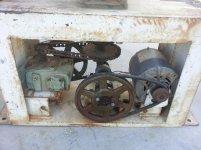
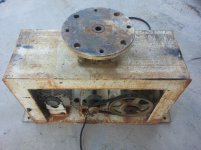
I've been wanting to build a weld positioner from a HD turntable I got for free.
It was used as a Motorcycle Display turntable.
It has a 5/8 base and the frame is 8'' channel 1/4''thick.
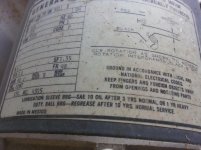
It has a General Electric 1/4 HP AC motor
the Speed Reducer Box(gear reduction) is a SHINKO HAMPTON
type U
SIZE 50
RATIO 1/60

This is a heavy turntable but it has lots of torque.

My plans are:
Build a Tilting base using a scissor jack
adapting a lathe chuck
make it variable speed.

Does anyone have any ideas on the best way to convert it to variable speed?
Im thinking a Drillpress step pulley or a bicycle sprocket system.
Some pics of it and a couple of my project to follow.
Thanks in advance.
 

Attachments
  • 20140327_165821.jpg
    20140327_165821.jpg
    145.5 KB · Views: 82
  • 20140327_165826.jpg
    20140327_165826.jpg
    144.1 KB · Views: 81
  • 20140327_165840.jpg
    20140327_165840.jpg
    143.6 KB · Views: 78
  • 20140327_165904.jpg
    20140327_165904.jpg
    136 KB · Views: 63
  • 2014-01-09 11.16.01.jpg
    2014-01-09 11.16.01.jpg
    14.7 KB · Views: 47
  • 2014-01-09 11.19.22.jpg
    2014-01-09 11.19.22.jpg
    18.1 KB · Views: 44
Last edited:
To avoid these ads, REGISTER NOW!

zkling

Well-known member
Joined
Jan 23, 2007
Messages
16,939
Geeze, how large of parts do you typically weld? :lol:

The variable speed is probably going to be the hardest one to tackle. That motor is not really designed to be run variable speed. A DC motor or a different style of AC motor with a suitable range would be a much better option.

What is the overall ratio as it is now? I can't imagine it being very fast considering the intended use. Probably too slow a travel rate for most welding. :dunno:
 

diebog

Well-known member
Joined
Dec 12, 2012
Messages
154
Location
Grass Valley CA
I had a similar issue when I wanted to make my small lathe variable speed. All the research I did, I found the same thing. A/C motors just don't like to be adjusted. I think mechans idea of a treadmill motor seems the best way to me. You can find treadmills for free allot of times. Take the motor and find a way to make your pulley fit the shaft and then mount the speed control part somewhere and there ya go! Before found my Baldor smart motor (variable speed) I was going to do the same thing. One piece of advice is to find a treadmill that has the speed control button separate so you don't have t mount the entire dash panel. Just the buttons and speed display.

Another though you could try is one of those plug in speed controllers for 110v like the ones at harbor freight. Ill post a link
 

diebog

Well-known member
Joined
Dec 12, 2012
Messages
154
Location
Grass Valley CA
I have this one Its mainly for wood routers but it may work for you. Harbor freight has a cheaper version for like 24 bucks as well
 

rsanter

Well-known member
Joined
Dec 22, 2007
Messages
18,549
Location
visalia ca
Variable speed is easy
Take that motor out and install a 3phase motor
Connect a VFD and you will have variable speed, reversible and even a jog function and can still power it from single phase

Bob
 

mechan

Well-known member
Joined
Apr 16, 2009
Messages
401
Variable speed is easy
Take that motor out and install a 3phase motor
Connect a VFD and you will have variable speed, reversible and even a jog function and can still power it from single phase

Bob

VFD and 3 phase would be a good way to go for speed control. Little more expensive, but for sure would be more flexible.
 

Strouty

Well-known member
Joined
Mar 21, 2010
Messages
38,228
Location
Southern Maine
The treadmill motor idea would be your cheapest bet. 3 phase and VFD would be the cleanest and probably give you the most control.
 

Prototyper

Well-known member
Joined
Oct 31, 2009
Messages
77
Location
Kalispell, Montana
Wow, that is a great start at a rotary positioner! As mentioned, plenty heavy duty to handle a lot of stuff you'd want one for.

A few things come to mind. First of all, the motor on it now is a synchronous AC motor. It's speed is determined by the line frequency driving it (1740 rpm @ 60 hz). This is a given. The router speed controls suggested won't work, as they don't change the frequency, just vary the voltage. This only works on a brush type "universal motor".

A DC treadmill motor is a good option, and can be had cheap/free on Craigslist. I have used a bunch of DC motors for stuff like this. They work, but their low speed control and torque isn't the greatest. Example would be if you had a weldment clamped to it, rotating about a horizontal axis, and had a portion hanging off one side (eccentric load). The DC motor would slow down as the eccentric rotated up, and accelerate as it rotated down.

I am a huge fan of VFD's (variable Frequency Drives) and 3 phase motors. They are amazing! and pretty darn affordable these days. They can convert 120 V 1ph power into 240 V 3 ph to your motor. They give you infinite speed control, and full torque from almost zero speed on up. The motor will give perfectly constant speed, virtually regardless of load.
A motor like this: http://www.surpluscenter.com/Electr...-230-460-VAC-3PH-S56-LEESON-MOTOR-10-2709.axd

Driven by a VFD like this: http://www.automationdirect.com/adc...l)/GS1_Drive_Units_(120_-z-_230_VAC)/GS1-10P5

Add a potentiometer foot pedal (the L5000):http://www.ssccontrols.com/shoppingcart/agora.cgi?product=pot_controls

And you will have one bitchin setup! A commercial version would cost thousands.

Also, that thing is WAY too geared down currently, to be useful. That's 60:1 plus 2 pairs of belt reductions. I'd guess you have close to 360:1 reduction (4.8 rpm, or 12.5 secs/rev). Lose the belt reductions, belt drive 1:1 to the gear reducer. That will give you 29 rpm max, about 2 secs/rev. You will want the speed for small dia welds.

Also, you NEED a slip ring for welding current to pass through. Don't rely on the bearings, as the arcing will chow them quickly. A copper block, spring loaded against the rotating axle is ideal. Simpler solutions could be implemented as well.

Please update as it comes together. I'm interested, as a positioner is in my future as well.

Jonathan
 

zkling

Well-known member
Joined
Jan 23, 2007
Messages
16,939
The treadmill motor idea would be your cheapest bet. 3 phase and VFD would be the cleanest and probably give you the most control.

Nah, a DC motor and proper drive controller would by far be the best for this application. But if had to be purchased new, probably the most expensive option.

Prototyper aka Jonathan brought up a good point about how to properly ground the table, otherwise you run the risk of welding bearings or other joints together.
 
Last edited:

Prototyper

Well-known member
Joined
Oct 31, 2009
Messages
77
Location
Kalispell, Montana
Nah, a DC motor and proper drive controller would by far be the best for this application. But if had to be purchased new, probably the most expensive option.

Prototyper aka Jonathan brought up a good point about how to properly ground the table, otherwise you run the risk of welding bearings or other joints together.

And your reasoning for why a DC motor is by far the best option, would be???

DC is dated technology. AC drives are light years ahead technologically, are cheaper, the motors are far more reliable, more flexible for different applications, programmable, more efficient, quieter, better speed control, more torque...what did I forget?
 

zkling

Well-known member
Joined
Jan 23, 2007
Messages
16,939
And your reasoning for why a DC motor is by far the best option, would be???

DC is dated technology. AC drives are light years ahead technologically, are cheaper, the motors are far more reliable, more flexible for different applications, programmable, more efficient, quieter, better speed control, more torque...what did I forget?

Lots of things....

Large speed range with torque. Reversible, programmable, just to name a few. Hence they are used on most industrial weld positioners. To not recognize DC motors and their industrial applications is just foolish. It's all going to depend on what features the OP needs and what is current designed into that system. Large, accurate speed range? Quick reverses?
 
To avoid these ads, REGISTER NOW!

Prototyper

Well-known member
Joined
Oct 31, 2009
Messages
77
Location
Kalispell, Montana
To not recognize DC motors and their industrial applications is just foolish. It's all going to depend on what features the OP needs and what is current designed into that system. Large, accurate speed range? Quick reverses?

Before labeling me as foolish, please take a moment to read the lengthy post I contributed regarding the motor the OP has, and the options he has for his positioner (DC vs AC/VFD). I did recognize DC motors as an option, and took the time to explain their inferior performance to AC.

To not recognize the superiority of VFD's is a little behind the times...

I wonder why the latest front load H.E. Washers, hybrid vehicles, forklifts, air compressors, machine tool spindles, water well pumps, chair lifts, elevators, ventilation fans, etc are using AC motors with VFD's? Maybe someday, they'll realize DC is better...
 
OP
I

iwanaflattie

Member
Joined
Apr 10, 2013
Messages
6
Wow thanks for all the responses guys..
Im going to sit down and study them before I dive into it.
Im a hobby welder but I will be going to take classes soon and get certified.
Im basically tired of tripping over this thing so I have been looking for a good use fot it.
A rotary positioner would be very handy to have and I would only invest a few 100$.
Thanks for all the responses.
 

Spareparts

Well-known member
Joined
Mar 12, 2010
Messages
2,049
Location
Lansing Ks.
How about a Comet Clutch set up, the slower speed the more torque. Slide the motor back for slower speed and forward for more speed, simple adjustable motor base and a foot switch for on and off.
 

HAY YOU

Well-known member
Joined
Nov 19, 2012
Messages
585
If it's in your way I'd sell it, you'll also be saving the money you would spend on it. Once you learn to weld you won't need it. You'd spend more time getting ready to get ready instead of just welding whatever project your working on.
 

zkling

Well-known member
Joined
Jan 23, 2007
Messages
16,939
Before labeling me as foolish, please take a moment to read the lengthy post I contributed regarding the motor the OP has, and the options he has for his positioner (DC vs AC/VFD). I did recognize DC motors as an option, and took the time to explain their inferior performance to AC.

To not recognize the superiority of VFD's is a little behind the times...

I wonder why the latest front load H.E. Washers, hybrid vehicles, forklifts, air compressors, machine tool spindles, water well pumps, chair lifts, elevators, ventilation fans, etc are using AC motors with VFD's? Maybe someday, they'll realize DC is better...

I never said you were foolish, I said it is foolish to not credit dc drives. There is a difference. And yes I read your post twice, you are picking one application of DC drives (treadmills). And then picking another application of AC drives (washing machines, vehicles), comparing vastly different applications. There is a reason why the large names in positioners, plasma spray tables and dabber machines use DC drives for control, they are better suited to the task at hand compared to their AC counter parts.

Wow thanks for all the responses guys..
Im going to sit down and study them before I dive into it.
Im a hobby welder but I will be going to take classes soon and get certified.
Im basically tired of tripping over this thing so I have been looking for a good use fot it.
A rotary positioner would be very handy to have and I would only invest a few 100$.
Thanks for all the responses.

iwanaflattie, before you make any big decisions or part with the $, I'd suggest you sit down and take a note of what you want to use the positioner for. If you want some design ideas look at commercially built units. Depending on the the part size and process you want to run you will want a speed range from ~0-10ish RPM. Almost all of the industrial machine use a DC motor coupled to a gear box controlled with a solid state controller. In the corner I have one that I put together a while ago when I was making specific flanges for a place. Once fine tuned it is really handy.

What type of parts do you make that you want to use the positioner for? After weighing your options you may find that starting with a different drive system all together may be the best way to go. Using something you got cheap can be a good start, but sometimes it can also be a time and money waster to get what you need done vs just doing it a more direct way from the get go.
 
Last edited:

steel 35

Well-known member
Joined
Feb 20, 2011
Messages
2,105
Location
Between the PNW and the Emerald Triangle

R.Anderson

Well-known member
Joined
May 26, 2012
Messages
906
Location
Wisconsin
The grounding issue could be done nicely like what Faunuc does with their positioners. A spring loaded ground pin on the under side that acts like the brushes on a motor's commutator.
 

theknurl

Banned
Joined
Dec 18, 2010
Messages
921
Location
SoCal
AC motors don't like speed controls......

having burned up 3 AirCrafter #2 rotary welding machines, look the price of those POS up with their Bodine AC motors with triple gear reduction built in:wtf::wtf::wtf: they were $1,200 30 years ago

you need a DC motor or at least AC/DC

a Motorola rectifier 110AC in 110DC out

a standard sewing machine pedal rheostat

a SCR lamp dimmer switch

reversing switch

its wired AC >dimmer switch>pedal>rectifier>reversing switch >motor

also look into a kick wheel rotary table....I have the parts for a 30" one but the jobs just don't require one anymore, so it didn't get built
 
To avoid these ads, REGISTER NOW!
Top Bottom