To avoid these ads, REGISTER NOW!

Help a SMAW Noob? Trouble Maintaining Arc with 6011 & Buzzbox

Hoopy Frood

Well-known member
Joined
Sep 17, 2016
Messages
56
Location
Maine, USA
I'm very new to welding and have a very limited setup to work with. I'm a homesteader just trying to learn the basics. My lack of skill is definitely a large portion of the problems I'm having. But I'm REALLY struggling to maintain my arc; more so than I think my skill limitations should allow.

18 months ago I took a ~20 course class that used 6011 a bunch but always on nice Inverter machines running DCEP. I struggled with arc length and rod sticking then, too, but not ANYWHERE near as hard as I am now.

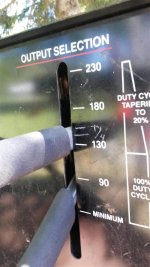
This is my first time welding with AC. My buzzbox is a 1991 Crafstman "Infinite Amp Arc Welder." It's model number is (as far as I can tell with a torn sticker) 110-1039919. The name will get you an image of the box on a Google image search. But the model number gives no results on a Google search at all. It was a gift from a friend (an unwanted hand-me-down from his dad). It's a 240V box. Maximum setting is 230 amps at "20% Duty Cycle." "100% duty cycle" tapers off at anything over 130 amps. I'm afraid I don't know what that means but will do research if needed.

I'm using 1/8" 6011 rods (Harbor Freight "Vulcan" rods) on 1/4 inch C-channel for practice. My practice bead pads are horrible. The major factor in the awfulness is maintaining the arc...

When I successfully maintain arc, the beads are "acceptable", given my lack of skill. But 90% of the time I can't maintain an arc for more than 2-4 seconds. Every time the arc goes out I fight slag inclusions, and the beads can be either cratered out or piled up.

Every 6011 video I watch shows a very strong, robust arc. Since I struggled so hard initially, I have since then spent about six hours over two days running pad after pad while slowly increasing the amps trying to get a stable arc before entering "too hot" territory.

As far as I can tell the arc is every bit as hard to maintain in "too hot" conditions as it is in "too cold" conditions. My lack of skill is a factor in this, sure - BUT - it seems if I pull the electrode any (and I mean ANY) distance off the surface of the puddle the arc goes out immediately.

I've been pre-grinding surfaces to moderately clean them up. I have intentionally not been fastidious in my prep. Part of 6011 use is that it SHOULD work in dirty conditions. I cleaned practice surfaces to better-than-mill-scale but no more for most tests. However failing so hard, out of desperation I have also tried to practice with VERY cleanly-ground surfaces and also with cruddy, rusty surfaces. All surfaces, regardless of prep work, weld the same: the arc is VERY difficult to maintain.

Current settings: The HF "Vulcan" rods are rated only to 120 amps. They were inexpensive and well reviewed, so I picked up a few pounds. I was very surprised to see them rated to only 120 amps after I got them home...

Initially I was sticking them like nothing else at any current, including 120 amps... Per common advise I increased current. The sticking continued at 130 amps where my welder drops below "100% duty cycle" (see attached pic). I may be bad, but I'm not THAT bad...

According to the current selection handle I got best performance at about what would be labeled as 150 amps (again see attached picture). I welded quite about bit at 160-170 amps on the gauge but the arc would still go out at the drop of a hat; I estimate at 1-2mm above the puddle even at that high current it would extinguish instantly. However that was definitely too hot for the electrode... the flux discolored along the entire rod in short order.

The only way I could keep the arc going - regardless of current setting - was to keep the electrode right on the surface of the puddle. ANY hiccup resulting in that 1-2 mm gap between puddle and electrode would kill the arc immediately. I do not remember my DC welding in the class being even 10% as temperamental as what I've been dealing with the past couple days.

Again, I'm bad, but I don't think I'm THAT bad. Could there be an equipment issue I'm not aware of? I've heard an AC arc is harder to maintain than a DC arc. But this is ridiculous.

I filed the jaws on the the return connection clamp to make sure they were super clean (and ground clean the connection point for the return clamp on each work piece) every time, so that was not an issue.

Any thoughts or suggestions? I'll keep knuckling down. But I feel something is amiss that my n00bness is ignorant of.

Thank you in advance for any help you can offer! I promise (actually just plain hope) I'm not a lost cause :bounce:
 

Attachments

  • 20180521_145343.jpg
    20180521_145343.jpg
    68.8 KB · Views: 62
To avoid these ads, REGISTER NOW!

hefnerconstructionlc

Well-known member
Joined
Nov 1, 2016
Messages
665
Location
Kansas
Well it sounds like you’re running the rod hot enough. So another thing is to keep in mind is whatever the thickness of the rod diameter is, that’s pretty much the distance you should keep from the workpiece. Also make sure your lead connections are tight your connection interesting arrange around. And then also may want to check the connections inside the box/welder make sure those connections are all clean and making good contact. If none of those have problems then it’s probably technique. The last thing would be to get auto darkening helmet it makes everyone a better welder.
 

Provincial

Well-known member
Joined
Sep 21, 2011
Messages
6,874
Location
Near Salem, OR
Check the voltage, both open-circuit and while an arc is active. It sounds like you have low voltage. Bad connections can result in low voltage or low amperage.

Sometimes the cheap ground clamps have high resistance. Make shure that all the parts of the ground connection are clean and have low resistance.

Your amperage adjustment is accurate only if there is low resistance in the entire circuit.
 
OP
H

Hoopy Frood

Well-known member
Joined
Sep 17, 2016
Messages
56
Location
Maine, USA
Thank you @hefnerconstructionlc - I do have an auto darkening helmet, I just **** apparently :D The 1/8" rod arc goes out long before the rod is 1/8" above the work piece... so I definitely think there is a resistive connection somewhere. I will give it a full going over!

Check the voltage, both open-circuit and while an arc is active. It sounds like you have low voltage. Bad connections can result in low voltage or low amperage.

Sometimes the cheap ground clamps have high resistance. Make shure that all the parts of the ground connection are clean and have low resistance.

Your amperage adjustment is accurate only if there is low resistance in the entire circuit.

I agree something sounds amiss. I will check over everything I can and report back here.

But how would I check the voltage when an arc is active? Sounds like a dangerous operation for a person with a multimeter! :shocking:
 

gorilla

Well-known member
Joined
Dec 13, 2007
Messages
1,656
The flux on AC welding rods is chemically formed to help stablise the arc. You may want to try a better quality rod like Lincoln or some other rod made in the USA. If I remember correctly 1/8" 6011 should run at about 90 amps.
 

95vette

Banned
Joined
Jul 24, 2011
Messages
119
Hello, Ac and Dc welding are two different things, learning on Ac is a lot harder, pickup a few 7014 rods and try them, think you will be better off. Jim
 

MoonRise

Well-known member
Joined
Nov 5, 2010
Messages
4,031
Location
NJ
In no particular order:

Duty cycle - how long (in percentage) out of 10 minutes you can weld at a certain power output (amperage setting) before the welding machine overheats.

example- 100% duty cycle means you can weld 10 minutes out of 10 and not overheat the machine

20% duty cycle means you can weld for 2 minutes and then the machine should idle/rest for the next 8 minutes to cool off so that it doesn't overheat. Then weld for another 2 minutes and cool of for 8 minutes, etc.

Or weld for 1 minute and cool off for 4 minutes (while you replace the electrode stick, remove the slag from the weld you just attempted, readjust the workpiece or the welding cables or whatever) and then weld for another minute and let the machine cool off for 4 minutes, etc.

I haven't used any of HF's Vulcan welding electrodes. I'm not a good enough welder to use crappy or 'unknown' quality welding consumables. :lol:

That said, are you sure that the electrodes you have are 6011 (made for use with AC or DC) or are they 6010 (made for use with DC only)?

In case you didn't realize it, the 'number' of a welding electrode is usually a 'code' that specifies some of the properties and characteristics of that electrode.

For SMAW (aka 'stick') electrodes, AWS (American Welding Society) A5.1 (the AWS spec for SMAW electrodes) 'code' is as follows:

ExxYz

E - means electrode
** - is the welding filler minimum tensile strength in ksi (thousand psi)
Y - is the welding position code 1=all position, 2=flat and horizontal only
z - is the code for the flux coating type and electrical characteristics

0 = DCEP
1 = AC or DCEP
2 = AC or DCEN
3 = AC or DCEP or DCEN
4 = AC or DCEP or DCEN
8 = AC or DCEP

So, an E6010 electrode means:

E =electrode
60 = 60 ksi or 60,000 psi minimum tensile strength
1 = all position
0 = DCEP welding current

Most 1/8" 6011 electrodes run at 80-125 amps or so. Depending on operator's preference, welding position, etc.

Trying to run an E6010 electrode (made for use with DC) with AC will almost always be a complete exercise in frustration as the arc with AC will go 'out' each time the current changes 'direction' (the "alternating" in alternating current) and goes to a zero volt value. E6011 electrodes are supposed to have a flux coating chemistry that has arc stabilizers in it to (help) maintain the arc as it alternates from Plus to zero to Minus at 60 times per second (usual USA 60 Hz AC power frequency).

Read up about SMAW on the Lincoln or Hobart or ESAB or Miller websites, among others.

http://www.esabna.com/euweb/awtc/lesson1_1.htm
 
OP
H

Hoopy Frood

Well-known member
Joined
Sep 17, 2016
Messages
56
Location
Maine, USA
Check the voltage, both open-circuit and while an arc is active. It sounds like you have low voltage. Bad connections can result in low voltage or low amperage.

Sometimes the cheap ground clamps have high resistance. Make shure that all the parts of the ground connection are clean and have low resistance.

Your amperage adjustment is accurate only if there is low resistance in the entire circuit.

Solved!

I burnished the contacts in the stinger, did a very thorough filing on the return clamp jaws. Using an ohmmeter I verified there was a dead short on the output side and there was. All connections seemed very solid.

So I made sure to grind a return clamp connection on the work piece that was 100% new metal. I then ground the pad face ~90% clean where I was going about 70% clean before.

NIGHT AND DAY DIFFERENCE.

The welder is working perfectly and now pointing all fingers to "operator error" for any remaining issues.

Looks like I have a LOT of practice ahead of me. But at least the buzzbox is solid! Taking it apart I was shocked at how simple a device it is! No wonder these are a thing!

Thank you all for your help!!
 

Boilerhouse

Well-known member
Joined
Mar 20, 2012
Messages
1,321
Location
Muskoka
Good job correcting the problem. What amperage setting are you using now? I found with my Lincoln AC buzz box, 6011 generally likes somewhere around 105 to 120 amps. I also find that rod fairly aggressive and not real user friendly for someone just starting out. You may try 6013 and 7014 rods as they are beginner friendly - run nice on AC, easy to start and maintain the arc and fairly nice looking beads from novices. Then move on to 7018 (Lincoln AC brand) and between it and 6011, it will take care of most of your projects.
 
OP
H

Hoopy Frood

Well-known member
Joined
Sep 17, 2016
Messages
56
Location
Maine, USA
Thank you so much!!

Good job correcting the problem. What amperage setting are you using now? I found with my Lincoln AC buzz box, 6011 generally likes somewhere around 105 to 120 amps. I also find that rod fairly aggressive and not real user friendly for someone just starting out. You may try 6013 and 7014 rods as they are beginner friendly - run nice on AC, easy to start and maintain the arc and fairly nice looking beads from novices. Then move on to 7018 (Lincoln AC brand) and between it and 6011, it will take care of most of your projects.

I was running it about 140-150 amps for for the 1/8" 6011. After I made my corrections mentioned above, that previously-marked current level started burning right through the c-channel and making an awful spattery mess. I immediately dialed it back to 120 and it worked MUCH better. I did still have arc continuity problems at that current but it was obvious that *I* was not handling the electrode correctly. Extinguishing at that point was my fault.

I understand I'm making life hard on myself by starting with 6011 and a buzzbox. I'll balance the cost of wasted practice 6011 rods and the cost of noob-friendly 6013 and 7014 rods in mind. I like the penetration and toughness of 6011. As you said with it and 7018 you can do most anything. Those two are the only two I ever used in my class. I'm on a very tight budget so I'm trying to always keep costs down...

I'm struggling with 6011, but each session gets better :)

I'll do some serious electrode shopping in the very near future. I still have enough HF 6011 on hand to finish my initial rounds of practice and hopefully build my first project (pallet pry bar). Then... who knows what will happen?
 
To avoid these ads, REGISTER NOW!
OP
H

Hoopy Frood

Well-known member
Joined
Sep 17, 2016
Messages
56
Location
Maine, USA
In no particular order:

Duty cycle - how long (in percentage) out of 10 minutes you can weld at a certain power output (amperage setting) before the welding machine overheats.

example- 100% duty cycle means you can weld 10 minutes out of 10 and not overheat the machine

20% duty cycle means you can weld for 2 minutes and then the machine should idle/rest for the next 8 minutes to cool off so that it doesn't overheat. Then weld for another 2 minutes and cool of for 8 minutes, etc.

Or weld for 1 minute and cool off for 4 minutes (while you replace the electrode stick, remove the slag from the weld you just attempted, readjust the workpiece or the welding cables or whatever) and then weld for another minute and let the machine cool off for 4 minutes, etc.

Good heavens! Thank you! That makes perfect sense. I was going to look into it, but hadn't got there yet. But you just enlightened me!


I haven't used any of HF's Vulcan welding electrodes. I'm not a good enough welder to use crappy or 'unknown' quality welding consumables. :lol:

That said, are you sure that the electrodes you have are 6011 (made for use with AC or DC) or are they 6010 (made for use with DC only)?

I hear ya! I read lots of reviews where people were slamming Lincoln as junk and praising Harbor Freight. Counter-intuitive, right? :) Yes, the HF cheapies are E6011 AC rated to 120 amps. I've never actually seen 6010 though folks talk about them a lot. I've only used 6011 and 7018 although only in DCEP configs. My past couple days of AC with the HF 6011 are my first time using a buzzbox.

In case you didn't realize it, the 'number' of a welding electrode is usually a 'code' that specifies some of the properties and characteristics of that electrode.

For SMAW (aka 'stick') electrodes, AWS (American Welding Society) A5.1 (the AWS spec for SMAW electrodes) 'code' is as follows:

ExxYz

E - means electrode
** - is the welding filler minimum tensile strength in ksi (thousand psi)
Y - is the welding position code 1=all position, 2=flat and horizontal only
z - is the code for the flux coating type and electrical characteristics

0 = DCEP
1 = AC or DCEP
2 = AC or DCEN
3 = AC or DCEP or DCEN
4 = AC or DCEP or DCEN
8 = AC or DCEP

So, an E6010 electrode means:

E =electrode
60 = 60 ksi or 60,000 psi minimum tensile strength
1 = all position
0 = DCEP welding current

Most 1/8" 6011 electrodes run at 80-125 amps or so. Depending on operator's preference, welding position, etc.

Makes sense then that the HF 6011 are rated to only 120A (AC or DC). Thank you for that GREAT write up! That's almost EXACTLY identical to my class notes - too funny! Glad to know they weren't lying to me :p

Trying to run an E6010 electrode (made for use with DC) with AC will almost always be a complete exercise in frustration as the arc with AC will go 'out' each time the current changes 'direction' (the "alternating" in alternating current) and goes to a zero volt value. E6011 electrodes are supposed to have a flux coating chemistry that has arc stabilizers in it to (help) maintain the arc as it alternates from Plus to zero to Minus at 60 times per second (usual USA 60 Hz AC power frequency).

Yeppers! No 6010 here, would never try such a stunt. I'm too unskilled as it is! I'm a lowly homesteader but I've got a mechanical engineering degree and spent 15 years as an engineer in the power industry, mostly control systems and electrical grid operation/protection engineering. When I tore my buzzbox open to check lead and winding integrity I was surprised to find the whole thing was nothing but a power switch, a cooling fan and a current transformer (CT).

CTs are absolutely essential in monitoring and protecting electrical power systems. But I've always thought of them as telemetry devices. Now I've got one that will burn through 3/4 of an inch of steel and not pop a 30A 240V breaker.

Amazingly simple, yet POWERFUL technology!

Thank you Mr. Tesla! ;)

Read up about SMAW on the Lincoln or Hobart or ESAB or Miller websites, among others.

http://www.esabna.com/euweb/awtc/lesson1_1.htm

Miller's site has come recommended before and been helpful. I've also used the hell out of WeldingTipsAndTricks.com and their forums. Jody's videos are the best! I've also watched a lot of ChuckE2009 on YouTube. He irritates a lot of people, but has good, basic info and at least makes ME laugh.

I have not checked out Lincoln, Hobar or ESAB's sites yet but I definitely WILL do! I'm very new to this and am very happy to have multiple sources of information.

Thanks again! Love the GJ community!
 

BD1

Well-known member
Joined
Mar 18, 2007
Messages
4,602
Location
north side
Placing your ground clamp on what you are welding on may help too.
If these issue continue, consider looking for a AC/DC machine. A Miller Thunderbolt and Lincoln Tombstone type are still go to machines today. Check craiglist for for machine and welding goodies.
A great site is weldingweb, search there

http://weldingweb.com/forum.php
 

hefnerconstructionlc

Well-known member
Joined
Nov 1, 2016
Messages
665
Location
Kansas
Great to hear you got your welder sorted out. I would not give up on the 6011 just yet. It is a great all around rod. It is very spattery and rough running. Just watch your arc length and make little e's for manipulation and you will have it in no time. If you can make 6011 look reasonably nice, you will find the 6013 and 7018 to be much easier to make pretty.
6013 likes nice little e's and 7018 is a drag rod. And there is nothing wrong with an AC225 lots of projects have been built with those units. Its just lots of rod burnt and time under the hood. Good luck

This was built with an AC225
 

Attachments

  • P1010105.jpg
    P1010105.jpg
    151.8 KB · Views: 36
  • P1010098.jpg
    P1010098.jpg
    158.5 KB · Views: 39
  • P1010100.jpg
    P1010100.jpg
    146.9 KB · Views: 32
OP
H

Hoopy Frood

Well-known member
Joined
Sep 17, 2016
Messages
56
Location
Maine, USA
Placing your ground clamp on what you are welding on may help too.
If these issue continue, consider looking for a AC/DC machine. A Miller Thunderbolt and Lincoln Tombstone type are still go to machines today. Check craiglist for for machine and welding goodies.
A great site is weldingweb, search there

http://weldingweb.com/forum.php

My worktop was made from scrap. I really didn't feel like grinding it clean; too time consuming. So I'm just clamping directly to the work piece.

I just need practice :) But I'll definitely look for a nicer machine in the future.

Thanks for the link, I'll check it out!

Great to hear you got your welder sorted out. I would not give up on the 6011 just yet. It is a great all around rod. It is very spattery and rough running. Just watch your arc length and make little e's for manipulation and you will have it in no time. If you can make 6011 look reasonably nice, you will find the 6013 and 7018 to be much easier to make pretty.
6013 likes nice little e's and 7018 is a drag rod. And there is nothing wrong with an AC225 lots of projects have been built with those units. Its just lots of rod burnt and time under the hood. Good luck

This was built with an AC225

Wow! What a project! My dad had a tombstone when I was growing up. He built a utility trailer from scratch with it and that trailer was used (heavily) for about 20 years until he build an even better one.

ChuckE2009 on YouTube did a section on 6010/6011 comparing the "little e" method versus the whip-and-pause. I think functionally they both should work. I haven't tried the "e" yet, but maybe I should! I might find it easier.

Yep 6011 is messy fo sho! That's why I'm being stubborn and sticking with it. I figure if I can get proficient with 6011 on a buzzbox, I will be well suited to any form of welding in the future.

That is some beautiful work! Thank you for the tips and encouragement!
 

Provincial

Well-known member
Joined
Sep 21, 2011
Messages
6,874
Location
Near Salem, OR
To expand on Boilerhouse's comment: 7018AC rod will run on your machine. It is a 7018 rod made to run on AC. I don't know why they didn't use the standard numbering system to describe it. I have used in on a similar AC buzz-box with great results. You can find it any any good welding supply store.

Once you get the hang of using your machine, consider buying high-quality rod for serious projects. There is a big difference in performance compared to low-priced rod.
 
OP
H

Hoopy Frood

Well-known member
Joined
Sep 17, 2016
Messages
56
Location
Maine, USA
To expand on Boilerhouse's comment: 7018AC rod will run on your machine. It is a 7018 rod made to run on AC. I don't know why they didn't use the standard numbering system to describe it. I have used in on a similar AC buzz-box with great results. You can find it any any good welding supply store.

Once you get the hang of using your machine, consider buying high-quality rod for serious projects. There is a big difference in performance compared to low-priced rod.

I'll keep all that in mind. Thanks so much!

I got rained out of my welding practice yesterday, so I hope to get back to it today :)
 
OP
H

Hoopy Frood

Well-known member
Joined
Sep 17, 2016
Messages
56
Location
Maine, USA
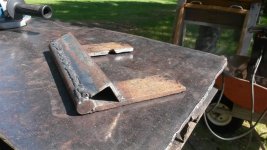
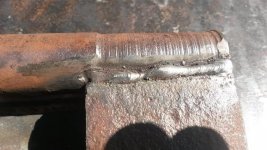
Not only did I get back to it, I finished the first (and the most difficult) stage of my first real welding project: my pallet wrecking prybar. The head is mostly finished!

The design was inspired buy JDCD Design on YouTube:

All of my materials were scrounged from junk piles and I have quite a LOT to work with now. It's amazing how much you can pick up in just a few successful scrounge trips! It's fugly to be sure and full of mistakes. But I think (hope) it's good enough to pull pallets apart!

If it isn't, I'll just re-build it better. Practice, practice, practice!

My hands are very unpracticed and unsteady. But I can feel the difference clearly between when it's going well and when it's going badly. I think I had my first lesson in not arc amperage heat but actual work piece temperature. One more variable to contend with... practice...

Thank you all for your help!
 

Attachments

  • 1-Front (Medium).jpg
    1-Front (Medium).jpg
    148.9 KB · Views: 40
  • 2-Side (Medium).jpg
    2-Side (Medium).jpg
    146.9 KB · Views: 39
  • 3-Best Weld (Medium).jpg
    3-Best Weld (Medium).jpg
    151.1 KB · Views: 43
  • 4-Worst Mess (Medium).jpg
    4-Worst Mess (Medium).jpg
    154 KB · Views: 41

alexb2000

Well-known member
Joined
Feb 7, 2010
Messages
664
Location
Fort Worth, TX
You may not like to hear this, but the welder is part of the problem. Great work can be done with those welders, but they take an experienced hand. It's hard to describe, but with a machine like an SA-200 you can bury the rod and it won't snuff and the welds will just lay down.

I would try to tune your heat by welding together two pieces of the same thickness steel. I see some thin to thick welding that will be far more challenging, like the last picture with the angle iron welded to the rod (too hot on the angle iron and cold on the rod).
 

Mgdoug3

Well-known member
Joined
Mar 2, 2018
Messages
1,391
Location
KY
I hate a 6013 rod. Since I got a DC machine I mainly use 6011 and 7018. Occasionally I'll use a 7014. The only time I use a 6013 is on thin metal. I like to use a 6011 (6010 are hard to find in stores around here) and cap it with a 7018. It get a nice deep pass followed by a strong weld on top.
 
To avoid these ads, REGISTER NOW!
Top Bottom