To avoid these ads, REGISTER NOW!

Help Deciding on Radiant vs Forced Air

finnishchef

New member
Joined
Apr 28, 2023
Messages
1
Hi Everyone,

First time posting. I ran a search or two to try to ensure this wasn't too much of a duplicate post. If I missed a totally on-topic previous thread, apologies.

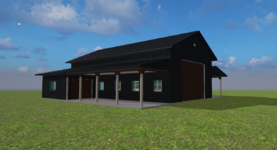
I'm in the final permitting stages of a pole barn build in NW Wyoming through Morton Buildings. Interior sq. ft. area will be 2,304. That's made up of a 60'x30' main structure (16' ceilings) with flanking "lean-to's" on the east and west side. The south 21' of each of the flanking lean-to's will be enclosed and will have lower ceilings than the main area of the barn. So, like I said, 2,304 interior sq. ft. Factoring in ceiling height, enclosed area will be 33,504 cu. ft. I'm attaching a photo for reference.

We lost a smaller, old tack barn to a fire in early 2022. I've been really missing that work space and am really excited for this new structure.

What I'm wrestling with is in-floor radiant hydronic heating versus forced air. Electricity in my area is super cheap. We paid ~$0.067/kwh last month. Originally we spec'ed the structure with two electric, forced air, ceiling-mount units. But now I'm considering coughing up (a lot) more cash to go with in-floor radiant hydronic system. Our first bid, however, came in at $60k (!). The SOW on that included all the in-slab heat tubes, gas boiler and controls, venting as needed, permitting, up to 25' of gas tubing, under-slab insulation, and the wire mesh for attaching the pex.

Given the insane building costs right now, perhaps I should have been more prepared for the magnitude of the quote. I've solicited more quotes, but I'm having trouble finding local contractors with capacity/interest in even quoting.

Everyone I talked to before this quote came in said the in-slab radiant was the way to go. I'm just having trouble justifying the magnitude of the additional up-front cost that comes with this system. What would you do? Go all in on the in-slab radiant? Or go simple with a couple ceiling-mount forced air units? I see that a lot of people do the install for this themselves. I'd love to do that, but I'm worried I won't be able to find the time to both (a) educate myself sufficiently on installing properly and (b) being able to find the time needed to do that install quickly and efficiently so as to not slow down the construction process.

Love to hear your thoughts. This forum is a great resource. Look forward to spending more time here.
 

Attachments

  • NE Per 3-19.png
    NE Per 3-19.png
    937.7 KB · Views: 13
To avoid these ads, REGISTER NOW!

Rusted Nut

Well-known member
Joined
Dec 11, 2022
Messages
1,806
Location
PNW
I had a home with radiant in floor heat. Nice to have a warm floor. Radiant works well in places that dont have a huge temperature swings, night to day. Radiant is slow to heat, so don’t expect to walk in and turn the heat on and have instant heat. If you use your shop everyday, then radiant could work. But if you’re only in the shop every once in a while, forced air would heat it much quicker.
 

kj_mustang

Well-known member
Joined
Feb 9, 2011
Messages
1,213
Location
Harrisonburg, VA
Insulation and the boiler are your two highest cost for materials. You can price out both of those. The pex tubing, pumps, manifold, etc are not a lot of money. I did my own on a 52 x 32 pole building about 7-8 years ago. Probably have $5,000 or less in materials.
 
Last edited:

readhead

Well-known member
Joined
Dec 8, 2012
Messages
6,177
Location
Durango, Co.
Nice thing about forced air is that you can condition it. Heat, cool, humidify or dehumidify. In floor heat, which works well, is a one trick pony.
 

theoldwizard1

Well-known member
Joined
Feb 22, 2011
Messages
43,135
Location
SE MI
What I'm wrestling with is in-floor radiant hydronic heating versus forced air.
Radiant hydronic heating is the most COMFORTABLE form if heating. If your feet are warm, you are warm.

The down sides are cost of installation and slow recovery, especially after a door is opened. Not common, but using a heat pump to heat your water will save you money in the long run. It will cost more to install, but then with air handlers (more $$$) you can have some amount of force air for faster recovery and A/C !

At a minimum all cement floors should have a vapor barrier, but good insulation (2" recommended for NW Wyoming) is a must for in floor heating.
 

jack stand

Well-known member
Joined
Feb 29, 2012
Messages
3,328
Location
Lakes Region Maine
Radiant hydronic heating is the most COMFORTABLE form if heating. If your feet are warm, you are warm.

The down sides are cost of installation and slow recovery, especially after a door is opened.
I find there is no recovery unless you count the 10-15 seconds it might take. The mass of the slab is a huge part of the beauty of radiant heat.
I can bring in a cold 20* 5 ton hunk of metal (truck, equipment, tractors etc. and including the door opening after only about 20-30 minutes you no longer notice the cold, it's still cold to touch but the area is already comfortable.
I had a ceiling hung LP Modine hot air heaters. I could have a NASCAR team there operating the door and bringing in 1 vehicle would still take me +/- an hour to recover.
 

BUGTHUG

Well-known member
Joined
Nov 12, 2010
Messages
2,960
Location
Kansas
I just had a radiant heat put in my shop. Now that Im much older today than I was 10 years ago, everything hurts. I'm from Kansas, so we don't really get extreme weather changes. But it does get cold, and very hot on occasion. So , I can't go out in my shop when it is cold, because of health issues. So I figure I was loosing 3 to 4 months a year because its way to cold.
I finally saved up enough money to have some kind of heat installed. I've been in a bunch of different shops with every kind of heating set ups available. If you are young you might put in a wood stove, but you have just the area around the stove that keeps warm or hot. You have to cut wood to keep it going. Also it will make your insurance go UP. Plex floors are very nice and quiet . I f you haven't poured your floor and have the extra money, this is the ultimate IMO. Forced air is nice, but it heats the area in front of it, so if you have a large shop , one end will be warmer than the other. If you have a house like furnace, it takes up some extra room, but the forced air is nice and you can duct it anywhere you want. It is noisy when it cycles. I went with the radiant tube heat. One, because its very quiet, and it radiates the heat and warms everything in the shop. Mine is 125K btu, one part of the barn is 40 X 60 which is the main area I do work in. I like my music loud, and don't want to hear a furnace kicking on and off. I've only used it once so far and I like it. My tube is 40ft long so it takes care of the main area.
I hope this helps you out.
 

Copymutt

Well-known member
Joined
Sep 3, 2016
Messages
3,390
Location
Colorado
This winter NG went through the roof! Both my in floor and forced air that heat the shop were 3x’s last winters cost.I ended up adding very low cost passive solar.
 

Keep

Well-known member
Joined
Jan 1, 2009
Messages
1,398
Location
Oshawa, Ontario
I am getting ready to build a garage, I am planning on installing the insulation and piping for in floor heating, not sure I am going to end up using it, but once that slab is poured, you lose that option. So if you can, at least run the lines and insulate.
 
To avoid these ads, REGISTER NOW!

jblnut

ALLIANCE MEMBER
Joined
Jan 17, 2015
Messages
6,992
Location
In the Middle of MN
The down sides are cost of installation and slow recovery, especially after a door is opened.
The recovery is actually really quick in my farm shop with infloor heat. I'll bring stuff in through the 26' door and it'll feel like it was never opened 10-15 minutes later tops. Everything in the building is warm and helping to heat up the newly added cold item.

OP - $60k seems insane!! As far as doing it yourself there is a fair bit of labor involved but it isn't undoable. The only thing you may need to rent would be a mini excavator of sorts to dig down around the outside walls to put in the vertical foam.

Putting down the foam under the floor and stapling the PEX to it isn't hard but will take some time. You don't need a fancy preplanned PEX layout either. Lots of online resources to help with that.

If the space is planned to be heated having the slab insulated is a good idea no matter the type of heat you'll have. If you factor that in you're only adding the tubing to get the radiant system in the floor.

It's always easy to say something like "buy once, cry once" and "you'll enjoy it forever so go-ahead and spend" when it's not my money but I have infloor heat in every heated building on my property. It is sooooooooo nice and worth the extra money.
 

19D2P

Well-known member
Joined
Mar 31, 2008
Messages
56
Location
NW Montana
To be fair to the quote, it includes the insulation and wire mesh which will be needed regardless of source of heat. 2" of XPS foamboard is $54 for 32 SF at the orange store. So you'd need a minumum of 75 sheets which is $4000 just for the material.

If you are slightly handy and have free time do the vapor barrier, insulation, and the PEX all your self and you will save considerably. I DIY'd my entire setup on my 40x60 and nothing was complicated, just took time. My radiant setup with an electric boiler was all in under 8k minus insulation.
 

stingry

Well-known member
Joined
Oct 14, 2006
Messages
732
Location
Western Nebraska
Coming at you from across the border in Western Nebraska. You absolutely want radiant floor heat if you can justify the first cost especially with 16’ ceilings. The $60 k estimate is ridiculous, I did my 3600 sq ft shop 7 yrs ago for around $2/ sq ft but XPS was $32/ sq ft not the $54/ sq ft mentioned above. Laying the pex is easily a DIY job. Work with your concrete contractor, he should lay the insulation and insulate the perimeter. Then you can go in and lay and staple the pex to the insulation. I then placed wire mesh over the pex to help protect the pex while the concrete was poured. At this point you have the floor poured and construction of the building can go on. The boiler or whatever heat source you choose and the controls can be added later. As others have mentioned, in floor radiant is best when a constant temperature is maintained. I keep my temperature at 65 degrees and that is equivalent to 70 degrees in my house.
 

cannuck

Well-known member
Joined
Nov 30, 2021
Messages
4,610
Location
Rural SK
I have worked in a hangar with infloor heating (built in WWII) and it was one of the nicest places ever to crawl around under an airplane. BUT: no cooling in summer and makes installation of thing bolted to the floor (that I do a LOT of) impossible or ultra-high risk.

BTW: if you are doing the heated slab, seriously consider the extra cost of 2" pu foam board instead of EPS. Twice the insulation value.
 

readhead

Well-known member
Joined
Dec 8, 2012
Messages
6,177
Location
Durango, Co.
If you go with in floor heat study up on the products you are going to use. A lot of people install regular PEX and wonder why they are replacing cast iron components in a few years. Take your pick. Install oxygen barrier tubing or stainless steel pumps and components.
 

fitter30

Well-known member
Joined
Jun 23, 2019
Messages
2,969
Location
Peace Valley,mo
There is no better heat than floor radiate . Draw backs higher install cost, heat has to be left on depends on recovery time of a cold slab. 5 hours or longer isn't out of the question. Then all the mass has to be bought up to temp no difference than with other types of heat. Tube heaters for hanging radiate (gas), electric radiate hangs from ceiling both heat things and you not so much air but is quite and is more comfortable than a unit heaters.
 

finn

Well-known member
Joined
Mar 27, 2005
Messages
16,227
Location
The UP, God's country
I have radiant in my house and shop. Frankly, it’s not the best setup for a shop unless the shop is used on a daily basis. Setback thermostats don’t work well because of the slow response time, and if you’re only in the shop for, say, ten hours per week actively working on projects, that’s something in the order of 160 hours per week that you’re heating to working temperature, with all the associated heat loss to the atmosphere. For me, that translates to a lot of wasted propane.

That’s not a popular position, though. I ended up using the radiant to establish and hold a base temperature, and installed a hanging heater to quickly bring the shop up to working temperature as needed.

The house has nice warm floors, but struggles in extreme cold, The radiant area from the floors can’t transfer enoug heat to keep the room, with high cathedral ceilings and lots of glass, comfortable, and in the shoulder seasons, with wild daily temperature swings, the room temperatures also swing, even with outdoor reset. I end up usinf the mini split heat pump in the shoulder seasons because the temperature control is more responsive and room temp more stable.

My experience is that the radiant systems are rather costly to install and operate, considering that they aren’t responsive enough for my needs and thus need additional hardware support.
 

PoorUB

Well-known member
Joined
Mar 29, 2021
Messages
11,627
Location
Fargo, ND
I agree with Finn. If you want to bump up the shop temp with in floor radiant it might take 3-4 days of running to catch up. If you use that shop most days then set the air temp to 60-65 and forget it.
I also have done some floor heat jobs with forced air heater. The customer set the floor to heat the air to 50 degrees, and use the forced air to bump up the temp.
 
Last edited:

jack stand

Well-known member
Joined
Feb 29, 2012
Messages
3,328
Location
Lakes Region Maine
Radiant is not for those that are constantly fiddling around with the t stat.
Spend your money on insulation, that means real insulation - no fiberglass and attention to air infiltration.
At that point your heat  source becomes drastically less important. 👍
 
To avoid these ads, REGISTER NOW!
Top Bottom