To avoid these ads, REGISTER NOW!

Help finding a broken wire.

Wyoming09

Well-known member
Joined
Sep 24, 2014
Messages
523
Location
Wyoming, MI
Not wanting to hijack another thread about Electrical receiver / transmitter tool to identify wires I need advice. I have a light near the street controlled by a switch at the back door. Somewhere between the switch and lamp the wire is broken. The wire, I believe, is buried along the driveway. I need a way to locate the break. What tool do I need to help locate the break without digging up all approx. 75 feet of wire. Does such a thing even exist? Any help would be greatly appreciated. Thanks, Marty
 
To avoid these ads, REGISTER NOW!

rhandwor

Well-known member
Joined
Oct 10, 2008
Messages
1,366
Usually something had to cut the wire look for a hole in the ground. Have you used a meter and made sure the switch is working. You could also have a bad connection at the lamp. Is your fuse or breaker tripped? You may have to run a new wire all the way.
 

tonyciambrone

Well-known member
Joined
Nov 4, 2015
Messages
1,152
Location
Northern Illinois
Depends on how you feel about electrical code but I doubt there is a junction box between the light and switch where you could repair the wiring...I think you would be best off eliminating incoming power, the switch and light fixture as possible faults and then pull new wire.
 

Bert_

Well-known member
Joined
Dec 24, 2016
Messages
9,771
Location
NW Iowa
It's not a tool your average joe is going to have but an undergound fault finder is what you need.

I've got a "pulser" made by progressive electronics. It's 20-30 years old but works well. It will get you within inches of the fault. You then dig it up and fix it with a direct buy spice.
 

kctyphoon

Banned
Joined
Jun 9, 2014
Messages
9,102
Location
Jersey/Staten Island
Is it direct buried, or in a conduit? If it's in conduit, the wire shouldn't just "break" but who knows.., just pull a new wire in as you pull the old out..

If it's direct buried, buy a flashlight.. it'll be easier
 
OP
W

Wyoming09

Well-known member
Joined
Sep 24, 2014
Messages
523
Location
Wyoming, MI
Thanks for the help guys. I've got some time before the ground thaws but it looks like I may just have to hand dig the entire length until I find the break.
 

Slednut

Well-known member
Joined
Dec 20, 2012
Messages
2,554
Location
Washington state
It's not a tool your average joe is going to have but an undergound fault finder is what you need.

I've got a "pulser" made by progressive electronics. It's 20-30 years old but works well. It will get you within inches of the fault. You then dig it up and fix it with a direct buy spice.

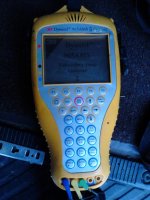
This is what I use to find faults, goes down to 19 gauge. If you know someone who has access to a fault locator they are really easy to run.

Even with it set up at 19 gauge it would still find the open with good accuracy.

If the wire is aluminum I would replace it.
 

Attachments

  • P82A1365.jpg
    P82A1365.jpg
    137.3 KB · Views: 31

kctyphoon

Banned
Joined
Jun 9, 2014
Messages
9,102
Location
Jersey/Staten Island
This might be a stupid question, but how SURE are you that the wire in the ground is broken, and it's not a connection on either end that's your issue?

Anyway, on a more serious note- and don't quote me on this, cause this really isn't my field, BUT - I'd think what you need is a cable fault finder. Like this one -https://www.ebay.com/p/Harris-TS-100-Cable-Fault-Finder-Harris-Ts100/1224593394?iid=183052851093
I wanna say you'd be able to put the meter on one side, and it should be able to tell you how many feet away from where you are that the break, or open, is.. I'm SURE there's a YouTube video that can show you how to do this..
 
Last edited:

Snakebyt

Well-known member
Joined
Sep 2, 2014
Messages
1,075
Location
Lubbock Tx
Thanks for the help guys. I've got some time before the ground thaws but it looks like I may just have to hand dig the entire length until I find the break.


If you are going to go that far, why not go ahead and lay conduit and new line while its already dug up?
 

Fierljeppen

Well-known member
Joined
Jan 26, 2018
Messages
1,159
I have a light near the street controlled by a switch at the back door. Somewhere between the switch and lamp the wire is broken. The wire, I believe, is buried along the driveway. I need a way to locate the break. What tool do I need to help locate the break without digging up all approx. 75 feet of wire. Does such a thing even exist? Any help would be greatly appreciated. Thanks, Marty

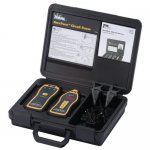
Ideal 61-955 SureTrace Circuit Tracer Kit

This has become one of my favorite electrical tools. It's quite pricey, unless you're going to use it often and can write off tools, but it works! You-tube has some really good videos if you're interested. Ebay might save you some coin.

Good luck!
 

Attachments

  • ideal-61-955_1.jpg
    ideal-61-955_1.jpg
    105.1 KB · Views: 20

rharman

Well-known member
Joined
Apr 22, 2012
Messages
8,894
Location
SoCal
I'm going to second the thoughts of check the switch and, possibly, check continuity.
Be sure power is off.
 

skruft

Well-known member
Joined
May 9, 2011
Messages
759
Right - it is much more likely for there to be a problem at one end or the other, rather than a break in the ground, unless some sort of digging was done and cut the wire. Even switches break. I suggest, turn the power off and check continuity of the wire and everything at each end.
 
OP
W

Wyoming09

Well-known member
Joined
Sep 24, 2014
Messages
523
Location
Wyoming, MI
A couple of years ago after a particularly wet spring when I would flip the switch the breaker would trip. After it dried up some then nothing. I believe the wire runs along the driveway and under a walk to the front porch. I'm thinking the wire was broken by the plow company putting in driveway markers before winter started. I'm pretty certain it's direct buried, seems like 6" to 8" deep. Part of the problem is that I have no idea where the wire exits the house. I'll be checking the switch and lamp socket this weekend. The weather seems to easing up a bit.
 
To avoid these ads, REGISTER NOW!

Kaizen

Well-known member
Joined
Jan 9, 2015
Messages
6,948
Location
New England
Thanks for the help guys. I've got some time before the ground thaws but it looks like I may just have to hand dig the entire length until I find the break.


Others have said it but not told you how to do it so here it is. At the switch disconnect incoming wires completely. Check you have voltage on those incoming then cap them. Go out to the light and connect the white and black TEMPORARILY. Go back inside with a tester that checks conductivity. Normally on a tester it’s the setting that makes a beep when both leads are touched. If you get a beep then neither are broken and it is in fact the light or switch. Also if it’s a light post with an outlet your problem could be there as well. If no beep you should dig the whole thing and replace as you should not splice underground. Spend the time testing as that is normally the place of fault


Sent from my iPhone using Tapatalk
 

SteveW1000

Active member
Joined
Sep 13, 2013
Messages
41
Location
London, UK
Lots of the cable detector look like they are for shallow depth so might struggle with finding this cable. Over here most utilities are buried so the crews use something like this to find services and prevent damage before digging. https://www.hss.com/hire/p/cable-and-pipe-locator-cat-3-hire-pack-1 Would think something similar should be available over there if so you might even be able to get someone to find the break for a six pack, If you can find it and dont want to replace the whole cable you can get epoxy filled splices to repair the break.
 

NUTTSGT

Super Moderator
Staff member
Joined
Sep 14, 2009
Messages
51,093
Location
Northern Central Ohio
If it was a wet spring, what kind of light was it ? Did it get water inside it ? I'd be double checking everything before I started digging, including replacing the bulb with "another" new one. I thought I had an issue one time, turns out the new bulb that replaced the bad bulb was bad.
 

shawhite

Well-known member
Joined
May 28, 2014
Messages
1,519
Disconnect power. Short black and white at the load like said above. Disconnect switch and test for resistance across black and white. You should see low resistance. If not go back to the load and short black to ground (assuming a ground is in the cable). Go back to switch end gear for short. If no short is present this wire is probably open. Do the same with the white wire. After you are no isolating which wire has the fault then you can move to capacitance testing to try to isolate the fault. Usually you would check capacitance at both ends black/white, white to ground and black to ground. Once you have these values look up approx capacitance for 1 ft of same size cable used and do some math. This is not an exact science but has worked for phone men for many many years before the advent of fault locators and tdrs
 

rlitman

Well-known member
Joined
Oct 18, 2010
Messages
24,650
Location
Long Island

mm08822

Well-known member
Joined
Jan 13, 2012
Messages
6,034
Location
NJ
Disconnect power. Short black and white at the load like said above. Disconnect switch and test for resistance across black and white. You should see low resistance. If not go back to the load and short black to ground (assuming a ground is in the cable). Go back to switch end gear for short. If no short is present this wire is probably open. Do the same with the white wire. After you are no isolating which wire has the fault then you can move to capacitance testing to try to isolate the fault. Usually you would check capacitance at both ends black/white, white to ground and black to ground. Once you have these values look up approx capacitance for 1 ft of same size cable used and do some math. This is not an exact science but has worked for phone men for many many years before the advent of fault locators and tdrs

A step is being missed.

Remove the bulb and disconnect from switch/ground and then test:
continuity between h-n, h-g, n-g.
Each of these readings should be open = infinity. Any of these tests fail then your cable is bad.

Then proceed looking for continuity between pairs of twisted conductors as stated.
 

shawhite

Well-known member
Joined
May 28, 2014
Messages
1,519
A step is being missed.

Remove the bulb and disconnect from switch/ground and then test:
continuity between h-n, h-g, n-g.
Each of these readings should be open = infinity. Any of these tests fail then your cable is bad.

Then proceed looking for continuity between pairs of twisted conductors as stated.

Good catch got a little a head of my self
 
To avoid these ads, REGISTER NOW!
Top Bottom