jeffmoss26
Well-known member
got this lot from the restore - obviously the top 2 rows are dies but I have no idea what the others are. any help would be appreciated!

Huh?Die guides
 www.garagejournal.com
I’m starting to understand, but what holds it in place? I tried to find a YouTube of it in use, but had no luck.You put them on the rod you are going to cut threads on before the die to keep the threads square. I have a set for smaller T&Ds, but I can't find them right now.


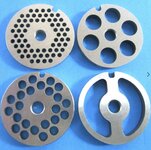
Don’t laugh too hard, that crossed my mind. I had just put one out at our garage sale last weekend, so the pain was fresh.Meat grinder plates.
You want a 7/16” sausage? You got it.
My arm is sore, and my eyes are misting up, just thinking about them. My grandparents made a special sausage from the old country called hurka. Unless you can roll your r's, you'd be hard pressed to pronounce it, but phonetically, something like HOO-err-tka. Anyway, when I was young, my brothers and I had the job of grinding. It was fun, until it wasn't! Haha.I’ve bought and sold a few meat grinders. Might have convinced a Griswold collecting friend that he needed one too.
I knowAt the top of the picture is a bag of red Plastic Anti-Short Bushings.
They are used with BX cable, metal shielded cable.
I just used several of these, adding outlets and lights to my neighbors garage.
I will get more picsWhat are the cam-like slots for, Beemer? The pieces marked 5/8 and 9/16 have them, the piece marked 7/16 does not. Are the other two pieces marked on the flip side, Jeff? Or do they work with the others? It almost looks like an antique threader I have with multiple plates that turn (in those cam slots) and lock the die into place. But I'm not "seeing" how that would work from here.
I have a few antique adjustable die stocks that come with guides, but they all insert in the die stock, not on the work piece. And all vintage drop head style pipe threaders have guides, of course, but they, too, insert inside the die stock.
Curious to see the resolution on this one.


