
You are using an out of date browser. It may not display this or other websites correctly.
You should upgrade or use an alternative browser.
You should upgrade or use an alternative browser.
Help identify motor
- Thread starter Perfectstranger
- Start date

Freejack
Well-known member
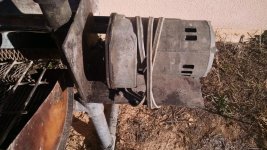
Since that is a gearmotor, your going to need to find some more information, like a nameplate or manufacturers part number.
It's likely you'll need to figure out the specs (shaft RPM, HP etc) and try to find something close.
Looks like a grill in the shot, is that for a spit?
Jake
It's likely you'll need to figure out the specs (shaft RPM, HP etc) and try to find something close.
Looks like a grill in the shot, is that for a spit?
Jake
OccupantRJ
Well-known member
Dayton makes a gearmotor that looks similar. Search on Grainger. Checking amp draw on it could give a clue about hp. Inhave used the Dayton gearmotors several times for projects. They come in various output shaft speeds.
OP
Perfectstranger
Well-known member
RJ, there is no other plate on it, I was hoping someone might recognize the one in the picture.
Jake, great eye man. Yes It's got about 100 pigs on it. Here is a picture with a 90 pounder. Biggest I've had on it is 185 lbs. It took the weight but porky was almost to long for my spit.
Jake, great eye man. Yes It's got about 100 pigs on it. Here is a picture with a 90 pounder. Biggest I've had on it is 185 lbs. It took the weight but porky was almost to long for my spit.
Attachments

Freejack
Well-known member
Cool, whole-hog, yum.
If this is direct coupled to the spit, main thing you'll need to do is figure out the ratio. if it's not locked up, you can likely spin the motor to count the rotations on the shaft. Or you can just select an RPM you'd like. The hardest part is figuring out what HP is needed to replace what you have today without any nameplate data.
Jake
If this is direct coupled to the spit, main thing you'll need to do is figure out the ratio. if it's not locked up, you can likely spin the motor to count the rotations on the shaft. Or you can just select an RPM you'd like. The hardest part is figuring out what HP is needed to replace what you have today without any nameplate data.
Jake
justsam
Well-known member
The end cap looks like an old GE motor, but I am far from expert.
Have you completely removed the motor so you can look on all sides of it to check for a data plate?
Do you recall what the original application of this motor was, before it was re-purposed for spit duty?
How has the motor failed, or is it a gear box failure?
Have you completely removed the motor so you can look on all sides of it to check for a data plate?
Do you recall what the original application of this motor was, before it was re-purposed for spit duty?
How has the motor failed, or is it a gear box failure?
OP
Perfectstranger
Well-known member
First thank you guys for your help.
Jake the spit is chain driven.
Justsam, I have taken the motor off, there is no other plate. No I don't remember where I got the motor. I'm a bit of a hoarder so really there is no telling.
The whole thing started with the motor and a lot of beer. Everything other the the spit itself was gotten at "Hugh M Woods". The spit was fabricated with some SS bar stock and a bicycle sprocket.
The motor has not failed, I would like to build another one built in , in the back yard and use this one as the "road rig"
Jake the spit is chain driven.
Justsam, I have taken the motor off, there is no other plate. No I don't remember where I got the motor. I'm a bit of a hoarder so really there is no telling.
The whole thing started with the motor and a lot of beer. Everything other the the spit itself was gotten at "Hugh M Woods". The spit was fabricated with some SS bar stock and a bicycle sprocket.
The motor has not failed, I would like to build another one built in , in the back yard and use this one as the "road rig"
Freejack
Well-known member
If you want another, you will need at least a couple data points to ID something similar.
First you'll need RPM: Get the RPM on the output shaft of the motor,. Count the rotations of your spit per minute, multiplied by the gear ratio of the sprockets in you chain drive (if any difference). If you have access to a photo sensor-style tach, that would be straightforward way to measure also.
Second motor strength: In this case the only thing that we can really go on is amp draw, which isn't a perfect way to measure motor strength, but should get pretty close. With the motor connected to the spit, load the motor up to max load you'd expect it to see when you have a hog on there and measure the amp draw of the motor.
Going to Grainger, or some other parts house, find a similar RPM and gearbox configuration and select the next highest amp draw to what you measured. That should get you close enough.
Jake
First you'll need RPM: Get the RPM on the output shaft of the motor,. Count the rotations of your spit per minute, multiplied by the gear ratio of the sprockets in you chain drive (if any difference). If you have access to a photo sensor-style tach, that would be straightforward way to measure also.
Second motor strength: In this case the only thing that we can really go on is amp draw, which isn't a perfect way to measure motor strength, but should get pretty close. With the motor connected to the spit, load the motor up to max load you'd expect it to see when you have a hog on there and measure the amp draw of the motor.
Going to Grainger, or some other parts house, find a similar RPM and gearbox configuration and select the next highest amp draw to what you measured. That should get you close enough.
Jake
Last edited:
OP
Perfectstranger
Well-known member
Thanks again guys!! I think I can pull that off.