To avoid these ads, REGISTER NOW!

Help me identify these old tools

ConductorChris

Well-known member
Joined
Mar 21, 2017
Messages
160
Hello, I have purchased a few estate sales over the last year and it has left me with a few tools I can not identify. I look forward to the experts here giving me a hand and want to say thank you in advance. I'll post the pics for each tool in separate messages so it is easier to keep the info straight.

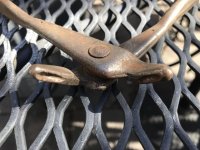
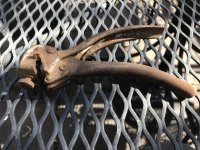
Tool #1
These are like a small pair of pliers but the ends don't come together tight and on the inside of the tips there are small indents.
 

Attachments

  • IMG_3169.jpg
    IMG_3169.jpg
    114 KB · Views: 187
  • IMG_3170.jpg
    IMG_3170.jpg
    158.3 KB · Views: 168
  • IMG_3171.jpg
    IMG_3171.jpg
    150.9 KB · Views: 158
To avoid these ads, REGISTER NOW!
OP
C

ConductorChris

Well-known member
Joined
Mar 21, 2017
Messages
160
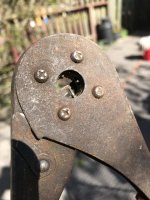
Tool #2
This tool has a small hole in the end, and when you squeeze the handles together there are gear driven conical points that would pierce whatever was put in the hole.
 

Attachments

  • IMG_3180.jpg
    IMG_3180.jpg
    80.6 KB · Views: 134
  • IMG_3179.jpg
    IMG_3179.jpg
    120.5 KB · Views: 116
  • IMG_3178.jpg
    IMG_3178.jpg
    124.9 KB · Views: 103
  • IMG_3177.jpg
    IMG_3177.jpg
    129.4 KB · Views: 127
OP
C

ConductorChris

Well-known member
Joined
Mar 21, 2017
Messages
160
Tool #3
This tool has about a 12" long wooden handle and then the metal part seems to be a holder for something.
 

Attachments

  • IMG_3172.jpg
    IMG_3172.jpg
    156.2 KB · Views: 165
  • IMG_3173.jpg
    IMG_3173.jpg
    161.4 KB · Views: 148
OP
C

ConductorChris

Well-known member
Joined
Mar 21, 2017
Messages
160
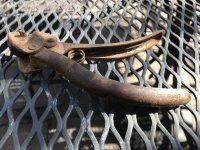
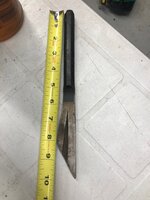
Tool #4
This tool I believe is for setting the teeth on a handsaw. When you squeeze the handle a small metal block moves into the gap.
 

Attachments

  • IMG_3174.jpg
    IMG_3174.jpg
    158.1 KB · Views: 106
  • IMG_3175.jpg
    IMG_3175.jpg
    156.6 KB · Views: 78
  • IMG_3176.jpg
    IMG_3176.jpg
    83.5 KB · Views: 80
OP
C

ConductorChris

Well-known member
Joined
Mar 21, 2017
Messages
160
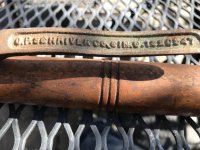
Tool #5
I just realized that the picture of the working end of this tool didn't turn out. I'll take another today. Anyhow to get started the lettering on this tool says "Malleable Iron IXL Chain Peter Patented" and "O.P. SCHRIVER". I am going to take a closer look to get the rest of the writing off this tool. But it also has a copper tone to the metal. Like it was coated or painted at one time.
 

Attachments

  • IMG_3168.jpg
    IMG_3168.jpg
    153.4 KB · Views: 108
  • IMG_3167.jpg
    IMG_3167.jpg
    154.2 KB · Views: 130
OP
C

ConductorChris

Well-known member
Joined
Mar 21, 2017
Messages
160
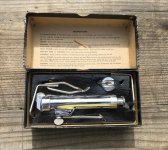
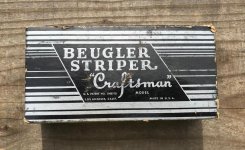
Tool #6
This little contraption is between 3 - 4 inches long. The glass vial unscrews from the metal body. There is a cork gasket between the glass and metal. The small gold disk on the bottom turns when you roll it on a surface. I am assuming this was some sort of marking instrument. The metal wire seems to be a guide, and it is moveable as well. Whatever it is, it was never used.
 

Attachments

  • IMG_3526 (1).jpg
    IMG_3526 (1).jpg
    100.3 KB · Views: 130
  • IMG_3527 (1).jpg
    IMG_3527 (1).jpg
    97.5 KB · Views: 117
  • IMG_3528 (1).jpg
    IMG_3528 (1).jpg
    103 KB · Views: 111
OP
C

ConductorChris

Well-known member
Joined
Mar 21, 2017
Messages
160
Some pictures of saw set tools for you to look at:

https://www.toolsforworkingwood.com/store/item/MS-SAWSET.**/Saw_Sets
Thanks, that seems to be what I thought it was. I am unsure how well it works. It give it a try this afternoon.
 

gorilla

Well-known member
Joined
Dec 13, 2007
Messages
1,650
Tool#6 is a pin striping tool. You fill the glass vial with one shot paint and the wheel lays down the line. The wire is a guide used to follow an edge or a line.
 

Al Borland

Well-known member
Joined
Jan 20, 2016
Messages
1,598
#6 is a Bugeler (Bugler???) striping tool. glass pot seems likely it is an old one, guide usually has to be depressed for paint to dispense on the roller.
 
Last edited:

markhm

Well-known member
Joined
Mar 4, 2017
Messages
264
Location
NY
#5 is a chain plier. The end is used to open non-welded chain links and the notches in the handle are used to close chain links. This tool was mostly used by electricians to hand chain mounted lighting fixtures.
 

454ragtop

Well-known member
Joined
Mar 24, 2008
Messages
5,011
Location
Carver, MA
I'm not convinced the crimping tool is a crimping tool. How do you get it off the wire after, or is it only used when working right at the open end?
 
To avoid these ads, REGISTER NOW!
OP
C

ConductorChris

Well-known member
Joined
Mar 21, 2017
Messages
160
I have some more tools to identify

#1 is a double ended sockets. They don't have a manufacture's name but do have model numbers (I googled but came up with nothing)
They are very much like nut setters with a magnet deep in the socket, but the other end is a different socket. This came with other stuff that looks like it came from a factory or specialty shop.
The numbers on them are: Y471201166, Y43241009 and smallest one is worn off. 3 are the same and the other 2 are different sizes.
Sockets 1.jpgSockets 2.jpg
 
OP
C

ConductorChris

Well-known member
Joined
Mar 21, 2017
Messages
160
Another one that I don't know what it is for is a socket. It looks to be 7 mm, has an imbedded magnet, the other end is square drive 1/2", with a small removeable retaining pin that is held in place with a rubber o-ring. Number on it is Y4716009342.jpg3.jpg
 

Attachments

  • 1.jpg
    1.jpg
    164.7 KB · Views: 81

bonneyman

Well-known member
Joined
Apr 22, 2010
Messages
8,773
Location
Desert SW
Tool#6 is a pin striping tool. You fill the glass vial with one shot paint and the wheel lays down the line. The wire is a guide used to follow an edge or a line.
Agreed on the pin striping tool. :thumbup:

My dad used one that was similar to stripe my mom's '68 Camaro when I was a young lad. Plastic reservoir and his had a wheel on that guide bar but unmistakably the same tool.
 

leg17

Well-known member
Joined
Aug 11, 2011
Messages
1,369
Location
Kentucky
Maybe some kind of torque limiting assembly drivers for large scale manufacturing???
Can't see the business end but just a guess.
 

sac02

Well-known member
Joined
May 15, 2011
Messages
446
I have some more tools to identify

#1 is a double ended sockets. They don't have a manufacture's name but do have model numbers (I googled but came up with nothing)
They are very much like nut setters with a magnet deep in the socket, but the other end is a different socket. This came with other stuff that looks like it came from a factory or specialty shop.
The numbers on them are: Y471201166, Y43241009 and smallest one is worn off. 3 are the same and the other 2 are different sizes.
Sockets 1.jpgSockets 2.jpg

I'm an engineer at a Japanese Automotive OEM. We use these flip sockets / drivers in various places. They are handy for use in things like off-line repairs and for engineers to do investigations. We don't use them on the production line, there are better tools for that (see next post).

The drive on these is a standard 1/4" hex power drive.

Not sure who the manufacturer is. Very possible it's Japanese. Axel or NAC are two Japanese industrial tool brands I've seen / remember floating around here.
 
Last edited:

sac02

Well-known member
Joined
May 15, 2011
Messages
446
Another one that I don't know what it is for is a socket. It looks to be 7 mm, has an imbedded magnet, the other end is square drive 1/2", with a small removeable retaining pin that is held in place with a rubber o-ring. Number on it is Y4716009342.jpg3.jpg

Again, tools meant for efficient production in a manufacturing environment. Magnets to prevent dropped fasteners, and pins (instead of ball detents or friction rings) to prevent the socket from disconnecting from the tool anvil.

We use the same or similar in Automotive OEM manufacturing, virtually all of our sockets and bits on the production line are like this.

(I assume this is not unique to automotive, any manufacturing could have the same benefits.)

Edit: I bet the reason you found a 7mm is because nobody uses 7mm, lol. All the "regular" sizes were used, this guy took home an unused socket because hey, free tools. But that particular socket you have pictured is not a tool that ever saw regular use, just based on its condition, lol.
 
Last edited:
To avoid these ads, REGISTER NOW!
Top Bottom