
mikeyr
Well-known member
So, I need to make 4 (2 left, 2 right) interior door locks for a old 1934 British car, no keys or anything its just something to open the door. I only have 2 springs, but I don't see why I can't use modern coil springs near the base of the arm to a new post in the lower right. Or is there a better place ? I am a little concerned that the spring would get in the way of the bar that will be at the bottom of the pic. That notch with 2 brass washers at the bottom of the pic, that is for the bar that goes to the exterior door lock/latch at the front of the door and spring will go in same direction.

Then for the other side, I need to figure out to make this part with the square section that goes into the handle itself. I would rather not re-invent the wheel, i even thought of using socket extension cut to fit but wrong size, I do have a small metal lathe and mill combo (shoptask bridgemill), but certainly not a machinist, I could turn it to size, but no idea how to mill that perfect square...only have to make 4 so I could use a hand file I guess. Or buy some type of indexing (expensive) tool for the mill this is GJ after all.
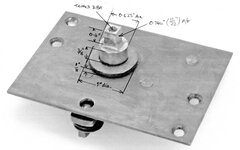
It all looks really simple to make, I would not mind making up more than 4 for others in the club and if i did, i would rather avoid hand filing. I have pretty good drawings of the parts but you get the idea. Basically, can I get away with a modern spring that i can get at any corner store so I am not dependent on that spring that I can't get more of. I can weld it all up where it calls for the pins to be swaged in or do the swaging but wondering if some screws might not be better. Screws would require more machining since I have to tap the parts and welding the posts in is pretty easy. Basically its all covered by upholstery and only the handle will be visible so I am free to do anything as long as I stay with the overall plate size that is inlet into the wood door frame. I am also worried about the angle, I would love to be able to change it after assembly to make the door handle sit at the right angle, but that would require splines above my machining skills, unless I can find something pre-made to cut/weld together.
Then for the other side, I need to figure out to make this part with the square section that goes into the handle itself. I would rather not re-invent the wheel, i even thought of using socket extension cut to fit but wrong size, I do have a small metal lathe and mill combo (shoptask bridgemill), but certainly not a machinist, I could turn it to size, but no idea how to mill that perfect square...only have to make 4 so I could use a hand file I guess. Or buy some type of indexing (expensive) tool for the mill
this is GJ after all.It all looks really simple to make, I would not mind making up more than 4 for others in the club and if i did, i would rather avoid hand filing. I have pretty good drawings of the parts but you get the idea. Basically, can I get away with a modern spring that i can get at any corner store so I am not dependent on that spring that I can't get more of. I can weld it all up where it calls for the pins to be swaged in or do the swaging but wondering if some screws might not be better. Screws would require more machining since I have to tap the parts and welding the posts in is pretty easy. Basically its all covered by upholstery and only the handle will be visible so I am free to do anything as long as I stay with the overall plate size that is inlet into the wood door frame. I am also worried about the angle, I would love to be able to change it after assembly to make the door handle sit at the right angle, but that would require splines above my machining skills, unless I can find something pre-made to cut/weld together.
Last edited:


