To avoid these ads, REGISTER NOW!

Help me setup a basic woodworking shop...

owdlvr

Well-known member
Joined
Oct 16, 2006
Messages
119
Location
Vancouver, BC
So a bit of background: I've been working on cars as a hobby for 19 years. There isn't anything on an automobile I won't rebuild, modify, or repair...though, after spraying one car I'm smart enough to do the prep work and have someone else lay down the paint now! Cutting, welding, tearing apart engines and transmissions and successfully rebuilding them is no problem at all.

Having recently purchased a house, and renovating the shop out back, I've realized that in many ways I'd rather build the things I need vs. buying them. Since I'm a first-time home owner who's never done any renos, the shop is the perfect place to learn and practice, before I reno the house.

In the shop I'll need to build the following in the coming weeks:
- Workbenches
- Storage Shelves
- A few random custom cabinets

In the house, over the next six months, I'll be looking to build:
- Shelving
- TV / Media stand
- Dining Room Table (live edge)
- Bench & shelving for the front hall

Long term I also plan on renovating the downstairs for a suite. I've already built myself a desk, a couple of floating shelves for the garage and done all the wood paneling in the garage. Enough to discover I enjoy wood working, but also enough to know I have lots to learn!

-------------------------

On to the shop! The goal is to end up with the ability to do wood working, without taking up tonnes of space in my garage. I'm a classic car guy, the primary use of my space is classic car work. I'd like to "pull out" and setup wood working equipment for specific jobs and then tuck it all away as compactly as possible.

I currently own:
- Table Saw
- Mitre Saw, 7" sliding
- Circular Saw
- Jig Saw
- Router & Table
- Various drills
- 18ga Brad Nailer
- 16ga stapler
- Framing nailer
- 2x 12" trigger clamps
- 2x 6" trigger clamps

The table saw and mitre saw are currently "loose" with no stands to speak of. I've used both on saw horses and temporary benches, and I know that I definitely want something more secure and permanent. I think I need to decide between a Paulk Total Station where I could use each tool at the same time, or build two or three "folding mitre cart" stations. One for the mitre saw, one for the table saw and probably have one of the two setup to switch over to the router.

Paulk Total Station (image shows a slightly modified version):
3c081bd51ab64a1b292a355c4d21de95.jpg


Folding Mitre Saw Station:
IMG_0102-1024x768.jpg


For an occasional wood-working user, which would be a better starting point? The Paulk station certainly has advantages with clamping, etc. But it's pretty big and bulky to store. The folding cart stations certainly setup faster, but take up more floor space.

Tools I'm missing?
It would appear that pocket-holes are 'the thing' for joining two pieces of wood together. Would you call it a necessity? I'm not scared of buying tools, but prefer to buy tools I will actually need / use. The workbench drawer designs I'm looking at, and the Paulk Total Station build both use pocket screws, but it would be just as easy to build them without. Pick up a jig, or skip it for now?

If I should pick one up, K5 or K3 for the occasional user?

Dust - How do you deal with it on the cheap / compact?
Having cut all the plywood for my shop walls in the shop, with my tool chests, I now need to vacuum out EVERY drawer. Wood dust is brutal, and I would be inclined to simply roll my wood working stuff out into the driveway to work, but during the winter that's pretty cold and rainy. I don't mind moving the shop vac from tool to tool to help with the dust abatement, but what else do I need? Simply hook up the shop vac direct for now, or do I need a cyclone unit?

What else am I missing?
Besides a mentor who can show me how to do things...what else is 'essential' for working with wood that I've missed?

-Dave
 
To avoid these ads, REGISTER NOW!

drivesitfar

Well-known member
Joined
Oct 23, 2013
Messages
36,000
Location
Pacific Northwest
OWD: might i suggest you put the link to your new thread in your Sig line? you'll have to go in your GJ profile to cut and paste it there. anyway if you might also post up your questions and refer them to this thread we have some members that are very able to make a piece of wood look better. its the Woodworking 101 thread and there is a link in my sig line. from what i see i like your stuff, but i need to run so best of luck and i'll check back later.

cheers
 

ratdoggy

Well-known member
Joined
Mar 27, 2009
Messages
11,971
Location
Akron-Canton area OH
I've done more with less...
You don't need those fancy stands do do the basic stuff it seems you want to do..
Basic stuff table saw and a router table built this....
it's been finished in the meantime
 

Attachments

  • P1300341.jpg
    P1300341.jpg
    142.4 KB · Views: 256
  • P2080347.jpg
    P2080347.jpg
    139.7 KB · Views: 229

jakemac

Well-known member
Joined
May 21, 2013
Messages
9,035
Location
New England
As far as dust collection is concerned, do EVERYTHING you can afford to do. Shop Vacs, Dust Collection, Air Filtration, etc.. That said, fair warning, you will NEVER stop the dust. It WILL get everywhere. So do all that you can at the source, and resign yourself to having to periodically do a full cleaning. Have tarps handy to cover up while making dust, then leave them on for another day as the particles in the air take their time to settle.

I wouldn't spend money on an expensive pocket hole jig unless I was doing a lot of production work. For the occasional home project, a cheaper clamp on guide will work fine. It might take a little more time to set up, but won't take up as much storage space.

What you WILL need to buy is ................CLAMPS !!!!!!
You will never have enough if you're working on big projects.

C-clamps in various sizes for edge clamping.
Pipe clamps in various lengths for big projects (buy the heads and then multiple size pipes to swap out).
Strap clamps (endless cargo clamps w/out the hooks) for holding box shapes together.

A good glue dispenser is helpful, as well as bulk disposable acid brushes to spread the glue.
 
Last edited:
OP
O

owdlvr

Well-known member
Joined
Oct 16, 2006
Messages
119
Location
Vancouver, BC
Awesome! Keep the suggestions coming.

For the record, I know I don't *need* the fancy tables or stands...but I'm also quite happy to build them to make building things easier. Besides, I'd rather 'practice' while making a garage cart vs. trying to build a media stand for my house on the first go!

-Dave
 
Last edited:

mbatarga

Well-known member
Joined
Sep 14, 2005
Messages
883
Location
GA
I'd steer you away from pipe style clamps. I'd suggest some high quality clamps from Bessey instead - K body style. They will have a larger clamping surface and will help square up medium sized assemblies. I've got pipe clamps myself - but rarely use them. If you've got some large sized assemblies planned though - there is not really a substitute for pipe clamps.
 
Last edited:

rsanter

Well-known member
Joined
Dec 22, 2007
Messages
18,493
Location
visalia ca
If you hang the poulk station from the ceiling it won't take that much space.
But you have really not provided enough information to get a solid answer. How much room do you have! How often are you going to use this stuff? When you use it how long can you leave them setup!...etc

For me what always worked was to have everything on wheels and pull them to the center to use them. I use the large pallet racks so I can store the larger tools under them like the table saw, shaper, jointer...etc and then the smaller tools go on the pallet rack shelving

Bob
 

derosa

Well-known member
Joined
Oct 19, 2010
Messages
1,078
Location
Oceanside, NY
A good bandsaw and a planer are real important in my opinion. I can live without a tablesaw and have done just fine without but always found a planer and bandsaw necessary. I haven't got a single pipe clamp but own plenty of F clamps. The HF versions will do OK for a while but you want to get better. I just use a piece of ply with a 2x4 screwed to each end on saw horses for my mitre saw stand. A larger shopvac should take care of most of the mitresaw dust. A HF dust collector will do OK for a while with the rest of your tools. Personally I find putting a sheet of ply through a hybrid tablesaw hard enough, I wouldn't use a tabletop qsaw when Lowes and HD have 500ish dollar hybrids that use a good motor.
 

ssdave

Banned
Joined
Apr 11, 2015
Messages
2,913
Location
Eastern Oregon
Interesting perspectives people have, and it highlights just how different everybody's experiences are.

I see recommendations to not use pipe clamps. I see recommendations that you need a planer, but not a table saw. I see a recommendation that a bandsaw is essential. I see that a pocket screw jig is needed. Outside this thread, I see a lot of people who want to get into woodworking make fancy tables and specialty worksurfaces for doing the work. Hell, I've seen retired guys that worked for 15 years after their retirement making jigs and tables and benches for the perfect woodworking shop, and never actually doing a useful project.

I'd go a totally different direction: I'd not build any specialty workbenches or stands or such. I'd make or buy or assemble a simple, flat top, 4' x 8' layout and work table that goes in the center of my shop, or along one edge. I'd use my miter saw on it, sand stuff on it, use it to glue up panels, use it to do layout and assembly, etc. etc. etc. I've always made my tables using commercial rivet lock shelving stuff; cut the uprights to 3 feet or so, use shelf cross pieces and cross braces, and follow up with a 3/4" or 1 1/8" plywood top. You can screw stuff into the top, sand it off when it gets dirty, and replace it for low cost if it gets ruined. Most everything that can be done on a fancy workbench can be done on a plain layout table. You can mount a router under the layout table, and screw a fence onto it to so better edge/corner treatment work than with the handheld router.

I'd use a tablesaw and miter saw to do almost everything. A drill press would be nice also, but not a necessity. Other niceties are a jointer (very rarely a necessity) and a planer (only a necessity if you build up sections, finish rough lumber or use non-standard thicknesses of wood). A bandsaw is so specialized you will rarely use it for conventional work. Cutting curves and resawing thick wood to make your own lumber are the primary uses for it.

Go into a production cabinet shop and see what tools they use. First and foremost, is the table saw. That is the centerpiece of their operation; often equipped with a power feed since they use it so much. Second is a miter saw or similar cutoff saw for cutting boards to length/angle. After those two pieces, they go into specialty machines that vary shop to shop. They typically have a planer and/or thickness sander. Also, a belt and disc sander. And, some kind of a specialty drilling machine for doing hinges. That's about it. Sometimes a jigsaw or a bandsaw, sometimes a drill press, a hollow chisel mortiser, and specialty gluing and clamping machines. Some have a panel saw, some do not. They all have multiple layout tables that they use hand tools and electric tools such as sanders on. You'll see rack after rack of clamps.

Clamps were mentioned above. Whatever type you choose (I'd get some of each) have a lot of them. You'll need quality, quantity and variety. I see nothing wrong with pipe clamps; they are quite versatile but are heavy and bulky to store. To rack them takes up precious wall space. But, they're strong and versatile. F clamps are great, I own a few, but not nearly as many as pipe clamps. Easier to use, but not as strong as pipe clamps. They do store easier. I own about 50 C clamps that are 6" and larger, and about 75 that are less than 6". I have run out of a needed size many times when I'm gluing up stuff. A vise is great to have. A woodworking vise with retractable dog and holes on the table for a table cleat are traditional and useful. You can do a lot of the same by clamping stuff to the table with c clamps and scrap boards if you want to save the cost and space of the vise. A mechanics vise can be very useful, and you can use wood shims in it to keep from marring wood.

Specialty jointing tools like a hollow chisel mortiser, a dovetail jig, a doweling jig, a pocket screw jig, etc are nice, but a buy as you find the need item.

What I would invest in is a high quality (think porter cable) 3x21 belt sander and 1/2 sheet sander (think porter cable 505). A 1/4 sheet sander is nice, but is not the workhorse a 1/2 sheet, sealed motor sander is. I'd also invest in a air brad nailer, I prefer bostich or porter cable. A high quality screw gun is nice, a cordless drill works. A portable scroll saw is useful, as is a worm drive skill saw (for cutting dimension lumber and for roughing sheets down to a size for precise cuts on the tablesaw). A good router for finishing edges is essential, with a decent assortment of carbide bits.

I've built several houses, and built high quality cabinets and specialty woodwork throughout them with this list of tools:

1) Tablesaw (larger, cast iron, not contractor saw).
2) Drill Press.
3) Double tilt compound miter saw. (double tilt is essential for complex trim).
4) Belt sander
5) Half sheet sander
6) Router.
7) Brad nailer and pancake compressor to run it.
8) Screw gun
9) Normal hand tools (rasp, files, hook scraper, screwdrivers, hammers, pliers, nail set, angle gauge, tri-square or speed square, chisels, putty knife, eye protection, dust mask, etc.
10) Power hand tools: Worm Drive Saw, Corded and cordless drills, sabre saw.
11) Lots of clamps - buy more each time you need more.

Good dust collection is nice to have, but not essential. As noted before, dust will get everywhere, just how much is the question.

After I had the essential tools numbered above, I'd invest in these in the following order as I saw the use for them:

1) 6" belt and 9" disc sander combo, or larger.
2) 12" wide thickness planer.
3) Mechanics vise
4) Woodworking vise
5) 2 wheel shop grinder.
6) Reciprocating saw.
7) Planer blade and chisel wet sharpening machine.
8) Jointing jigs such as dowel jig, pocket screw jig, biscuit jointer, etc.
9) Jointer/planer
10) Bandsaw
11) Jigsaw
12) Oscillating spindle sander


Bottom line is that you already have most of what you need; I'd just start in and do some work, and find out what YOU need, not what us internet experts think you do.
 
Last edited:

Toolfool

Well-known member
Joined
Aug 22, 2011
Messages
4,981
Location
Tallahassee, FL
If you already have a portable table saw look into http://rousseauco.com/ . A folding stand and outfeed table will allow you to rip, sand, rout, assemble, and fold it up out of the way when you're finished. I've been using one of these set-ups daily for 20+ years on jobsites.
 

Adam.C

Banned
Joined
Jan 29, 2013
Messages
1,490
If you are working with sheet goods and 1 and 2 by lumber, I'd look long and hard at a track saw and selling the table saw. In my experience, no table saw is ever really big enough for a 4x8 sheet of stuff. The new track saws are excellent, and do a good job of dust collection. You can get routers that run on the same track.
 
OP
O

owdlvr

Well-known member
Joined
Oct 16, 2006
Messages
119
Location
Vancouver, BC
Interesting perspectives people have, and it highlights just how different everybody's experiences are.

...trimmed for brevity in the quote...

Bottom line is that you already have most of what you need; I'd just start in and do some work, and find out what YOU need, not what us internet experts think you do.

Thanks for taking the time write that out. Very helpful. The point of the thread is to get a bunch of opinions, with back-up experience, so I can hopefully learn faster then by trail and error. I've done *just* enough work on the current shop to confirm that while I can use my two saws as is, I'd much prefer to have an out-feed table for the table saw, and something on either side of the miter saw to support long pieces. Thus, starting to think about benches.

On the tool list, I have much of what you've listed in the "must have" section, things like the Drill Press and plenty of the hand tools are all cross-over from my automotive boxes. I also have some of the items on the future purchase list. Interesting that you noted a planer, it's on my list of future purchases only because I have access to _really_ inexpensive rough-cut wood from a local mill. One of my carports has a dually-pickup bed full of lumber which is waiting to dry out.

On the tools side of things, I usually buy when I have a need for them or if I can highlight items I'm _going_ to need, I watch the sale flyers. I suspect I've underestimated my need for clamps, based on the posts above and the photos I see of woodworking shops, so as they come on sale I'm likely to buy some here and there whether I need them or not.

I think based on the various posts above, and after driving for the day mulling over options, I've got a good idea of what might work for _my_ shop. Need to model something up and I'll post up my idea for thoughts later tonight or tomorrow.

Thanks again everyone for the input, very much appreciated.

-Dave
 
OP
O

owdlvr

Well-known member
Joined
Oct 16, 2006
Messages
119
Location
Vancouver, BC
Hmmm, actually, let me post up my thoughts before I waste any time modelling up a bench.

Okay, so my shop is a 3-car shop and primarily used for automotive work. Somehow I'd like to squeeze some wood working abilities into my life. Ultimately the wood working stuff should end up on wheels, so I can move it into the centre of the shop or (ideally) outside. It should also tuck away relatively easily. Now, the initial thought was to build a mitre saw stand and something for the table saw so that I have an out feed table...and then it hit me to today while driving that I could probably double-up some of my needs.

In the back of bay one, my 'storage' bay, I will end up having a roughly 6ft wide waste of empty space, as I'm building an air compressor closet. My original plan was to build a workbench for building engines back there. It won't be used often (avg 1 a year), but it's nice to have a separate clean spot to do it with.

In the back of bay three, beside the milling machine, is where I plan to have my "fab" bench. In my shop this is the "general work bench", it has a vice and I can lay things out while milling. It's general purpose.

Now, if I build things right...I think I can nail it all with relative ease.

Bay One Bench - This bench will be built to fit the space, but will include a boxed section in the middle for the mitre saw, and a boxed section at one corner for the table saw. I'll have to set threaded inserts or T-track into the table for mitre saw fences, but that doesn't strike me as a deal killer. To swap the bench over for engine building, simply put the mitre saw under the table, and lay a sheet of plywood (cut to size) over top that can get oily. I should be able to store this sheet of plywood behind the table, thus making it "out of the way" as well.

For the fabrication bench, I simply need to make sure that it's finished height is exactly the same as the first bench, thus I can roll it over when I need an out feed table.

Haven't worked out in my head how the router fits into all of this, but then I also haven't unpacked grandpas old router and table to see exactly what I have. Don't even know if it's a plunge router, or a fixed unit. Just know I got a router and table in a box somewhere!

Does the above plan sound reasonable? One convertible bench which can be used for two types of jobs, and one simple bench which can serve as an out feed.

-Dave
 

kctyphoon

Banned
Joined
Jun 9, 2014
Messages
9,102
Location
Jersey/Staten Island
Just to point out - by the time this thread is over, people will have recommended about $20,000 in tools..

Unless you're planning on building some crazy stuff, furniture grade items can be achieved with basic wood working tools/machines. Make the table saw your "better" investment.

Basic shop (not including common sense stuff) will need these... table saw, miter saw, jointer, small surface planer, router, sanders, straight edge clamping guide and patience... you'd be amazed what you can make just with those..

A band saw isn't a necessity unless your going to start doing some elaborate items, drill press too..
 

code4pay

Well-known member
Joined
Jun 5, 2014
Messages
237
Location
Jervis Bay Australia
What you need is different to what would be good you can do a lot with out alot of tools and what would be good depends alot on what you plan on making. Sheet good construction pocket holes are great, fine furniture not so much. I'd start making stuff with what you have then add to it on a needs basis.

Sent from my SM-T530 using Tapatalk
 

derosa

Well-known member
Joined
Oct 19, 2010
Messages
1,078
Location
Oceanside, NY
Other niceties are a jointer (very rarely a necessity) and a planer (only a necessity if you build up sections, finish rough lumber or use non-standard thicknesses of wood). A bandsaw is so specialized you will rarely use it for conventional work. Cutting curves and resawing thick wood to make your own lumber are the primary uses for it.
.

A band saw isn't a necessity unless your going to start doing some elaborate items, drill press too..
Unless you're only using sheet goods these statements aren't fully true. If you're going to work with wood it is expensive to buy prefinished lumber, when rough cut is so readily available. I have started a kid's pine bedroom set for my son, it will be made with a bandsaw, planer, mitersaw, screwgun and chisel, there will be no need for a tablesaw. There will be nothing elaborate or fancy though I expect it to look good. Making the top of the dresser or nightstand will require a planer to clean up the edges so they can be glued. At the same time I will be working on a dining room table and chairs. Since I'm working with rough cut oak I find it easier to use a snap line and rip my straight lines on the bandsaw where there's no kickback. I will be using a tablesaw for making a built in bookcase but that will be mostly made of sheet goods.
Cheap but effective is the HF workbench for an assembly table.
 

trainer

Well-known member
Joined
Nov 28, 2005
Messages
2,019
Location
Northern Ontario, Canada
It looks like you have a pretty good start.
I have a kreg r3. With a kreg face clamp, it will put a pocket hole just about anywhere.

For a sander, i would get a good random orbit machine. I rarely use my belt sander or 1/4 sheet one anymore.
Hand tools.. for starters a block plane, basic set of wood chisels, dovetail- type saw. Framing square, combination square, level.
 

Dave455

Well-known member
Joined
Mar 19, 2013
Messages
5,800
Location
Sussex, England
Owdlvr - I think your situation sounds like most of us - we all like working on our vehicles, but in reality garages / shops have to be multi purpose to do all the other stuff we have to!

I end up doing a fair amount of woodwork too, but I'm lucky in that I have some useful machines around, albeit mostly metalworking!

The thing I find myself using all the time is my Pillar Drill, and if I was setting up again, it's the first thing I'd get, together with perhaps some sort of mitre saw which you already have.

If you can cut wood dead square, then drill holes dead square, it's really easy to turn planed wood into kits of parts to make just about anything. Cabinets and stuff are dead easy, and if you want more than one, it gets really easy to make multiples of parts!
 
Last edited:

theoldwizard1

Well-known member
Joined
Feb 22, 2011
Messages
43,106
Location
SE MI
I am NOT much of a wood worker, but I like the concept of the Paulik Total station. Add a router inert with fence.

What is missing from that setup a drill press, a band saw and a good sanding station. A good disc/belt sander is indispensable, but he table top one are just too small. Oscillating, spindle sanders are great, when you need them. A handheld randow orbit sander is also a great power tool.

You have to have a Kreg pocket hole jig.
 
To avoid these ads, REGISTER NOW!

ssdave

Banned
Joined
Apr 11, 2015
Messages
2,913
Location
Eastern Oregon
Unless you're only using sheet goods these statements aren't fully true. If you're going to work with wood it is expensive to buy prefinished lumber, when rough cut is so readily available. I have started a kid's pine bedroom set for my son, it will be made with a bandsaw, planer, mitersaw, screwgun and chisel, there will be no need for a tablesaw. There will be nothing elaborate or fancy though I expect it to look good. Making the top of the dresser or nightstand will require a planer to clean up the edges so they can be glued. At the same time I will be working on a dining room table and chairs. Since I'm working with rough cut oak I find it easier to use a snap line and rip my straight lines on the bandsaw where there's no kickback. I will be using a tablesaw for making a built in bookcase but that will be mostly made of sheet goods.
Cheap but effective is the HF workbench for an assembly table.


Cheap rough wood must be a local thing. Never been where I've lived. When I've bought truckload lots of wood, I've paid the mill an extra $.25 per bf to plane it, and straight line rip one edge. From there, it's easy to work.
 

ez-duzit

Well-known member
Joined
Jun 24, 2013
Messages
5,094
Location
Marina del Rey
Forget about the silly "specialty" bench (you won't see those in any professional shop) and the tippy chop saw table.

Instead, start with a good table saw with off-cut table. A very workable bench can be made starting with 2 sawhorses (or 2 rollaway cabinets) and a solid core door. But a better bench would be 4' x 8', with storage beneath, if you have room. The chop saw can be stored below.

A track saw will add a lot of capability. And get the best bandsaw you can afford, on a rolling base.

In the attached photo, viewed from the off-cut table side, a useful setup which includes a table saw with attached router table and sliding table track. The off-cut table mounts a flush woodworking vise and serves as an excellent workbench with storage beneath. Stable and heavy duty, not fancy.

saw-bench-1_zps89bce13b.jpg
 
Last edited:

rsanter

Well-known member
Joined
Dec 22, 2007
Messages
18,493
Location
visalia ca
I have a combination of automotive, metal working, and woodworking shop. The biggest issue is cross contamination and lack of space for everything I need.

I have a heavy steel general workbench that I have a piece of plywood that goes over it so I can use it for woodworking without contaminating the wood.
The workbench is in wheels so I can bring it to center when needed.
If you are going to have one the small worksite table saws you could make a shelf that folds out for the table saw so the bench is an outfees table or you can do a mount system Like the paulk table. Do the same with your general vise so it is not in the way for woodworking.

If you are going to have a full sized table saw you can just make the bench and table saw the same height. On my table saw I have a hinged outfeed table mounted to the back of it so I'm set there

For the miter saw you can do the same thing and make paulk type mounting system for the saw and the side support leafs.
Same with the surface planer.

Yes, take stuff outside or near the garage door whenever you can, and I use a leaf blower to blow everything off before coming back in the garage and even in the garage to blow everything off when needed.

I have never really used a dust collection system because I do much of my work near the garage door opening but I had though about one at one time. There are very good plans for them on the net if you want to just build one

I stated it in an earlier post but one of the best things in my shop has been the pallet racking.
Without it I would not be able,to have as much in the shop as I do


Bob
 

LeeG

Well-known member
Joined
Nov 29, 2012
Messages
1,525
Location
Phoenix, AZ
Although I have a pretty complete woodworking shop in my garage now, I had next to nothing 10 years ago. If I were starting basically from scratch now, here's what I would get.

  1. Small table saw. I have a large cabinet style saw, but for 95% of what I do, a small portable saw would be sufficient. Dewalt DW745 would be fine ($300)
  2. Kreg Pocket Jig. I started with a K3. I used it to build just about every piece of shop furniture I own. Its not strictly required, but well worth the less than $100 I spent on it. ($99 for K4)
  3. Track saw. This tool was a complete game changer for me. It is the reason I recommended a smaller table saw over a larger one. I use a track saw for all of my sheet good preparation and most of my cross cutting. ($409 for Makita with 55" rail)
  4. 5" Random orbit sander. Good for about everything. I started with a basic Dewalt and used it for years. Hooked it to a shop vac to control dust. ($60 for Dewalt)
  5. Hollow core door and saw horses for workbench. A good pair of saw horses and a cheap hollow core door will give you a flat surface to work on. I still use this setup for extra bench space and as a finishing and assembly table.
  6. Clamps. The bar style clamps are best, but I built a bunch of stuff with just pipe clamps. They are cheap, and can easily be made as long as you need them. I have over 200 clamps of different types and styles, and still use the basic pipe clamp fairly often.

So for about $1000, you can get all of the basics to allow you to make quality cabinets and do basic home improvement. Other tools will be useful, but those above will get a lot of general use.
 

jimreed2160

Well-known member
Joined
Aug 7, 2016
Messages
3,589
Location
Tallahassee FL
OW--You have a pretty ambitious plan. As pointed out earlier, cross contamination will probably be an issue. My shop is a 24x24 2 car garage with a small lean to on the end. I do woodworking in the garage and metal working in the lean to. That area is full of grinding dust and swarf. The garage gets loaded with sawdust. When I clean up vises, I have to use lots of newspaper to keep from getting grease all over the woodworking areas. I vacuum sawdust as I make it but my handtool work keeps sawdust at bay. About twice a year, I crank up the compressor and blow the accumulated dust out the garage doors.

You will need some careful planning to keep sawdust out of your engines and grease off your wood stash. I like the removable benchtop idea.
 

kctyphoon

Banned
Joined
Jun 9, 2014
Messages
9,102
Location
Jersey/Staten Island
Unless you're only using sheet goods these statements aren't fully true. If you're going to work with wood it is expensive to buy prefinished lumber, when rough cut is so readily available. I have started a kid's pine bedroom set for my son, it will be made with a bandsaw, planer, mitersaw, screwgun and chisel, there will be no need for a tablesaw. There will be nothing elaborate or fancy though I expect it to look good. Making the top of the dresser or nightstand will require a planer to clean up the edges so they can be glued. At the same time I will be working on a dining room table and chairs. Since I'm working with rough cut oak I find it easier to use a snap line and rip my straight lines on the bandsaw where there's no kickback. I will be using a tablesaw for making a built in bookcase but that will be mostly made of sheet goods.
Cheap but effective is the HF workbench for an assembly table.


I'll go out on a limb and assume he's not planning on chopping down trees, and buying rough lumber just for basic projects.. I have a 16" bandsaw that I've used once since I bought it.. full disclosure, I don't use any of my stuff a lot any more, I'm not a professional woodworker, but I've made a few things (had plans to start a small side business that I never followed through with) and the band saw really isn't necessary unless you want to resaw, cut long curves or make circles. Most projects don't call for that, and a big band saw just winds up taking up space that can be better utilized. It's one of those things better left for when you need one, buy one, instead of buying just to say it's there...

Even finished lumber at home centers will not be planed down to exactly the same size. A bench top planer will see a lot more use..

Anyway - OP, I'd really consider a contractor type table saw with an extension table over a bench top. A sliding table for the saw is something else worth getting of making. I bought a smaller one, don't remember the name, but it's a great addition to crosscuting on the table saw. It's a must have in my book.

I bought almost everything off Craigslist used. Delta is a good option to buy used.
 
Last edited:

PBCampbell

Well-known member
Joined
Feb 2, 2009
Messages
871
Location
WV
I've only glanced over this thread, but it looks like you're setup fairly well with power tools. Those workstations you posted are pretty neat, but if your interested in just getting busy get a mobile workstation. All the major brands offer them and should be less than $200. You can easily roll out to your driveway and use your miter saw or jobsite tablesaw with these. Add an edge guide for your hand held circular saw and router and skip the track saw until the time comes where you're doing so much that it makes sense.
Hand tools and clamps look like your deficiency's. Kreg jigs are fine for knocking something together quick, so I'd suggest the "mini" and later decide if you want to get their more expensive setups. Pocket holes aren't the end all of wood joinery and if you get into woodworking a bit you'll want better joints than a screw and glue.
Pipe clamps work great! Get a few heads as money allows and add lenghts of pipe as needed. You're allowed to store them separate, no need to have every clamp head on a piece of pipe. Add in some F-clamps with heavy beams and some run of the mill G-clamps(C-clamps) and as always add when needed or when you run across a estate/garage sale with good pricing.
A basic set of decent chisels and a mallet wouldn't be a terrible idea either.
 

derosa

Well-known member
Joined
Oct 19, 2010
Messages
1,078
Location
Oceanside, NY
I'll go out on a limb and assume he's not planning on chopping down trees, and buying rough lumber just for basic projects.. I have a 16" bandsaw that I've used once since I bought it.. full disclosure, I don't use any of my stuff a lot any more, I'm not a professional woodworker, but I've made a few things (had plans to start a small side business that I never followed through with) and the band saw really isn't necessary unless you want to resaw, cut long curves or make circles. Most projects don't call for that, and a big band saw just winds up taking up space that can be better utilized. It's one of those things better left for when you need one, buy one, instead of buying just to say it's there...

Even finished lumber at home centers will not be planed down to exactly the same size. A bench top planer will see a lot more use..
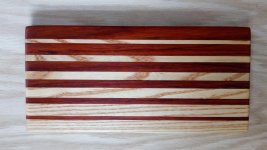
Who said anything about cutting down trees? Though I might use an occasional piece of firewood that looks cool, I do have a couple of pieces of figured red maple that just split out. Just a perspective on where the bandsaw comes in, and not fine stuftablesaw. The rocking brontosaurus can't be done on a tablesaw. The laminated backs and matching curves of the seat and foot rests of the chair are easier done on a bandsaw. The lamination of the future bicycle frame is better done on a bandsaw though you could waste time and wood on a tablesaw, cutting out the form for shaping and hollowing it does require a bandsaw. Even the cutting board couldn't be done with a tablesaw unless I wanted something 5/8 thick. Ash is easy to get in 5/4 while padauk is only available to me in 3/4. That meant cutting 1 1/8 strips that could then be resawn to width. Due to the thin bandsaw kerf both sides of each cut could be used.
Even working on the house, its faster and safer to rip a 2x4 on a bandsaw then a tablesaw.
If all that's being made is cabinets then get a much better tablesaw, if you want to do woodworking don't forget a bandsaw and learn how to use it. Like the guy over in woodworking 101 post who's cutting tenons on his bandsaw, something I've also found easier and faster to set up on a bandsaw
 

Attachments

  • IMG_20161216_174003.jpg
    IMG_20161216_174003.jpg
    145.8 KB · Views: 68
  • IMG_20161216_173941.jpg
    IMG_20161216_173941.jpg
    142.8 KB · Views: 67
  • IMG_20161211_130731.jpg
    IMG_20161211_130731.jpg
    143 KB · Views: 65
  • IMG_20161216_173846.jpg
    IMG_20161216_173846.jpg
    140.3 KB · Views: 67

ssdave

Banned
Joined
Apr 11, 2015
Messages
2,913
Location
Eastern Oregon
Derosa, now I see where you're coming from; you're thinking woodworking in terms of woodcraft, not in terms of what I thought the OP asked. He talked about doing house renovations.

I agree with you, if you want to do craft woodworking like toys and artistic furniture, cutting boards, etc, a bandsaw will be quite useful.

I disagree about using it more effectively working on the house. A tablesaw will easily and safely do many cuts that are difficult to do precisely on a bandsaw. The bandsaw is versatile in doing non-linear cuts, and the tablesaw is superb in doing straight cuts. Each have their strengths, and while a bandsaw can do both non-linear cuts and to some extent, straight cuts, it doesn't do straight cuts as well.

For doing craft woodworking, of course you will be seeking out higher value and more unusual woods. Both the bandsaw and the planer will be valuable there, as the wood may not be in the size you need, or may be available at lower cost in a different size that you can mill to what you need. There is usually very little call for unusual woods in the typical home renovation project. Most wood comes in the right shape and size from the lumberyard, and is simply processed for length and maybe width in the installation process. A miter saw and table saw does that quite handily. They also easily process the sheet goods that are commonly used in conjunction with the dimensional lumber. I feel that the straight cuts that can be made with a tablesaw and miter saw are vastly superior to similar cuts that can be made on a bandsaw for the purpose of house and cabinet work.

Again, I see your perspective, and it's valid for the the type of projects that you have illustrated that you do. It will be very different for someone doing only house renovations and maybe house and shop cabinetry.
 

ez-duzit

Well-known member
Joined
Jun 24, 2013
Messages
5,094
Location
Marina del Rey
In my shop the bandsaw is most often used for straight cuts. Because of this, my 20" is setup with a 1" wide carbide blade, which is especially good for re-sawing up to 12" thick. It cuts very fast and produces huge amounts of sawdust. It is an indispensable machine in a woodworking shop, as is a good table saw.

When tight curves are needed I virtually always do them with a saber saw, rather than change blades on the bandsaw.
 

Gizmosity

Well-known member
Joined
Jun 17, 2014
Messages
376
Location
SW Wisconsin
I've seen some gallery quality, stunning work done by folks with less than you already own in a single car garage.

It took me years and years to figure out 'how' I work and what works best for how I work.....and it changes. I've seen recommendations for stuff I quit using 20 years ago. Everybody works differently.

Just start. Start with what you have. Don't spend a dime. Make do and start making something.....anything. What you are missing to work 'how you work' becomes evident during the project using your methods.
 
OP
O

owdlvr

Well-known member
Joined
Oct 16, 2006
Messages
119
Location
Vancouver, BC
I've seen some gallery quality, stunning work done by folks with less than you already own in a single car garage.

It took me years and years to figure out 'how' I work and what works best for how I work.....and it changes. I've seen recommendations for stuff I quit using 20 years ago. Everybody works differently.

Just start. Start with what you have. Don't spend a dime. Make do and start making something.....anything. What you are missing to work 'how you work' becomes evident during the project using your methods.

You're not wrong, but replies that say just start with what I have are missing the part where I _have_ started, and I was frustrated by the work flow with the tools balanced on saw horses and plywood. Knowing my next step is to either build work benches like the PaulK with build in tools, or individual rolling carts for each tool is what prompted the thread. I suppose I could have kept it to just that question, but I expanded it to include the question of what a basic woodworking shop should have.

Either way, you're not wrong...just a few weeks behind me in terms of what I should do!

-Dave
 

jakemac

Well-known member
Joined
May 21, 2013
Messages
9,035
Location
New England
I'd go with individual carts with locking wheels/bases. Keep the working surfaces at the same hight as your workbench and you can use it as an out feed table for all the tools.

Mobil units will let you roll everything out of the way when you're doing paying work in the rest of the space.

Make storage space underneath and you will be able to keep all the accessories with each machine.

Remember, woodworking isn't the primary use of your shop, so it shouldn't take away space from your working areas. You only need these as temporary setups when working on wood projects.
 

bczygan

Well-known member
Joined
Nov 4, 2009
Messages
22,002
Location
DETROIT! Arsenal of Scrappers
For real woodworking the first tool is a big jointer and then a serious planer and then a HD vertical band saw, and of course a serious table saw. After that a router, shaper and various sanding machines.

Layout and glue up table with clamp rack and finishing room.

And the first thing you need upon entering is a place for stock to acclimate.

What is the building layout?

Bill
 
Last edited:
OP
O

owdlvr

Well-known member
Joined
Oct 16, 2006
Messages
119
Location
Vancouver, BC
What you describe is a mix of finish carpentry and fine woodworking.

Once you are finished upgrading and furnishing the house, what will you do?

Bill

Ha! There is no way I can think that far ahead. A year ago I was pretty sure I was going to be renting for the rest of my life, and yet here I am typing this off the couch in my own home. So, really, no idea.

For real woodworking the first tool is a big jointer and then a serious planer and then a HD vertical band saw, and of course a serious table saw. After that a router, shaper and various sanding machines.

Layout and glue up table with clamp rack and finishing room.

And the first thing you need upon entering is a place for stock to acclimate.

What is the building layout?

Bill

Building layout and plans are all in my triple-garage build thread, linked in my sig. As for the tool list, thanks for the list. I've already noticed that stock storage is going to be an issue...


------

Figured out this morning what height I want for workbenches, and started by building the plain workbench which will be going in my main shop. Now that I've done this one, I can start to wrap my head around integrating the mitre saw and/or table saw into the next bench, which will live in my smaller bay (and be used less frequently). Bought enough lumber to build both a second bench (with cabinet-grade top) and a mitre-saw folding stand if I choose to go that direction.

The every-day bench is built with 3/4" Factory (sanded one-side) plywood top, and 3/4" MDF shelf bottom. Considered boxing the bottom, but decided not to at this stage.

31714033865_aca591381a_z.jpg


30904184123_c03a164b31_z.jpg


31598410721_4a0785b932_z.jpg


-Dave
 

slodat

ALLIANCE MEMBER
Joined
Feb 6, 2010
Messages
3,679
Location
Central-ish, WA
My first big purchase, at the age of 12 or so, was a craftsman table saw. I was in wood shop in school and I fell in love. I've been playing with wood for the 30+ years since. In my opinion, a quality table saw is the center of a wood shop. I have a early 70's Unisaw that I went through after buying it with a Biesmeyer fence. I use it almost every time I touch a piece of wood. My thoughts, if you are playing with wood-whether that be home remodel/trim out, fine woodworking, trinkets or shop projects.. table saw, bandsaw, jointer, planer, Router table (I have six routers in tables), drill press... I say this because it's what I have and I wouldn't want to give up any of them.

On that note, for me the new tool in the shop presents new options and ways to do things. A new addition often influences design, etc. I put my fun money into my shop and enjoy my tools and machinery.

Last point.. I try to finish everything. My basic idea is to leave nothing in the raw. To the point, you've built the start of a nice bench.. have you thought about painting the rest?


Sent from my iPhone using Tapatalk
 

bj383ss

Well-known member
Joined
Sep 29, 2011
Messages
3,166
Location
TX
OW, you have received a lot of advice so I will just post my shop for you. 3 car garage with the single bay woodworking and the double bay for automotive. Maybe it will give you some ideas.

My dad has everything on mobile bases so he can put everything away into a small space so my mom can park her car at night. If he could leave everything stationary he would. As you said you need to find your workflow.

As far as tool advice I think you nailed it with buying tools as you need them for projects. And if you get serious I would buy the best you can if you plan to use it again in the future. If it is a one time thing Amazon and HF have plenty of one time use tools.

Single bay with woodworking.

20161208_195643 by bjohnson388, on Flickr

Automotive side and lumber storage plus miterbench.

20160606_191645 by bjohnson388, on Flickr

received_1324858424198027 by bjohnson388, on Flickr

Bret
 

derosa

Well-known member
Joined
Oct 19, 2010
Messages
1,078
Location
Oceanside, NY
That looked like construction adhesive on your bench top, in my experience that stuff doesn't squeeze down great and grabs too fast. Get some titebond 3, has a decent open time, impervious to weather and the board will break before the glue bond. Also tends to be on the cheaper side since the bottle will last at least 6 months after opening. Otherwise good looking bench
 
To avoid these ads, REGISTER NOW!
Top Bottom