
Hey everyone. I'm new here. I stumbled on the site when realizing how in over my head I think I got in on this field, at least it wasn't as complicated as I initially expected. I don't side track much, but I am working on building a track car, and have gotten to the point to where I wanto to do my own paint (big surprise to you all, I'm sure, that this turns out to be complicated on many facets.)
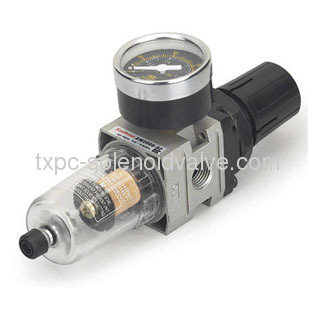
Anyways, I have a Craftsman Professional 27 Gallon Oiled Compressor I got on Black Friday last year in 2012. I messed with the tank outlet setup a bit to accomodate what I thought to be my needs at the time. I proceeded to buy a in-line filter/regulator from Northern Tool. I can't find a link to the exact item I bought, but the photo below shows what it looks like:
Up until now, I've just been running from the compressor, through the filter/regulator, through a 50' hose to my tool. I've got some Ingersoll Rand tool oil for my tools, but for the most part, I've just gotten around to using a cutting wheel and dye grinder, both of which were cheap from Harbor Freight. I try to stay away from HF for some things, but these were so cheap, I figured, why not...
So, now for my questions. I know, when running the dye grinder excessively, I eventually have to let it sit for the compressor to catch back up. Its at this time I get a nice spray of water come out of the tool. Other times, it feels like the tool freezes up. I add oil, but I think its too late and doesn't help.
My goal is to get dry air. I've actually read and learned quite a bit on this site (thanks!) but unfortunately, as with many things, I have some specific questions to ask.
1) Is my current setup with the filter straight out of the tank stopping the oil from getting into my current hose?
It rarely builds up with moisture worth draining, most of which is just visible condensation. I now realize that's due to me not allowing sufficient time/pipe length/volume expansion/pressure reduction to allow the water to condense and allow the filter to actually catch the water like the filter is designed to do. BUT, is it likely catching the oil?
2) Is my hose at this point not deemed worthy for using with a paint gun?
I bought some disposable air filters to use just before the gun, but I understand maybe that will create some volume issues? (I'll ask more about that later) But, would the filter have caught enough oil to not "contaminate" my hose?
3) If the filter didn't do squat, can I clean out my hose?
Can I run water/soap mixture through it? Anything able to be done here?
4) Can I even use these disposable filters? Is it good, cheap insurance or just a hinderance that will ruin my paint job?
I've read both. I was thinking maybe if I put a regulator after the disposable filter, but before my gun, leaving a little extra pressure to accomodate it might help? But I could also see this as a place to allow pressure drop and thus create more moisture?
5) I think I'm planning on piping in a (very) little system, and maybe use the $30 Harbor Freight desiccant filter, but I suppose I'll add photos and links for that later. But do I need much pipe length before the desiccant filter for it to work? Can I just use something like 10' or 15' of pipe, then hit the desiccant filter, then an outlet?
Will that be sufficient pipe length to allow enough cooling for condensation? Do I need a lot of cooling for the desiccant filter to work?
6) Should I leave a in-line filter to seperate the oil before the copper piping? or before the desiccant filter? or after the desiccant filter?
_________________________________
I'm sorry, I have a lot of questions. Thanks for anyone who reads this and responds.
Anyways, I have a Craftsman Professional 27 Gallon Oiled Compressor I got on Black Friday last year in 2012. I messed with the tank outlet setup a bit to accomodate what I thought to be my needs at the time. I proceeded to buy a in-line filter/regulator from Northern Tool. I can't find a link to the exact item I bought, but the photo below shows what it looks like:
Up until now, I've just been running from the compressor, through the filter/regulator, through a 50' hose to my tool. I've got some Ingersoll Rand tool oil for my tools, but for the most part, I've just gotten around to using a cutting wheel and dye grinder, both of which were cheap from Harbor Freight. I try to stay away from HF for some things, but these were so cheap, I figured, why not...
So, now for my questions. I know, when running the dye grinder excessively, I eventually have to let it sit for the compressor to catch back up. Its at this time I get a nice spray of water come out of the tool. Other times, it feels like the tool freezes up. I add oil, but I think its too late and doesn't help.
My goal is to get dry air. I've actually read and learned quite a bit on this site (thanks!) but unfortunately, as with many things, I have some specific questions to ask.
1) Is my current setup with the filter straight out of the tank stopping the oil from getting into my current hose?
It rarely builds up with moisture worth draining, most of which is just visible condensation. I now realize that's due to me not allowing sufficient time/pipe length/volume expansion/pressure reduction to allow the water to condense and allow the filter to actually catch the water like the filter is designed to do. BUT, is it likely catching the oil?
2) Is my hose at this point not deemed worthy for using with a paint gun?
I bought some disposable air filters to use just before the gun, but I understand maybe that will create some volume issues? (I'll ask more about that later) But, would the filter have caught enough oil to not "contaminate" my hose?
3) If the filter didn't do squat, can I clean out my hose?
Can I run water/soap mixture through it? Anything able to be done here?
4) Can I even use these disposable filters? Is it good, cheap insurance or just a hinderance that will ruin my paint job?
I've read both. I was thinking maybe if I put a regulator after the disposable filter, but before my gun, leaving a little extra pressure to accomodate it might help? But I could also see this as a place to allow pressure drop and thus create more moisture?
5) I think I'm planning on piping in a (very) little system, and maybe use the $30 Harbor Freight desiccant filter, but I suppose I'll add photos and links for that later. But do I need much pipe length before the desiccant filter for it to work? Can I just use something like 10' or 15' of pipe, then hit the desiccant filter, then an outlet?
Will that be sufficient pipe length to allow enough cooling for condensation? Do I need a lot of cooling for the desiccant filter to work?
6) Should I leave a in-line filter to seperate the oil before the copper piping? or before the desiccant filter? or after the desiccant filter?
_________________________________
I'm sorry, I have a lot of questions. Thanks for anyone who reads this and responds.
