To avoid these ads, REGISTER NOW!

Help: Notch sheathing for trusses before truss install?

PinkJohn

Member
Joined
Jan 17, 2019
Messages
19
Location
Milwaukee, WI
Hi everyone.
I'm just about finished with the framing of my garage and hope to get the trusses installed next weekend. I'd like to get the sheathing on before then. The trusses will arrive in a few days.

I need your advice. I'm going to install Simpson H10A hurricane/truss connectors on the outside of the wall before the sheathing (I'll be using a telehandler to lower the trusses in place.)

Should I cut a small notch in the sheathing (1/2 Plywood), right below the top plate so that it doesn't interfere with the truss tail? I couldn't find examples of this but it seems like the right thing to do. If the trusses are designed for a 28' wide, that doesn't include the thickness of the sheathing, so these notches seem appropriate, but I'm not quite sure....

I've attached a drawing to illustrate the idea/question.

Thanks much!

attachment.php
 

Attachments

  • SheathingTrussQuestion.jpg
    SheathingTrussQuestion.jpg
    20.6 KB · Views: 413
Last edited:
To avoid these ads, REGISTER NOW!

NUTTSGT

Super Moderator
Staff member
Joined
Sep 14, 2009
Messages
50,867
Location
Northern Central Ohio
For illustration purposes, the picture you have attached, looks more like a rafter design as there doesn't appear to be a bottom chord like a standard truss has.

Unless they interfere with the pressed in plates on the trusses, I'd install them on the inside.

If you choose to install them outside, how tall are your walls ? Can you leave one row of sheathing off at the top until after the Strong-Ties are installed ?
 
OP
P

PinkJohn

Member
Joined
Jan 17, 2019
Messages
19
Location
Milwaukee, WI
Sorry that I didn't include the bottom chord, this is what the trusses will actually look like:

attachment.php


It's 10' to the top of the double plate and I'm using 4 x 10 plywood.

I'll know Tuesday once the trusses arrive whether there will be any issue with the truss nailing plates.

Half of the trusses are room in attic, the other half are scissors.

Thanks for the reply!
 

Attachments

  • Screen Shot 2019-06-23 at 8.16.24 AM.jpg
    Screen Shot 2019-06-23 at 8.16.24 AM.jpg
    21.4 KB · Views: 418

PCustoms

Well-known member
Joined
Jul 23, 2011
Messages
22,388
Location
VT
Sorry that I didn't include the bottom chord, this is what the trusses will actually look like:

attachment.php


It's 10' to the top of the double plate and I'm using 4 x 10 plywood.

I'll know Tuesday once the trusses arrive whether there will be any issue with the truss nailing plates.

Half of the trusses are room in attic, the other half are scissors.

Thanks for the reply!

pretty sure you are going to want to run your sheathing horizontally, with staggered seams, for shear. So 2 rows 4' high, then rip sheets in half for the last 2'. Odds are the ply will but right up to the tails with maybe a small gap to the top olate, but siding will cover that. Never seen sheathing notched out.
 

NUTTSGT

Super Moderator
Staff member
Joined
Sep 14, 2009
Messages
50,867
Location
Northern Central Ohio
pretty sure you are going to want to run your sheathing horizontally, with staggered seams, for shear. So 2 rows 4' high, then rip sheets in half for the last 2'. Odds are the ply will but right up to the tails with maybe a small gap to the top plate, but siding will cover that. Never seen sheathing notched out.

That was my thought as well when I mentioned leaving a row of sheathing off.
 
OP
P

PinkJohn

Member
Joined
Jan 17, 2019
Messages
19
Location
Milwaukee, WI
Thanks. I'm probably overthinking it, I thought that the sheathing should go all the way up to the top of the top plate. Not sure how picky the inspector will be and trying to do things the 'right' way, though it seems that's always open to interpretation.
 

PCustoms

Well-known member
Joined
Jul 23, 2011
Messages
22,388
Location
VT
IMHO, Inspector will be more picky about the shearwall then how tight the sheathing is to the top plate (if he even sees that).

What is in your plans?

Also how are you finishing the tails? Are you just blocking them in, framing sofit etc.
 
OP
P

PinkJohn

Member
Joined
Jan 17, 2019
Messages
19
Location
Milwaukee, WI
I designed the garage and had it reviewed by an engineer, approved by the city for permit. A lot of work went into the sheer detail for the front wall but the side walls were OK'd with the 4 x 10 sheathing run vertical (no blocking required in that case).

I'll have a framed soffit so all of that detail up at the top plate will be out of sight anyway.
 

Kaizen

Well-known member
Joined
Jan 9, 2015
Messages
6,946
Location
New England
Guessing you were going to put the brackets on before the trusses for a more precise installation? Don’t. They will get crushed and those Simpson ones are knife sharp. Cut 2x spacers instead that exactly fit between the trusses and nail to top plate as you go. I nailed the same fasteners in the inside. It did overlap the nail plate but I was able to do it. Much easier on the inside. Make sure you use the right nails.
I’d also leave off the top row of sheathing in the walls so workers have something to hold on to that won’t be in the way of the flying truss


Sent from my iPhone using The Garage Journal mobile app
 

wrenchguy

Well-known member
Joined
Sep 22, 2011
Messages
4,697
Location
NW Indiana
All da trusses i seen bottom cord sits flat on the plate, there is no seat or plumb cut (birdsmouth). Depending on how close ur holding the span and the pitch of the roof hold ur plywood down 1/2" from top of plate. If this ain't enough field fixing is easy with a hammer.:shocking:
 
OP
P

PinkJohn

Member
Joined
Jan 17, 2019
Messages
19
Location
Milwaukee, WI
Guessing you were going to put the brackets on before the trusses.... I’d also leave off the top row of sheathing in the walls so workers have something to hold on to that won’t be in the way of the flying truss

Thanks Kaizen, all great things to consider! I'm just trying to do all that I can to prepare for setting the trusses and trying to make it easy for myself and my helpers.
 
To avoid these ads, REGISTER NOW!
OP
P

PinkJohn

Member
Joined
Jan 17, 2019
Messages
19
Location
Milwaukee, WI
All da trusses i seen bottom cord sits flat on the plate, there is no seat or plumb cut (birdsmouth). Depending on how close ur holding the span and the pitch of the roof hold ur plywood down 1/2" from top of plate. If this ain't enough field fixing is easy with a hammer.:shocking:

Thanks for the reply, good idea!
 

TRWham

Well-known member
Joined
Aug 11, 2017
Messages
1,957
Location
East Cobb County, Georgia
Thanks. I'm probably overthinking it, I thought that the sheathing should go all the way up to the top of the top plate. Not sure how picky the inspector will be and trying to do things the 'right' way, though it seems that's always open to interpretation.

The most common things I have seen inspectors focus on regarding sheathing are nailing pattern and full sheets at corners and openings. Do not start sheathing at one end and simply run to the other. Do the corners first with full sheets, then around any openings with full sheets, then fill in between. Some AHJs require a sheathing inspection prior to house wrap, so you might want to verify that before you go too far down the road.
 

Kaizen

Well-known member
Joined
Jan 9, 2015
Messages
6,946
Location
New England
Thanks Kaizen, all great things to consider! I'm just trying to do all that I can to prepare for setting the trusses and trying to make it easy for myself and my helpers.

recommend marking out where the 2x4 of the trusses should end up on the top plate. Also make sure you mark the trusses all at the same place from one end on the ground. Pick which wall is most straight and line these marks up on that wall. I did not do this and my roof sheathing was a little wavy as well as i had to trim the tails.
Make sure you are securing as you go. You already put 2x6 up on the end walls to place the end wall trusses against? Once you get those in the rest usually are less stressful.
 

matt_i

Well-known member
Joined
Mar 14, 2008
Messages
10,725
Location
SE Michigan
You probably should have had the trusses designed for 28' 1" wide, or an "energy heel" to keep the tails higher up. But at this point I'd notch or bevel the sheathing in those areas. Something like a microplane or a rasp or even an angle grinder with flap wheel should take care of it. Shouldn't take long but make sure your pattern is correct if you are doing this beforehand, as incremental errors can add up and the roof sheathing doesn't tolerate that.
 
Last edited:

TractorJeff

Well-known member
Joined
Dec 8, 2013
Messages
3,309
Location
Elkhorn, WI
Bottom plate at 1.5", Studs at (?), Two top plates at 1.5" each. This adds 4.5" unless you are cutting Studs to length?
 

jbwilkins

Well-known member
Joined
Mar 16, 2016
Messages
310
Location
Nashville Tn
Typically a 8' wall is actually 8'1" when you use a single bottom and double top plate (hence why 'dry' studs are 92 5/8") ....

The sheathing should be held up 1/2 inch from the slab and will overlap the top plate by 1/2 inch providing a continuous connection .....If you have a horizontal seam, per code, it should be fully blocked and nailed....The sheathing has to be 'continuous' to provide the full shear value. A lot of inspectors won't say a thing if you have horizontal seams that aren't blocked however....
 

TRWham

Well-known member
Joined
Aug 11, 2017
Messages
1,957
Location
East Cobb County, Georgia
Yes, I have had an inspector call out blocking to support edges where sheets **** together on taller walls. You may have that condition and will need to know whether it's an issue in your area or not. We work with about 10 AHJs across metro Atlanta (Cobb County and City of Marietta most often) and there are subtle differences as to what their hot buttons are.
 

thammel

Well-known member
Joined
Oct 3, 2005
Messages
2,239
Location
Maryland
Suggestion as an alternative to hurricane ties. Look up the use of 6" long timberlock screws as an alternative and great way of locking the trusses in place. You drive them from the inside at an angle through the top of each stud into the truss. Much easier and faster and simpler. And I believe this is an approved method. I did this on my shed and it was really easy to do.

Good luck!
Tom
 
OP
P

PinkJohn

Member
Joined
Jan 17, 2019
Messages
19
Location
Milwaukee, WI
Thanks everyone for all of the feedback. I've been scrambling and working as hard as I can to get things ready, I'm almost at the sheathing stage.
Finishing what I needed to on the front wall of the garage took a lot longer than expected, and I'm hoping I can get to the sheathing today so I can get the trusses up tomorrow.

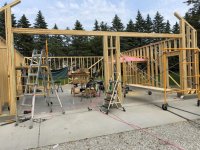
I have internal diagonal wall bracing in place, if I can't get all of the sheathing up first would I still be OK or should I really make sure I have all the sheathing up before placing the trusses?

Thanks.

I've attached a pic. The front wall is only partially constructed, but it's all I need at the moment. The double top plates of the front wall are dropped for 2x6 outlookers to connect to the first scissors truss. This was an engineered solution for high wind load and getting that 4-ply beam up there was a real pain, but everything has been perfectly squared, leveled and plumb and I'm really happy with how it's going for only 10 days so far and just myself working on it.

IMG_2001.jpg
 
To avoid these ads, REGISTER NOW!
Top Bottom