To avoid these ads, REGISTER NOW!

Help Request on Installing Duplex Outlets into Workbench

apittmanii

Well-known member
Joined
Dec 28, 2015
Messages
110
Good evening,

I would like to have easy access to electrical outlets on this ULine table: http://www.uline.com/Product/Detail/H-2484-LAM/Packing-Tables/Packing-Table-96-x-30-Laminate-Top

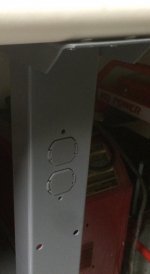
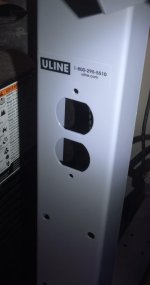
As depicted in the first two attached photos, the table includes pre-cut 120-volt duplex outlet holes on every steel leg (three spots for duplex installation total). I would like to fill each of the slots with a duplex outlet and have the source power in the form of a standard three-prong plug. In other words, I would like to plug the table in to a wall outlet and have it power each of the outlets on the table legs. Basically the same concept as a power strip. Usage will be well within the 20 amp receptacle it is plugged in to.

I have several questions about this installation:

1. Can you confirm a receptacle box is necessary for each of the installed duplex outlets? I assume I need to install these to protect the outlets, but the space seems very tight and there are no holes to mount the receptacle box to inside of the legs.

2. If a receptacle box is in fact needed, does it need to be independently attached to the steel legs, or can the two pre-drilled duplex outlet holes depicted in the first photos hold the weight of the outlet as well as receptacle box?

3. Will 12/2 flexible metal conduit cable (“BX”) work as the wiring between each of the outlets, and also as the wire leading to the 120 volt power source plug? Is there any advantage in using Romex rather than the metal conduit cable?

4. The legs of the table are steel. Is it necessary to ground each of the table legs at every outlet location?

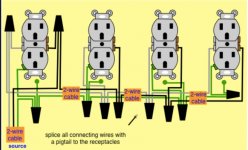
5. Is the wiring diagram depicted in the 3rd photo appropriate for the above application?

6. Any other concerns, cautions or recommendations for this project?

I realize I can purchase a pre-assembled stand alone power strip, but would like to use the existing outlet holes if possible.

Thank you for your help.
 

Attachments

  • FullSizeRender.jpg
    FullSizeRender.jpg
    126.3 KB · Views: 113
  • FullSizeRender_1.jpg
    FullSizeRender_1.jpg
    137.5 KB · Views: 96
  • wiring diagram_JPEG.jpg
    wiring diagram_JPEG.jpg
    92.9 KB · Views: 122
To avoid these ads, REGISTER NOW!

mikegt4

Well-known member
Joined
Sep 12, 2005
Messages
3,277
Location
sw ohio
We had several work benches with that kind of receptacle. I have been retired for several years so I can't look at them but they had metal boxes behind the leg.
What does your bench manufacture recommend?
 

matt_i

Well-known member
Joined
Mar 14, 2008
Messages
10,741
Location
SE Michigan
I would put a Plugmold, more convenient outlets, you only need one J box, no hacking off BX or buying its fittings. Just have to put a wood strip to mount it to.

https://www.legrand.us/wiremold/at-...r-strips/pm-plugmold-multi-outlet-strips.aspx

Could even be the treadplate version
https://www.legrand.us/wiremold/at-...trips/pm48tc-plugmold-tough-power-strips.aspx

I would run a #12/3 SO cord (like General Cable Carolprene or the like) to wherever its going to hookup to (maybe a wall mounted outlet)...note you can't just plug a 20A load into every single outlet on the strip :D Its not "free power".
 
Last edited:

nadogail

Well-known member
Joined
Jan 23, 2009
Messages
32,032
Location
Coronado, CA
I too would use 12/3 SO cord. In a home garage workshop with the outlets covered on three sides by the steel table legs I would question the practical necessity of a box around the receptacle. There may be Code or OSHA considerations that I am unaware of.

I think I would wrap the sides of the connected receptacles with Scotch 33+ if I thought someone might be crawling around under the bench.

Consider some kind of strain relief for the SO cord, even cable ties to the bench frame might be enough, just someone forgets to unplug the cable before moving the bench.
 
OP
A

apittmanii

Well-known member
Joined
Dec 28, 2015
Messages
110
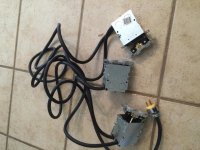
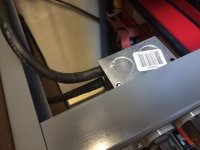
Thanks everyone for your help. I wanted to play it safe, so used handy boxes as suggested. They fit without any problems. Good call on using deep ones. The boxes included pre-installed wire clamps to secure the SO cables running into them. This made life much easier because there were not additional fittings.

I used the SO cord as suggested. Far easier than the “BX” flexible metal conduit cable, and even Romex. I secured using large “U” shaped wire staples under the table. Installed an armored 120 volt outlet. Overall the cost was $50, but I opted for the more expensive 20 amp duplex outlets and I wanted to get it done quick, so purchased everything at a big box store. If I shopped online for the best prices and used cheaper outlets and handy boxes, the total cost would have been around $35.

Attached photos show the fit of the boxes and outlets. Looking forward to having more than one outlet location in my garage!
 

Attachments

  • IMG_5999.jpg
    IMG_5999.jpg
    139.3 KB · Views: 131
  • IMG_6001.jpg
    IMG_6001.jpg
    139.1 KB · Views: 109
  • IMG_6002.jpg
    IMG_6002.jpg
    108.7 KB · Views: 105
  • IMG_6004.jpg
    IMG_6004.jpg
    141.8 KB · Views: 110
  • FullSizeRender.jpg
    FullSizeRender.jpg
    129.9 KB · Views: 98

CJ7VFR

Well-known member
Joined
Jan 13, 2015
Messages
2,941
Location
Central New Jersey
Is the male plug you are using on your SO cord made for 15 amp circuits? It looks like it is.

Be careful, and don't plug in any 20 amp devices into your new workbench 20 amp receptacles because you can overload the circuit you plug the SO cord into if it is a 15 amp circuit and not at 20 amp circuit.

Jim
 
Last edited:
To avoid these ads, REGISTER NOW!
OP
A

apittmanii

Well-known member
Joined
Dec 28, 2015
Messages
110
You are right, the yellow armored plug is good for 15 amps, not 20.

The SO cord is this one: http://www.lowes.com/pd_56592-295-55808745_0__ , the Lowes website and Soutwire specifications both say it's good up to 25 amps.

The outlets I installed on the workbench are good for 20 AMPS, the circuit breaker is 20 AMPS, and the wall receptacle I'm plugging the workbench into is 20 AMPs.

So I need to replace that 15 amp armored plug for a 20 amp plug. Thanks for catching that.
 
Last edited:

nadogail

Well-known member
Joined
Jan 23, 2009
Messages
32,032
Location
Coronado, CA
What is ampere rating of the overcurrent protection device, commonly known as a fuse or circuit breaker, that serves the receptacle the bench will be plugged into?

If it is 15 amps, IMHO, there is nothing to be gained by changing the plug to an expensive 20.
 

CJ7VFR

Well-known member
Joined
Jan 13, 2015
Messages
2,941
Location
Central New Jersey
What is ampere rating of the overcurrent protection device, commonly known as a fuse or circuit breaker, that serves the receptacle the bench will be plugged into?

If it is 15 amps, IMHO, there is nothing to be gained by changing the plug to an expensive 20.

I agree. To an extent. That is if he is the one doing it, and not a family member or someone else coming along and thinking they can plug in a 20 amp device into his bench, only to find out you now have a problem because the 20 amp receptacles were actually attached to a 15 amp circuit breaker.

Also, if the receptacle he is going to put that 15 amp male plug into is on a 20 amp circuit, and the male plug doesn't have a 20 amp pass thru, then if he attaches a 20 amp device to one of those 20 amp receptacles he put on the bench it could cause a problem at the 15 amp male plug.

As you said, if all he wanted was 15 amps, then he could have saved money and bought 15 amp receptacles and 14 gage wire to put the receptacles on his bench. Then it wouldn't matter what size circuit breaker he was connecting into in his panel, 20 amp or 15 amp.

But he did not. He bought 20 amp receptacles, 12 gage wire, and everything else to be able to run 20 amp devices at his bench from a 20 amp circuit breaker in his panel.

So changing the male plug to a 20 amp version seems like the smart thing to do to keep everything safe.

Jim
 
Last edited:

1991Syclone

Well-known member
Joined
Jul 19, 2007
Messages
278
Location
Englewood, FL
Kind of an off topic question, but why do all the 20 amp plugs have the sideways prong on them? To ensure you don't plug it into a 15 amp outlet?
 

CJ7VFR

Well-known member
Joined
Jan 13, 2015
Messages
2,941
Location
Central New Jersey
Kind of an off topic question, but why do all the 20 amp plugs have the sideways prong on them? To ensure you don't plug it into a 15 amp outlet?

Yes! That is why. You can only plug a 20 amp device into a 20 amp receptacle. It's for safety.

You can however plug a 15 amp device into a 20 amp receptacle.

Jim
 

Norcal

Well-known member
Joined
Mar 16, 2008
Messages
13,769
As much as I hate handy boxes they would be the best choice.
 

texasranger

Well-known member
Joined
Dec 29, 2011
Messages
223
Location
Maryland
You are right, the yellow armored plug is good for 15 amps, not 20.

The SO cord is this one: http://www.lowes.com/pd_56592-295-55808745_0__ , the Lowes website and Soutwire specifications both say it's good up to 25 amps.

The outlets I installed on the workbench are good for 20 AMPS, the circuit breaker is 20 AMPS, and the wall receptacle I'm plugging the workbench into is 20 AMPs.

So I need to replace that 15 amp armored plug for a 20 amp plug. Thanks for catching that.
Thanks for posting this, I have very similar tables I found cheap on CL and was debating how best to install the outlets in the legs!
 
To avoid these ads, REGISTER NOW!
Top Bottom