To avoid these ads, REGISTER NOW!

Help: vintage drill press quill spring repair

jjj240

Member
Joined
Oct 29, 2018
Messages
19
Location
CA
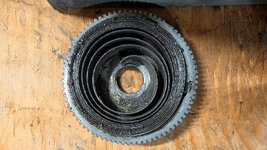
I am restoring two drill presses- both quill springs are broken.

1) Walker-Turner 900- needs to drill two holes (kinda snowman shape, so the spring end get hooked on the feed pinion end pin), but the spring seems very hard metal and failed to even make scratches using drill press (tried HSS metal bit, ceramic tile bits). I need advice How to drill those holes on the spring end?

2) Delta 14" drill press- need to bend the spring end, so it can get hooked on the slot of the pinion shaft end. I was thinking about heating the spring end area to bend, but I don't want to heat up the entire spring. I need advice how to bend the spring end?

Both quill spring photos attached for reference.
 

Attachments

  • 1-Quill Spr- W-T .jpg
    1-Quill Spr- W-T .jpg
    906.8 KB · Views: 13
  • 2-Quill Spr- Delta.jpg
    2-Quill Spr- Delta.jpg
    966.3 KB · Views: 13
To avoid these ads, REGISTER NOW!

OccupantRJ

Well-known member
Joined
May 15, 2009
Messages
11,196
Location
Eastern North Carolina
Heat only the tip of the spring you want to bend.
Heat the end only of the spring you need to drill red and let it cool by itself. This will anneal the metal to allow it to be more readily drilled. I have done both these things on both my own Walker Turner 900 along with other Delta drill presses at work to get them back in action.
 

OccupantRJ

Well-known member
Joined
May 15, 2009
Messages
11,196
Location
Eastern North Carolina
A properly sharpened masonry drill in the correct geometry will drill harder metals. They actually work pretty well because the steel shanks do not break as easily as solid carbide drills. There are also carbide tipped drills readily available from machining suppliers.
 

seagiant

Well-known member
Joined
Sep 16, 2011
Messages
305
Hi,
Just take 2 pair of needle nose pliers and bend a 90, on the spring end so it will go into the slot.

Remember to wind it CCW so the quill works right!

Don't ask how I know this!

Not that hard, you are over thinking it...
 

RTM

Well-known member
Joined
May 13, 2019
Messages
13,222
Location
SF Bay Area
I’ve heard you can run a drill bit in reverse to ”spot” heat up the metal prior to drilling. Any credence to that theory?

Also, have a saw blade punch, and a Roper Whitney #5Jr. Are either of those suitable for this task? Never done spring steel before.
 
To avoid these ads, REGISTER NOW!

RoninB4

Well-known member
Joined
Jul 22, 2020
Messages
3,597
Location
Under My House
-Annealing the spot for drilling would be best, in the procedure already suggested. Would also suggest a slight rounding of the hole edges to reduce the chance of crack propagation. The repeated stress from winding/unwinding of springs like these are why so many of them break off at the stress point. There's not much that can be easily done about that, metal will fatigue after repeated stress cycles and fracture. Anneal, bend/drill is about all one can do for a simple repair.

If using carbide or carbide tipped drills I'd recommend using a solid back-up plate, preferably of metal. As the drill point starts to break through the other side there's a tendency for the drill to "grab" or dig into the material. Carbide doesn't like things like that and the shock loading may cause the tip to chip/shatter. A backup plate lessens the chance of that happening. This also happens with HSS drills but HSS is tougher than carbide and more tolerant of "break through". A backup plate/block is best whenever drilling.

Running a drill in reverse to "spot" heat is possible, I've observed this even when running the cutter in the forward direction. However, if you've used enough friction to heat up the material to red hot then you've also ruined the HSS drill. Using a carbide tipped drill will resist the red heat but also runs the risk of heating up the solder that holds the carbide to the steel, the tip will either launch or get buried into the material. If I had no other means to anneal the material I might try that out of desperation. Running in reverse can also cause material, like SS, to work harden through rubbing instead of cutting. I regard all of this as an absolute last resort.

A saw blade punch/hand perforator may or may not be able to knock a hole in the material, it depends upon the material thickness and how much grip you have. Spring steel is often perforated in stamping dies that go into a multi-ton press. For material thickness of .010-.015 it's probably no big deal for a hand held hole popper, for material thickness greater than that I wouldn't bet on it being pleasant if the punch and die aren't sharp. I can tell you that just by the sound it makes at snap through on .030-.040 material thickness that it doesn't like it.
 
OP
J

jjj240

Member
Joined
Oct 29, 2018
Messages
19
Location
CA
Thanks for everyone responded. I will try spot Annealing first. I have a heat gun. Would it be enough? If so, Can i use a nozzle to apply spot heating? Or should I get gas torch? Or any other suggestions?
 

Provincial

Well-known member
Joined
Sep 21, 2011
Messages
6,872
Location
Near Salem, OR
Find someone with a oxy-acetylene torch an a small welding tip. You want to heat the area you are going to bend or drill red hot and let it cool slowly. You don't want to let the red area expand very far beyond were you will be working. Anyone with torch welding experience will understand what you need and it will take only a few seconds, once the torch is set up and burning.
 

RoninB4

Well-known member
Joined
Jul 22, 2020
Messages
3,597
Location
Under My House
I have a heat gun. Would it be enough?
-You should look up what annealing temperatures for steel are so you're better informed. A consumer grade heat gun is not nearly enough.
Or should I get gas torch?
-Do some homework so you know what to use. Not trying to be a jerk, just trying to get you better informed about this.
Or any other suggestions?
-What Provincial posted is good advice. You need to have the annealed area planned in layout and avoid heating the surrounding area as that alters the temper/spring-back you want to retain. Use of heatsinks (research this) will bleed off excess area heat but it will be somewhat of a trial and error procedure that will depend on how much heat you're applying to a given area and how much heat will be bled off by the heat sinks. It's not difficult, when the designated area isn't getting hot enough then move the heatsinks out a bit until you get the red zone. Post results.
 
To avoid these ads, REGISTER NOW!
Top Bottom