To avoid these ads, REGISTER NOW!

Help wiring compressor

To avoid these ads, REGISTER NOW!

CoopVA

Well-known member
Joined
Jan 20, 2014
Messages
2,144
Location
Virginia
That will work also. All this switch is doing is disabling the circuit at the piece of equipment. As long as the switch is HP rated at or above the motor, you're good to go.

Yes, it has the pull out disconnect.

If the air compressor has a switch integral to the unit, you do not need anything more than that...
 

sberry

Banned
Joined
Jun 18, 2005
Messages
35,747
Location
Brethren, Michigan
I don't think it is a switch??? Home Depot s description says it is but I believe it is simply a disconnect. GE for 8$ too. Its a glorified range plug,,, hahahaha Ruins a good piece of wire with another splice.
 
Last edited:

pattenp

Well-known member
Joined
Jun 4, 2008
Messages
10,175
Location
Virginia - USA
It is a switch. The listed part is a QO200, NON-AUTOMATIC MINIATURE SWITCH 240V 60A.

I don't think it is a switch??? Home Depot s description says it is but I believe it is simply a disconnect. GE for 8$ too. Its a glorified range plug,,, hahahaha Ruins a good piece of wire with another splice.
 

MrMark

Well-known member
Joined
Jan 25, 2010
Messages
4,626
Location
Southern Cal.
Thanks Pattenp, looks like the same one I linked above that Grainger sells for 42 but with not quite as nice a cover.
 

MixManSC

Well-known member
Joined
Jan 6, 2014
Messages
154
Location
South Carolina
I did not read the whole thread to see if it was mentioned.... another thing I recently added to the compressor install at my graphics shop is a contactor inline right before the disconnect beside the compressor. I added another metal box for the contactor - the contactor itself is a 3 pole with a 120v coil. I tied a wire into the nearest ceiling light fixture and ran it to the contactor. Reasoning, one of us inevitably forgets to kill the power and shut the valve off at the compressor before we leave. As much as I am vigilant I have forgotten myself more than once and am terrified that it might be on over a weekend and one of the soft air lines will pop and the compressor will run continuously until it catches on fire. We always remember to cut the lights off on the way out of the shop though. This way if the lights are off, power is cut to the compressor no matter what. :)
 

sberry

Banned
Joined
Jun 18, 2005
Messages
35,747
Location
Brethren, Michigan
I would be awful nervous of standing there jamming a plug in with a 10hp load. A switch to do 10 hp and 60a rated would be 200$ that thing is a pos, they burn up all the time.

Famous for being installed in drip lines from the eve side of a tavern.

A 2 pole switch that fits a handi box cost 6 or 8 dollars and rated to a hp, this thing aint nothing but a manual range plug, no lever. Does it actually list this on the device label, I don't have a new one in a box here.
 
Last edited:

2ManyProjects

Well-known member
Joined
Jul 18, 2013
Messages
757
[SIDE NOTE: First, my apologies for both the tardiness and the length of this post (which will necessarily be broken into several segments). I've been down with the flu (or something like it) for about a week and a half, then the Forum software took a dump, and I'm just now starting to get back into things. So there is quite a lot to catch up with...]

^^I don't know what you pointed to but electricity is electricity. Theoretically, you can have a motor that pulls 100A (@ 2% efficiency) and produce 5hp and you can have a motor that pulls 20A (@80% efficiency) and produce the same 5HP.

Basically true, but irrelevant.

I'm not disputing if there's HP value to plugs or not. As a matter of fact, each motor is designed slight differently with loading characteristic (amp, torque, etc...). Again, you can have one 5HP that pulls different amp base on its efficiency rating. Therefore "HP" rating is not the true value for termination and wiring requirement. It just so happen that motors have an HP value, and people use the term "HP" for ease of conversation/understanding.

You're missing it.

The question is NOT what the "theoretical" horsepower of any given motor might be relative to its current draw. THE issue is that, for the purpose of sizing supply wiring, the NEC REQUIRES us to ignore the marked motor amps, and use the FLC shown in the appropriate table (430.248 in this case), apply a 125% "fudge factor", then size the conductors accordingly. For a 5HP single-phase motor. that works out to a 35A minimum wire rating.


Wow tons of information given. Mind blown. Info overload. My intention is to wire a branch circuit off of the sub panel already located in the garage. When this panel was installed, it was done so for light duty use with only 50 amp service. I know I am limited with that, but I don't care to run another 100ft 100 amp service since this isn't my permanent place of living.

Fair enough, as long as you are really willing to live with the limitations that will impose.

I was hoping to be able to wire a single plug that I could use for either compressor or welder. Not both simultaneously. However, it seems based on the discussion here that safety wise as well as cost, hard wiring the compressor would be the best bet.

No question about it.

I can continue to run my welder off 110v, as I don't do any real heavy gauge welding at home that can't be done multi-pass.

Your call. But as long as you're going to all this trouble, why not "un-cripple" the welder while you're at it?

As for supplies...35 amp breaker for code even though motor states 22 amps?

Yes. At minimum. Personally, I'd probably go with a 40A breaker, presuming everything else about the installation was absolutely up to snuff. (Yes, that would be "legal" in this application.)

And I happen to have about 50-60' of 10/3 that was given to me by a friend off a construction site that they left behind. How do I know if the wire is adequate?

It's not.

First, it's Type UF-B, which for your purposes is equivalent to Type NM-B. As such, its maximum ampacity MUST be based on the 60-deg. C. column in the appropriate NEC chart, which yields only 30A.

Second, you have no need for a Neutral in this application.

As several folks have by now told you, the CORRECT wire for your compressor is EITHER AWG 8-2 w/g NM-B, OR separate runs of single-conductor (and properly color-coded) AWG 10 THHN; the latter must be run completely within conduit.


^welcome to GJ. You'll find different minded people with different background; some will act like robot and give you answer what they heard and some will provide you a direct answer.

And which do you claim to be?

That ROMEX wire #10AWG is proper for your Century 5HP motor.

First, it's NOT "Romex" (which is a brand name); it is Type UF-B.

Second, as explained above, it is NOT "proper" for a 5HP motor load. Period. Please stop posting misinformation.


[The BBS software is nattering at me that the message is too long. So I'm breaking it here. Continued in next message...]


2ManyProjects

Well-known member
Joined
Jul 18, 2013
Messages
757
[...Continued from previous message.]

I appreciate all the responses. Better to have multiple points of view anyway.

Only if those various "multiple points of view" are at least putatively correct. SOME of the ones you have been getting are FAR from that.

By chance, would that Romex also be adequate for my welder in the future?

Maybe. Welders are a special case; and there are special rules which can be applied to dedicated welder circuits (note that "dedicated" is the key word in this statement). As an initial starting point: Will 30A @ 240V be adequate to supply your (future) welder?

Alright, so many conflicting opinions here.

Simple question. Is the wire I have adequate for running the compressor?

Depends on your definition of "adequate".

Will it work? Probably; tho' it might make the the motor's life somewhat more difficult (hence, shorter) than it needs to be.

Is it code-legal? ABSOLUTELY NOT!

Or do I need to run #8?

As noted above, to be code-legal, you need to use (at minimum) either AWG 8 NM-B, or AWG 10 THHN.

The plate on the motor says 22 amps, but I don't know if that is running amps, startup surge, etc. Nor can I find out searching online. To me, if #10 is rated for 30 amps, then a 30 amp breaker with my #10 wire would be fine. But I have next to no idea what I am talking about so I could be entirely wrong.

Your logic is fine; but it's based on incomplete (and therefore misleading) information, compounded by a few too many sweeping generalizations.

The key point is, as noted above, the marked FLA on that motor plate DOES NOT MATTER. The NEC demands that it be ignored, and the appropriate table (430.248 in this case) be used to determine the nominal FLC. The supply wire must then be sized based on 125% of that value, at minimum. This may seem arbitrary and confusing; but there ARE good reasons behind it (primarily, but not exclusively, having to do with the highly inductive nature of motors, and the current surges they routinely produce during start-up cycles).

Second question - Is the wire I have adequate for running my Miller 211? According to the manual at 230v it is going to pull 25 amps max.

Without digging up the specs for myself to see if there are any lurking "gotcha"s, I'd say very probably yes. But remember what I said about there being special rules for dedicated welder circuits.

Seems I was replying as you were typing. I will be hard wiring it that is settled.

Good.

Now I'm just trying to figure out what I need to pick up to do so. I'm not saying you are wrong, but I am curious why it says 22 amps on the name plate if a 5hp compressor requires 35?

See above. It's all about the requirement to use the tables, not the numbers on the data plate.


[The BBS software is nattering at me that the message is too long. So I'm breaking it here. Continued in next message...]


2ManyProjects

Well-known member
Joined
Jul 18, 2013
Messages
757
[...Continued from previous message.]

Sorry for all of the antics. Let's get back to productivity on this subject.

if the Full Load Amp rating is 22A, then a 30A capacity wire will be proper

NO, it won't be. See above. The marked FLA is COMPLETELY IRRELEVANT.

(120% is right under 30A).

The CORRECT factor is 125%. And it needs to be applied to the TABLE value for FLC, NOT the FLA marked on the motor plate.

I say again: PLEASE stop spreading misinformation!

The proper breaker for the #10 wire is 30A or less. Note that circuit breaker or any fuses is intended to primarily protect the wiring, not the equipment.

In and of itself, this statement is correct. The problem is that, per code, 30A-rated wiring is NOT adequate to supply a 5HP single-phase motor.

This is very silly! It's even sillier when y'all say I'm wrong, you don't dare to reference the code.

Code has been referenced several times. And yes, YOU ARE WRONG.

Who are the GJ experts that explain to y'all of this? When reading codes, it's important to NOT take it as face-value but analyze it and then interpret it. It happens all the time in my work line.

For the sake of your employer, hopefully not by you.

AGAIN, I'm not disputing the power (HP) value that one motor make when it comes to wire sizing. #10 wire size may not work for other 5HP based on specific motor design. I'm sure NEC will provide some general current value based a "typical" 5HP motor design but that's general - that's code guys, it's conservative! If I was to provide a turn-key installation for any 5HP motor out there to run on the feed line, I would size it up to #8. Again, this is not a job, it's for his specific motor he provided.

That's not a valid excuse to ignore code.

Like I said before, HP is relative (NOT DIRECT) to FLA, and I highly doubt NEC will advise using "HP" to size wire w/o specifing a general statement regarding the NEMA design characteristic (torque, speed, etc...) of modern AC motor.

Obviously, you've never read the relevant section(s) of the NEC.

One More Time: The marked (on the motor plate) FLA simply DOES NOT MATTER.

Not all motor will have the "normal speed" of 1700rpm or 3400rpm; it's all different from brand to brand. Also, not all motor ppl use are NEMA design specs!!!

Again, mostly true; but COMPLETELY IRRELEVANT.

Go ahead and quote what NEC says about HP and wire size. Like all codes, it will state very general but enough for accurate interpretation.

It's not "general" at all. The code states that the resulting FLC figure, based on the motor's nominal HP rating in the appropriate table, MUST be used. Period. It further states that the supply wiring must be upsized to 125% of that value. None if this is ambiguous or "approximate" or "in general", or in any other way subject to evasion.


FYI:

After speaking with my electrician, he suggested pulling 10-3 for a compressor and 8-3 for a welder. He did suggest keeping the 8-3 run as short as possible.
A purchase of either is not imminent, heck, maybe not ever. But maybe the next guy who lives in my house will want them? With the walls open, it's much easier for me to do it now and 'future proof' it the best I can.

First, if you are bound and determined to "pre-wire" for equipment you have no current plans to purchase (and therefore cannot accurately predict the electrical requirements which will actually be in play), the ONLY prudent path is to generously oversize EVERYTHING, so as to minimize the chance of an unpleasant surprise later on. Your electrician's "suggested" wire sizes don't come close to that.

Second, "10-3" (which implies Type NM-B) would NOT be adequate for more than a relatively modest compressor, and the "-3" part is inappropriate in any case.

Similarly, "8-3" (which again implies Type NM-B) is not appropriate for a dedicated welder circuit. The correct sizing depends on the specific welder in question (which puts us right back into "cart before horse" territory); but the larger point is, neither of these devices has any possible use for a Neutral -- so using wire which includes such effectively constitutes a big neon sign flashing in six-foot letters: HACK WORK!!!"


[The BBS software is nattering at me that the message is too long. So I'm breaking it here. Continued in next message...]


Trey T

Well-known member
Joined
Aug 3, 2011
Messages
3,749
Location
Houston, TX
^So what did the OP do? Did he do based on everybody's recommendation or someone else offline?

If you really want to go into code, then NEC allows two methods of sizing wires based on service duty (not motor rated duty):

1)Table 430.148 (NEC 2011)
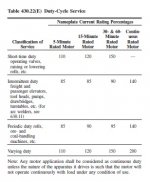
2)article 430.22 (E)

I suggest you and everyone read both.
 

2ManyProjects

Well-known member
Joined
Jul 18, 2013
Messages
757
[...Continued from previous message.]

In case interested, this article provides the cites that you must use the NEC table values to determine ampacity of motor circuits based on HP ratings.

Good reference! So good, in fact, that I'm going to quote a couple of key passages, which directly address the points some here (<cough>"Trey T"<cough>) are repeatedly tripping over:

Section 430-6(a)(1) requires the use of Tables 430-147 through 430-150, based upon the motor horsepower rating, for determining the ampacity of circuit conductors and for sizing any switches or branch-circuit short-circuit and ground-fault devices for the circuit. The current rating marked on the motor nameplate is only used for sizing of overloads for the circuit and if the motor nameplate ampacity is larger than the table values given.

If a single motor is being installed for a continuous duty application, Section 430-22 requires the branch-circuit conductors to have an ampacity of not less than 125 percent of the motor’s full load current rating based upon Tables 430-147 through 430-150.

The tables give FLC (full load current) based on nameplate horsepower. This table value FLC must then by multiplied by 1.25 to arrive at the required minimum wire ampacity.

Exactly correct.

The FLA (full load amps) listed, here 22, is used only for the overload (thermal protection on the motor itself).

Presuming said motor HAS such thermal/overload protection, yes.


That's not entirely true

You are absolutely correct he has to use the 60 C deg column as UL and the NEC only require equipment 100 amps and above to be designed 70 C deg. Unless otherwise stated on the device you must assume it is 60 C deg

But as for Hp rates - No

The NEC is Very specific allowing you to wire dedicated circuit based off the Manufactures FLA/Current rating.

430-6 (a)(1) Exception 3 - Period End of Subject

Are you still trying to flog that gross misinterpretation?

As we have discussed before, that "exception" applies ONLY when it is the "appliance" data plate which carries the HP and FLA ratings (a handy example might be the outdoor compressor/condenser unit for a central air-conditioning system), NOT the data plate for the motor itself. The language within the exception itself makes this perfectly clear.

Since you've been aware for at least a week that the "exception" does NOT apply in the case of MOTOR data plates, one wonders why you are apparently now deliberately posting misinformation.

Not to even take in account for motor efficiency but the motor design load has been sufficiently demonstrated to the Underwriter Laboratory to draw the rated amount of current.

What does this have to do with anything, in the context of NEC motor-load wiring requirements?

No where in the NEC are you required to wire to what you suspect the motor MIGHT be changed out to

TTBOMK, no one has claimed otherwise. It HAS been mentioned ("speculated", perhaps?) that one of the (probably secondary) reasons behind the NEC-mandated wire-sizing methods for motor loads is to accommodate possible future repairs/replacements. But that is not at all the same thing as claiming that an installer is required to have a crystal ball.


Moreover, it is MOST unclear that exception you refer to applies here. That the exception states specifically that it is for nameplates on the APPLIANCE, not the motor.

Exactly.

The very following section of the NEC, Section 430.6(A)(2), states, "Nameplate Values. Separate Motor Overload protection shall be based on the motor nameplate current rating."

The commentary that follows states:

"[the] ampacity of motor branch circuit conductors . . . are determined by the ampere values listed in Tables 430.247 through 430.250, not the ampere values listed on the motor nameplate. The ampere rating provided on the motor nameplate is used to size the overload protective devices . . . ."

Thus, we have a pretty nice explanation of what the motor plate amps are to be used for and motor nameplates are distinguished from appliance nameplates expressly.

Again, EXACTLY.

But, I suppose you would argue that this section is just for bare motors that are not part of some appliance and an air compressor is an appliance and it can use the manf. stated current rating. I think the section is UNCLEAR at best. It is poorly drafted, no doubt.

Gawd-only-knows what JoeFin might argue; but I don't think that section of the code is at all unclear or exceptionally poorly written. You just have to read what is actually there, and NOT ignore things like the rules of grammar and punctuation.

In the case of the typical shop air compressor, if the data plate is on the motor (as it usually is) it is NOT an "appliance data plate"; it is a "motor data plate". So the exception does not apply.

In the case of the HVAC compressor/condenser unit, there are (usually) at least two motors within that "appliance", and the data plate in question is attached to the unit itself, NOT to either of the motors. So the exception (at least potentially) DOES apply.

I suppose if the compressor has a UL listing and a label on the compressor itself, apart from the motor plate, that we could use your exception. For me, it all comes down to whether the compressor is a "listed motor-driven appliance" with a UL listing and separate UL labeled specification plate, otherwise it gets treated like a motor.

Yep.


[The BBS software is nattering at me that the message is too long. So I'm breaking it here. Continued in next message...]

 
Last edited:

2ManyProjects

Well-known member
Joined
Jul 18, 2013
Messages
757
[...Continued from previous message.]

^NEC calls it full-load current and manufactures calls them full-load amp; they're the same. I have to SCREAM at y'all guys again: FLA is the SAME as FLC.

Ummmm... No.

See that article "MrMark" linked to above. Another pertinent excerpt reads:

Use of the term “full load current (FLC) rating” indicates the table rating while use of the term “full load ampere (FLA) rating” indicates the actual nameplate rating. This makes it easier to clarify whether the table ampacity or the nameplate ampacity is being used.

FLC in NEC tables are more like theoretical values, based on a general motor design specification or characteristic -

On the contrary, they are the CONTROLLING values -- i.e., those which MUST be followed, regardless of whatever FLA rating may be stamped on the motor data plate.


He said he likes to run an extra neutral wire on 'future' stuff - that way in the future I could run 120v out of it if necessay. I'm not sure if it's worth the $25 difference in wire cost to me, however.

The $25 cost difference is not the issue. After all, you're intentionally spending a lot more than that to install something you don't need anyway, right?

However, the logic is seriously flawed, regardless of cost. These are, at least putatively, DEDICATED circuits for a compressor and a welder, respectively. Given that, it is NEVER appropriate (or code-legal) to "tap off" a 120V feed to some other device.


For a temporary installation, surface mount conduit to the compressor is probably your best bet. In that case, 10AWG stranded wire is the way to go. If you decide to use the leftover 10/3 nm cable instead, then be aware that it "might" not meet code,

No "might" about it. It does NOT meet code, period.


That gray romex wire is proper w/ 30A breaker to run that 5HP, and many other 5HP out there.

Do you recall the old joke about the Elementary-school marching band? The punchline is when one proud parent in the stands turns to the person next to her and beams, "Oh, look, everyone is out of step except for my little Johnny!"

That was your Mom, right?

No matter how many times you post this bogus claim, it will STILL be absolutely, positively, completely, incontrovertibly, inexorably, 100% DEAD WRONG. Every time.

Those gray romex are actually more expensive with better rating. Don't they have higher amp capacity than the typical romex?

A. - It's not "Romex" (which is a brand name); it is Type UF-B.

B. - The distinguishing difference between Type NM-B and Type UF-B is that the latter is rated for wet-location (such as underground) use. This has NOTHING to do with ampacity.


Against some advice, and following some others, I got the compressor wired in with the romex I had and a 30 amp breaker. It is running just fine. I will say, start up amperage is a surge. Lights in the garage dim pretty good for a fraction of a second.

That dimming should give you a clue as to how severely the compressor is dragging down the entire shop's supply voltage during its start-up cycle; and that in turn should at least roughly imply the CONSIDERABLE current it is drawing at that moment. It is primarily for this very reason that the NEC wiring requirements for motor loads are written the way they are.

Further, those severe (if short-lived) voltage sags are NOT good for the long-term health of ANYTHING subjected to them, most notably including the compressor motor. By undersizing the wiring, you have exacerbated that problem.

I'm renting from family so I can do as I please to the place with no issue as far as permission goes. I've got it hooked up with the wire I had, and a 30 amp breaker. For the time being, that is how it will stay. So far no problems. If somehow I end up living here for longer than I anticipate, I will upgrade the sub panel and the wiring to the compressor.

I urge you to reconsider. Here's the thing:

Regardless of whether or not those repeated over-draws and voltage sags actually DO cause you to see a practical problem (and it may take awhile for sufficient damage to "accumulate"; or it MAY never happen), you are taking a HUGE risk from a liability point of view. If perchance something bad (like a fire) does happen, even if it wasn't directly caused by your wiring, and your local fire inspector or the insurance adjuster ever learns of your non-compliant electrical installation, you can bet the farm that the insurance company WILL attempt to use that as an excuse to deny the claim. Make no mistake: Advertising campaigns notwithstanding, insurance companies are NOT in the business of "being your friend"; they are in the business of taking your money, and NOT giving it back unless absolutely forced to -- and they didn't manage to transmogrify into multi-trillion-dollar investment banks by giving it back very often.

So, here is something to ponder: Can you afford to reimburse your family for the replacement value of that house/garage, out of your pocket?


[The BBS software is nattering at me that the message is too long. So I'm breaking it here. Continued in next message...]


2ManyProjects

Well-known member
Joined
Jul 18, 2013
Messages
757
[...Continued from previous message.]

This is crazy because I tried to explain the logic behind it and thought many of y'all guys are good at reading the NEC; I guess I'm wrong about that. I'm no electrician but I can very well read codes and I'm very good at it.

Now THAT is funny, at least based on the evidence presented thus far.

If you want to follow the code, let's follow the code. Base on the NEC 2011 (430.22 (E)), the full-load current value to size the wire is 30.8Amps for that Century B384 motor. SO NO, IT'S NOT 35A.

Wrong.

The motor data place clearly denotes it as being a 230V single-phase motor rated at a nominal 5HP. Therefore, per NEC Table 430.248 (cf. http://www.buildmyowncabin.com/nec/nec2011_table430.248.html), the nominal FLA is 28A. Period. I have no idea from where you pulled that 30.8A figure (a bodily orifice, perhaps?), but it doesn't matter; Table 430.248 is the definitive and controlling language, and the "22A" also marked on the plate is irrelevant for this purpose. Further, section 430.22 requires that the supply conductors be sized for 125% of this nominal load. 28A * 1.25 = 35A.

Again, the OP isn't providing a service.

So? How would this be relevant even if he was?

If you want to use the table based on general 5HP design specs, go ahead and size it up based on 35A FLC (28A*1.25).

It's not a matter of "if you want to use the table..."; you are REQUIRED to use the table. Re-read that as many times as it takes to sink in.

As long as his breaker is 30A, the wire is protected and his motor will run under 30A - that whats matter!

With a PROPERLY sized wire (8-2 NM-B or AWG 10 THHN in conduit), use of a 30A breaker would be "legal", but likely lead to nuisance trips. Use of a 35A (or larger) breaker would at least minimize that problem.

Many of you mention start up in-rush current, so why not size that wire/breaker to ...let's say... #2/100A? ...why even mention it? Why? So silly!!!

Tell that to the NFPA.

If anyone of you is an electrician and wanting to bid on large project, you will never win any contract because your copper/aluminum cost will be too high!

So in your book, the "cheapest way out" is always preferred? Even if it doesn't meet code, let alone be anything near "best practice"?

Does the word "liability" mean anything to you?

(And yes, SEVERAL of the folks who have been consistently trying to correct you on these points ARE licensed electricians.)

All along, I was just trying to make some practical sense from experience and most of y'all guys say I didn't read the NEC. Well fine, I haven't looked at the NEC in ages. Well, the truth is you and others obviously did not read NEC section 430.22.

On the contrary, it is precisely because several folks here ARE intimately familiar with 430.22 (and the accompanying tables & footnotes) -- far MORE familiar than you obviously are -- that you keep getting shot down.

The code usually are general and flexible but y'all guys are stuck with sizing wire only with "HP" value.

Not "stuck"; just doing it right.

AGAIN, FUNDAMENTALLY, HP VALUE IS NOT DIRECT RELATION TO CURRENT (AMP).

Potentially true (depending on context); but completely irrelevant.

W/o gripping the idea behind electricity well, and NEC is the only thing you got, I can understand why one would use "HP" to size their wire.

No.

You use "HP" to size the wire because:

IT'S THE LAW.

If you have nothing better to waste your time on, you are free to amuse yourself by theorizing about what the actual current flows might be for any given specific scenario to your heart's content. But at the end of the day, it simply doesn't matter. When it comes time to select wiring for a motor load, the methods I (and others) have been trying (in vain) to get across to you are the ONLY acceptable choices. Period.

 
Last edited:

sberry

Banned
Joined
Jun 18, 2005
Messages
35,747
Location
Brethren, Michigan
You ever wonder what happened to those genius QC engineers,,,,,,,,,,,,,,,,,,,,,,,,,,,, wait,,, better yet, the professor trying to build a radio from a coconut but cant fix the hole in the boat.
 
Last edited:

2ManyProjects

Well-known member
Joined
Jul 18, 2013
Messages
757
^So what did the OP do?

He screwed up, is what he did. All for the sake of "saving" the trivial amount of money it would have taken to buy the CORRECT wire & breaker. Whether or not he will take that to heart, bite the bullet, and re-do the job RIGHT is anybody's guess.

If you really want to go into code, then NEC allows two methods of sizing wires based on service duty (not motor rated duty):

1)Table 430.148 (NEC 2011)
2)article 430.22 (E)

I suggest you and everyone read both.

It's NOT two alternate methods which the installer can pick from at his whim. Article 430.22 requires the use of Table 430.248 (in the case of single-phase AC motors; there are alternate tables for other motor types) for conductor sizing, regardless. The motor in question is specifically marked as being "Continuous Duty". Table 430.22(e) pertains to derating "Intermittent Duty" motors; and would in any case effectively cause the minimum required conductor size to grow LARGER, not smaller.

 
To avoid these ads, REGISTER NOW!
OP
J

jtyson

Active member
Joined
Jan 6, 2014
Messages
29
Location
Albuquerque, NM
I fully intend to replace the wire I have with 8/2 when I've got an extra $100 to throw at it. I'd also love to upgrade the panel when I have an extra $500 to throw at wire for that. Unfortunately, in my current position, money is even harder to come by than the truth about eletrical code. Had I known this question would have started a ******* match, I wouldn't have bothered asking the internet experts.

Thanks to those who clarified everything, and those who muddied it too.
 
Last edited:

2ManyProjects

Well-known member
Joined
Jul 18, 2013
Messages
757
I fully intend to replace the wire I have with 8/2 when I've got an extra $100 to throw at it.

Just how long is that wire run from the panel to the junction box next to the compressor? $100 would just about buy you a 125-foot spool:

http://www.homedepot.com/p/Southwire-125-ft-8-2-NM-B-Wire-28893602/202316591
dd998fae-1ac1-4787-9190-6e8d62e9ba66_300.jpg


which, if you need anywhere near that much, potentially brings voltage-drop into the equation, which in turn MAY warrant upsizing to AWG 6.

OTOH, $35 will get you a 25-foot roll at your local Lowe's:

http://www.lowes.com/pd_330916-295-28893621_0__?productId=3338754

and it's probably available even cheaper if you shop harder than I just did (which took all of 10 seconds).

I'd also love to upgrade the panel when I have an extra $500 to throw at wire for that. Unfortunately, in my current position, money is even harder to come by than the truth about eletrical code.

I think you are overestimating those costs, as well. But regardless, the "I can't afford it" claim brings us right back to the question I asked you earlier:

Can you afford to reimburse your family for the replacement value of that house/garage, out of your pocket?

Had I known this question would have started a ******* match, I wouldn't have bothered asking the internet experts.

It would not have deteriorated so badly, had some folks not insisted on repeatedly posting bogus information. That happens sometimes.


Nick Danger

Well-known member
Joined
May 7, 2013
Messages
4,244
Location
Albuquerque
I want to thank the electricians who've taken time to explain things so thoroughly. I'll rewire the circuit for my compressor with 8 AWG and get rid of the plug and receptacle.

Would there be any potential future benefit to running 3 conductor cable with an unused neutral?
 

sberry

Banned
Joined
Jun 18, 2005
Messages
35,747
Location
Brethren, Michigan
There is no need for a neutral. This discussion has hurt as much as it has helped. This is my take. Its a good thing to do something over. I added a gfci today for a new use that came up. But to the OP, I got to commend him for making an effort on a couple of fronts, one is scoring a cable for free that will well serve the load he has connected to it and some overcurrent protection.

This 50A service could run a class bigger comp but its not made for that, in the future Jr here might make some changes but for now he didn't recklessly endanger anyone and gets to use his air today vs coming up with money in some future scenario and its safe as it can get. Hopefully he used a couple box connectors. I bet if we really wanted to get down to it could make an argument for 12 wire in a pipe but here the reality is a 20A load down a 30A wire and larger wire would only aid in tripping on starts.

I say for a newb he did good. It works, it hasn't tripped, its safe, millions in the world are not, its an improvement from what he had.
 

CoopVA

Well-known member
Joined
Jan 20, 2014
Messages
2,144
Location
Virginia
sberry, if you want to cobble in an electrical circuit in a half assed way, you go right ahead and do that. Why you insist on recommending half assed ways is beyond me, and in seeing some of the outstanding workmanship from many members of this forum, you should be embarrassed. I would think the people here would want to do something in the best way possible, not in some scab, half *** way. On top of that you denigrating us for explaining how to do it the correct way just shows your ignorance.

Rant Off.
 

sberry

Banned
Joined
Jun 18, 2005
Messages
35,747
Location
Brethren, Michigan
There is such a thing as adequate and a bird in the hand within reason. It would be different if the op was grossly negligent with a 14 cord somewhere with a hi duty cycle and this isn't cobbled, it will serve.
He doesn't need to feel bad like he fukked up, it isn't the case. I bet you were born a genius like this other dipstick. Its not an insist he cobble anything but that he doesn't need to lose sleep with this especially when its idle and disconnected by switch 99% if the time.

It would also be different if he had 50's hanging out of his pocket and didn't know what to do with them. Hos is it that Kevin here finds out by examination his unit was underwired for the last 10 yrs,,,, never knew it, did by7 someone that was sposed to know.

I would be the first one to jump on the wagon if this was gross negligence but its not. To imply that is not accurate by a factor way beyond what the correction would ever save. This model and power of comp has never overloaded a number 10 cable and I really doubt has tripped many 30A breakers powering them numbered in likely in the hundreds of thousands.
 

CoopVA

Well-known member
Joined
Jan 20, 2014
Messages
2,144
Location
Virginia
It was stated that a #10 on a 30a was "adequate", even by me... The problem with that is it is not correct to use #10 NM cable or a 30a breaker. Will it work, yes it will. Is it correct no. Would any electrician worth his salt recommend or install it that way, No.

For you to criticize people who are giving sound, professional advice and that actually do this for a living is not very smart. I certainly wouldn't tell you that the way you grow strawberries is over the top, not the way to do it and then tell others not to pay attention to what you know because my way is cheaper, is adequate and will get you by...

Pretty simple.
 
Last edited:

sberry

Banned
Joined
Jun 18, 2005
Messages
35,747
Location
Brethren, Michigan
I see a 250 wire feeder dealer provided with a 12 whip on it. A size under by good practice anywhere with that type of machine and that type of shop. Some of them use 8 in pipe on 50A, Miller, my red allows 10 (got 8 whip) but barring that type of machine the rest come with 12 cord. Code leagal is 12 pipe but can tell you after running more than one rigged to a power pole near the shade tree that would trade that for a piece of 10 cable.
 
OP
J

jtyson

Active member
Joined
Jan 6, 2014
Messages
29
Location
Albuquerque, NM
Just how long is that wire run from the panel to the junction box next to the compressor? $100 would just about buy you a 125-foot spool:

http://www.homedepot.com/p/Southwire-125-ft-8-2-NM-B-Wire-28893602/202316591
dd998fae-1ac1-4787-9190-6e8d62e9ba66_300.jpg


which, if you need anywhere near that much, potentially brings voltage-drop into the equation, which in turn MAY warrant upsizing to AWG 6.

OTOH, $35 will get you a 25-foot roll at your local Lowe's:

http://www.lowes.com/pd_330916-295-28893621_0__?productId=3338754

and it's probably available even cheaper if you shop harder than I just did (which took all of 10 seconds).


I think you are overestimating those costs, as well. But regardless, the "I can't afford it" claim brings us right back to the question I asked you earlier:

Can you afford to reimburse your family for the replacement value of that house/garage, out of your pocket?


It would not have deteriorated so badly, had some folks not insisted on repeatedly posting bogus information. That happens sometimes.


The compressor is about 30' from the box. So too long for the 25' roll. Unless I were to go to a box with a metal whip from there, which I guess is technically what I would need to do. So say $35 for the 8/2, then $2.50/ft for the whip - $10, the $20-60 disconnect box, and a new breaker $20, all tallies up to $85-$125.

To upgrade my panel, I would need to run #3 in conduit roughly 80' from my main panel. Conduit I have there wouldn't be adequate, so that would have to be replaced. Wire alone is $1.40/ft x 4, so in total, 320 ft or $448, plus the cost of the new conduit, the 100 amp breaker and I'm assuming new grounding rods. $500 was actually a bit of a conservative estimate.

No, I cannot afford to replace the garage or it's contents out of my pocket. Hence my reason for flipping the breaker off whenever I am not using the compressor. I've been well warned that what I have done is inadequate. I know this. I also know that I need a compressor, and don't have the cash to run the new wire at the moment. I had a 120v compressor that took a dump last week and I was able to get this compressor for free, use wire I had been given for free and all I had to buy was a breaker, some pipe and some oil to be back in business again. I'm all of $25 into this project, which is all I can afford at the moment.
 
Last edited:

Trey T

Well-known member
Joined
Aug 3, 2011
Messages
3,749
Location
Houston, TX
...

It's NOT two alternate methods which the installer can pick from at his whim. Article 430.22 requires the use of Table 430.248 (in the case of single-phase AC motors; there are alternate tables for other motor types) for conductor sizing, regardless. The motor in question is specifically marked as being "Continuous Duty". Table 430.22(e) pertains to derating "Intermittent Duty" motors; and would in any case effectively cause the minimum required conductor size to grow LARGER, not smaller.

Maybe I should've copy and paste the whole portion of NEC in the first place. Hopefully, you don't twist NEC's language like you did w/ mine.

From the top:
ARTICLE 430 Motors, Motor Circuits, and Controllers

430.1 Scope. This article covers motors, motor branch-circuit
and feeder conductors and their protection, motor overload
protection, motor control circuits, motor controllers, and motor
control centers.

Motor Circuit Conductors, 430.21 through 430.29 Part II

[Part] II. Motor Circuit Conductors
430.21 General. Part II specifies ampacities of conductors
that are capable of carrying the motor current without overheating
under the conditions specified.
430.22 Single Motor. Conductors that supply a single motor
used in a continuous duty application shall have an ampacity
of not less than 125 percent of the motor full-load current
rating, as determined by 430.6(A)(1), or not less than specified
in 430.22(A) through (G).

Decision #1- For Continuous Duty Application: Article 430.6(A)(1) said:
430.6 Ampacity and Motor Rating Determination. The
size of conductors supplying equipment covered by Article
430 shall be selected from the allowable ampacity tables in
accordance with 310.15(B) or shall be calculated in accordance
with 310.15(C). …

The required ampacity and motor ratings shall be determined
as specified in 430.6(A), (B), (C), and (D).
[430.6](A) General Motor Applications. For general motor applications,
current ratings shall be determined based on
(A)(1) and (A)(2).

[430.6(A)](1) Table Values. Other than for motors built for low speeds
(less than 1200 RPM) or high torques, and for multispeed
motors, the values given in Table 430.247, Table 430.248,
Table 430.249, and Table 430.250 shall be used to determine
the ampacity of conductors or ampere ratings of switches,
branch-circuit short-circuit and ground-fault protection, instead
of the actual current rating marked on the motor
nameplate.

Decision #2- For Intermittent Duty Application: 430.22(E) said:
(E) Other Than Continuous Duty. Conductors for a motor
used in a short-time, intermittent, periodic, or varying
duty application shall have an ampacity of not less than the
percentage of the motor nameplate current rating shown in
Table 430.22(E), unless the authority having jurisdiction
grants special permission for conductors of lower ampacity.
 

Attachments

  • NEC 430.22(e).jpg
    NEC 430.22(e).jpg
    39.9 KB · Views: 19
  • NEC 430.248.jpg
    NEC 430.248.jpg
    38.2 KB · Views: 16

CoopVA

Well-known member
Joined
Jan 20, 2014
Messages
2,144
Location
Virginia
There is not two choices here Trey. There is only one. The installation of this compressor requires a minimum of a 35 amp circuit breaker at the panel. The wiring needs to be #10 THHN or #8 NN cable. Period.

This is like trying to talk to a Liberal about guns...
 

Trey T

Well-known member
Joined
Aug 3, 2011
Messages
3,749
Location
Houston, TX
Why - because NEC states that motor nameplate full-load current is not to be used to size branch-circuit conductors?
 

CoopVA

Well-known member
Joined
Jan 20, 2014
Messages
2,144
Location
Virginia
In this application, yes. And there are reasons as to why it says that. What part of "shall be used" do you not understand?

What are you saying? Are you implying that someone should install an electrical circuit contrary to the NEC because your theory as to what will work is logical?

That's what it sounds like to me...
 
Last edited:

Trey T

Well-known member
Joined
Aug 3, 2011
Messages
3,749
Location
Houston, TX
Is below(Quote #1) what you read and understand from the NEC?
If that's all you grasp, you missed the sentences before it which changes the meaning completely.
#1 said:
... instead of the actual current rating marked on the motor
nameplate.

Complete language.
#2 said:
[430.6(A)](1) Table Values. Other than for motors built for low speeds
(less than 1200 RPM) or high torques, and for multispeed
motors, the values given in Table 430.247, Table 430.248,
Table 430.249, and Table 430.250 shall be used to determine
the ampacity of conductors or ampere ratings
of switches,
branch-circuit short-circuit and ground-fault protection, instead
of the actual current rating marked on the motor
nameplate.

Anyways, I'm no helpful here... I'm out! :rolleyes:
 

CoopVA

Well-known member
Joined
Jan 20, 2014
Messages
2,144
Location
Virginia
Is below(Quote #1) what you read and understand from the NEC?
If that's all you grasp, you missed the sentences before it which changes the meaning completely.


Complete language.


Anyways, I'm no helpful here... I'm out! :rolleyes:

Ok, one more time...

1. 430.22(E) states the branch conductors for the 22a listed on this motors data plate of a continuous duty motor needs to be 140% of the rating. 22x140%=30.8. Since you cannot use a 30a breaker, (30.8 is larger than 30) You have up size to the next circuit breaker size, which would be 35a. #10 NM cable is not rated for more than 30a...

2. For this 5hp motor in this compressor, 430.6(a)(1) directs us to Table 430.248. Table 430.248 gives a value of 28a. The circuit amperage for the conductors for this motor must be 125% of the rating given for the motor. 28x125%=35a.

#10 NM cable is Not rated for 35a.

Any questions?

:shocking:
 
Last edited:

sberry

Banned
Joined
Jun 18, 2005
Messages
35,747
Location
Brethren, Michigan
well there is a different view. Just like the question where the OP wants to run a 150A general circuit so someday he can hook on a 300 ****** tig should the need arise, along the way in a 48 ft building he wants to tap it for small welders and an air comp,,, what connectors do I need.

You would be surprised those that jumped on with a,,,, you go girl,,,, masters all and dumb *** farmer can see this is a brain fart at best. The rest sitting around figuring out how to make it legal.

Don't see me advocating multiple motor circuits for this crowd or a scheme to tap a 1/0 for 50A, I tell the guy to get a roll of 8 and run another pipe, pun a circuit for the 60A machine he has now and another for 50A cord supplied machines.
 
To avoid these ads, REGISTER NOW!
Top Bottom