To avoid these ads, REGISTER NOW!

Help Wiring TWO 200amp panels to Generator Input Box??

OP
K

ket-tek

Well-known member
Joined
Jan 28, 2009
Messages
1,289
Ok, at this point I'm looking at ATS's since a 400 amp manual switch is not much less than a 400 ATS or two 200 ATS's.

It's seems a single 100 or 200 amp panel/service is cake and 90% of what home generators are being sold for, tons of options, tons of products, and low pricing.

Cost wise, or ease of integration could I be looking at just ditching the two panels and getting a large single 400amp panel, neutral problem solved? Then just wire it in like everyone else gets to do, weather just an inlet box for portable or a basic generac or similar 400 ATS/genset combo??
 
To avoid these ads, REGISTER NOW!
OP
K

ket-tek

Well-known member
Joined
Jan 28, 2009
Messages
1,289
cough up the bucks and get the ats. your life will be so much simpler.

Yeah that's exactly what I just previously said I was looking into. How about any advice on wiring two panels, and/or recommendations for which ATS(s) to use??
 

theoldwizard1

Well-known member
Joined
Feb 22, 2011
Messages
43,131
Location
SE MI
Thanks for the input, but as I see it the diagram you give is the exact same thing as the first one I posted. But just making up the parralled connections in a j-box before the input box.
I guess I did not stare long enough at your picture.

I read for about 6-8hours on this in various other forums last night and this morning about using dual 200 panels on a 400 service, and there is confusion and no clear answers in all of the threads.
.
.
.
Is the issue only arising because you can have one panel on gen and one panel on service???
The issue is arising because dual panels on a single service is fairly unusual !

I asked my electrician buddy this and he kept wanting to treat the second panel as a sub of the first one, which you say it is not.

Ok, at this point I'm looking at ATS's since a 400 amp manual switch is not much less than a 400 ATS or two 200 ATS's.
It's your money. Spend it however you want.

I would not. You have a bunch of "NEC lawyers" telling you what to do. GO TALK TO THE INSPECTOR !

Before you do, take the front off of both panel and take some good pictures. The issue seems to be where are the neutrals and ground bonded inside those panels so make certain you have them clearly marked in the pictures.

Is the issue only arising because you can have one panel on gen and one panel on service???
I am NOT an NEC lawyer or a licensed electrician. I would say the issue is the code is written assuming there is only one "main" breaker panel per service. That does NOT mean that having more than one is illegal, just confusing,
 
OP
K

ket-tek

Well-known member
Joined
Jan 28, 2009
Messages
1,289
Otherwise I did find Briggs makes a specific 400 in dual 200 out ATS with load control for two heat pumps. The specs say it is nema 3r, indoor/outdoor, service entrance rated, and ul listed.

This seems to be a pretty easy all inclusive solution.

Here is the PDF specs:

http://www.norwall.com/product_pdfs/9410_71058_instm.pdf

It says it's only for use with the 20/30/45k Briggs units, and the switch is not sold separately.

But the 20k Generator and 400/200 ATS combo is $5799 from NT..

http://www.northerntool.com/shop/tools/product_200513597_200513597

Pricewise that's certainly seems reasonable to me, if it is infact that simple of a solution, and if with the heat pump power control feature 20kw would be enough power for a whole house auto switchover? I would not care about or need to run both pumps anyway.

Does anyone have any experience with the Briggs generators?? I usually see generac guardians as the most popular, but then I've also read that briggs bought generac and they are now similar build units.
 
OP
K

ket-tek

Well-known member
Joined
Jan 28, 2009
Messages
1,289
I guess I did not stare long enough at your picture.


The issue is arising because dual panels on a single service is fairly unusual !

I asked my electrician buddy this and he kept wanting to treat the second panel as a sub of the first one, which you say it is not.


It's your money. Spend it however you want.

I would not. You have a bunch of "NEC lawyers" telling you what to do. GO TALK TO THE INSPECTOR !

Before you do, take the front off of both panel and take some good pictures. The issue seems to be where are the neutrals and ground bonded inside those panels so make certain you have them clearly marked in the pictures.


I am NOT an NEC lawyer or a licensed electrician. I would say the issue is the code is written assuming there is only one "main" breaker panel per service. That does NOT mean that having more than one is illegal, just confusing,

Thanks for the input, the more reading I do, it seems that having dual 200's on a 400 input is actually pretty common installation. Some of the reasoning I've seen were in garages and basements where the panels need to be 'x' amount of inches off the floor but the top of the panels can't be more than 'x' inch high then alot of 400 panels are just too tall.

Another reason why I saw was that the 400amp panels still only have maybe 40~ish breaker spots, but dual 200's give you 80 or so.

The other reasons and probably the biggest in a residential install is cost and availability, builders pay alot less for two 200's as opposed to a single 400, and electricians that wire lots or residential commonly have plenty of 200's at the shop or supply house already.

It is definantly not a subpanel, I saw the meter base and panels when they got mounted and wired. This house would normally have a single 200amp like the others in my neighborhood, I paid the builder an upcharge to have 400amp service brought in because of the large garage and that I knew I would be building an addition soon after moving in. The electrician just used two of the same panels that they always use for a single install.
 

theoldwizard1

Well-known member
Joined
Feb 22, 2011
Messages
43,131
Location
SE MI
For those of you who still believe that 2 panels off of 1 meter is not kosher, check this link

I have done many (double taps) by using a 200 or 320 meter base, and installing double barrel lugs, this way the conductors to the house are still service entrance and only require 3 conductors, and since your not entering the well house you don't need a disconnect.

From the load side of the meter one set of service entrance conductors run into the main breaker panel in the well house and is wired as a service, the other set is ran out of the meter into the ground over to the house and is treated just like a service without a meter on the building, hitting a main breaker panel or disconnect, grounding and bonding is done just like a service.


So, again, how about a picture showing the internals of each panel and how they are currently grounded and bonded ?
 

theoldwizard1

Well-known member
Joined
Feb 22, 2011
Messages
43,131
Location
SE MI
Another reason why I saw was that the 400amp panels still only have maybe 40~ish breaker spots, but dual 200's give you 80 or so.

The other reasons and probably the biggest in a residential install is cost and availability, builders pay alot less for two 200's as opposed to a single 400, and electricians that wire lots or residential commonly have plenty of 200's at the shop or supply house already.
Both excellent reasons for the original electrician to wire it that way although I'll bet cost and availability really was the deciding factor.

Your original drawing is correct. The only issue is neutrals and bonding. How is it done now ?
 
OP
K

ket-tek

Well-known member
Joined
Jan 28, 2009
Messages
1,289
And so this how wiring your own generator gets such a bad rep.

This guy is rediculous, 40 breaker on a 30 wire, no inter-lock, hacked up coverplate, male-to-male power cord.. geez.

200,000 views and 187 likes, so 187 people basically said 'thanks, now I know how to go do my own install' ????


rockwithjason

Well-known member
Joined
Jan 8, 2006
Messages
2,633
Location
Las Vegas
Yeah that's exactly what I just previously said I was looking into. How about any advice on wiring two panels, and/or recommendations for which ATS(s) to use??

i would go with a 400a on/off/on switch in a 3r can. i don't know of any that come with dual lugs on the load side so you may end up mounting a power distribution block in a jbox next to the switch. the two panel on one service set up is common on larger custom houses. the key is to mount the panels right next to the switch so that you are within the tap rules limits. if you have to mount one of the panels remotely you will have to mount a fused disconnect or a 200a breaker can at the meter so the feeder is protected.
 

mrb

Well-known member
Joined
Dec 31, 2008
Messages
3,734
i havent read the entire thread, but here are a couple thoughts. If you have an ATS code now requires the generator be sized to power the connected load. So no more whole house ATS with a 6kw generator behind it. So if you want an ATS with auto start generator, put the critical load circuits in a seperate panel and have the ATS sit ahead of that panel. There are some panelboards with built in ATS and automatic load shedding that also meet the requirement but those are expensive.

I would put a 400A manual transfer switch between the service and the 2 panelboards.

Another option would be two 200A 3 pole transfer switches ahead of each of the 2x 200a panels.

Another option would be using the interlock kits in each panel, each with their own seperate inlet and 2 small generators.

You cant supply the two panels from one inlet without switching the neutral as you will have a parallel neutral path between the two panels via the inlet's neutral connection.
 

wyliesdiesels

Well-known member
Joined
Aug 14, 2012
Messages
19,995
Location
Modesto, CA
The issue is arising because dual panels on a single service is fairly unusual!

Dual panels on a single meter or service is not that unusual. I've seen it a # of times

I asked my electrician buddy this and he kept wanting to treat the second panel as a sub of the first one, which you say it is not.

One of the panels is definitely not a sub because they are both fed from the meter not one from the other!
 
OP
K

ket-tek

Well-known member
Joined
Jan 28, 2009
Messages
1,289
If you have an ATS code now requires the generator be sized to power the connected load. So no more whole house ATS with a 6kw generator behind it. So if you want an ATS with auto start generator, put the critical load circuits in a seperate panel and have the ATS sit ahead of that panel. There are some panelboards with built in ATS and automatic load shedding that also meet the requirement but those are expensive.

Thanks for the input mrb, I may be way off but will ask this question. My building and electrical permit was opened in march of 2009, and I only have to conform to IRC2003 for the work done, does this give me any benefit with the NEC change stopping the use of a 20kw and ATS? Not sure if I may only have to conform to the NEC in 2009 since that is when the permit was pulled?
 
OP
K

ket-tek

Well-known member
Joined
Jan 28, 2009
Messages
1,289
And does this NEC line help any at all? Getting a typical max load over a 30 day period?

As long as I don't use the compressor, welder, cutter, or lift during that time then it would be a fairly small load with only me and my wife.

Would they force to count all those garage equipment service ratings? As they obviously won't be used with a generator, and the reason why I added a 400 service feed in the first place. In my breaker panels I have a 30a comp, 50a welder, 30a plasma/second welder, 30a lift, x3 20a garage outlets, it seems that these would falsely increase my NEC required genset dramatically?

And if the ATS has shedding control of the two hvac units then they can be eliminated from the count correct?

220.87 Determining Existing Loads. The calculation of a
feeder or service load for existing installations shall be
permitted to use actual maximum demand to determine the
existing load under all of the following conditions:
(1) The maximum demand data is available for a 1-year
period.
Exception: If the maximum demand data for a 1-year period
is not available, the calculated load shall be permitted
to be based on the maximum demand (measure of average
power demand over a 15-minute period) continuously recorded
over a minimum 30-day period using a recording
ammeter or power meter connected to the highest loaded
phase of the feeder or service, based on the initial loading
at the start of the recording. The recording shall reflect the
maximum demand of the feeder or service by being taken
when the building or space is occupied and shall include by measurement or calculation the larger of the heating or
cooling equipment load, and other loads that may be periodic
in nature due to seasonal or similar conditions.
 
Last edited:

mrb

Well-known member
Joined
Dec 31, 2008
Messages
3,734
how big of a generator are you planning to install? Why do you not want a smaller ATS supplying a panel with the loads that need power during an outage?
 
To avoid these ads, REGISTER NOW!
OP
K

ket-tek

Well-known member
Joined
Jan 28, 2009
Messages
1,289
how big of a generator are you planning to install? Why do you not want a smaller ATS supplying a panel with the loads that need power during an outage?

I was looking at a 20kw, I don't want run 100% of the house but I want ultimate flexibility in the future of what I want to run and where, as various room layouts or usage may change.

And looking at this single 400 in/dual 200 ATS it seems for a very simplified installation.

Quick Specs:
http://www.northerntool.com/images/downloads/manuals/26110-2.pdf

Installation manual:
http://www.norwall.com/product_pdfs/9410_71058_instm.pdf
 
Last edited:

wyliesdiesels

Well-known member
Joined
Aug 14, 2012
Messages
19,995
Location
Modesto, CA
Thanks for the input mrb, I may be way off but will ask this question. My building and electrical permit was opened in march of 2009, and I only have to conform to IRC2003 for the work done, does this give me any benefit with the NEC change stopping the use of a 20kw and ATS? Not sure if I may only have to conform to the NEC in 2009 since that is when the permit was pulled?

NEC codes cycle every 3 years, so it would have been 2008 NEC for 2009. But just because your permit was pulled 3 years ago doesn't mean that's the code cycle they will be basing their inspections off of! With that being said, u should ask your inspector or building department which code cycle they're on because not all building departments are on the latest (2011) NEC code cycle. Also, maybe 'mrb' knows when that ATS requirement went into effect!
 
OP
K

ket-tek

Well-known member
Joined
Jan 28, 2009
Messages
1,289
NEC codes cycle every 3 years, so it would have been 2008 NEC for 2009. But just because your permit was pulled 3 years ago doesn't mean that's the code cycle they will be basing their inspections off of! With that being said, u should ask your inspector or building department which code cycle they're on because not all building departments are on the latest (2011) NEC code cycle. Also, maybe 'mrb' knows when that ATS requirement went into effect!

From what I've found so it looks like the ATS code went in effect in 2008.

Page 23, 702.5(2) of this document:

http://ewh.ieee.org/r3/nashville/events/2007/2007.08.07.pdf
 

theoldwizard1

Well-known member
Joined
Feb 22, 2011
Messages
43,131
Location
SE MI
Does anyone have any experience with the Briggs generators?? I usually see generac guardians as the most popular, but then I've also read that briggs bought generac and they are now similar build units.
I have "heard" that the bigger/stationary B&S units are actually made by Generac. It was part of some deal several years ago, but I do not think it was a full "buy out".
 

J@son

New member
Joined
Jun 4, 2013
Messages
1
ket-tek,
What was your end result? I have a similar setup but with (2) 150amp panels. I liked the idea of splitting at the j-box or in the the 1st panel, but the whole joined neutral thing has me second guessing.
My generator (Generac 6500) has the neutral bonded to the frame, do I need to do anything with that?

Here is a picture of the exterior, indicating (2) separate feeds to the panels:
Exterior.jpg

I also plan on using a GE Power Inlet Box. Unlike the popular flip cover power inlets, this one is waterproof even while in use. It's bigger too which will allow more flexible wiring options.
GE Power Inlet Box.jpg

I don't know if this helps any but here are the ground rods.
Ground.jpg
 
Last edited:

Wangstang

Well-known member
Joined
May 25, 2006
Messages
405
Location
Triangle Area, NC, USA
Instead of starting my own thread, I thought I'd start here.

Here's my current setup:
attachment.php


The power coming into the house feeds to a 200amp pannel that's inside of the residence with seperate breakers and all if that matters.

Is there a way you guys can see to keep the above boxes in place and then add a plug and manual switch in the system that would allow me to disconect the meter input side and then set up a 7500 watt generator to feed power at least into my house but perferably into my house and the garage/barn pannel?

Also, since there's a lot of converstations about bonded/non-bonded neutrals and grounds, looking at everything opened up in the photo, what would I need to do with my generator to make sure everything is happy with the existing wiring in the image?

Thanks
Wes
 

Attachments

  • DualPannelsW320.jpg
    DualPannelsW320.jpg
    37.1 KB · Views: 197

pattenp

Well-known member
Joined
Jun 4, 2008
Messages
10,175
Location
Virginia - USA
There is a meter that has a generator inlet but I'm not sure if it's available in a 400A meter. Otherwise you'd need a transfer switch or a breaker interlock. Either way the gen inlet hook up will need to be with four conductors and the neutral/ground bonding in the generator will need to be removed. It can get a little complicated so you need to have an electrician look at what you have.

Edit: Appears the meter generator connection is only available for 200A services or less.

http://www.generlink.com/about_generlink.cfm


*
 
Last edited:

Wangstang

Well-known member
Joined
May 25, 2006
Messages
405
Location
Triangle Area, NC, USA
There is a meter that has a generator inlet but I'm not sure if it's available in a 400A meter. Otherwise you'd need a transfer switch or a breaker interlock. Either way the gen inlet hook up will need to be with four conductors and the neutral/ground bonding in the generator will need to be removed. It can get a little complicated so you need to have an electrician look at what you have.

Edit: Appears the meter generator connection is only available for 200A services or less.

http://www.generlink.com/about_generlink.cfm


*

As of this past winter they were only offering a 200A product. They don not have a product that will work with 400A or 320A services.

Wes
 
OP
K

ket-tek

Well-known member
Joined
Jan 28, 2009
Messages
1,289
I know this thread of mine is very old, but there were never any definitive answers on the neutral situation, and it has caused much confusion.

I still have not wired this in lol, and am looking into it again as I want to get it completed.

I have asked a few electricians over the past few years about the neutral question and all had very confused looks on their faces and weren't sure of what to say. Although they all said they've done plenty of single panel generator input boxes, and never did anything with checking a G/N bond on the generator itself, nor have ran a portable generator ground to the grounding rod, as was mentioned in this thread, saying that the the G/N is already together in the panel, and the panel is already grounded to the rod, making no difference if the generator is bonded to itself or grounded to the rod either way.

Are these electricians hacks? Are they doing it wrong? I don't know, but I'd still love to find out. So I can wire my dual panels properly and safely.

Here are some diagrams I made to show the 3 scenarios I interpreted from this thread, I would love to get any feedback from the experienced guys here that have been willing to discuss this in the past.

This shows as previously discussed how some generators have the Ground and Neutral Bonded which would also be connected to the Frame from what I understood, which is supposedly bad?

dual panel bonded by ...

This one shows a generator with no bond or the bond removed.

dual panel unbonded by ...

And this one with no bond and the generator grounded to the panel ground rod.
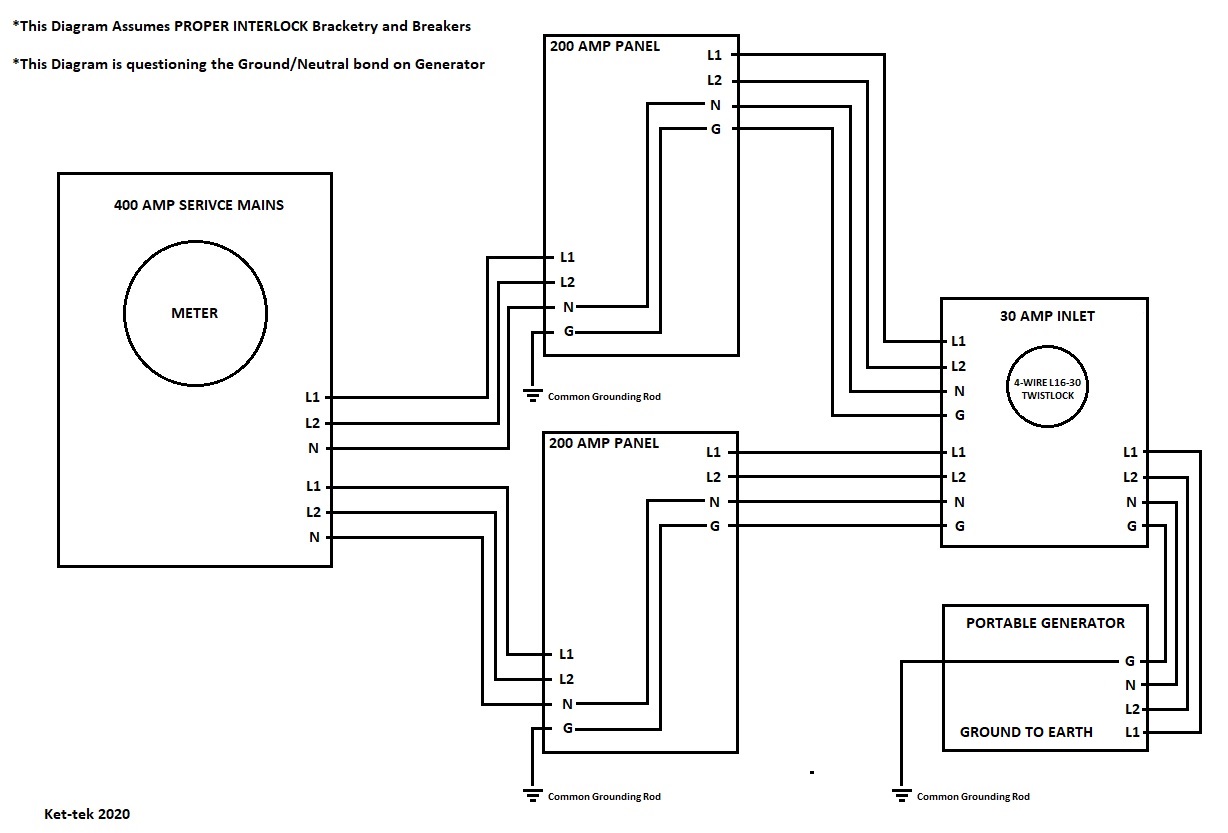
dual panel grounded by ...
 
Last edited:

nsula_country

Well-known member
Joined
May 23, 2013
Messages
1,534
Location
Northwestern Louisiana
I recently started a thread on 320 w/ panels generator interlock. Stumbled across this searching Google images.

My plan was to do like your original picture 2. Two main interlocks, one on each 200 amp panel outside. Panel 1 interlocks generator input. Panel 2 interlocks breaker from panel 1. Both panels are neutral bonded service enterance. Panels in house are 4 wire sub panels.

Clear as mud?

CT
 

Fasthotrod

Well-known member
Joined
Dec 14, 2015
Messages
218
Location
Oklahoma
I know this thread of mine is very old, but there were never any definitive answers on the neutral situation, and it has caused much confusion.

I still have not wired this in lol, and am looking into it again as I want to get it completed.

I have asked a few electricians over the past few years about the neutral question and all had very confused looks on their faces and weren't sure of what to say.

No disrespect intended towards my electrician friends... but it's not really a question that they would be able to answer unless they have a lot of experience with power systems design. You need to be talking to an engineer, specifically one with power generation/distribution experience. That's likely why you haven't received a 'straight answer' from anyone on this subject... what you want to do it not an easy thing to whip out in a few minutes. It's going to take some work.

Although they all said they've done plenty of single panel generator input boxes, and never did anything with checking a G/N bond on the generator itself, nor have ran a portable generator ground to the grounding rod, as was mentioned in this thread, saying that the the G/N is already together in the panel, and the panel is already grounded to the rod, making no difference if the generator is bonded to itself or grounded to the rod either way.

Right... because they don't typically have their heads buried in the National Electrical Code (NEC) and know where to look for it. They may not understand the difference between a system that has a Separately Derived Source or not.

If you are using a generator out in the field for a party and you aren't tied into any distribution equipment, then the safe and proper thing to do is to drop a ground rod and tie the generator to it. The generator will be the only source, so it will have the neutral/ground bond established inside of itself. No problems.

But if your intent is to tie that generator into an existing system like a house panel, then you have to decide how to do it, and do it correctly. If you want to have a non-separately derived system, then remove the system bonding jumper (neutral/ground bond) at the generator. Run four conductors from the generator to the panel. (L1, L2, Neutral, and ground.) The only neutral/ground bond will be at the panel. You can drive another ground rod for the generator if you want, just make sure to tie all of the grounds together so it's basically one big grounding system.

If you don't remove the neutral/ground bond at the generator, then you HAVE to have a way to switch the neutral between two sources. That typically means having a 3-pole switch for a typical single phase 240 VAC system, or a 4-pole switch for a 3-phase 208 VAC and/or 480 VAC system. But the fact is... you don't have a way to 'lift' the neutral from the POCO in your panel and remove the neutral/ground inside the panel. Even if you could, you likely wouldn't want to do that... so you need to step back and think about a better approach.

Are these electricians hacks? Are they doing it wrong? I don't know, but I'd still love to find out. So I can wire my dual panels properly and safely.

I have no idea if they are hacks or not... and it's not for me to judge based on the limited info given. But as I said, your question is more about how to properly design the system so that it meets your needs and is correct per the NEC. That's not typically a job for an electrician... that's a job for an engineer. (Again, no disrespect intended towards electricians. I've known some master electricians that can run circles around engineers all day long. Not every electrician is an idiot, and engineers don't know everything because of a college degree.)

Here are some diagrams I made to show the 3 scenarios I interpreted from this thread, I would love to get any feedback from the experienced guys here that have been willing to discuss this in the past.

This shows as previously discussed how some generators have the Ground and Neutral Bonded which would also be connected to the Frame from what I understood, which is supposedly bad?

dual panel bonded by ...

This one shows a generator with no bond or the bond removed.

dual panel unbonded by ...

And this one with no bond and the generator grounded to the panel ground rod.

dual panel grounded by ...

None of those drawings are correct, because none of them show a neutral/ground bond in the panels. In all three drawings, you are trying to backfeed two panels with one generator... and each panel is really considered it's own 'source' because that's where the neutral/ground bond is established in each panel. Technically, you are only allowed one.

If you want to figure this out on your own, I would suggest getting a copy of the NEC. Look in Section 250.30 Grounding Separately Derived Alternating-Current Systems. It explains the difference between a Separately Derived System and a Non-Separately Derived System.

Non Separately Derived System:

NECH_250-12-13%20thumbnail.jpg


Separately Derived System:

krXvacO9q7OJRvwwwbOFTNXKU0-FUhOHykWC1QUZdAYuHLk837K3x49WMJ00rEA2f06n43s0CNwMz-DBqgjLs59ViGg0iDJ7nP-KY9CwIIWmrrdCu1AV


For a system that is not separately derived, there is no system bonding jumper inside the generator. (Neutral/Ground Bond.) The neutral and the equipment grounding conductor (or supply side bonding jumper) are separate conductors that go back to the transfer switch. The neutral and the ground stay separated in the transfer switch and stay that way all the way back to the main panel, where the neutral/ground bond takes place.

If you had a Separately Derived System, then you would look at each source as being it's own, independent source. Each would have it's own system bonding jumper (neutral/ground bond) at the source, and the transfer switch would be a 3-pole (single phase) or 4-pole (three-phase) unit that automatically swaps the neutral from one source to the other. That way you don't have the possibility of any circulating currents from one source to the next.

The problem as I see it, is that in your examples above the POCO is supplying power to your panels, but because the meter does NOT have a neutral/ground bond then each panel is considered the 'source' of power to each structure. Each panel has it's own established neutral/ground bond. So if you try and feed both panels from one generator, how do you keep the neutrals and grounds separated? What happens when one panel is fed from the E/G and other other is fed by commercial power? Aren't the neutrals and grounds connected together in the generator 30A plug? If so... you have a problem.

The best way to power both panels is to get yourself a Service Entrance rated 400A Automatic Transfer Switch (ATS) and put it between the meter and the two panels as shown above. The transfer switch would establish the neutral/ground bond for the system, and the two 200A panels would become sub-panels. You would need to separate the neutrals and the grounds in each panel, likely add a ground bar in each panel, and remove the system bonding jumpers (neutral/ground bond) in each panel. (A Kohler 400A Automatic Transfer Switch is about $2,800) Do a proper load study and size the generator to the loads. (Or drop in a 80kW/100kVA to 'match' the 400A service... but I'd bet that it's serious overkill.)

As it was pointed out before, it doesn't matter how many panels you feed from the generator... provided the generator has the power to supply all of the loads. If it's not big enough, then you have to have a way to shed the loads that are not needed/required when the generator is on-line. Some ATS's have automatic load shed capabilities, some do not. If you are doing it manually, then technically you would need to split each panel into two panels: Essential and non-Essential loads. Essential loads would be powered by the E/G, non-essential loads would not. The generator would have to be rated to handle all of the Essential loads... and you're looking at some big $$$ to try and split the loads into what would become four panels in this instance.

Hope this helps.

Mark
 

jbfrancis3

Member
Joined
Oct 9, 2013
Messages
5
None of those drawings are correct, because none of them show a neutral/ground bond in the panels. In all three drawings, you are trying to backfeed two panels with one generator... and each panel is really considered it's own 'source' because that's where the neutral/ground bond is established in each panel. Technically, you are only allowed one.

For a system that is not separately derived, there is no system bonding jumper inside the generator. (Neutral/Ground Bond.) The neutral and the equipment grounding conductor (or supply side bonding jumper) are separate conductors that go back to the transfer switch. The neutral and the ground stay separated in the transfer switch and stay that way all the way back to the main panel, where the neutral/ground bond takes place.

If you had a Separately Derived System, then you would look at each source as being it's own, independent source. Each would have it's own system bonding jumper (neutral/ground bond) at the source, and the transfer switch would be a 3-pole (single phase) or 4-pole (three-phase) unit that automatically swaps the neutral from one source to the other. That way you don't have the possibility of any circulating currents from one source to the next.

The problem as I see it, is that in your examples above the POCO is supplying power to your panels, but because the meter does NOT have a neutral/ground bond then each panel is considered the 'source' of power to each structure. Each panel has it's own established neutral/ground bond. So if you try and feed both panels from one generator, how do you keep the neutrals and grounds separated? What happens when one panel is fed from the E/G and other other is fed by commercial power? Aren't the neutrals and grounds connected together in the generator 30A plug? If so... you have a problem.

As it was pointed out before, it doesn't matter how many panels you feed from the generator... provided the generator has the power to supply all of the loads. If it's not big enough, then you have to have a way to shed the loads that are not needed/required when the generator is on-line. Some ATS's have automatic load shed capabilities, some do not. If you are doing it manually, then technically you would need to split each panel into two panels: Essential and non-Essential loads. Essential loads would be powered by the E/G, non-essential loads would not. The generator would have to be rated to handle all of the Essential loads... and you're looking at some big $$$ to try and split the loads into what would become four panels in this instance.

Mark

Hi Mark, I agree with everything you've pointed out and appreciate the thorough response. Here is my attempt to clarify and make additional points:

- Each panel is indeed considered its own source as that is where neutral and ground is bonded. In his diagrams, he needs to show this and its likely the bonding occurs in each panel. The comment "you are only allowed one" means that you are only allowed one place in the system for that bonding to occur. This simply means that you must configure your generator to be a non separately derived system = floating neutral configuration = ground and neutral separate from one another at the generation. So diagram #2 is correct IF the author illustrates the bonding in each panel. You stated all of this but I was trying to tie it together.

- Then the question of two panels. Consider the incoming power:

Mains: 2 hots, 1 neutral. Each is simply split feeding the two sources (the panels​

Generator: 2 hots, 1 neutral. In the diagrams posted, each is split to feed the two sources (the panels)​

So, same-same.

- A transfer switch would certainly be a good way to do it as you suggest

- But interlocks on both panels will work, too. This is switching just the hots, of course. You would strive to switch both backfeeds (the interlocks) before connecting the generator, and switch both back before reverting back to main power. Let's pretend if you left one backfeed off (main power on) and one backfeed on (generator on), and both main power and generator source were energized, you still would not pose a backfeed risk. The neutrals would be common but there would be no referencing to one another.
 
To avoid these ads, REGISTER NOW!
Top Bottom