

You are using an out of date browser. It may not display this or other websites correctly.
You should upgrade or use an alternative browser.
You should upgrade or use an alternative browser.
Help with battery charger
- Thread starter GarageDan
- Start date

Duke74
Well-known member
if you are sure the fuses are good. Check to see if there are burn marks on the circuit board. Check connections at both ends of the cables. Also check for power wherever you had it plugged into, maybe the problem isn’t with the charger.

paulsomlo
Well-known member
Do you have a DVM?
htmdude57
Well-known member
What Paul said.
Do you know how to use it?
Do you understand anything about electricity?
Is there 120v at the power switch?
Is there any voltage coming out of the transformer?
What's on the circuit board?
Etc.
Do you know how to use it?
Do you understand anything about electricity?
Is there 120v at the power switch?
Is there any voltage coming out of the transformer?
What's on the circuit board?
Etc.
As mentioned, you're going to need a multimeter, then you check for a blown fuse (continuity or resistance), then past the fuse to the primary winding and the other primary winding to the other prong on the wall outlet.
Next check resistance of the primary winding itself, should read several ohms and if it's not reading you probably blew a thermal fuse that "might" (or might not) be embedded in its windings. Next you could do the same for the two taps on the secondary side of the transformer but the thermal fuse is usually on the primary side if present.
So far power didn't need applied but you might then want to plug it in, turn on, and measure for mains AC voltage on the transformer primary windings and roughly (floating a bit above) 6V and 12V AC on the secondary windings.
Next there may be a diode in series so you can check between the output of that diode and the other secondary winding for a DC voltage, OR use the multimeter diode check function if it has one.
Beyond that, depends on how it does this "Automatic" function what is involved but you can also measure for resistance across the ammeter panel in it, which doesn't need power on to do so.
Best guess would be blown fuse, thermal breaker that's too old to reset itself, or a blown diode.
Next check resistance of the primary winding itself, should read several ohms and if it's not reading you probably blew a thermal fuse that "might" (or might not) be embedded in its windings. Next you could do the same for the two taps on the secondary side of the transformer but the thermal fuse is usually on the primary side if present.
So far power didn't need applied but you might then want to plug it in, turn on, and measure for mains AC voltage on the transformer primary windings and roughly (floating a bit above) 6V and 12V AC on the secondary windings.
Next there may be a diode in series so you can check between the output of that diode and the other secondary winding for a DC voltage, OR use the multimeter diode check function if it has one.
Beyond that, depends on how it does this "Automatic" function what is involved but you can also measure for resistance across the ammeter panel in it, which doesn't need power on to do so.
Best guess would be blown fuse, thermal breaker that's too old to reset itself, or a blown diode.
Multimeter? Yes. I’m not Elec. Engineer however.Do you have a DVM?
paulsomlo
Well-known member
Check the voltage at the transformer primary - the black, brown, and yellow wires; be careful, there should be 110v there somewhere. Then check the other side of the transformer, there may be three wires.
There appears to be a thermal device, not exactly a fuse. It's that rectangular item at the lower left of your picture, riveted to the bottom of the chassis. Check it with the charger unplugged, should be zero ohms across its two terminals.
There appears to be a thermal device, not exactly a fuse. It's that rectangular item at the lower left of your picture, riveted to the bottom of the chassis. Check it with the charger unplugged, should be zero ohms across its two terminals.
i have 2 older chargers with burnt rectifiers (pictured). 120v in/5 & 20A out).
120v is going in, 2 taps coming out of transformer.
i assume these are 2-diode rectifiers.
Substituting a bridge rectifier (50A) burnt up on first attempt.
How would I wire button diodes onto these heat shields?
Thanks
120v is going in, 2 taps coming out of transformer.
i assume these are 2-diode rectifiers.
Substituting a bridge rectifier (50A) burnt up on first attempt.
How would I wire button diodes onto these heat shields?
Thanks
Attachments


better picture of older rectifier.i have 2 older chargers with burnt rectifiers (pictured). 120v in/5 & 20A out).
120v is going in, 2 taps coming out of transformer.
i assume these are 2-diode rectifiers.
Substituting a bridge rectifier (50A) burnt up on first attempt.
How would I wire button diodes onto these heat shields?
Thanks
Attachments
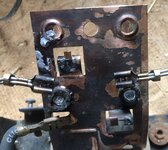
paulsomlo
Well-known member
In the pic on the left, I would guess that the downstream side of the two diodes is connected to the metal of the heat shield.i have 2 older chargers with burnt rectifiers (pictured). 120v in/5 & 20A out).
120v is going in, 2 taps coming out of transformer.
i assume these are 2-diode rectifiers.
Substituting a bridge rectifier (50A) burnt up on first attempt.
How would I wire button diodes onto these heat shields?
Thanks
Check whether there is a low ohm connection between the heatsink plate and negative, OR the positive jumper cable clamp. I'd guess negative but electrically it could be done either way. I mean it depends on the initial design, but if that heatsink plate has conductivity to the charger chassis then you'd think they'd necessarily make the chassis negative, considering it may be in contact with vehicle chassis metal too which is negative/ground for vehicle electrical system.i have 2 older chargers with burnt rectifiers (pictured). 120v in/5 & 20A out).
120v is going in, 2 taps coming out of transformer.
i assume these are 2-diode rectifiers.
Substituting a bridge rectifier (50A) burnt up on first attempt.
How would I wire button diodes onto these heat shields?
Thanks
If negative connection between plate and jumper cable clamp, the diodes' anodes connect/touch the heatsink aka "heat shield" plate. If positive connection to cable clamp, the diodes' cathodes connect to the heatsink. If you are getting a button or stud mount diode this will determine which type, mounting polarity (anode vs cathode) diode to choose.
This should have been possible to do with a bridge rectifier too if hooked up right. if it blew right away then I suspect hooked up wrong but if it blew under load (charging a battery) then I'd add the wonder of whether it was a generic counterfeit component, or not sufficiently heatsunk, poor thermal interface.
Also keep in mind that some other diode form factors, casing types are usable but may have a live (non-insulated) metal mounting tab, I'm sure I've seen and used some where that tab was the cathode (different project not a battery charger), but if you wanted to drill the holes and use the stud type diodes (threaded stud and matching nut) that diode case/stud could also be either anode or cathode.
Last edited:
redmondjp
Well-known member
If I am remembering correctly, these older chargers typically use only two diodes for rectification. I would find the thread on this site titled 'vintage battery chargers' and post there - I am pretty sure you will find somebody that has repaired these and may even have a wiring diagram for one - the specific brand doesn't matter so much as they were made by just a few manufacturers and private-labeled for many different retailers.
If negative connection between plate and jumper cable clamp, the diodes' anodes connect/touch the heatsink aka "heat shield" plate. If positive connection to cable clamp, the diodes' cathodes connect to the heatsink.
When I wrote this I was only envisioning one possible way this could be designed. I'd be a lot more comfortable with this assumption if I had a sketch of the circuit or were able to measure it myself with a meter.