To avoid these ads, REGISTER NOW!

Help with drainage in the back yard (pics)

NewShockerGuy

Well-known member
Joined
Oct 12, 2010
Messages
2,481
Location
Northern Virginia / DC
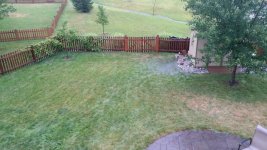
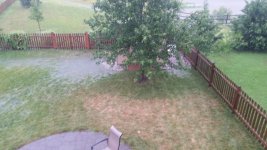
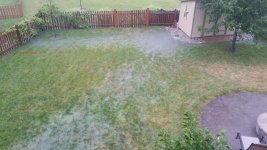
Saturday we got a TON of rain. More so that I can remember in a long time. This type of rain is rare. Raining hard in the morning and didn't really stop until the night. The back yard was filling up with water in places I never noticed before and especially around the shed.

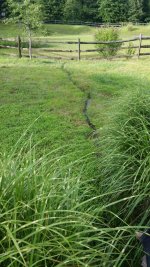
I see a couple problems but not sure how to really fix it. My house is beside neighbors, but there is a hill on both sides of the house, so the run off goes into my yard.. nothing really I can do to change this. The two problems I think I can fix or mitigate. The neighbor on my left has drain type thing in the middle of his yard and then that ends up draining into my back yard. When there is a normal rain it's not bad, but Saturday it was clear how much water comes into the yard from that thing. See picture.

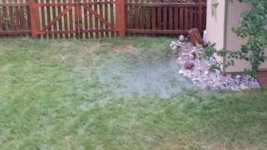
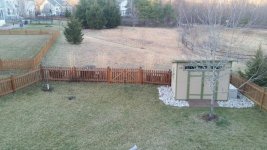
Next is all the water pooling around the shed. The ground IS lower there slightly. I have made a make shift drainage but it still is a problem. The water was so high it was to the bottom of the trim of the shed. It's never gotten that high before.

I wanted to somehow grade the back yard slightly. First is making sure that all that water on the left from my neighbor is not going through the yard. Do I put more soil on my side so that the water can't come through the fence? And if doing so would it then just move to another spot in the yard. IE: If I build up one side it would just travel until it reaches a lower point. How do I make it not go in the yard? Behind the yard in the common area is fine.

The shed is surrounded by river rock and actually has some pavers in the back. I was planning on removing ALL the rocks on the left side/back, and building up that area with soil and then toward the back near the fence but still in my yard, channel the water to go behind and out the shed. I would then redo that area slightly by putting down some sod and making the actual profile of the river rocks smaller on the left side of the shed.

I will note that when I pulled some of the larger river rock out from the side and back drainage was improved as you can see in the later pictures. French drains won't help here but there is no problem channeling all water to behind/common area. There is a picture of the dry pond that is completely filled in the back ground.

I've never done this. What type of dirt do I need? Top soil will get washed away, VA has clay like dirt, so when you dig there is dirt but there is clay.. Do I take the grass and cut underneath (like sod) put dirt down and then put the grass back over it? Or do I just but the dirt on top of the grass and pack it down, thus killing the grass? Is there a good time to do so? I do aeration/grass work late September/mid October so I don't mind messing the grass up but would prefer it to be messed up around that time frame...
I guess what I am asking is how do I do this properly. I do not have machines or tractors or anything of that nature. Just normal manual labor, wheelbarrow, shovels, rakes..etc. Typical home owner stuff.

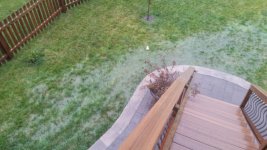
Pictures show flow of water, then the last couple show when the rain slowed down and after I moved some pavers. Apologies for some blurry pictures. Trying to take them while holding an umbrella were hard and getting wet/windy.

Thanks,
-Nigel
 

Attachments

  • 1.jpg
    1.jpg
    150.5 KB · Views: 266
  • 7.jpg
    7.jpg
    152.4 KB · Views: 205
  • 6.jpg
    6.jpg
    152.5 KB · Views: 216
  • 5.jpg
    5.jpg
    133.4 KB · Views: 241
  • 4.jpg
    4.jpg
    149 KB · Views: 232
  • 3.1.jpg
    3.1.jpg
    151 KB · Views: 252
  • 2.jpg
    2.jpg
    152.5 KB · Views: 240
To avoid these ads, REGISTER NOW!

EOC_Jason

Well-known member
Joined
Jun 25, 2012
Messages
11,388
Location
Bentonville, AR
That must be the storm on the news they were talking about the other day that was supposed to hit.

If your grass is in good shape you can rent machines to cut the sod so you can re-use it after applying dirt. It would probably be cheaper to do that than to buy new sod for such a large area. Realize there is a finite amount of time though once you cut it before you need to get it back in place or the sod will die.

The purpose of grass is to hold the soil in place. Grass grows best with nice topsoil. For what little you need to raise it I would just use all topsoil.

Water is always going to flow to the lowest point. Key thing is you always want water to flow away from your house. If you can grade the backyard to drain towards that common area that would be the way to go.

Really, if that's all the pooling you get from "heavy rains", and it drains off pretty quickly afterwards, I would not worry about it. I'm from Houston originally where it is very flat... You see that from just regular rains every time.
 

matt_i

Well-known member
Joined
Mar 14, 2008
Messages
10,728
Location
SE Michigan
I wouldn't bother, if its rare-volume then its not going to happen often.

A full solution would mean raising the ~entire~ yard (including the shed) so the next lowest point is outside on another property.
 

steveo1o9

Well-known member
Joined
Oct 10, 2016
Messages
603
Location
Eastern MD
If this standing water is as rare as you say then I would probably just live with it when it occasionally happens, especially if it is not causing any damage. What type of "drain thing" does your neighbor have that directs water to your yard? You may want to have a chat with them to correct that since you cannot divert runoff from your property onto someone else's. Definitely looks like the shed is the lowpoint in the yard so you could fill around the sides to shift that lowpoint away from the shed to prevent water damage. You could also save some earth work and build some planter boxes along the fences line to prevent your neighbors runoff from entering your yard. Then you would have a dryer yard and a nice garden to look at.
 

Jinks

Well-known member
Joined
Aug 28, 2012
Messages
2,885
Location
Daytona Beach
Is that a pond or other body of water behind your fence? It doesn't look like you have a big problem, & since you say it's only during very heavy rain it should be easy to fix. Grass will grow through light to medium fill. Mark (lawn paint) the standing area & where the run off from your neighbor runs in. Add top soil fill in those places in 1 or 2 inch layers. Rake everything level & wait a few weeks for the grass to grow through. Shape the fill to keep the neighbors run off along his side of your yard, & slope to the back & that common area. Create a gentle berm around your shed leaving the rock & an opening at the back towards the common area & that water feature behind you. Might take a few months & several applications, but it doesn't look like your lawn will suffer & it won't take a lot of work.
 

garagelogician

Well-known member
Joined
Jan 27, 2016
Messages
453
Location
Blaine, MN
If this only happens in the biggest of rains, I'd leave it (though maybe raise the shed if you are worried about it getting wet).

If this is a common problem however, I would build up a little berm along the property line to keep your neighbors drainage from coming onto your property. Just to the right of the berm, cut in a small "rain garden" type depression and plant moisture tolerant plants and ornamental grasses (google rain garden plants). Raise up the shed and other areas and direct your other drainage towards the rain garden.

What kind of soils do you have? If clay, you'll probably want to over-excavate the rain garden area and replace with crushed stone and/or washed sand (wrap the crushed stone in filter fabric).

See attached rudimentary sketch as a rough guide.
 

Attachments

  • drainage sketch.jpg
    drainage sketch.jpg
    118.1 KB · Views: 135

Augus7us

Well-known member
Joined
Jan 14, 2017
Messages
1,190
Location
Central Ohio
How does this work out with neighbors? Say your neighbor's yard is not currently holding water but yours is. You raise your back yard but now your neighbors yard is a swamp. Can they do anything? Has anyone ever done this and pissed off their neighbor?

-Clint
 

Bretny

Well-known member
Joined
Jul 31, 2017
Messages
3,918
Location
Dutchess county NY
Your lawn, the flood zone is the lowest point of all your neighbors? If so really the only sure fire and long lasting way to fix this is to add fill.

Aiming your gutters away from the back yard or putting a gutter pipe in to behind your fence may help.
 

Chaznsc

Well-known member
Joined
Apr 9, 2013
Messages
6,534
Location
SC
Simplest solution is to regrade towards that asphalt walk if you can negotiate that.
 

Attachments

  • grade.jpg
    grade.jpg
    115 KB · Views: 107
To avoid these ads, REGISTER NOW!

BillK

Well-known member
Joined
Aug 24, 2006
Messages
9,322
Location
Beautiful Southern Maryland
Mine was about twice that bad yesterday over here across the river. I wouldnt worry about it. Unless we start getting this type of rain on a regular basis I dont think it is worth the trouble. I think they said we got 6 or 7 inches in Charles County ?
 

garagelogician

Well-known member
Joined
Jan 27, 2016
Messages
453
Location
Blaine, MN
How does this work out with neighbors? Say your neighbor's yard is not currently holding water but yours is. You raise your back yard but now your neighbors yard is a swamp. Can they do anything? Has anyone ever done this and pissed off their neighbor?

-Clint

As long as you aren't directing the water from your property onto theirs, or filling in a designated drainage easement that their property was designed to drain through, they can't do anything.

The neighbor shouldn't be directing his downspouts or sump discharge his way either.
 

driftpin

Well-known member
Joined
Dec 22, 2016
Messages
11,261
Location
Miami-Dade/Broward Co. Florida
A property is supposed to contain the ground water/precipitation that accumulates on it, and it should not be draining onto a neighbor's property. That's the purpose of the retention ponds you see, grassy depressions next-to a parking lot for a commercial business. They will often have corrugated ducts feeding into the depression from drains in the parking lot. When it rains heavily, the engineered system pools the water in the depression, preventing the water from flooding the parking lot, the store, or adjacent parcels.

That idea of 'a parcel should contain its own ground water' applies to residential parcels too. Your neighbor cannot berm or contour his land to dump his runoff rainwater onto your property. I would go have a talk with the engineering dept of your local government. Ask about what type of drainage you would be required to have, if you wanted to build a new structure/dwelling on your property. I suspect they will have a set of regulations in the land development code for engineered drawings displaying the grade of the land, and water retention areas to contain what accumulates due to precipitation on your property.

Honestly, your accumulation didn't look bad, that may have been a 'rare event' in the amount of rainfall you had. Probably the least-intensive way to deal with this would be to use sand as gmyers suggested. Multiple shallow layers over-time, and have the side benefit of seeing those excess lb-ows melt-away!
 
OP
N

NewShockerGuy

Well-known member
Joined
Oct 12, 2010
Messages
2,481
Location
Northern Virginia / DC
Thanks for all the replies! This puts my mind at ease than when it was the other day... I just saw all the damn water and started freaking out.

I really like the idea of planter boxes/garden. That make the most sense for that area I think on the side and it would look nice, plus less grass to mow!

The area behind the house is the common area. No one really does anything there or takes care of it besides me, I cut at least have of that area when I mow our back yard.. I have planted a weeping willow, maple, and crepe myrtle back there to make it look nicer in a couple years. I also have planted ornamental grass behind the fence and store our fire wood there... no one says anything. The problem with that area behind the fence is that it's slightly higher than the yard. So I do not think it would be possible to direct the water from the yard to the middle of that smaller v shaped canal that you see the center weeping willow in. BUT, I could direct the water from the shed area under the fence and to the dry pond in the back. See attached picture of the dry pond on the far right. It's like that the majority of the time and only fills up when there is heavy rain and when something like Saturday's rain came in. Currently I have a smaller channel cut out so all the water from the behind the shed goes to that and goes to dry pond. It's make shift and very ghetto. See attached picture. My plan was to dig the trench deeper/straight and put a 4" or larger solid PVC pipe and then burry it so that no one would ever see it/know it's there but it would take the run off water of the yard/shed and quickly get it out of there. Currently all gutter drainage is run through pipes all the way to the common area to the right near the make shift drainage behind the shed. I was planning on installing a rear gutter on the rear of the shed since the roof only slops rearward, that would also help I think.

I have a question on the sand. What is to stop the sand from just getting washed away? That may sound like a dumb question but it seems like if I just use the sand it would just wash out and or become spongy? Is there any particular sand to use? When I did pavers on the side of the shed I used some special orange packing sand. As a kid we used sand box sand.. lowes also sells sand but not sure what kind.

Note that I don't my neighbor is doing anything on purpose to to spite. He did this before I moved in. And all takes the water from the drain pipes that are close to his house to the middle of his yard. I think that because his neighbor is higher than him as well, and has a slight incline, their water, plus his water goes to the lower point which is our yard. The neighbor to my right gets no run off at all from anyone.

More pictures attached just to show drainage by shed that I will re-do make better and the dry pond.

Thanks for all the help!

-Nigel
 

Attachments

  • drainage1.jpg
    drainage1.jpg
    103.2 KB · Views: 76
  • drainage2.jpg
    drainage2.jpg
    147.2 KB · Views: 75
  • yard dry pond.jpg
    yard dry pond.jpg
    143 KB · Views: 84
  • drypond.jpg
    drypond.jpg
    147.5 KB · Views: 66

gnpenning

Well-known member
Joined
Jan 25, 2015
Messages
2,754
Location
I have more questions than answers.
Is the shed on a slab? If not it's small enough to easily raise.

Put in the drain pipe. With as seldom as you have had problems it may not be cost effective, but you could bury a sump with a pump that would take water to your drain line?? Might be more hassle and expense than its worth in your case, but another option.

The grass roots should help hold the sand.
 

Trey T

Well-known member
Joined
Aug 3, 2011
Messages
3,749
Location
Houston, TX
The most feasible way is to change the slope of the area to route the surface run-off toward drainage area. In a planned community, most (if not all) backyards slopes toward the curb.

The topsoil (6") will always be mostly clay material and you need clay to retain moisture and organic material (food). Erosion of soil particle can be controlled if the yard is properly sloped and vegetated.
 

Jinks

Well-known member
Joined
Aug 28, 2012
Messages
2,885
Location
Daytona Beach
Much better pictures! Looks like the developer put in that retention pond for just your situation. Most of what you have is fine. A little top soil, or sand, will fill & shape your yard to take advantage of sloping towards that retention pond. The existing grass will keep the sand/soil in place. Raising your shed on some 20 X 20 pavers & leaving the river rock will keep the shed dry.
 

kbs2244

Well-known member
Joined
Nov 11, 2006
Messages
14,065
Your shed is in the lowest spot of your yard.
That is where the water will go.
But it should just go under the fence on its way down hill.
It looks like you have a wood pile behind the fence that is acting like a dam.
If this is a continuing problem I would move the wood pile first.
 
To avoid these ads, REGISTER NOW!
Top Bottom