To avoid these ads, REGISTER NOW!

Help with Floor for Epoxy Prep

toucansma

Member
Joined
Aug 4, 2014
Messages
10
Hi, been a long time reader on these forums. I have learned a lot and appreciate everyone's help. I am in the process of prepping my garage for an epoxy floor coating. My house was a foreclosure and the garage was converted into a few rooms. I ended up taking everything out and going back down to the concrete. The floors were full of some type paint and carpet glue. The concrete is about 8-9 years old and like many newer houses, I think it was done quickly and is slightly uneven in parts. We so far have scrapped most of the glue off and acid etched the floor. We then ended up grinding it with a diamond grinder from home depot. I also have filled in some small holes that were used for anchor bolts. However I have a few concerns. I plan on using a primer, then 100% solids epoxy, and then a urethane coat on top (possibly Legacy, thanks Scotty for your help/suggestions so far!). It's Florida and humid so I am worried about it adhering properly. I have am posting some pictures with issues I am worried about.

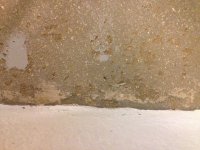
(Picture 1 on left) First issue, even after doing everything above, there is still some paint (or stain?) on the floor that even the grinding didn't completely take off. Should I go back and keep grinding it(I am worried about the floor being even more un-level, it already seems to be in parts). If it is fairly rough over the painted parts, should it adhere alright?

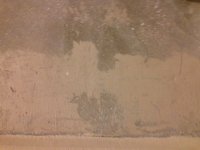
(Picture 2 middle) I am worried about some weird discoloration and it looks like unusual pitting. Should I try to use something like that quik-crete concrete repair and level that section out (I have only used the small tubes, not the self mixing tubs yet) or am I worrying too much?

(Picture 3 right) Finally 3 out of my 4 walls are exposed concrete block and stucco. Some parts have gaps as you can see. Will the epoxy fill those crevices (between wall and the floor) in or should I do something else about it? Sorry for the length and all the questions, but I just want to make sure!
Any help would be greatly appreciated!

Sam
 

Attachments

  • IMG_3822.jpg
    IMG_3822.jpg
    30.8 KB · Views: 28
  • IMG_3823.jpg
    IMG_3823.jpg
    51.7 KB · Views: 25
  • IMG_3824.jpg
    IMG_3824.jpg
    51.9 KB · Views: 22
To avoid these ads, REGISTER NOW!

LegacyIndustrial

ALLIANCE MEMBER
Joined
Jun 7, 2010
Messages
7,995
Location
deerfield, IL
I cant see the first two too well. Dap makes a good concrete repair filler for those perimeter gap. No traffic so its ok to use.


Sent from my iPhone using Tapatalk
 
OP
T

toucansma

Member
Joined
Aug 4, 2014
Messages
10
I cant see the first two too well. Dap makes a good concrete repair filler for those perimeter gap. No traffic so its ok to use.


Sent from my iPhone using Tapatalk


Scotty,

Thanks! First picture I am trying to show it still has paint stains. The grinding didn't even seem to take it off (hand or walk behind). Second picture, its a weird pitting, almost like the top of an omelette (can't think of a better description). They are not deep. I have DAP concrete repair/filler (in the tube) that I have been using for cracks and such, should I just use the same stuff?

Thanks again!

Sam
 

thisisme08

New member
Joined
Jul 13, 2014
Messages
2
I found myself in a similar situation to yours; foreclosed 8 year old spec home with a garage floor that had been abused with paint/oil/adhesive everywhere. I ended up etching, sanding, scraping, and de-greasing many multiple of times just to get to "go time" and paralyze myself thinking I hadn't done enough as it was rough in areas and smoother in others while also still being able to "see" the outlines where the paint/adhesive used to be at. IMO if you get a good result with the water test (e.g. when you wet it down the water absorbs and doesn't sit on top) then you probably are good to go.

Question 2: Don't worry about it unless you want that 100% smooth as glass floor. I didn't bother to fill pits/craters like that.

Question 3: Are you epoxying your side walls? I believe the epoxy may cover that type of small gap if you goop it up enough. Though it's probably easier to use a crack filler if that's the look your going for.

Hope it all turns out for you.
 

LegacyIndustrial

ALLIANCE MEMBER
Joined
Jun 7, 2010
Messages
7,995
Location
deerfield, IL
Scotty,

Thanks! First picture I am trying to show it still has paint stains. The grinding didn't even seem to take it off (hand or walk behind). Second picture, its a weird pitting, almost like the top of an omelette (can't think of a better description). They are not deep. I have DAP concrete repair/filler (in the tube) that I have been using for cracks and such, should I just use the same stuff?

Thanks again!

Sam


Good for the perimeter joints. Anything with traffic needs to have good strength. Epoxy patch, etc..,

Good call on the water test, does the water sit or absorb in?

Sent from my iPhone using Tapatalk
 
OP
T

toucansma

Member
Joined
Aug 4, 2014
Messages
10
I found myself in a similar situation to yours; foreclosed 8 year old spec home with a garage floor that had been abused with paint/oil/adhesive everywhere. I ended up etching, sanding, scraping, and de-greasing many multiple of times just to get to "go time" and paralyze myself thinking I hadn't done enough as it was rough in areas and smoother in others while also still being able to "see" the outlines where the paint/adhesive used to be at. IMO if you get a good result with the water test (e.g. when you wet it down the water absorbs and doesn't sit on top) then you probably are good to go.

Question 2: Don't worry about it unless you want that 100% smooth as glass floor. I didn't bother to fill pits/craters like that.

Question 3: Are you epoxying your side walls? I believe the epoxy may cover that type of small gap if you goop it up enough. Though it's probably easier to use a crack filler if that's the look your going for.

Hope it all turns out for you.


Ok, thanks that makes me feel a little better! I don't know how I can epoxy the side walls as the wall surface is stucco (so don't know if it would be even enough?). I will try the water test asap. Thanks again!
 
To avoid these ads, REGISTER NOW!

benwah

Well-known member
Joined
May 21, 2014
Messages
980
Location
Crested Butte, Colorado
toucansma,

As far as the gaps between the floor and walls you have a few options. You can use a product called Speed Cove (http://www.speedcove.com) and adhere this pre-made cove to the floor and wall then epoxy over it.

You can use wood or plastic baseboard..

Another option is using a polyurethane caulking after you've coated your floor. This works well for small gaps, large gaps would need to be filled with a backing material then caulked over.
 
OP
T

toucansma

Member
Joined
Aug 4, 2014
Messages
10
toucansma,

As far as the gaps between the floor and walls you have a few options. You can use a product called Speed Cove (http://www.speedcove.com) and adhere this pre-made cove to the floor and wall then epoxy over it.

You can use wood or plastic baseboard..

Another option is using a polyurethane caulking after you've coated your floor. This works well for small gaps, large gaps would need to be filled with a backing material then caulked over.


Benwah, thanks! Would it matter if it was installed before or after I epoxyed the floor? For example could I epoxy the floor, then install the speed cover/wood/plastic baseboard and epoxy over that? The only reason I wonder is if I install it first, then it would cover over a little bit over the floor that that would be unable to be epoxyed (which I would only care if I had to remove the trim later on for some reason). Is it better to do it all at the same time and not worry about what's underneath?
 

benwah

Well-known member
Joined
May 21, 2014
Messages
980
Location
Crested Butte, Colorado
It is truly up to you. If it were me this is how I'd do it.

Speedcove - Adhere Speedcove to uncoated wall and floor. Nail in accordingly. This essentially becomes part of your floor. Install epoxy coating on floor and cove. Caulk top of cove where it meets the wall.

-or-

Baseboards - Install floor coating. Install baseboards to wall. Caulk bottom (and top if you'd like) to ensure any spills will be contained temporarily.

Speedcove recommends an adhesion test before full installation.
 
OP
T

toucansma

Member
Joined
Aug 4, 2014
Messages
10
It is truly up to you. If it were me this is how I'd do it.

Speedcove - Adhere Speedcove to uncoated wall and floor. Nail in accordingly. This essentially becomes part of your floor. Install epoxy coating on floor and cove. Caulk top of cove where it meets the wall.

-or-

Baseboards - Install floor coating. Install baseboards to wall. Caulk bottom (and top if you'd like) to ensure any spills will be contained temporarily.

Speedcove recommends an adhesion test before full installation.

Benwah. Thanks! One last stupid question (well hopefully). Would you epoxy over the baseboard in that last example?
 

benwah

Well-known member
Joined
May 21, 2014
Messages
980
Location
Crested Butte, Colorado
Depends on what the substrate was and if the epoxy product you're using allows it. It would have to be unpainted wood or plastic. Typically you would sand the baseboard a bit to promote adhesion and apply 2 coats of your epoxy. That would give you enough dry mils to cover any marks left from sanding. If you don't want to go that route there are still other options out there.

Hope that helps some!
 
OP
T

toucansma

Member
Joined
Aug 4, 2014
Messages
10
Depends on what the substrate was and if the epoxy product you're using allows it. It would have to be unpainted wood or plastic. Typically you would sand the baseboard a bit to promote adhesion and apply 2 coats of your epoxy. That would give you enough dry mils to cover any marks left from sanding. If you don't want to go that route there are still other options out there.

Hope that helps some!

Thank you so much benwah. Really appreciate the ideas!
 
To avoid these ads, REGISTER NOW!
Top Bottom