To avoid these ads, REGISTER NOW!

Help with panel grounding.

MikeF2316

Well-known member
Joined
Dec 29, 2012
Messages
9,605
Location
Thornhill, ON
To the detriment of my long term worrying, but maybe to the benefit of my long term health, I've learned a few things in this forum.

I went into my main (200 A) breaker panel for the first time, I've only lived here for 20 years! I've just added onto circuits here and there until now. My house used to have electric baseboard heat, but that's all gone except some breakers and wire. I acquired a 240 volt portable heater, one I thought would be handy to help heat the house if my furnace ever quit. If I had a place to plug it in. I went searching for a breaker and wire I could move to a place I could put an outlet, and this is what I found.

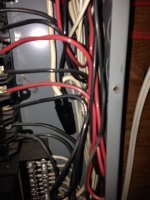
You can see on the right side where someone made some sparks back in the day.
There is a neutral connected to the ground bus, because it's too short to reach the neutral bus! This circuit works fine as connected.

attachment.php


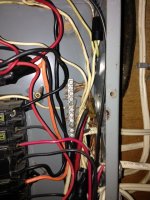
There are a couple of wires extended with wire nuts, including the neutrals for the stove and dryer.

attachment.php


This made be curious about what could be hiding under the cover at the bottom. I'm pretty sure this is wrong though, but I'm not 100% positive. The small black wire is actually a bare ground that is taped up until it's 6" outside the panel. I'm thinking it shouldn't be connected to the neutral, but should be connected to the ground lug that's right there. The neutral must be connected to the ground somewhere, but I couldn't see it. Some of the schematics show that neutral and ground are all connected to the same buses in the main panel, in which case non of this matters...

attachment.php


(The red wires are actually black with red tape, part of a flat rate water heater option that was offered around here years ago. Maybe still offered, I don't know.)
 

Attachments

  • IMG_0573.JPG
    IMG_0573.JPG
    124.8 KB · Views: 281
  • IMG_0574.JPG
    IMG_0574.JPG
    80.8 KB · Views: 279
  • IMG_0575.JPG
    IMG_0575.JPG
    115.8 KB · Views: 280
To avoid these ads, REGISTER NOW!

wyliesdiesels

Well-known member
Joined
Aug 14, 2012
Messages
20,067
Location
Modesto, CA
Is this your main service ie. Theres no breaker between it and the meter?

If so then neutral should be bonded and its ok for neutrals and grounds to be on the same panel.
 

grounded-b

Well-known member
Joined
Oct 23, 2012
Messages
285
Location
Milwaukee, WI
The taped up bare wire is your "Grounding Electrode Conductor". It probably goes to a metal cold water pipe or ground rod(s). The Neutral (white wire) is "bonded" to ground ONLY at your service (first disconnect). In your case by a green (typically) screw, which is connecting your main neutal lug to the metal enclosure. Hard to tell in your photo if the darker screw in the third photo is green or not.

So, connecting the GEC (ground) to the neutral lug is the accepted way of doing things.

And yes, it is ok to connect grounds to the neutral bar at the service. Also neutrals to the ground bar, since they are electrically the same.
 

Stuff

Well-known member
Joined
Aug 31, 2013
Messages
572
Neutrals should not be on a dedicated ground bar as that makes the chassis part of the normal electric path. I don't know what the Canadian rules are but that white should be extended with a wire-nut to a real neutral connection.
 
Last edited:
OP
M

MikeF2316

Well-known member
Joined
Dec 29, 2012
Messages
9,605
Location
Thornhill, ON
Thanks all.

Yes this in the main panel. Theres no breaker between it and the meter.
It makes sense that there's just one little thing to remove to bond/unbond (yes I've learned that meaning of the word in the last month, thanks Google), it's probably mentioned in the paper that comes with the panel...

It just looks so wrong having 2 neutral buses down at the bottom with only neutral wires then 2 ground buses at the top with all ground wires and one neutral wire on one side. :headscrat

So there's nothing here that I should be concerned about? It has been working like this for more than 20 years.

What do you guys think of arc fault breakers? I see that they're required for bedroom circuits now. Is it worth spending the money?
 

Pwrgeek

Well-known member
Joined
Oct 18, 2015
Messages
288
Location
Texas USA
AFCI is a crock. They are expensive with no appreciable increase in protection. That said they are now a code requirement for any new circuit to a bedroom.


Sent from my iPhone using Tapatalk
 

Norcal

Well-known member
Joined
Mar 16, 2008
Messages
13,769
AFCI is a crock. They are expensive with no appreciable increase in protection. That said they are now a code requirement for any new circuit to a bedroom.


Sent from my iPhone using Tapatalk

AFCI's are required almost everywhere under the latest NEC, have no idea what the CEC requires, and yeah I think they are snake oil.
 
To avoid these ads, REGISTER NOW!
OP
M

MikeF2316

Well-known member
Joined
Dec 29, 2012
Messages
9,605
Location
Thornhill, ON
AFCI's are required almost everywhere under the latest NEC, have no idea what the CEC requires, and yeah I think they are snake oil.

I first saw them on an episode of This Old House about a year ago. They were talking about how many lives they've saved, but the conditions where they'd prevent a fire would be exceedingly rare, in my estimation. I have a book I just picked up, Electrical Code Simplified, "Based on the 25th edition of the Ontario electrical safety code and bulletins." They're required (rules 26-722(f) and (g)) on outlets in the "sleeping facilities of a dwelling unit" according to the book.

However, since you guys don't like them, since they're so expensive, since they take up more room in the breaker panel, and since I already have breakers, I think I'll give them a pass for now.
 

Cmreschke

Well-known member
Joined
Feb 15, 2014
Messages
775
Location
North of Detroit
As stated above picture 1 is technically wrong unless there is a phisical wire connecting that ground bar to the panels neutral bar. Your using the frame of the panel to carry current back to the neutral conductor.
 
OP
M

MikeF2316

Well-known member
Joined
Dec 29, 2012
Messages
9,605
Location
Thornhill, ON
As stated above picture 1 is technically wrong unless there is a phisical wire connecting that ground bar to the panels neutral bar. Your using the frame of the panel to carry current back to the neutral conductor.

There isn't a wire. It offended me enough so I found enough slack in the basement rafters to bring that wire to the neutral bus. So you're saying I would need to run a wire between that ground bus and one of the neutral buses to be up to code? Because, yes, the neutral current in that wire was going through the frame of the panel.
 

myredracer

Well-known member
Joined
Nov 1, 2015
Messages
557
Location
Langley, BC
No main breaker? Panels back in the 40s/50s and older didn't have them. Did someone replace the panel without a permit? If you don't have a main breaker to disconnect the incoming power, do not work on the panel. You will be directly connected to the transformer out on the street and if you have an accidental short circuit, you will be subjected to the full available short circuit let-through current of the transformer. Potentially very dangerous. Is that not a main breaker in the 3rd pic? Only way to disconnect power would be to pull the meter and you'd need to contact Ontario Hydro.

Why all the splices inside the panel? That is not allowable under the CEC. The only way to fix this is to mount junction boxes outside the panel, make new splices there and extend new loomex into the panel. I would as a matter of course, check all connections for proper tightness, including the main incoming conductors (definitely not if live!).

In the top pic, the neutral wire at ground bus should be redirected to the neutral bus. That shouldn't be left like that.

There should be a neutral bonding screw in there which connects the neutral to ground. These are removable for when you have a sub-panel. This screw should be in there and it could be the brass one where the main neutral is connected. Make sure it is tightened okay and is in fact the bonding screw. The only electrical connection between a neutral and a ground bus should be the bonding screw. Neutral wires only should connect to a neutral bus and ground wires only should connect to a ground bus.

The incoming main ground conductor should connect directly to the neutral as you have. However, it looks like the ground conductor is too small. The bare ground did not require tape on it. What is the main ground electrode? Water pipe, rod(s), plate electrode?? I would want to know it's done right.

It is not allowable to run other wires in a raceway/conduit that is for a feeder or incoming service conductors. If those red taped wires are not needed, take them right out (don't relocate them).

Who knows what else might be lurking in there that doesn't meet the CEC? For piece of mind, I would recommend getting an electrician to look at it. You can still do any work under a permit as the homeowner.
 

Norcal

Well-known member
Joined
Mar 16, 2008
Messages
13,769
There is one thing I forgot about, Canadian panels have a seperated / isolated compartment for the main and the service entrance conductors which any branch circuit conductors are prohibited from, did someone go across the border for one intended for the US market?
 
OP
M

MikeF2316

Well-known member
Joined
Dec 29, 2012
Messages
9,605
Location
Thornhill, ON
Now I'm starting to get confused. I'll explain what I have. My house was built in 1950, and the electrical was upgraded sometime in the late '80s or early '90s, before I bought the house. This was because electric baseboard heating was added throughout. Also, before I bought the house, they added a gas furnace and this electric heating turned off. The original wiring with asphalt based insulation comes in the very top of this new panel. It's all very neatly run across the basement. All the plastic based insulated cables go in the sides of the panel, and are shall we say a little haphazardly run. Until I got a 240 volt heater, I hadn't done anything to the electrical in the house other than confirm what load was on what fuse. I figured I could take one of the unused 240 volt circuits from the old baseboard heaters, run it to a new outlet in hall and have an emergency source of heat. That's when I noticed the stuff in post #1.

The wires come from the street to my service cap, then down to the meter base. I've never seen inside the base, so I have no idea what's there.

However I did see inside the meter base at my parents house when my dad upgraded the service to 200 amps there, and I believe what I have is the same. Above the meter there was a wire (probably 10 or 12 gauge) connected to each hot leg. These wires continued down the conduit with the service wires connected to bottom of the meter base. So any power through these smaller wires would be unmetered. These smaller wires went to a disconnect box with fuses then on to the flat rate water heater through normal electrical cable.

I believe what I can't see is like this, but I have no idea, and I didn't check these wires to see if they were live.

There is a main breaker, it's in the top of the 3rd picture in post 1. The connections from the incoming wires are normally hidden behind a cover that I removed for pic 3.

I was able to find enough slack in the cable and have moved that one neutral to one of the neutral buses. My project for the weekend is to see if I can do the same to the ones with wire nuts. One is the stove which is on the other side of the house, 40 feet away! Even though I don't think these conditions are dangerous, I don't like them.

Keep in mind that this has been like this for a minimum of 22 years! A couple of years ago I hired a licensed electrician to run some 6 gauge teck90 to the garage, but I was only there for the garage to the house (trenching) part. The second day, I had to work so I missed them running the cable across the basement to the panel. He supplied a new breaker and filled in the last 2 empty spots.

I would assume that a permit would have to be pulled to do this. The house has a proper 200 amp connection from the street (my neighbour's house had a smaller service wire until he upgraded to 200 amp a couple of years ago) Presumably the panel passed inspection even with the wire nuts.

And here's a picture of the ground wire, with a pencil for scale. It goes to the water pipe on the incoming side of the water meter.

attachment.php
 

Attachments

  • IMG_0577.JPG
    IMG_0577.JPG
    72.4 KB · Views: 79
To avoid these ads, REGISTER NOW!
Top Bottom