To avoid these ads, REGISTER NOW!

Help with Shed Wiring

Todd.Brock

Well-known member
Joined
Jul 15, 2008
Messages
4,250
Location
Cincinnati
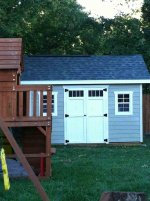
Hey all looking to run one 20 amp circuit using 12 ga in conduit out to the barn/shed. 100ft from panel. Would like some help with

1. How deep should trench be? Can I use a spade to get it 16" deep or so it do I need a trencher and get all the way down?

2 How do I go about laying out the circuit? I want one 4 bulb t8 fixture on a switch and 2 or 3 receptacles. I'm not sure how best to lay it using EMT.

3. I intend to run 3/4 PVC conduit out of the garage wall and back to the panel. How do I transition into the shed?
 
To avoid these ads, REGISTER NOW!

sberry

Banned
Joined
Jun 18, 2005
Messages
35,747
Location
Brethren, Michigan
In the shed run it right up in to a switchbox, use a common switch as a disconnect. This is the most simple circuit for a detatched structure, if you feed it from a gfci outlet before it leaves the building are only required to bury it 12 inches. Use the right wire.
 

Norcal

Well-known member
Joined
Mar 16, 2008
Messages
13,752
In the shed run it right up in to a switchbox, use a common switch as a disconnect. This is the most simple circuit for a detatched structure, if you feed it from a gfci outlet before it leaves the building are only required to bury it 12 inches. Use the right wire.

The receptacles are required to have GFCI protection anyway, so that could be the best option, but deeper down could prevent damage in the future when digging near the buried conduit.
 

wyliesdiesels

Well-known member
Joined
Aug 14, 2012
Messages
19,994
Location
Modesto, CA
Hey all looking to run one 20 amp circuit using 12 ga in conduit out to the barn/shed. 100ft from panel. Would like some help with:

What are u planning on running off this 20amp circuit? Due to voltage drop over that long of a distance I would recommend upsizing your wire to THWN #8 to limit the drop to 3%! If your not going to be plugging in any high amperage tools, then u could go with #10! Whatever size u use, make sure to use THWN wire as its rated for wet locations(ie. conduit). You could also use UF and bury it directly!

1. How deep should trench be? Can I use a spade to get it 16" deep or so it do I need a trencher and get all the way down?

If PvC, 18". If UF romex, then 24".

2. How do I go about laying out the circuit? I want one 4 bulb t8 fixture on a switch and 2 or 3 receptacles. I'm not sure how best to lay it using EMT.

Have u bent EMT before? If not, pvc will be way easier! Where the conduit comes into the shed u can put in a 4x square box and make your splices for going to the light switch and outlets.

3. I intend to run 3/4 PVC conduit out of the garage wall and back to the panel. How do I transition into the shed?

3/4" should be fine. U can use a 90deg sweep going into the shed or an LB.
 
OP
T

Todd.Brock

Well-known member
Joined
Jul 15, 2008
Messages
4,250
Location
Cincinnati
Thanks guys for all the imput. I was thinking about running a GFCI breaker to make sure everything is protected. So I should :
1. run conduit all the way to the panel, TWHN 12 or 10ga., in 3/4 pvc buried 16"
2. Run into a switch first as a disconnect, then in a 4x jbox.
3. run PVC coinduit over to the recepticle locations, switch and jbox for light fixture.
4. I was contemplating to small soffitt lights that were LED just for decoration. Any thoughts on those?
 

pattenp

Well-known member
Joined
Jun 4, 2008
Messages
10,175
Location
Virginia - USA
I assume the 20A circuit is just 120V. If so what sberry said about 12 inch depth is what I'd do. I'd also use UF cable because it doesn't have to be in conduit, but you could use conduit just in the trench for added protection. I'd do the #8.
 

wyliesdiesels

Well-known member
Joined
Aug 14, 2012
Messages
19,994
Location
Modesto, CA
In the shed run it right up in to a switchbox, use a common switch as a disconnect. This is the most simple circuit for a detached structure, if you feed it from a gfci outlet before it leaves the building you are only required to bury it 12 inches. Use the right wire.

What is the purpose of using a switch in the shed as a disconnect? The feeding breaker or GFCI serves the same purpose! I've never wired a shed with a switch inside to disconnect the power in the shed!
 

wyliesdiesels

Well-known member
Joined
Aug 14, 2012
Messages
19,994
Location
Modesto, CA
Thanks guys for all the input. I was thinking about running a GFCI breaker to make sure everything is protected. So I should :
1. Run conduit all the way to the panel, THWN 12ga. or 10ga., in 3/4 pvc buried 16"
2. Run into a switch first as a disconnect, then in a 4x jbox.
3. Run PVC conduit over to the receptacle locations, switch and jbox for light fixture.
4. I was contemplating to small soffit lights that were LED just for decoration. Any thoughts on those?

1)Definitely don't do #12cu and #10cu is questionable! I would go with #8cu to be safe! And if u use UF with a GFCI on the main houseside before the trench, then u only have to go down 12". But I would go deeper in case of digging issues!

Another thing u might consider is putting the GFCI in the shed so u don't have to go all the way back to the house to reset it. If u do this though, you will have to dig a deeper trench because I wouldn't feed a GFCI with a GFCI! You're only allowed to do 12" deep if protected with a GFCI.

What do u mean by panel? Breaker panel feeding the shed? Or breaker panel in the shed? If u mean ur gonna run conduit all the way into the feeding panel, u don't have to if u use UF because its rated for interior use.

2) U could put the switch in the same jbox where u make ur splices(though I don't see the point to the disconnect switch). I would run the conduit coming into the shed into the jbox first and then make your splices in there and run your interior conduit from this jbox!

4)Decoration is up to personal preference and I don't use LED bulbs too often(since they're too expensive still) so I can't help u there!
 

eljefino

Well-known member
Joined
Feb 21, 2008
Messages
336
Lot of overthought here!

I got a 2 watt LED bulb from walmart for $7. It might be a 1.2 watt, per the shelf label. It has a nice white light. This is in my woodshed in a $2 ceramic edison base. I plan to turn it on in November and off in April. I had a motion detector light out there but I figure its motion detection circuit uses two watts anyway and it bugged me when it false tripped. Need the light for retrieving firewood with my hands full.

I direct buried 14 ga underground rated romex; is protected through a GFCI in a crawl space. Crossing fingers but it hasn't tripped yet. I don't give a rat's hiney about voltage drop for a 2 watt bulb nor should OP about 200 watts of tube flourescents. Cold temps will cut his light output way more than any wiring resistance.

Don't forget your little "this outlet has GFCI protection" stickers out in the shed; this helps strangers when they're scratching their heads why it's not working.
 

sberry

Banned
Joined
Jun 18, 2005
Messages
35,747
Location
Brethren, Michigan
A 12 will be suffecient for common tasks,,,,, a uf wire is the most simple. If I was going to the trouble of doing anything else, upsizing etc it would get a service or a multiwire circuit.
)Definitely don't do #12cu and #10cu is questionable! I would go with #8cu to be safe!
Where you come up with this? And to add,,, you buy a roll of 8 uf lately?


(though I don't see the point to the disconnect switch).
If they left it up to everyone to see the point then there would be no reason for the code book.
 
Last edited:

electures

Member
Joined
Sep 20, 2012
Messages
8
What is the purpose of using a switch in the shed as a disconnect? The feeding breaker or GFCI serves the same purpose! I've never wired a shed with a switch inside to disconnect the power in the shed!

The NEC requires a disconnect at the shed. Since it is only one circuit, a single pole switch meets this requirement.
 

electures

Member
Joined
Sep 20, 2012
Messages
8
Hey all looking to run one 20 amp circuit using 12 ga in conduit out to the barn/shed. 100ft from panel. Would like some help with

1. How deep should trench be? Can I use a spade to get it 16" deep or so it do I need a trencher and get all the way down?

12" deep is acceptable as long os the circuit is GFI protected. Otherwise 18" to 24" depending on where it is ran.

2 How do I go about laying out the circuit? I want one 4 bulb t8 fixture on a switch and 2 or 3 receptacles. I'm not sure how best to lay it using EMT.

EMT is not required. Romex may be acceptable depending on what version of the NEC is adopted in your local. If you are worried about physical damage, use MC.

3. I intend to run 3/4 PVC conduit out of the garage wall and back to the panel. How do I transition into the shed?

Use a PVC LB to transission into the shed. You can connect it directly into the back of a 1900 box and start your wiring from there. Feed a multigang box hitting a master switch (meeting the NEC disconnect requirement) then supply the other switches from there. Next feed out of the switch box and supply the receptacle outlets. Install a GFI in the first receptacle and connect the out feed to the load side of the GFI. If you atre going through all the trouble of digging a trench, I would install 1" PVC instead of 3/4". For a few dollars more it will allow for upgrading.


Responses in red.
 
OP
T

Todd.Brock

Well-known member
Joined
Jul 15, 2008
Messages
4,250
Location
Cincinnati
Thansk for all the feedback.. I intend this circuit to power an overhead light, maybe 2 LED soffit lights, and 1-2 recepticles for plugging in battery chargers for the power tools, lawn mower starter, power wheels (the kids toys), etc... This is strictly a storage barn so no air compressors, grinders, welders, etc.. It is a 120v circuit. I could see the argument for 10, but thinking I am over killing at 8. I am not convinced that 12 wouldnt suffice.
The main electrical meter and panel is on the outside wall of the garage. It is a straight line to the shed approx. 85 to to 90 feet. I am avoiding UF just b/c I want the extra measure of protection from conduit. Its cheap enough.

Thanks again!
 

pattenp

Well-known member
Joined
Jun 4, 2008
Messages
10,175
Location
Virginia - USA
The distance is the issue for needing larger wire. At first you said 100', now it's 85'-90'. The little less distance makes some difference but not a lot. You are going to be getting about a 6 volt drop with #10 @90' @ 15A load, so 120V is now down to 114V. A #12 you will get about a 9 volt drop @ 90' with a 15A load, so you're at about 111V. You should do #10 at a minimum. If you pull loads closer to the 20A of the circuit the voltage drop will be higher.

If you don't use UF and go with individual THHN/THWN wires, the individual wires need to be in conduit from termination end to termination end.
 
Last edited:

matt151617

Well-known member
Joined
Dec 17, 2011
Messages
488
Location
New Jersey
Your best bet is to get a roll of 500' of #8 or #10 THWN wire, and run it in conduit. That is probably the most economical option, it would allow you to run 240v if desired (and have double the available 120v amps), and it would allow for future upgrades. You could actually get away with 3/4" conduit (5 #8 wires are allowed).

You'll have to come out of the panel with conduit, into the ground (18" deep minimum), then out of the ground at the shed, through the wall, and then into either a little subpanel or a jbox. Schedule 80 conduit where it comes out of the ground/is subject to damage. You can get a little Square D subpanel with 2 spaces for ~$15 at Lowes. I would run 4 wires so you have 2 separate 120v circuits available, one for lighting/accessories, one for the outlet(s). Also make sure you GFI protect the entire circuit, and keep the neutral isolated from the ground inside the panel.

Inside the shed, you can use simple NM/Romex, or go for a cleaner look and use EMT conduit.
 

wyliesdiesels

Well-known member
Joined
Aug 14, 2012
Messages
19,994
Location
Modesto, CA
Lot of over-thought here!

I direct buried 14 ga underground rated Romex; it's protected through a GFCI in a crawl space. Crossing fingers but it hasn't tripped yet. I don't give a rat's hiney about voltage drop for a 2 watt bulb nor should OP about 200 watts of tube fluorescents. Cold temps will cut his light output way more than any wiring resistance.

Its way over-thought unless u want to actually run a load on the line, like the OP does, without significant voltage loss! He's not gonna be running just some light bulbs off the line. 'Pattenp' has backed me up on the voltage drop issue as well!

I'm curious- how long is that 14ga romex u ran?
 

eljefino

Well-known member
Joined
Feb 21, 2008
Messages
336
My 14 ga romex is ~55 feet.

OP wants 4x 32 watt t8s and some wall wart battery chargers. None need an exact or precise amount of voltage and all of that may not even be running at the same time!

What's the payback, efficiency wise, at 1.25 amps of use, of buying thicker copper?
 

sberry

Banned
Joined
Jun 18, 2005
Messages
35,747
Location
Brethren, Michigan
Its different if some serious load is applies 24/7 but you can zing a few boards off with a circ saw 100 ft of 16 ga extension cord. Likely to apply only one real load at a time. My neighbor has a deal like this, about 100 ft of 12, if it was me might have done something different but for him, a couple lights and a saw on occasion or battery charger its just fine.
 

wyliesdiesels

Well-known member
Joined
Aug 14, 2012
Messages
19,994
Location
Modesto, CA
sberry;2570278Where you come up with this? And to add....you buy a roll of 8 uf lately?.....[/QUOTE said:
"Where do I come up with this stuff?" Ever heard of some thing called voltage drop. Let's say he only needs the circuit for chargers and lights right now. Yeah, 12ga WOULD be sufficient. Then, let's say a year or so down the road, he decides he wants to run an air compressor or other high load device off this circuit. It definitely ain't gonna happen with 14ga or even possibly 12ga. While he's doing all the work and going to all the trouble to put in the wire, why not plan for the future and give oneself a little headroom?

I'll never forget the time when I use to do carpentry and my friend plugged in his compressor directly into an ext. outlet. He turned it on and it just buzzed. The motor wouldn't kick on due to voltage drop! The outlet was no more than 40' from the main but the compressor was drawing so much that it caused a major sag and wouldn't work.

The NEC requires a disconnect at the shed. Since it is only one circuit, a single pole switch meets this requirement.

Thank you for the direct answer. Do u happen to have a code article and section #? Thank you!
 
To avoid these ads, REGISTER NOW!
OP
T

Todd.Brock

Well-known member
Joined
Jul 15, 2008
Messages
4,250
Location
Cincinnati
Thanks again for all the imput. I agree that 12 would be a little light. I have a couple rolls of THHN I was trying to use to save some money. I'm not sure I have enough to complete the work. If I have to buy more wire, I may as well by the 500ft roll of #10 THHN and colored electrical tape! That would allow me some headroom as some one suggested. Any thought in the best tool for trenching?
 

Norcal

Well-known member
Joined
Mar 16, 2008
Messages
13,752
Thanks again for all the imput. I agree that 12 would be a little light. I have a couple rolls of THHN I was trying to use to save some money. I'm not sure I have enough to complete the work. If I have to buy more wire, I may as well by the 500ft roll of #10 THHN and colored electrical tape! That would allow me some headroom as some one suggested. Any thought in the best tool for trenching?

The NEC prohibits reidentifying conductors 6 AWG & smaller either white or green, 250.119(A)(1), & 200.6(A). You will need to buy wire of each color to comply w/ code.
 
OP
T

Todd.Brock

Well-known member
Joined
Jul 15, 2008
Messages
4,250
Location
Cincinnati
Your best bet is to get a roll of 500' of #8 or #10 THWN wire, and run it in conduit. That is probably the most economical option, it would allow you to run 240v if desired (and have double the available 120v amps), and it would allow for future upgrades. You could actually get away with 3/4" conduit (5 #8 wires are allowed).

You'll have to come out of the panel with conduit, into the ground (18" deep minimum), then out of the ground at the shed, through the wall, and then into either a little subpanel or a jbox. Schedule 80 conduit where it comes out of the ground/is subject to damage. You can get a little Square D subpanel with 2 spaces for ~$15 at Lowes. I would run 4 wires so you have 2 separate 120v circuits available, one for lighting/accessories, one for the outlet(s). Also make sure you GFI protect the entire circuit, and keep the neutral isolated from the ground inside the panel.

Inside the shed, you can use simple NM/Romex, or go for a cleaner look and use EMT conduit.

So the idea of one 500 ft roll is a bad idea? That put me at about 350 bucks in wire, (115/ role) not to mention over a quarter mile of the stuff for 2 light fixtures and a plug for 3.2v battery shears. Sounds like a plan.
I can appreciate the insight, but there has to be a middle ground?
 

eljefino

Well-known member
Joined
Feb 21, 2008
Messages
336
In telecom, particularly fiber optics, the expense is in the trench. So what's the rental on your trencher going to cost?

Give me through this afternoon and I'll bring a 600/900/1500 watt heater out to my shed on the end of 55 ft of 14 ga to measure voltage drop. 55 feet of 14 should have around the same drop as 100 of 12.

Edit, I have to ask, is the definition, particularly grandness of a "shed" variable across the country and local dialects? In the Northeast I would define "shed" as one step above "shanty". Though I respect if GJ would encourage one to overdo it...
 

electures

Member
Joined
Sep 20, 2012
Messages
8
Thanks again for all the imput. I agree that 12 would be a little light. I have a couple rolls of THHN I was trying to use to save some money. I'm not sure I have enough to complete the work. If I have to buy more wire, I may as well by the 500ft roll of #10 THHN and colored electrical tape! That would allow me some headroom as some one suggested. Any thought in the best tool for trenching?

Try one of these. Link
 
Last edited:

pattenp

Well-known member
Joined
Jun 4, 2008
Messages
10,175
Location
Virginia - USA
So the idea of one 500 ft roll is a bad idea? That put me at about 350 bucks in wire, (115/ role) not to mention over a quarter mile of the stuff for 2 light fixtures and a plug for 3.2v battery shears. Sounds like a plan.
I can appreciate the insight, but there has to be a middle ground?

I don't understand all the complexity that's being made out of this. If you just want 20A @ 120V, the simplest approach to this is to buy X number of feet of 10/2 UF for the run from inside the house to the inside of the shed. If you want it in conduit under ground then do so. Go to an electrical supply and they should be able to cut the length of UF you need.
 
OP
T

Todd.Brock

Well-known member
Joined
Jul 15, 2008
Messages
4,250
Location
Cincinnati
The complexity is mucho opinions. When I think I have a plan, someone else has a reason not to do it. I didn't think Romex could go in conduit?
 

eljefino

Well-known member
Joined
Feb 21, 2008
Messages
336
Results are in, 120.8 volts at outlet with only a ~20 watt CFL and timer for a chicken coop. Dips to 113 with 900 watts, 110 with 1200 worth of heater. All this on 55 feet of 14 gauge.

However an additional 26 watts of CFL (my shed light setup) results in a mere 0.1 volt drop. ;)

Good bad or ugly (probably the latter two) there are your numbers. :D
 

pattenp

Well-known member
Joined
Jun 4, 2008
Messages
10,175
Location
Virginia - USA
The complexity is mucho opinions. When I think I have a plan, someone else has a reason not to do it. I didn't think Romex could go in conduit?

You can put Romex in conduit. You have to calculate the fill based on the wide cross section of the cable. The reason I say to use UF is it doesn't have to be in conduit when inside of a structure. You can put it in conduit on the outside from the exit and entry points on the wall. You can use the UF from house panel to jbox in the garage and not have to switch cable types because of the wire being used inside.
 
Last edited:

cafyrman

Well-known member
Joined
Aug 21, 2011
Messages
76
Location
Poway, CA
The complexity is mucho opinions.

That (and ****) is what the internet is good for.

On a serious note, thanks for bringing up this topic. I'm debating the same thing right now. The previous owner of my place ran 12 gauge to a couple of outlets in the backyard right next to my shed. I was planning on tapping into those for the shed. Then I found that he ran them directly from a junction box by tying into a run of 6 gauge that feeds a 50 amp subpanel. So there's no overcurrent or GFI protection on that run. :shocking:

Now what? I guess do the same thing you are. Luckily, I'm starting to think about a service upgrade. And starting to think about redoing that portion of the back yard.

So... back to your project. How do you intend to come from the ground into the shed? My shed sits atop a raised driveway, so I'd need to come out of the ground and then up about a foot and in about a foot. Basically, up and over the foundation. Have an elegant plan for this you'd like to share?
 

wyliesdiesels

Well-known member
Joined
Aug 14, 2012
Messages
19,994
Location
Modesto, CA
Thanks again for all the input. I agree that 12 would be a little light....That would allow me some headroom as someone suggested....

Glad someone agrees with me! If u decide down the road to run some high draw loads in your shed(like motors, table saw, compressor, wood planner, etc.), the motors will be starving for voltage especially if u went with some one's suggestion of 14ga!

....I have a couple rolls of THHN I was trying to use to save some money. I'm not sure I have enough to complete the work. If I have to buy more wire, I may as well buy the 500ft roll of #10 THHN and colored electrical tape!...

I wouldn't go with individual cond. Go with UF so u don't have to use conduit!

....Any thought in the best tool for trenching?

Ditch-witch?

The NEC prohibits reidentifying conductors 6 AWG & smaller either white or green, 250.119(A)(1), & 200.6(A). You will need to buy wire of each color to comply w/ code.

Thx! I did not know about this code. What is the point of prohibiting the reidentification of 6ga and smaller wire?

I don't understand all the complexity that's being made out of this. If you just want 20A @ 120V, the simplest approach to this is to buy X number of feet of 10/2 UF for the run from inside the house to the inside of the shed. If you want it in conduit under ground then do so. Go to an electrical supply and they should be able to cut the length of UF you need.

Agreed!

The complexity is mucho opinions. When I think I have a plan, someone else has a reason not to do it. I didn't think Romex could go in conduit?

UF Romex can go in conduit cause its rated for direct burial and wet locations!

Results are in, 120.8 volts at outlet with only a ~20 watt CFL and timer for a chicken coop. Dips to 113 with 900 watts, 110 with 1200 worth of heater. All this on 55 feet of 14 gauge.

However an additional 26 watts of CFL (my shed light setup) results in a mere 0.1 volt drop. ;)

Good bad or ugly (probably the latter two) there are your numbers. :D

You have to remember that a 15a circuit has 1800 watts, so your only loading that circuit 67%. Your #s WILL be ugly @ higher loads. You also have to remember that motors have in-rush current and when starting will cause the voltage to drop lower than that, possibly to the point that they'll take more than 15a to start, causing nuisance trips. I've seen it happen before!

Of course, if you're never gonna run anything like that on this line, then you're fine!

But my point to the OP is, while he's going to all the trouble of putting the wire in, why not plan for the future and give himself some headroom and flexibility- to be able to run stuff on the line he may not originally thought he would be running on the line!

You can put Romex in conduit. You have to calculate the fill based on the wide cross section of the cable...

You can't use regular Romex in conduit! We(board members) just had this discussion in another thread. Do u mean UF romex? The conductors in regular romex are not rated for wet locations- need THWN!
 
OP
T

Todd.Brock

Well-known member
Joined
Jul 15, 2008
Messages
4,250
Location
Cincinnati
Patton, If I use conduit, do I need UF? Does UF have to really be in conduit inside a structure? Can I just size the conduit for 10-2? I want conduit for an extra measure of protection underground.
I plan to use conduit out of the ground with an LB into the barn. Here ae some pics of what I am dealing with. The panel is on the outside wall of the garage.
ImageUploadedByTapatalk1348526417.970871.jpg
ImageUploadedByTapatalk1348526439.569340.jpg
ImageUploadedByTapatalk1348526466.285385.jpg
 

wyliesdiesels

Well-known member
Joined
Aug 14, 2012
Messages
19,994
Location
Modesto, CA
....The previous owner of my place ran 12 gauge to a couple of outlets in the backyard right next to my shed. I was planning on tapping into those for the shed. Then I found that he ran them directly from a junction box by tying into a run of 6 gauge that feeds a 50 amp subpanel. So there's no overcurrent or GFI protection on that run. :shocking:

Wow! That's just similar to the genius wiring I stumbled upon in an McDs a few years ago- 12ga wire on a 50amp 3 pole breaker!

First off, I would not tap into those at all. And I would not use them since there is no OCPD sized for that 12ga wire! If it were me, I would disconnect it, too!

So...back to your project. How do you intend to come from the ground into the shed? My shed sits atop a raised driveway, so I'd need to come out of the ground and then up about a foot and in about a foot. Basically, up and over the foundation. Have an elegant plan for this you'd like to share?

Yes! U could heat bend some schedule 80, use an LB or sweeping elbow! Pick ur poison!
 

pattenp

Well-known member
Joined
Jun 4, 2008
Messages
10,175
Location
Virginia - USA
Originally Posted by pattenp
You can put Romex in conduit. You have to calculate the fill based on the wide cross section of the cable...


You can't use regular Romex in conduit! We(board members) just had this discussion in another thread. Do u mean UF romex? The conductors in regular romex are not rated for wet locations- need THWN!

I was making a general statement that Romex can be put in conduit. I did't mean to imply that regular Romex can be used under ground. It would need to be UF for wet locations.
 

wyliesdiesels

Well-known member
Joined
Aug 14, 2012
Messages
19,994
Location
Modesto, CA
Patton, if I use conduit, do I need UF?

No! UF is not the only style cable u can use in conduit! You could also use THWN(the W stands for wet).

Does UF really have to be in conduit inside a structure?

No, UF does NOT have to be in conduit inside a building! It has the same rules as regular romex and it can be directly buried!

Can I just size the conduit for 10-2? I want conduit for an extra measure of protection underground. I plan to use conduit out of the ground with an LB into the barn. Here are some pics of what I am dealing with. The panel is on the outside wall of the garage.

Remember, UF needs protection from 18" below grade! An LB would work great!
 
Last edited:

pattenp

Well-known member
Joined
Jun 4, 2008
Messages
10,175
Location
Virginia - USA
Patton, If I use conduit, do I need UF? Does UF have to really be in conduit inside a structure? Can I just size the conduit for 10-2? I want conduit for an extra measure of protection underground.
I plan to use conduit out of the ground with an LB into the barn. Here ae some pics of what I am dealing with. The panel is on the outside wall of the garage.

If you use UF, you can use it from house panel to the inside of the barn. The only place you would have to put the UF in conduit is where it exits the earth to where it enters the structure. The UF when used inside does not have to be in conduit. If you use something such as individual conductors of THHN/THWN the wires will need to be in conduit totally from house panel to a panel or jbox in the garage. At the jbox in garage you can then transition to NM cable. There are a few ways to do it, but the simplest is using UF all the way.

1 inch conduit is all you need for the 10/2 UF. Use the long style 90 deg sweeps for the turns going under ground, they will make it easier to pull the UF through.
 

wyliesdiesels

Well-known member
Joined
Aug 14, 2012
Messages
19,994
Location
Modesto, CA
I was making a general statement that Romex can be put in conduit. I did't mean to imply that regular Romex can be used under ground. It would need to be UF for wet locations.

I thought so. I know you know what you're doing from all your posts and just thought it was a typo. Others on here may misread that and think they can put regular romex in conduit though!
 
To avoid these ads, REGISTER NOW!
Top Bottom