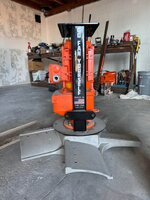
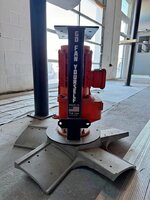
Just an ad I saw on FB MP. A "Go Fan Yourself fan" that's missing the blades. Not sure if it's three phase- probably a vfd controller?

You are using an out of date browser. It may not display this or other websites correctly.
You should upgrade or use an alternative browser.
You should upgrade or use an alternative browser.
Here's a big fan project
- Thread starter 930dreamer
- Start date

fitter30
Well-known member
Vane Axial Fans are the most efficient axial design, best suited for applications where there are high volumes of air at medium to high pressures. Used them in hi rise office buildings for air handlers. They were fitted with vfd's or moveable vanes and axial silencers ( muffler).
OP
I emailed the company asking about replacement blades, I'm sure that will be heart stopping.
Shiftless
Well-known member
Looks like the big *** fans have been upstaged.I emailed the company asking about replacement blades, I'm sure that will be heart stopping.
GJ is all about overkill but this looks like overkilling the overkill. Is this fan 24 feet in diameter?

OP
This model uses blades from 8'-24'.Looks like the big *** fans have been upstaged.
GJ is all about overkill but this looks like overfilling the overkill. Is this fan 24 feet in diameter?
Shiftless
Well-known member
An overhead fan with a blade tip to blade tip diameter of 50 feet would be quite a sight.This model uses blades from 8'-24'.

OP
Yup, my shop is only 40 feet deep.
OP
100x100' the perfect size shop.
SwissMetric
Well-known member
The motor gear unit is from Getriebebau NORD GmbH & Co. KG, it's a well-known German company (reliable products), with IEC asynchronous motor (also from NORD), here without fan cowl and probably no fan as sufficiently surface-cooled by the air flow, it's not a Dodge Quantis gear with ABB motor as mentioned in some sales flyers.
There are probably 3 PTC sensors in series to monitor the stator windings, carefully check the rating plate and make sure that protections are set according to the rating plate unless lower settings are required. IIRC protection curves are not the same for NEMA and IEC but I'm not used to NEMA rated motors.
Typically you'll use a VSD. If the RPM's are lower than nominal, sufficient cooling of the motor must be checked. If using a VSD the load can be read out which allows to determine if cooling requirements are met.
In theory, the required power increases with the power of 3 of the speed (RPM) of the fan, therefore even small differences in speed settings have quite an influence on the required shaft output power.
Any basic reliable VSD can be used. Depending on some details PTC's can be connected to the VSD or, in any case, an external PTC relay can, or sometimes must, be used. In some cases insufficient PELV/SELV isolation make external PTC relays mandatory, also ATEX conformity may require it but here it is irrelevant.
It's possibly also a 2-speed motor, if so make sure to connect windings correctly. That said, a VSD is probably still a better solution as the speed can be finely tuned. In such case only the higher speed winding has to be connected; in theory windings could be switched together with VSD parameter set switching but it becomes uselessly complicated and the efficiency gain, if any, isn't worth that implementation.
I'm used to very large low-voltage drive systems beyond 1.5 MW per motor but only IEC, not NEMA.
There are probably 3 PTC sensors in series to monitor the stator windings, carefully check the rating plate and make sure that protections are set according to the rating plate unless lower settings are required. IIRC protection curves are not the same for NEMA and IEC but I'm not used to NEMA rated motors.
Typically you'll use a VSD. If the RPM's are lower than nominal, sufficient cooling of the motor must be checked. If using a VSD the load can be read out which allows to determine if cooling requirements are met.
In theory, the required power increases with the power of 3 of the speed (RPM) of the fan, therefore even small differences in speed settings have quite an influence on the required shaft output power.
Any basic reliable VSD can be used. Depending on some details PTC's can be connected to the VSD or, in any case, an external PTC relay can, or sometimes must, be used. In some cases insufficient PELV/SELV isolation make external PTC relays mandatory, also ATEX conformity may require it but here it is irrelevant.
It's possibly also a 2-speed motor, if so make sure to connect windings correctly. That said, a VSD is probably still a better solution as the speed can be finely tuned. In such case only the higher speed winding has to be connected; in theory windings could be switched together with VSD parameter set switching but it becomes uselessly complicated and the efficiency gain, if any, isn't worth that implementation.
I'm used to very large low-voltage drive systems beyond 1.5 MW per motor but only IEC, not NEMA.