To avoid these ads, REGISTER NOW!

Here's one for fun —

To avoid these ads, REGISTER NOW!

sparky 1971

Well-known member
Joined
Oct 9, 2018
Messages
7,973
Location
Central Iowa
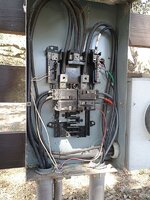
I'll play. The field punched knockout in the back needs some type of connector. The neutrals at the top are double lugged and need to be identified with some type of white or gray marking.

I've seen a lot worse...

Next...

Edit. The 100 amp breakers could be for 240 volt lighting, in which case the unidentified wires should be marked green.
 
Last edited:

Chuckster in NJ

Well-known member
Joined
Jan 26, 2010
Messages
2,298
Location
Hunterdon County NJ
No ground rod.
I would have to "investigate" a little more to see if the ****** between the pan and the panel needs a ground bushing.
Are the lugs torqued to specs?
Is the main breaker "secured" in place with a screw?
Is there a bonding screw?…… It should be a green color.
 
Last edited:
OP
E

ehcsrop

Active member
Joined
Aug 15, 2024
Messages
34
Location
Lakewood, CA
So, there is a question involved aside from the mess that constitutes the panel. The plan is to add another sub, probably need 50-60 amps for a small outbuilding that will contain an observatory. Small motors, some lighting, although that's not going to be much, a computer, and a small window AC for hot nights in TX.

The question is while correcting the existing panel (the 100a breakers are no longer needed) will the existing panel need a main breaker? Since the new building is detached, it will have a disconnect in a 6 slot panel.

BTW, I identified the violations except I missed the bushings. Wasn't sure about the requirements for PVC. Good catch on the bonding.
 

sparky 1971

Well-known member
Joined
Oct 9, 2018
Messages
7,973
Location
Central Iowa
So, there is a question involved aside from the mess that constitutes the panel. The plan is to add another sub, probably need 50-60 amps for a small outbuilding that will contain an observatory. Small motors, some lighting, although that's not going to be much, a computer, and a small window AC for hot nights in TX.

The question is while correcting the existing panel (the 100a breakers are no longer needed) will the existing panel need a main breaker? Since the new building is detached, it will have a disconnect in a 6 slot panel.

BTW, I identified the violations except I missed the bushings. Wasn't sure about the requirements for PVC. Good catch on the bonding.
I don't like it and won't do it with a new panel, but if the existing panel is kept to six breakers (handle throws) on it or or less you don't need a main. Since that panel is a 16 space, it could have anything from 16 single poles through eight two pole breakers. We don't worry about the next guy and I don't see much difference between one throw and 16 in the same panel but rules are rules.
 
OP
E

ehcsrop

Active member
Joined
Aug 15, 2024
Messages
34
Location
Lakewood, CA
I'm sorry, I don't understand your post ^^^ at all. I realize the existing panel with all of its violations does not exceed 6 switches and certainly won't after the 100a breakers are removed. But I did a search on sub panels in series and the requirements of disconnects, when and where, and even the Mike Holt forum offered little information.

I'm somewhat versed on subpanel requirements, separate busses, 2 ground rods, etc., but not so much when a sub powers another sub. The reason this is being kept in service is that it is well out on the land and is the closest source of power to the new structure. Otherwise, a new feed would require a LOT of trenching.

As I said, plenty in the existing panel can be removed so the double tap problem is easily solved. Other violations can be easily fixed. Still wanting to know if a main breaker in the new proposed panel in an outbuilding will suffice. And, yes, I found that it may come to light (no pun) that if a panel is large enough, e.g., a 16 slot panel, the 6 switch rule can come into question because of the ability to easily add more circuits.

I suppose the safe way is to just add a main to this existing mess, but IDT it's possible without changing the panel altogether. Getting a new panel here to match the old AFA conduits go could be tricky. I haven't shopped that yet.
 

sparky 1971

Well-known member
Joined
Oct 9, 2018
Messages
7,973
Location
Central Iowa
I'm sorry, I don't understand your post ^^^ at all. I realize the existing panel with all of its violations does not exceed 6 switches and certainly won't after the 100a breakers are removed. But I did a search on sub panels in series and the requirements of disconnects, when and where, and even the Mike Holt forum offered little information.
You asked if the existing panel needed a main breaker. The answer is no as long as it has six breakers or less.
I'm somewhat versed on subpanel requirements, separate busses, 2 ground rods, etc., but not so much when a sub powers another sub.
The existing panel isn't a sub, it's the main even if there's no main breaker. (If there's a main in the meter socket that I can't see, the panel will then be a sub and require the neutral to be isolated from the grounds but I doubt that's the case.


The reason this is being kept in service is that it is well out on the land and is the closest source of power to the new structure. Otherwise, a new feed would require a LOT of trenching.

As I said, plenty in the existing panel can be removed so the double tap problem is easily solved.
Its more easily solved with a lug adapter.

other violations can be easily fixed. Still wanting to know if a main breaker in the new proposed panel in an outbuilding will suffice. And, yes, I found that it may come to light (no pun) that if a panel is large enough, e.g., a 16 slot panel, the 6 switch rule can come into question because of the ability to easily add more circuits.

The new subpanel has to have a disconnect and a main breaker will suffice but that has nothing to do with the other panel. Since you didn't ask about the new panel that is yet to be installed, only stated it would have a disconnect along with a six space panel, I didn't answer the question that didn't exist. And, if you're thinking an exterior disconnect is required on the new building, it's not. That is only for dwellings. You could go ahead and do that, but you wouldn't need a main breaker panel unless you wanted one.
I suppose the safe way is to just add a main to this existing mess, but IDT it's possible without changing the panel altogether. Getting a new panel here to match the old AFA conduits go could be tricky. I haven't shopped that yet.
It might be a convertible main and a Square D QOM2200 would fit. Is there a knockout for the a main in the cover? Personally, I'd leave it as is.
 
OP
E

ehcsrop

Active member
Joined
Aug 15, 2024
Messages
34
Location
Lakewood, CA
Thank you, @Sparky. This is not my job. I don't live in TX. I'm just familiar with the owner. At first, the observatory builder was going to attempt this but I said don't touch it, get someone that knew what they were doing (licensed, if this is in an AHJ that requires one. I see in TX that the state says yes). In any case, someone that knew what they were doing.

You know what? I did not realize the meter beside this panel. I see the ring but I didn't even think of 2 meters on the property. It's 100 acres and I live in the city, so IDT of these things. So IDK what kind of main disconnect is present. Interestingly, the the builder mentioned that the panel was always hot (???). So, you see, there is a lot that I don't know about the job.

But thanks for clearing up the disconnect at the new sub. That is the info I found hard to come by without a new code book in hand.
 

sparky 1971

Well-known member
Joined
Oct 9, 2018
Messages
7,973
Location
Central Iowa
Thank you, @Sparky. This is not my job. I don't live in TX. I'm just familiar with the owner. At first, the observatory builder was going to attempt this but I said don't touch it, get someone that knew what they were doing (licensed, if this is in an AHJ that requires one. I see in TX that the state says yes). In any case, someone that knew what they were doing.

You know what? I did not realize the meter beside this panel. I see the ring but I didn't even think of 2 meters on the property. It's 100 acres and I live in the city, so IDT of these things. So IDK what kind of main disconnect is present. Interestingly, the the builder mentioned that the panel was always hot (???). So, you see, there is a lot that I don't know about the job
There probably isn't a main breaker and whoever installed the panel that is currently there let it fall under the six throw rule which, code wise, is acceptable even if I don't like it.
But thanks for clearing up the disconnect at the new sub. That is the info I found hard to come by without a new code book in hand.
 
OP
E

ehcsrop

Active member
Joined
Aug 15, 2024
Messages
34
Location
Lakewood, CA
The more I look at it, shouldn't the left bus be the EGC that also should be connected to the GEC of which we don't see any.
Also, the red wire on the RS neutral bus that goes into the non box connected KO is, well, what is it besides just wrong? I think I see where the neutral bonding screw would be on the RS bus. It's the non colored round head screw nearest the shield. What do you think? Lastly, I see the lines coming out of the meter socket (now that I realize the presence of the meter) but I don't see how it's fed. That big cable coming up into the panel on the left conduit sure looks like a feed.

I'm just reinforcing my electrical knowledge here. I appreciate the comments. I don't want to pass on bad information but I think I have made my case about the builder staying out of this and hiring the electrical done even if the builder does the trench and conduit with his labor instead of paying the electrician to dig. I'm a retired general and that is how I would do it. If the owner wants comms out there I would be doing that work.

This is not a licensed builder, he just started building home base observatories out of a personal hobby. He might know how those work. I understand there is a powered retractable roof. If that is weatherproof then I have to give this guy some chops.
 
To avoid these ads, REGISTER NOW!

wyliesdiesels

Well-known member
Joined
Aug 14, 2012
Messages
20,023
Location
Modesto, CA
The more I look at it, shouldn't the left bus be the EGC that also should be connected to the GEC of which we don't see any.
no because this is a main service panel unless there is a breaker ahead of it in the meter panel (which i doubt because he doesnt look like there is any room for one). neutrals and grounds can land on the same bars in main service panels. there should be a bonding strap or screw in one of the neutral bars
 

sparky 1971

Well-known member
Joined
Oct 9, 2018
Messages
7,973
Location
Central Iowa
The more I look at it, shouldn't the left bus be the EGC that also should be connected to the GEC of which we don't see any.
All of the neutral bus is basically one piece, you just can't see the sides tied together because of the plastic.
Also, the red wire on the RS neutral bus that goes into the non box connected KO is, well, what is it besides just wrong?
Looks like the red wire is being used for a ground since a black and white are present. The screen on my tablet isn't good enough for me to see those kinds of things, my desktop is and I see it now. There is probably a receptacle mounted on the back of the framing directly behind the panel, and maybe screwed directly to the panel judging by what looks like a screw coming through the back just to the right of the hole. That's a piddly little easy fix that in all reality isn't hurting anything.
I think I see where the neutral bonding screw would be on the RS bus. It's the non colored round head screw nearest the shield. What do you think?
You're right. The panel is old enough that it predates the screw being green, or the green has worn off.
Lastly, I see the lines coming out of the meter socket (now that I realize the presence of the meter) but I don't see how it's fed. The meter socket is probably fed underground. That big cable coming up into the panel on the left conduit sure looks like a feed.
I can't read the breaker, but that's probably a 100 amp breaker and feeding the lights. There are probably fused disconnects or another panel for the lights somewhere.
I'm just reinforcing my electrical knowledge here. I appreciate the comments. I don't want to pass on bad information but I think I have made my case about the builder staying out of this and hiring the electrical done even if the builder does the trench and conduit with his labor instead of paying the electrician to dig. I'm a retired general and that is how I would do it. If the owner wants comms out there I would be doing that work.

This is not a licensed builder, he just started building home base observatories out of a personal hobby. He might know how those work. I understand there is a powered retractable roof. If that is weatherproof then I have to give this guy some chops.
 

Skooterj

Well-known member
Joined
Mar 11, 2021
Messages
750
Location
Indiana
Maybe I just can't see clearly, but can someone explain the three wires in the middle at the top? It looks like one is the neutral coming in from the meter, but it looks like both the other two exit out the conduit on the bottom left?? Along with both legs from the breaker on the left? I don't get it, isn't that an extra neutral?
 

sparky 1971

Well-known member
Joined
Oct 9, 2018
Messages
7,973
Location
Central Iowa
Maybe I just can't see clearly, but can someone explain the three wires in the middle at the top? It looks like one is the neutral coming in from the meter, but it looks like both the other two exit out the conduit on the bottom left?? Along with both legs from the breaker on the left? I don't get it, isn't that an extra neutral?
I can't tell what is what or going where but one of them is probably a ground.
 
OP
E

ehcsrop

Active member
Joined
Aug 15, 2024
Messages
34
Location
Lakewood, CA
OK. Does that assume some idiot didn't connect that extra wire to a ground rod? Let's say this '***** lighting' has a lot of steel frame work, some in the ground. I would not even suppose they provided an UFER in the frame work anchors, but the question is, can someone think they are providing some sort of bond? As a contractor I never had one thing to do with high wattage exterior lighting. I might have done some work for lit sign outside at one time, but I don't remember. In TX do they do lightening rods on electrified poles?

I know there is confusion as to the difference between equipment grounds and grounding connectors. I don't see how this extra wire does any equipment grounding. But I ask simply because I don't know.

Anyway, I'm not there and pretty much out of information. I lost touch with the job probably because I suggested that things didn't look so good and maybe fix it.
 

sparky 1971

Well-known member
Joined
Oct 9, 2018
Messages
7,973
Location
Central Iowa
OK. Does that assume some idiot didn't connect that extra wire to a ground rod? Let's say this '***** lighting' has a lot of steel frame work, some in the ground. I would not even suppose they provided an UFER in the frame work anchors, but the question is, can someone think they are providing some sort of bond? As a contractor I never had one thing to do with high wattage exterior lighting. I might have done some work for lit sign outside at one time, but I don't remember. In TX do they do lightening rods on electrified poles?

I know there is confusion as to the difference between equipment grounds and grounding connectors. I don't see how this extra wire does any equipment grounding. But I ask simply because I don't know.

Anyway, I'm not there and pretty much out of information. I lost touch with the job probably because I suggested that things didn't look so good and maybe fix it.
It's an equipment ground if there are four conductors in the conduit. There's no way that a 100 amp breaker is directly feeding lights. That 100 feeder may be going to a trough with distribution blocks in it, then to fused disconnects, then the lights or it may be a four wire feeder to another panel. The other 100 amp circuit is a **** shoot with three wires. It could be a 120/240 three wire feeder with a bonded neutral or it could be straight 240 and the third wire is a ground. Nobody is going to be able to tell you what is what using the one picture. We need to know what us on the other ends of the wire to go any further.
 
Last edited:

sparky 1971

Well-known member
Joined
Oct 9, 2018
Messages
7,973
Location
Central Iowa
Looking at this on my desktop, I only see three wires per 2" conduit, including the meter socket which would leave one of the neutral/grounds unexplained if the one on the right with the white tape is included. I thought it might be a GEC, but don't see anything leaving the bottom. It could be going down the left conduit, but I sure as the world don't see it, it just disappears from view towards the bottom. If the picture were straight on and the top of the panel not cut off I might be able to see WTF is going on.
 
Last edited:
OP
E

ehcsrop

Active member
Joined
Aug 15, 2024
Messages
34
Location
Lakewood, CA
You're right, time to let it go. ***** range could have an electric clay pigeon device too. Another panel makes a lot of sense.

I believe I'm done here for now. IDT I'm going to hear any more from the project. Thank you all, gentlemen. It's been my pleasure.

Maybe when something else comes up. I've had a surface mount sub on my detached garage wall for 2 years (at least) and all that is hooked up is the GEC to the rods. Conduit to the area was undersized and until I'm willing to saw cut concrete and run a feeder, it's going to hang there doing nothing. 27 years in the garage on one 20a breaker and I've never tripped it unless I ran a space heater and forgot it was on when the compressor started.

When I weld I run a fat yellow contractor's twist lock to the house panel 25 feet away. 10 ga 240v cord on a 30a dbl has never stopped once. You'd think I'd get tired of that.
 
To avoid these ads, REGISTER NOW!
Top Bottom