To avoid these ads, REGISTER NOW!

Hex keys, straight or ball end?

atikovi

Well-known member
Joined
Feb 14, 2009
Messages
1,996
Location
Suburban Washington DC
Which one is less likely to round out the socket head fastener? I have a set of the ball end but the contact area on the ball is much smaller than that of a straight end. I already rounded out one socket head screw. Would a straight set be better. What brand to buy?
 
To avoid these ads, REGISTER NOW!

Adambomb946

Member
Joined
Jan 25, 2019
Messages
5
Location
Fairfax, VA
Ive wondered this myself. I would imagine that the ball type end would round out and strip the inner surface which is why ive never used them.
 

jumbojak

Well-known member
Joined
Jun 21, 2016
Messages
1,364
Location
Surry, VA
I have two sets of Carlyle that I really, really like. If you can use the straight end do that. The key is less likely to break, I can't say whether they're less likely to round a cap screw.
 

mikegt4

Well-known member
Joined
Sep 12, 2005
Messages
3,269
Location
sw ohio
Straight are stronger and less likely to strip out a screw head but they only work when you have a straight shot to the screw hence the invention of the ball head. I have both kinds and use the ball head when appropriate.
 

plinker

Well-known member
Joined
Feb 28, 2007
Messages
4,286
Location
Northern Wi
Straight hex keys would be the best. Ball hex is handy at times but somewhat fragile by nature and can round stuff. Even straight ones can round out stuff, but with the proper size and with it fully seated it isnt much of an issue unless the fastener is corroded.

Bondhus is very popular. I've got Snap-on's myself plus some Elkind.
 
Last edited:

M6erfan

Well-known member
Joined
Dec 6, 2014
Messages
10,170
Location
'Merica!
Which one is less likely to round out the socket head fastener? I have a set of the ball end but the contact area on the ball is much smaller than that of a straight end. I already rounded out one socket head screw. Would a straight set be better. What brand to buy?

I have both styles and I get a far more positive grip with the non-ball ends. Ball ends are great when you need them but I use regular straights whenever possible.

Bondhus are nice as are Wiha and PB Swiss.
 

PhysicsDude

Well-known member
Joined
Jan 28, 2013
Messages
805
Location
Dallas, TX
Ball end hexes are great for a lot of things, but the things I find annoying about them are:

1. Manufacturers seem to think ball end tools are the new fad and make a ton of tools with only ball end and no straight end option. Finding quality straight end hex screwdrivers is very difficult.

2. Obviously torque is limited. I haven't ever had a problem when installing a fastener, but when taking one off that's been installed for awhile... ball end just won't cut it.

3. When you're trying to install a hex screw, it flops around on the ball end. It can be annoyingly difficult to get the threads to line up.

Overall I prefer straight end. Hex socket or 1/4" shank bit in a multidriver are my preferred usage.
 

American Locomotive

Well-known member
Joined
Jan 8, 2017
Messages
10,957
Location
Rhode Island
I think it's wise to have both. I use ball ends whenever possible. I only switch to straight hex keys when the torque starts getting too high for the ball end (you can usually feel the ball end starting to dig into the fastener before anything bad happens).

We use Bondhus, Wiha and Wera. I find myself using the Wera Hex Plus set the most.
 

TheLurker

Well-known member
Joined
Dec 30, 2013
Messages
193
Location
HSV, AL
My experience is that the ball ends only work well on bolts that have thicker heads. Otherwise you're getting less surface area contact. I've stripped more than my share on bolts that I had to use a ball end due to clearance or slight angles.


I keep both on hand but use the straight more often than not.
 

d.mcfarland

Well-known member
Joined
Jun 18, 2012
Messages
6,570
Location
Western PA
I would say that the quality of the hex key design will make or break whether or not you damage the fastener.

Take these for example: https://www.kctoolco.com/wiha-66992...ex-l-key-inch-metric-set/?rfsn=2236887.e07e45
attachment.php


You can see that the ball end design is different in that the contact area of the Wiha's are much more squared off. The locking ring helps the key stay put also.
attachment.php


I don't know how you are twisting so hard with the little end of a L shape hex key though! Those hurt so bad to twist.
 

Attachments

  • IMG_4166.jpg
    IMG_4166.jpg
    130.1 KB · Views: 459
  • IMG_4177.jpg
    IMG_4177.jpg
    157.8 KB · Views: 469

ddawg16

Well-known member
Joined
Jul 11, 2008
Messages
21,005
Location
S. California
I think it's wise to have both. I use ball ends whenever possible. I only switch to straight hex keys when the torque starts getting too high for the ball end (you can usually feel the ball end starting to dig into the fastener before anything bad happens).

We use Bondhus, Wiha and Wera. I find myself using the Wera Hex Plus set the most.

Yup.....both
 
To avoid these ads, REGISTER NOW!

7635tools

Well-known member
Joined
Feb 19, 2015
Messages
87
Location
Southeast Wisconsin
I would say that the quality of the hex key design will make or break whether or not you damage the fastener.

Take these for example: https://www.kctoolco.com/wiha-66992...ex-l-key-inch-metric-set/?rfsn=2236887.e07e45
attachment.php


You can see that the ball end design is different in that the contact area of the Wiha's are much more squared off. The locking ring helps the key stay put also.
attachment.php


I don't know how you are twisting so hard with the little end of a L shape hex key though! Those hurt so bad to twist.


I’ve put box end wrenches or vise grips on the small end when the fastener doesn’t cooperate. I have both styles but prefer the straight ones.


Sent from my iPhone using Tapatalk
 

Citation

Well-known member
Joined
Jan 20, 2016
Messages
3,214
Location
Indy
I would suggest having both. I've had enough cases (and designed a few) where a ball end was either required or stupidly handy to get the screw in place. In some cases when the screw is near tight then I would switch from "screwdriver" mode with the ball end to "wrench" mode where, due to obstructions I could only turn a fraction of a turn at a time. In the cases of things I designed these were clean parts where high torque wasn't critical.

A ball end on the long leg plus squared end on the other side still doesn't cut it because sometimes I've had to use the long leg (and a handle) to get a stubborn, recessed bolt. This is one of those cases where I figured having both is just better.
 

Wamsutta

Well-known member
Joined
Jan 8, 2014
Messages
10,876
Location
Amarillo, Texas
The L hex end is for breaking the fastener free, and then the ball hex straight end is for spinning the fastener out from an angle. I recommend the stubby Bondhus ball hex L keys for that purpose. They are still a long L key, but the bent end is shorter than the bent end on a regular L key.

imageRendering.jsp
 

Michael_in_DE

Well-known member
Joined
May 11, 2017
Messages
1,012
Location
Wilmington, DE
I have a Matco Ball-end set. I was working on refurbing a large shop fan and used one of the ball ends. It snapped pretty easy. Matco guy replaced it easily enough but asked what kind of force I used. Not a lot. used one hand and didn't even twist it that hard. Now I'm hesitant to use them all all.
 

bwringer

Well-known member
Joined
Jan 1, 2013
Messages
10,273
Location
Indianapolis

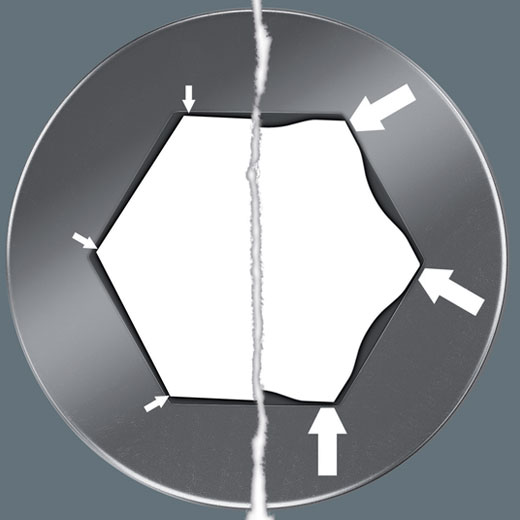
Whats the idea behind twisted keys? seems like a strange idea to have hex keys that are pre-damaged...lol

I dunno what the physics are, but those are so damn cool-looking I just might have to get a set. :thumbup:

Maybe the idea is that they expand slightly when you really crank on them? Dunno.


And yeah, ball ends aren't as strong as a straight end. Seems completely obvious there's a tradeoff there.

Sometimes a ball end is the only way to reach something, but usually you crack it loose with the straight end and then run it out with the ball.

The Wiha and Bondhus ball ends with the fastener holders are an incredible time and frustration saver, but again, it's fairly obvious there's a tradeoff in strength. They have a specific purpose of making disassembly and assembly easier, but they're very obviously not meant for final torquing or cracking loose stuck fasteners.

Those stubby keys are quite nice too -- I've had to make my own more than once.

And yes, if you deal with socket head fasteners much, you will need a variety of hex key tools. It's like any other type of fastener; the correct answer to "which tool" is "ALL OF THEM!"
 
Last edited:

dr_clyde

Well-known member
Joined
Jan 7, 2009
Messages
6,441
Location
Holland, MI
Both? They're like, $25.

I never understand these self imposed ultimatums on reasonably inexpensive tools.

6 or 12 point? Ball or straight? What drive size? Air or battery? Cord or battery? Sheesh.
 

bonneyman

Well-known member
Joined
Apr 22, 2010
Messages
8,794
Location
Desert SW
I would say that the quality of the hex key design will make or break whether or not you damage the fastener.

You can see that the ball end design is different in that the contact area of the Wiha's are much more squared off. The locking ring helps the key stay put also.
attachment.php

Nice close up! :thumbup:
I can see how the rubber o-ring would help fastener retention on the tool so you don't drop it, but you'd think the steel gripping surface would be reduced by the amount the ring takes up. From the looks of it that might be a 10% reduction or more.

I use straights almost exclusively, though I have a bunch of metric ball versions for work on my bicycles. Manufacturers love to put socket cap bolts in all sorts of inaccessible places.
 
Last edited:

d.mcfarland

Well-known member
Joined
Jun 18, 2012
Messages
6,570
Location
Western PA
I can see how the rubber o-ring would help fastener retention on the tool so you don't drop it, but you'd think the steel gripping surface would be reduced by the amount the ring takes up. From the looks of it that might be a 10% reduction or more.

The retention ring is steel. Works the same as a hog ring type of retention on impact guns.
 

Leaflessshadetree

Well-known member
Joined
Aug 1, 2013
Messages
7,154
Location
Don't ask.
The ball end are easier to insert fully and on a stubborn fastener the ball will likely twist off before stripping the head.
You can apply more force with the straight, again when fully seated.

If not fully seated the chance of rounding out the fastener is about equal.
 

rhys99

Well-known member
Joined
Jan 2, 2019
Messages
80
Location
Lancashire UK
For keys the ball end is always useful, i have a set of Snap on Stubby ones and a Wera long set, both get heavy use. As a motorcycle mechanic hex fasteners are used on everything and i use the Snap on Straight T bars constantly. Ball ended ones will round fasteners easier when used in higher torque applications.
 

Billy Jack

Well-known member
Joined
Jan 12, 2017
Messages
302
Location
Pittsburgh Suburbs
For keys the ball end is always useful, i have a set of Snap on Stubby ones and a Wera long set, both get heavy use. As a motorcycle mechanic hex fasteners are used on everything and i use the Snap on Straight T bars constantly. Ball ended ones will round fasteners easier when used in higher torque applications.

Your post reminded me of something from years ago.
Way in the back of my box are a set of these from when I did a bunch of motorcycle work.

GAW1908.jpg


They were a joy to use on bikes, as each one felt like it had its handle flex calibrated to be its own torque wrench.

Bill
 
To avoid these ads, REGISTER NOW!
Top Bottom