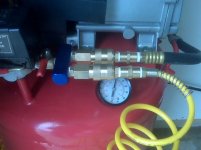
I have the older model 94667 referenced above, and it does all I need it to do with the 1/2" earthquake gun. I will say that the first thing I did was remove the regulator altogether, and here's why. I set the shutoff so that the pump shuts off at 120psi and kicks on at 90psi. When there is 120psi in the tank, with a pressure gauge mounted just before the impact wrench, as soon as you pull the trigger on the wrench, pressure drops to a perfect 90psi when using a 50' 3/8" goodyear air hose. This is using their hi-flow air couplers. So, I removed the regulator and mounted couplers on it so I could plumb it in if needed (brad nailer, etc), but the compressor is perfect with no regulator on it since the hose and fittings regulate it to 90 anyway.
The Earthquake gun is AWESOME. Worlds better then the cheap impact wrenches sold at HF and elsewhere. It zips lugnuts off like lightening (torqued to 110 ft/lb.), and I set it on setting 3 of 6 to put them back on, and that puts them just shy of clicking the torque wrench at 110 ft/lb. The gun is heavy though, but it's quick, so you won't be holding it long.
As for air usage, I can remove two wheels and re-install them for a brake job or tire-rotation on my Chevy Truck before the compressor kicks on if I'm quick about it. Then the compressor kicks on for 2 minutes or so. It's LOUD, but it's does all I need it to do.
I also swapped off the air shutoff to a 1/4" brass ball valve (at HF) since internally it is much larger than the one that came on it. I didn't notice much difference, but it certainly didn't hurt. Then, I installed a splitter to give the compressor 2 female hose couplers. This, in addition to the 1/2" air-hose supply line I made to run a hose reel and hookup for the bench on the opposite side of the garage, gives me air in three places and adds to the capacity of the system.
Here are some pictures before the shutoff conversion. The second photo is a comparison from the standard 1/4" air hose coupler and the hi-flow HF ones. The Hi-flow have the same internal size as 3/8" (roughly) connectors and are threaded for 1/4" hookups. The third photo shows the tee I made to measure pressure at the end of the hose just before the tool.