To avoid these ads, REGISTER NOW!

High Pressure in Radiant Heat?

t_oad01

Member
Joined
Sep 11, 2008
Messages
18
Hello Everyone,
I have been snooping around here for a good while, I have found it to be a great place for information while I have been building my garage.
I am having some issues with my in floor radiant heat that I just got up and running last weekend.

The pressure in the system keeps increasing. tap pressure is 40 psi, and in 12 hours the pressure rises to around 80 psi. I let it go for a full day and it blew out the 150 psi relief valve on the HWT! I am trying to run an open system to cover the heating and the two sinks that will be in the garage. When I completely shut the valves for the water into the system the pressure does not rise, and if anything I will find the pressure less than the 40 psi tap pressure that I left it at.

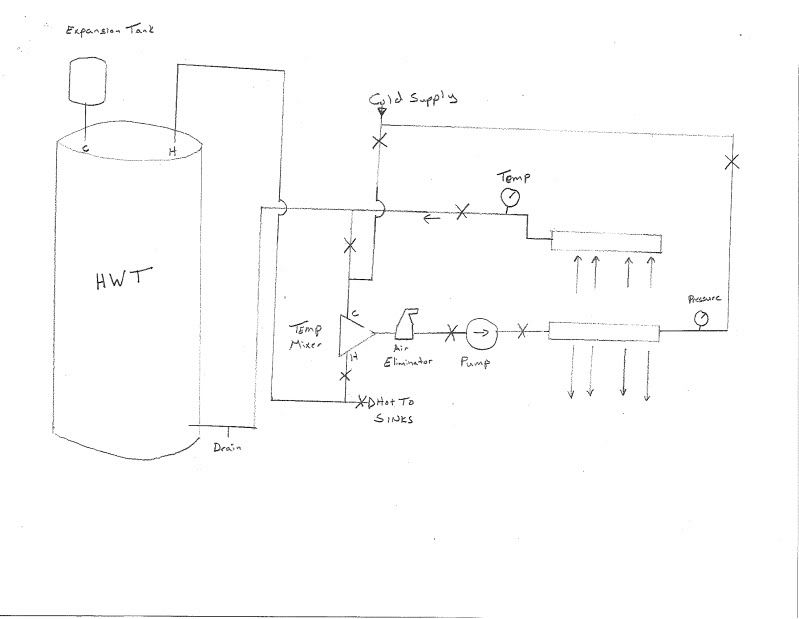
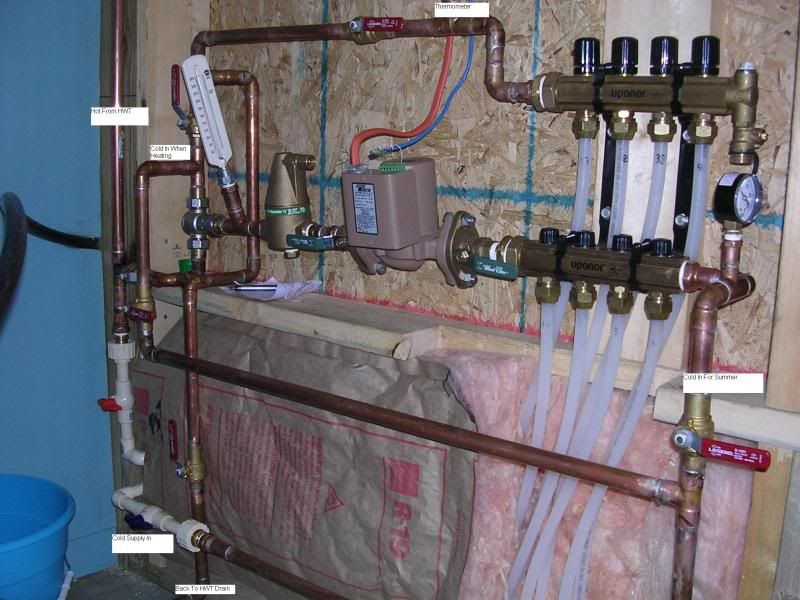
Hopefully my pictures are useful, but I will try to explain what I came up with.
The cold water into the system is coming in the blue PVC valve, and can enter the system in two places, while heating the cold water would enter the plumbing before the mixing valve on the cold side so it will not cool down the water entering the floor. During the summer I would close the valve going before the mixer and run the incoming cold water in the right side of the manifold so incoming water would circulate through the tubing and I would not have to worry about the check valve in the pump.

The cool water returning form the floor connects to the cold side of the mixing valve and also back to the HWT through the drain valve. Hot water exits the tank via the hot connection on the top of the tank, and the expansion tank is on the cold outlet of the HWT by its self.
I saw many example on the web of the open systems with the cold supply passing through the tubing in the floor before entering the HWT, but I cant see what my problem is.

FYI the expansion tank was pre-set to tap pressure. The HWT is 80 gal, and about 12 gal in the 1200 ft 1/2" tubing. I looked at the tank sizing, and it seems to be good for up over 100 gal given my water temperatures.
Taco 007 pump, Taco 5000 mixer, Taco air evacuation, free HWT.
Other than the high pressure, the system seems to be heating great! The temperature is always around where it should be, I can't complain with that.
Heating5Marked.jpg


DSCN0011.jpg

Thanks for the Help.
Todd
 
To avoid these ads, REGISTER NOW!
OP
T

t_oad01

Member
Joined
Sep 11, 2008
Messages
18
I talked to the tech's at watts and they confirmed that the expansion tank should be sized correctly. I am wondering if anyone with an open system could point out some differences between their system and my pictures. From what I can tell the mixer or check valve in the pump dont pose any major problems. Any info is appriceated.
Thanks.
 
OP
T

t_oad01

Member
Joined
Sep 11, 2008
Messages
18
Over the weekend I tried tying in the cold water inlet a couple different place. I tried hooking a hose up to the drain valve at the bottom of the HWT, and also separately tried hooking a hose up to the return manifold form the floor. Both had the same outcome and still increased the pressure, I let the system go to see how high the pressure would go and blew off the relief valve again. I added another expansion tank (same size as the plt-12) yesterday with no help, overnight the pressure rose from the 40 psi tap pressure to 80 psi, I left it be for today, but my guess is that it will overpressure the system during the day again. Any help or comment would be appreciated.
 

porphyre

Banned
Joined
Sep 2, 2009
Messages
1,321
Sorry nobody's helping you. Most times, guys around here can't stand not putting their two cents in.

I know nothing about radiant heating at all. But from your description, it seems there is something wrong with whatever controls the input and output. Either too much water is getting into the system or not enough is getting out.
 

custom1

Well-known member
Joined
Jan 8, 2008
Messages
307
Location
Pa
I have a guess. Keep in mind I don't know what I'm talking about and I'm not a heating guy. From the pictures it looks like your air bleed is not at the top of the system. There are two places that air can be trapped. At the top of the tank and in the line you have marked thermometer. Unless there is an air bleed that we can't see in the pic. Air will expand more than water and overpower the expansion tank just like air in a brake system will expand and keep a brake on.
I also thought that if you have two check valves somewhere it could cause problems, but your expansion tank is right there on the HWT so it must be air or something. I've seen most people mount the expansion tank the other way but I don't think that's your problem. Just a guess.
Maybe take some more pics from different angles so we can see the where the pipes go a little better. The left side of the first pic looks like one of those optical trick pictures or the "pipes" sceensaver to me.
 

Steve in Mi

Well-known member
Joined
Mar 13, 2007
Messages
1,042
Location
Mid Michigan
I am trying to run an open system to cover the heating and the two sinks that will be in the garage.

I don't understand why you would be using an expansion tank and have piped in water under pressure for an OPEN system.
 

tyrell2004

Well-known member
Joined
Feb 27, 2009
Messages
116
I had a closed system in my house but did not get a chance to operate in much(divorce) so just throwing out a couple of quick brain storm ideas.
Can't quite tell but it looks like the Expansion tank is on both the hot water and radiant loop.
1. Should the expansion tank be isolated to only the Radiant floor loop, not normally required in normal hot water supply? (not sure why that would cause over pressure but..
2. Is the thermostat on the water heater functioning properly, and heat coming on when there is not a demand to heat cold water and over pressurizing by over heating the tank?
 

duaneb9729

Active member
Joined
Aug 11, 2009
Messages
27
i suspect the expansion tank bladder is bad or isnt inflated to the proper pressure
 

duaneb9729

Active member
Joined
Aug 11, 2009
Messages
27
I am sorry i didnt read the page well, move the expansion tank to the bottom of the air eliminator,
 
OP
T

t_oad01

Member
Joined
Sep 11, 2008
Messages
18
Thank you everyone for your replies, I was starting to lose hope. I am having trouble getting everything into pictures because the room is only 4’ x 8’ I will attach a sketch hopefully that will help. The sketch I have is too big, I will try to resize it and add it later. The system is under tap pressure only, so that the hot out to the sinks will work properly.
I do not have a regulator, but it is on the list to try, it seems that a regulator may help, but I am not sure if it would actually solve the problem. I added another expansion tank Sunday night, but I don’t think the system has run enough to see if it will have an effect. Still at 82 psi, but I am not getting my hopes up, it should cycle a bit today.

When I originally filled the system I made sure that all the air was bled out, and it seems that the air eliminator had been doing its job, but I will double check just to make sure.

As far as I can tell the house has no check valve (built in 74), so the only check is what I installed coming from the house to the garage. The house also has no expansion tank at the 115 gal HWT. I will be investigating the pressure in the house after the HWT cycles, and its effect on the garage. I just got a hold of a gauge that shows what the max pressure was. I will also look into moving the expansion tank, although the techs at Watts didn’t seem to think that it would make a difference but it can be swapped in easily.
Thank you very much for the input; I will give pretty much anything a try at this point. I will keep you update, please just keep in mind that I can only make changes about every 12 hours to see results, so it is slow moving to try everything.
 

E.rodz

Well-known member
Joined
Nov 11, 2009
Messages
2,435
Location
st.paul MN.
first of all i would say that i am not an expert. but i think i can see a major flaw in your system.the expansion tank needs to be on the hot side of your heater hot water expands thats the reason for the exspansion tank.the only way that you can make your expansion tank work at all is put it on the hot side.:headscrat
 
To avoid these ads, REGISTER NOW!

custom1

Well-known member
Joined
Jan 8, 2008
Messages
307
Location
Pa
The diagram helps. I could not tell from the pic that the expansion tank was on the cold side. There could be a anti-siphon check valve at the cold inlet in the HWT that would make the expansion tank out of the loop. I agree with the other posters, move the expansion tank under the air eliminator.

When the pressure is high, is it high at the sink? I would think it was and you don't want to change the pressure in the system every time you use the sink. So I think you need a check valve there below the mixing valve.

Could the mixing valve be acting like a check valve? Do you even need a mixing valve when using a HWT?

I still would put an air eliminator at the highest point. How can you get all the air out without it?
 

nate379

Banned
Joined
Feb 2, 2009
Messages
7,279
Location
Palmer, AK
Why are you running it at so high of a pressure at 40psi even?? Most boiler systems run at 10-15psi, I would think you'd want around that for your setup as well right?

Need one of these on your water intake side...

http://www.google.com/products?q=pr...esult_group&ct=title&resnum=4&ved=0CCkQrQQwAw

As well as a check valve.

I don't think running your "boiler water" in the same loop as the domestic water is to code.

Any reason you tap off the drain on the heater instead of the cold side??
 

tyrell2004

Well-known member
Joined
Feb 27, 2009
Messages
116
Not an expert either...............
But yes it look like the Expansion tank is isolated form your heating loop.
Re Drain tap: I agree using the drain instead of the cold water inlet will ensure all the sediment from the Hot water tank will flow through your system.
I think your routing is not correct over all as well, really need to to have a radiant guy look it over.
This site looked hopeful
http://www.radiantdesigninstitute.com/
 

seamusmcfadden

New member
Joined
Dec 2, 2009
Messages
2
Expansion tanks with bladders are charged to" say around 40 psi" and you are running higher psi than the expansion tank? Not good. Also to repeat others, expansion tank would do well located underneath air eliminator, and on the hot side of system. BTW you can adjust bladder psi on expansion tanks, though it should not be necessary. But who knows, it could be something else.
 
OP
T

t_oad01

Member
Joined
Sep 11, 2008
Messages
18
Thanks for all the opinions, and advice. Watts’s tech support said that the placement of their expansion tank should make no difference. I had seen mixed data both on the internet and product brochures on where to put the expansion tank, of the two exp. Tanks I bought, one said put it on the hot side, the other said put it on the cold. There is no check valve that I know of on the cold side of the HWT, I had it apart and it was simply a dip tube that runs the cold down to the bottom of the tank.

The dip tube would stir up anything on the bottom of the tank anyway, but both my plumbing inspector and the designer said to run the return into the drain. Sediment catching in the screening in my air evacuator may be a problem, but I can clean that out when I shut down for the summer as I plan on simply removing from the mixing valve to the pump anyway.

The plumbing inspector didn’t have any problem with me running and open system, I showed him simple sketches off the internet and he said fine. I did set the system up to run cold supply though the tubing during off heating times, and I can't see much difference from that and just having a long run of piping from the house to a garage or shed that didnt get used very often, I did read up on the deseases possible, and discussed with the plumbing inspector and my brother who is the county sanitarian. You can find arguments for both sides on the web, but I didnt save the web pages to site so take it for what you will.

I used a mixing valve when I noticed my design sheet calling for 85 degree water to run through the floor, the mixer makes it easier on the HWT, and will keep the heating system from overshooting the desired room temp. I checked again to show no air in the system. When I filled the system the first time I left the thermometer on the return side loose, and disconnected the union on the top of the HWT to get all the air out. Everything I read on the air evacuated made it seem as if it didn’t matter where the unit was places, and so far that seems to hold true.
I am running at 40 psi because that is my tap pressure so when I use hot water out of the tap it is replaced with cold supply water to keep the pressure the same. The exp tank came at 40 psi pre- charge, and I set the second one to the same.

I had read over the heating design institute pages, along with about any other page that comes up when you search in floor radiant heat over the last 2 years when I started planning the build, and I ended up with a blend of all the ideas.

I am not trying to put down anybody’s opinion, I do appriceate any help I can get, but just letting you guys know what I have went through so far if anything to help out others. Info on these systems is few and far between, at least for what I have found for local assistance. Again thank you for your help.

Now for the update, Tuesday night I got a hold of a tell tale gage from the plumbing inspector that has a needle that shows peak pressure, I hooked it up in the house and overnight it got up to 80 psi in the house that has never had an expansion tank (built in the 70’s), and the lines into the garage were the same. I had isolated the heating system so it had no pressure rise, and could not have affected the house pressure. I then had the proof I needed to get a pressure regulator.
Wed. night I took the second exp tank off of the garage system and put it on a tap on the cold side of the house HWT. My buddy from college who is a HVAC engineer who designs steam systems said that they design with the expansion tank on the cold side. Pressure stayed at 40 in the house and garage. Last night I left the exp. Tank hooked up in the house and turned the water into the heating system on so that it could pull cold water into the system just before the cold side of the mixing valve as designed. The pressure of both the house and the heating system were 40 this morning!!!! I have not installed the pressure regulator, but I will still install it to be safe. I want to give it a couple days to make use everything is good, but for the 12 hours last night everything seemed ok. The system did run overnight so it should have been through a complete cycle. The next couple days will tell if everything is fixed.
I will keep everyone updated, and thank you for your suggestions.
 
Last edited:

Ezzie

Well-known member
Joined
Oct 15, 2007
Messages
371
Location
Lake Chapala, Jalisco
I have a combo boiler that has an indirect DWH tank inside. The pressure in the floor loop side (closed loop) is running at around 16psi. The DWH (open loop) pressure is 70 psi. The expansion tank and air eliminator are on the floor return line, not the supply side. I double checked the mfgs. installation instructions and this is the way they want it so it doesn't have anything to do with "hot" side or "cold" side. You want the air eliminator on the "suction" side of the circulator pump to reduce cavitation.
 

nate379

Banned
Joined
Feb 2, 2009
Messages
7,279
Location
Palmer, AK
The thing with running your domestic hot water with the boiler water is... well have you seen what boiler water looks like?
I guess in a garage where you'd just wash your hands it's not a big deal but I wouldn't want to shower or wash dishes or clothes with it!
 

Steve in Mi

Well-known member
Joined
Mar 13, 2007
Messages
1,042
Location
Mid Michigan
The thing with running your domestic hot water with the boiler water is... well have you seen what boiler water looks like?
I guess in a garage where you'd just wash your hands it's not a big deal but I wouldn't want to shower or wash dishes or clothes with it!

Yes, I've seen boiler water so I make this comment about safety.

When I get something in my eye (chemical or grit) while working in the garage or shop I want water to rinse it out, I want it NOW, lots of it and perferably tempered (warm) water as it's eaiser to take than a cold splash in the face. I sure don't want any boiler water anywhere near my eyes but ymmv. BTW, the main reason for water in my shop is for safety. My house is HWH, an all copper, brass and stainless system and hard to understand where all that black coating on the inside of my pipe comes from but it is there.
 

koditten

Well-known member
Joined
Apr 10, 2008
Messages
5,528
Location
Midland, Michigan
This system is confusing me. Are you getting your domestic hot water and your floor heat water from the same water heater? If yes, your supply water pressure is collapsing the bladder in the tank leaving no air space for the hot water to expand to. Remember, Liquids can be pressurized but not compressed into a smaller space. Air can almost be compressed to infinity with enough pressure behind it.

As you heat up your loop water you are making more pressure because there is no place for the extra water to go as it expands from the heat.

Please let me(us) know if this is how I am seeing it.
 

Ron Lombardo

Well-known member
Joined
Feb 20, 2006
Messages
393
Location
New York
Switch the cold water supply with the expansion tank.

Feed the cold water supply into the water heater add a check valve and expansion tank.

Plug the cold water supply in the radiant loop and add another expansion tank to the bottom of the air eliminator.

The hot water in the water heater is expanding with no place to expand to .. or send me the sketch to my email [email protected] and I will re sketch it for you ... this dual purpose domestic and heat is a little tricky to pipe.

Ron
 
OP
T

t_oad01

Member
Joined
Sep 11, 2008
Messages
18
Sorry it took so long for the update, I wanted to make sure that the system was truly fixed and then the holidays hit. No pressure spikes since I installed the expansion tank in the house, I did install the pressure regulator, but have not adjusted it from the 50 psi that it came pre set to, the highest I have seen is 60 psi, and I am thrilled with that. No more water out the HWT relief.
On the water quality issue, considering I am using a domestic HWT I am not too concerned with the water from the heating system being used in the sinks. I am humble enough to let you guys know if a problem develops and put up with the “I told you so”. And I will keep an eye on the system down the road.
To summarize, I did not change anything from when the pictures were taken other than installing a pressure regulator on the water supply into the system. I am running the water in to the system where it mixes with the return from the floor directly before the cold side of the mixing valve.
I had a hard time getting cost info on these systems with all the information, so here is my first months heating with my specs. 30’x 40’ 1200sqft 3 bay garage with 3- 9’x8’ overhead doors, 1-3’x7’ ,man door, 3-3’x4’ windows A 8’x4’x 8’ tall kick out on the back where the HWT, and compressor are Isolated from the main area. Walls are insulated with 2-layers of what looked like old R13 Insulation that I bought used on craigslist, the ceiling is R19 in the 40’x 8’center area with OSB spaced off the 2x4 trusses for storage, with the sides done with 2 layers of R19 top layer un-faced to get R38. I have the foil backed bubble wrapped insulation under the 4” slab and wrapped up the sides of the slab also. This may be my down fall, but it is too late to change now. I live in SE OHIO, and AEP supplies the electric.
The temp was set at 65 to start, and then I turned it down to 55 after a week or so, to help cut some cost, and because to work in a sweatshirt I don’t need any more than 55. It is very comfortable; if you are moving a lot you may even loose the sweatshirt.
My last meter cycle was from 11-16-09 to 12-18-09, the garage has its own meter. I started heating on 11-29-09. For the month I used 1242 KWH, 1195 KWH were when the heat was on. My normal KWH usage a month prior to heating were around 110 KWH a month. The system ran for about a day and a half straight, but I did fill with hot water from the HWT in the house. With the extra amount of energy used my usage rate went down, and my bill was $105 from my normal bill of $25-30 per month. My price per KWH is $.07 (I count everything except the meter charge into the price per KWH) my meter charger is $13.17 FYI.
With my heat loss calcs between 12,500 to 16,000 btu/h this is about what I expected. I plan on adding some more insulation around the edges of the slab just for fun. I will keep everyone updated on how everything works, but I am still thrilled with the system.
 
Last edited:
To avoid these ads, REGISTER NOW!
Top Bottom