To avoid these ads, REGISTER NOW!

High temp Air Dryer Dew Point

VoodooCLD

Well-known member
Joined
Sep 12, 2014
Messages
411
I'm looking at buying an air dryer for my Eaton 7.5 HP two stage air compressor. It's rated at 26 CFM at 175 psi and 31 CFM at 100 psi. Planning on using it for sandblasting and painting. Link to compressor - https://eatoncompressor.com/product/7-5hp-quiet-air-compressor-single-phase-80-gallon-vertical/

It doesn't have an aftercooler other than a cast iron finned manifold where the outlet of the two 2nd stages meet before going to the tank.

I keep reading that a piston compressor needs an aftercooler before going to an air dryer in order to cool the temperature. The issue is that I see air dryers without an aftercooler having a 38 degree dew point (usually limited to 100 or 120 degree F inlet temp), and air dryers WITH a built in aftercooler (high inlet temp models that accept 180-200 degree F) have a dew point of 50 degrees. I don't understand this cause if you were to build your own aftercooler and get around 100-120 degree air temp at the outlet and then run it into a standard air dryer youd get 38 degree dew point.

So why do these high temp models with built in after coolers only manage to get a 50 degree F dew point?

Second question is I noticed Eaton doesn't sell high temp inlet air dryers so I wonder if the low pump speed of my compressor keeps it cool enough for a standard air dryer. My model has the option to contiously run for sandblasting so I gotta believe the output temps are over 120 F after running for an hour.

That being said, can you just buy a larger model of a standard model NON high inlet temp and still cool down to 38 F without an aftercooler?

I feel like im missing something after reading the specs of the available models, can someone help clear it up?
 
To avoid these ads, REGISTER NOW!

GeoBruin

Well-known member
Joined
May 5, 2018
Messages
3,732
Have you measured the temperature of the air coming out of the pump to see where you're starting at?
 
OP
V

VoodooCLD

Well-known member
Joined
Sep 12, 2014
Messages
411
Not yet, I was trying to think of the best way to accomplish that. Have any recommendations? I have a fluke 87 meter with temp probe and was thinking of disconnecting the flex line and fixing the temp probe in front of the ball valve on the tank. Then just opening the valve and letting it run for a while. I was afraid this might show a cooler temperature than it really is since the air would be expanding as it left the tank.
 
OP
V

VoodooCLD

Well-known member
Joined
Sep 12, 2014
Messages
411
i would think a laser thermometer aimed at the outlet pipe will be good enough for this job. just let it run for a while first.
I have one of those as well. I'm in the process of installing copper air lines, but have enough installed to at least hook up to carry the air away from tank valve. I'm concerned the expansion of the air right at the valve will say it's cooler than it really will be when maintaining pressure going into an air dryer.

I'm gonna run a test to see where I'm at, but I'm still curious about the design of air dryers in general, does anyone know the engineering behind them?

Are the high temp dryers with aftercoolers in them actually capable of a 38 F dew point? Are they just rated at 50 F because their ratings are for max inlet temp (180-200) with ambient temp at 100 F? If I were to go up to the next size larger High temp dryer could I actually get 38 F dew point?

Or for that matter if I just bought a really large standard dryer would that cool enough to get a 38 F dew point despite not having an aftercooler?

I'm finding technical information on air dryers very sparse, even from the big name companies. I could call them and ask, but I've been fed a lot of misinformation on the phone about air systems from people who are really salesman and had no knowledge of the engineering behind the systems. I'm hoping some of you are better informed.
 

alex71

Well-known member
Joined
Jan 19, 2009
Messages
2,819
Location
SE Florida
I have worked at some places with refrigerated air dryers. I don't recall seeing any large aftercoolers in use... only the small ones installed on 2 stage compressors.

if you want to use a probe to measure the temp of the actual compressed air, you will need to install a bung into the line and thread the probe in. you won't get accurate results by using it the way you described. not necessary either way, just measure the temp of the line.

good luck with your project.
 

stonesfan68

Well-known member
Joined
Apr 19, 2012
Messages
2,757
Location
Houston, TX
Just to be clear, the dryer delivers air at a 38 deg F pressure dew point (PDP). The air leaving the dryer will not be at a temperature of 38F. Why do you think that you need a 38F PDP? Unless you plan on sand blasting and painting in temperatures below 50F then the moisture content of the air following the high temperature dryer will be plenty low for your use. Also, be sure that the hi-temp dryer includes a filtration package to remove bulk moisture and oil from the air stream.

When I worked for an IR distributor back in the day it was cheaper to get the compressor with no aftercooler and a hi-temp dryer then buying an aftercooler and a standard dryer. Things may have changed, of course.
 
OP
V

VoodooCLD

Well-known member
Joined
Sep 12, 2014
Messages
411
Just to be clear, the dryer delivers air at a 38 deg F pressure dew point (PDP). The air leaving the dryer will not be at a temperature of 38F. Why do you think that you need a 38F PDP? Unless you plan on sand blasting and painting in temperatures below 50F then the moisture content of the air following the high temperature dryer will be plenty low for your use. Also, be sure that the hi-temp dryer includes a filtration package to remove bulk moisture and oil from the air stream.

When I worked for an IR distributor back in the day it was cheaper to get the compressor with no aftercooler and a hi-temp dryer then buying an aftercooler and a standard dryer. Things may have changed, of course.
I'm aware the air doesnt leave at 38 degrees as I believe they warm it back up. The 38 F Pressure dew point will contain the maximum amount of water that 38 degree air can contain. Since 50 degree air can hold more water a 50 degree PDP will have more water in it. Once the air returns to room temperature the relative humidity of the 38 PDP system might be something like 20% humidity while the 50 PDP dryer might be like 45% (I don't know the exact numbers). Simply put the 38 PDP drier provides drier air. It has nothing to do with the temperature I'm going to paint/sandblast at.
 
To avoid these ads, REGISTER NOW!

Steve_P

Well-known member
Joined
Sep 15, 2010
Messages
5,181
Are you sure you actually need an air dryer? I have a similar compressor and have done a lot of blasting and painting; I do not have an air dryer, and I haven't had any issues. I do have a good system with ~60' of 3/4 copper tubing with 3 dead legs, and a filter/water separator and regulator for general use; for painting I have a valved off section of tubing with an additional and much better filter (I can't remember the type!).
 

PoorUB

Well-known member
Joined
Mar 29, 2021
Messages
11,615
Location
Fargo, ND
Not yet, I was trying to think of the best way to accomplish that. Have any recommendations? I have a fluke 87 meter with temp probe and was thinking of disconnecting the flex line and fixing the temp probe in front of the ball valve on the tank. Then just opening the valve and letting it run for a while. I was afraid this might show a cooler temperature than it really is since the air would be expanding as it left the tank.
Do you have one of the tiny bead type K temp sensors? Tape it to the pipe, wrap some insulation over it if you want, but it will read fairly accurately taped to the pipe.

Blowing air out the ball valve will get an acurate temp as the air temp will drop a lot as the pressure drops across the valve.
 

engineer2

Well-known member
Joined
Dec 13, 2009
Messages
11,790
Location
Chicago burbs
Are the high temp dryers with aftercoolers in them actually capable of a 38 F dew point?
Yes, my dryer is a hi-temp inlet with a 35 or 38°F dewpoint, I don't remember which.

The basics:
A refrigerated air dryer has 2 heat exchangers; air-to-air and refrigerant-to-air.
The air-to-air heat exchanger does two things: warms up the outgoing air and pre-cools the incoming air.
The refrigerant-to-air heat exchanger uses the thermostatically controlled refrigeration system to cool the air down to the dewpoint.

Can you adjust it? Maybe if....
The 50 or 35 is determined by the expansion valve setting in a conventional dryer. If you lower the thermostat setting from 50 to 38 or 35, it will reduce capacity. If you do that, you can measure the refrigerant temp right after the expansion valve.

Can you adjust it? Maybe not...
Some modern air dryers are microprocessor controlled and you may not have programming access to adjust it. I don't know if any air dryers use an orifice tube like car AC systems.

There is also a drain trap to let condensed water (mixed with some oil) out or the bottom of the refrigerant-to-air heat exchanger. Usually it is float drain and these require maintenance unless you convert it to an electronic one.
 
OP
V

VoodooCLD

Well-known member
Joined
Sep 12, 2014
Messages
411
Yes, my dryer is a hi-temp inlet with a 35 or 38°F dewpoint, I don't remember which.

The basics:
A refrigerated air dryer has 2 heat exchangers; air-to-air and refrigerant-to-air.
The air-to-air heat exchanger does two things: warms up the outgoing air and pre-cools the incoming air.
The refrigerant-to-air heat exchanger uses the thermostatically controlled refrigeration system to cool the air down to the dewpoint.

Can you adjust it? Maybe if....
The 50 or 35 is determined by the expansion valve setting in a conventional dryer. If you lower the thermostat setting from 50 to 38 or 35, it will reduce capacity. If you do that, you can measure the refrigerant temp right after the expansion valve.

Can you adjust it? Maybe not...
Some modern air dryers are microprocessor controlled and you may not have programming access to adjust it. I don't know if any air dryers use an orifice tube like car AC systems.

There is also a drain trap to let condensed water (mixed with some oil) out or the bottom of the refrigerant-to-air heat exchanger. Usually it is float drain and these require maintenance unless you convert it to an electronic one.
What model do you have?
 
OP
V

VoodooCLD

Well-known member
Joined
Sep 12, 2014
Messages
411
Are you sure you actually need an air dryer? I have a similar compressor and have done a lot of blasting and painting; I do not have an air dryer, and I haven't had any issues. I do have a good system with ~60' of 3/4 copper tubing with 3 dead legs, and a filter/water separator and regulator for general use; for painting I have a valved off section of tubing with an additional and much better filter (I can't remember the type!).
Where are you located? I'm in Oklahoma and it's pretty humid a lot of the year here. I'm in the process of installing 3/4 copper lines in my garage. It's going to Tee out from a compressor room and the first drop on each leg will only be about 25 and 35 feet. I plan to run 4 drops with regulators and filters on each drop. I'll see how it works without a dryer, but I expect I'll need one.
 
OP
V

VoodooCLD

Well-known member
Joined
Sep 12, 2014
Messages
411
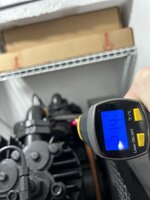
I did run some tests. I ran the compressor for 45 minutes alternating letting the tank build pressure and the letting it run out for a while to simulate when I'm painting or blasting. I was surprised at the numbers from the IR temp gun, although the inside of the shop is 55 degrees right now. The ball valve outlet never got over 100 degrees, the cylinder head was 184, and the outlet manifold was 214 before heading to the tank.

Im thinking I won't need a high temp inlet model and will just forgo any type of aftercooler. Any recommendations on 35-38 F dew point air dryers?
967976A1-8E7A-42A4-AB62-3819EAD89685.jpegF46DA2F4-2235-4A5E-90DD-E3CBC7B5EFC7.jpeg3FF0DACE-745D-46FF-92B3-30154BF6F8AB.jpeg
 

engineer2

Well-known member
Joined
Dec 13, 2009
Messages
11,790
Location
Chicago burbs
What model do you have?
I got it for free from work. They were going to scrap it. Took it home and it just needed a bit of 134a.
SPEEDAIRE 20 CFM Model 4NMJ1 (their catalog number). Likely a Hankinson.
Non-cycling, but it has 'hot gas bypass' for variable loads. 180F hi-temp inlet.
They don't specify a dewpoint, except for "ISO Air Quality Class 5 pressure dew point " which translates to about 45F. Good enough for me. I remember I tweaked the hot gas bypass valve adjustment to get the dewpoint indicator to where it should be.
It seems to work OK now.

A good option is to look for a used air dryer on FBMP or CL. Lots of people don't know what an air dryer is, so they tend to linger on the used market.
 

Steve_P

Well-known member
Joined
Sep 15, 2010
Messages
5,181
Where are you located? I'm in Oklahoma and it's pretty humid a lot of the year here. I'm in the process of installing 3/4 copper lines in my garage. It's going to Tee out from a compressor room and the first drop on each leg will only be about 25 and 35 feet. I plan to run 4 drops with regulators and filters on each drop. I'll see how it works without a dryer, but I expect I'll need one.

I'm in TN. It's very humid here in the warmer months even on sunny days (>80% RH is very common). When I bought my compressor I assumed that I might need a dryer. But I figured I'd try it first and see. Again, no issues for 20 years. I'd give it a try first. I always drain everything before painting or blasting. And if I take a break, I drain again.
 
To avoid these ads, REGISTER NOW!
Top Bottom