To avoid these ads, REGISTER NOW!

Highlander strange voltage readings

rmanrman

Well-known member
Joined
Nov 2, 2012
Messages
383
I bought new a 2017 Toyota Highlander xle 4wd new and after third battery the voltage is changing while driving
Ex. 14.3 volts after starting with ac on and headlights on.
13.3 v as soon as I accelerate in drive.
12.4 with radio on in addition
Come to a stop as soon as I remove my foot off the accelerator goes up to 14.3 volts
If the car is not driven in about 2 weeks the 6 month old battery barely starts
I’m on a third battery is it possible that I got two **** batteries. They are the Agm type cannot check electrolyte.
The electronic tester says bad battery but if I recharge it then the battery reads good
Help it’s driving me crazy also I never use the start/stop feature
 
To avoid these ads, REGISTER NOW!

PCustoms

Well-known member
Joined
Jul 23, 2011
Messages
22,408
Location
VT
Where/how are you reading these voltages?

It's likely normal, but you have a parasitic draw killing the battery when it's sits
 

Wrench97

Well-known member
Joined
Jun 23, 2018
Messages
12,056
Location
Southeastern Pa
ECM controlled Alternator, you need to see data to know what the ECM is commanding the alternator to put out, IE desired charge rate and actual charge rate. Next thing you need to know is does the car have a battery current sensor or it does not have a current sensor on the battery cable.
 
OP
R

rmanrman

Well-known member
Joined
Nov 2, 2012
Messages
383
I have a digital voltmeter plugged into the accessories socket on the dash
But it shuts off when engine is shuts off
American cars the accessories outlet stays on all the time but foreign cars the socket is off if engine is not running don’t know why but prefer constant on
 
OP
R

rmanrman

Well-known member
Joined
Nov 2, 2012
Messages
383
ECM controlled Alternator, you need to see data to know what the ECM is commanding the alternator to put out, IE desired charge rate and actual charge rate. Next thing you need to know is does the car have a battery current sensor or it does not have a current sensor on the battery cable.
Is the battery current sensor in the regulator?
 

Firebrick43

Well-known member
Joined
May 12, 2015
Messages
13,999
Location
West central Indiana
I bought new a 2017 Toyota Highlander xle 4wd new and after third battery the voltage is changing while driving
Ex. 14.3 volts after starting with ac on and headlights on.
13.3 v as soon as I accelerate in drive.
12.4 with radio on in addition
Come to a stop as soon as I remove my foot off the accelerator goes up to 14.3 volts
If the car is not driven in about 2 weeks the 6 month old battery barely starts
I’m on a third battery is it possible that I got two **** batteries. They are the Agm type cannot check electrolyte.
The electronic tester says bad battery but if I recharge it then the battery reads good
Help it’s driving me crazy also I never use the start/stop feature
Have you hooked up a scan tool and changed the battery type to unspecified? It will then maintain the standard 13.6 charger rate.

Your fortunate as later years they removed the ability to remove this BS.

Other wise it charges based on load and uses a program in an attempt to eak out a little fuel savings. This is done for off cycle credits to make CAFE standards, each approved technology is given a 3 mpg credit, same goes the the start stop or active grill shutters.
 

no704

Well-known member
Joined
Apr 27, 2016
Messages
5,207
I have a digital voltmeter plugged into the accessories socket on the dash
But it shuts off when engine is shuts off
American cars the accessories outlet stays on all the time but foreign cars the socket is off if engine is not running don’t know why but prefer constant on
Many have a 2 position fuse holder and you can select this.
 

Wrench97

Well-known member
Joined
Jun 23, 2018
Messages
12,056
Location
Southeastern Pa
It may be the cable end.
Always measure the voltage at the battery voltage loss to accessory socket is always there and the specs are for voltage at the battery.

1755125516130.png
 

Rusted Nut

Well-known member
Joined
Dec 11, 2022
Messages
1,802
Location
PNW
Sounds like a “smart charging” system, or variable output alternator. Charging voltage will fluctuate depending on battery state of charge, state of health, hard throttle or coasting, etc…
 

Captain Spaulding

Well-known member
Joined
Feb 13, 2017
Messages
749
Location
Southern Indiana
Voltage dropping to 12.4V indicates either voltage drop at the point of measurement, an electrical load larger than the battery and charging system can handle, or a battery that isn’t fully charged.

Not likely there is much drop on the circuit to the plug.

Battery is new

Your battery should output 12.65V or more with no load, so it’s pretty apparent that the charging system isn’t able to do its job or isn’t being told it needs to supply more power.
 
OP
R

rmanrman

Well-known member
Joined
Nov 2, 2012
Messages
383
I hooked up a clamp on dc amp meter to the output lead at the alternator
Got up to 55 amps at 14.1 volts with ac & lights and seat warmers on.
The engine was about 800 rpm in park
Then I shut off the engine and measured at the positive cable and got 440 ma at 13.3 volts with no loads on. Is 440 ma an acceptable amount for the battery to handle say 2 weeks of not running the car?
Do the computers ramp the standby current down when they go to sleep?
How long should I wait for the computers to sleep and I’ll check the draw on the batterie then.
Thanks for all contributions to this problem I’m having. In the past the alternator was a stand alone item with a built in regulator now computers control the output?
 
To avoid these ads, REGISTER NOW!

Wrench97

Well-known member
Joined
Jun 23, 2018
Messages
12,056
Location
Southeastern Pa
Yep it can take up to an hour sometimes more for the amp draw to drop off, sometimes especially with any add on like aftermarket GPS units, remote starts, devices plugged into the DLC can cause networks to go bonkers and keep waking up and polling devices on the network trying id it.
 
Last edited:

rooster59

Well-known member
Joined
Nov 16, 2014
Messages
940
Location
Land of the Pines
You should use a meter and do voltage drop tests with engine running, from battery hot to the hot stud on the alternator, and battery ground to case (ground) of alternator. Should be very low, like 0.1 volt and less. What’s the battery voltage after sitting overnight?
 
OP
R

rmanrman

Well-known member
Joined
Nov 2, 2012
Messages
383
Usually 12.5-12.6 volts
I did the grab and twist on the wires at the battery and alternator nothing moved
No corrosion on the battery terminal s
Could not unplug the regulator cable

Where could I look up the max parasitic draw on the battery when car has not been run for a week. The fact that the voltage varies between 12.4 and 14.2 volts during driving is crazy but sitting in park and idling it’s steady 14.1 volts with or without loads on.
 

Rusted Nut

Well-known member
Joined
Dec 11, 2022
Messages
1,802
Location
PNW
Does the vehicle have a variable output alternator/smart charging system? If so, the variable output voltage is normal.
 
Last edited:

Wrench97

Well-known member
Joined
Jun 23, 2018
Messages
12,056
Location
Southeastern Pa
Usually 12.5-12.6 volts
I did the grab and twist on the wires at the battery and alternator nothing moved
No corrosion on the battery terminal s
Could not unplug the regulator cable

Where could I look up the max parasitic draw on the battery when car has not been run for a week. The fact that the voltage varies between 12.4 and 14.2 volts during driving is crazy but sitting in park and idling it’s steady 14.1 volts with or without loads on.
Rule of thumb is less then 50mA, but you'll usually see less then then 30mA.
 

richfinn

Well-known member
Joined
Jan 29, 2011
Messages
4,810
Location
Leeds, Yorkshire, England
If it's capable of 14.3v there is unlikely to be any voltage drop, smart charge systems often "switch off" or de-rate the alternator to conserve fuel under certain driving conditions

Did you match the new AGM battery to BMS when you installed it? Are there any DTCs related to BMS?

What brand of battery are you buying?

If it has keyless entry, make sure the keys are not in close proximity of the vehicle.

What I usually do to check drain is snap the hood latch to the closed position/tie down the hood switch (so you can leave the hood open) and lock the car with the key fob.

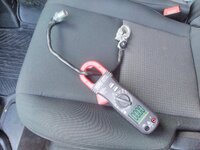
Wait an hour and check battery drain on the battery negative cable, you are looking for it to drop below 50mA (0.05A) if your DC amp clamp doesn't have that low a resolution you are going to have to put a regular multimeter in series set to amps with the red lead in the amp jack.

If your amp clamp will read that low and you can't hook it around the cable make up a temporary extension lead of suitable gauge.IMG_20250629_200527_118.jpgIMG_20250629_212219_175.jpgIMG_20250506_140902_604.jpg

This Brymen BM037 Amp Clamp is great for this kind of work, very little drift and it will record min/max readings so you can go do something else and still catch intermittent drains!!!!

Resolution down to 10mA and will read up to 600A for peak cranking amps etc.
 
Last edited:

Skooterj

Well-known member
Joined
Mar 11, 2021
Messages
749
Location
Indiana
It's a Highlander, the only appropriate solution is to cut the head off of the nearest Immortal and recharge the battery.
 

Fixr

Well-known member
Joined
Dec 23, 2012
Messages
9,702
Location
SW VA
Voltage dropping to 12.4V indicates either voltage drop at the point of measurement, an electrical load larger than the battery and charging system can handle, or a battery that isn’t fully charged.

Not likely there is much drop on the circuit to the plug.

Battery is new

Your battery should output 12.65V or more with no load, so it’s pretty apparent that the charging system isn’t able to do its job or isn’t being told it needs to supply more power.
Not really on newer cars. 10-15 year old GMs are designed to let the charging voltage drop really low under certain specific conditions. If I recall correctly, as low as 11.8 volts. Turning on the wipers triggers a higher charging voltage. It's complicated. I have to assume newer vehicles may have even more complex charging strategies. It's all about a .1% increase in fuel efficiency.

The old rules of thumb no longer apply on many newer vehicles. Having the factory diagnostic information is absolutely essential now.
 
  • Like
Reactions: RPH

Captain Spaulding

Well-known member
Joined
Feb 13, 2017
Messages
749
Location
Southern Indiana
Not really on newer cars. 10-15 year old GMs are designed to let the charging voltage drop really low under certain specific conditions. If I recall correctly, as low as 11.8 volts. Turning on the wipers triggers a higher charging voltage. It's complicated. I have to assume newer vehicles may have even more complex charging strategies. It's all about a .1% increase in fuel efficiency.

The old rules of thumb no longer apply on many newer vehicles. Having the factory diagnostic information is absolutely essential now.
Batteries haven’t changed. An 11.8V charger output would be below the battery OCV, resulting in it draining the battery rapidly. It would require significant power consumption and resultant heat to lower battery voltage to 11.8V
 

Fixr

Well-known member
Joined
Dec 23, 2012
Messages
9,702
Location
SW VA
Batteries haven’t changed. An 11.8V charger output would be below the battery OCV, resulting in it draining the battery rapidly. It would require significant power consumption and resultant heat to lower battery voltage to 11.8V
Yes it does, but the manufacturers (at least, GM) choose it under specific circumstances, like idling at a stoplight in gear. Accelerate, and the computer kicks up the charging rate. Turn on the headlights, it goes up more. Battery temperature can also be tracked and adjusted for. There are quite a few parameters. And sometimes, the charging voltage will go over 15 volts by design. I never did figure it all out, but there was a chart in the service manual showing the parameters and voltages.

All of that strategy led to chronic undercharging in our research fleet that tended to idle for long periods. The low voltage sometimes caused test equipment to shut down. Simply disconnecting the load sensor at the battery eliminated all of that and the alternator went back to being in control instead of the computer. This was on roughly 2005-2012 GM products. I expect that similar control strategies are used in many later model vehicles.
 
To avoid these ads, REGISTER NOW!
Top Bottom