
You are using an out of date browser. It may not display this or other websites correctly.
You should upgrade or use an alternative browser.
You should upgrade or use an alternative browser.
Holding a tapered part?
- Thread starter no704
- Start date
I’ll (read as some one else on the same machine) probably be processing like 300 or so of these. Over a few years.
So I’m looking at getting the casting process refined also. Might look into lost foam moulds also to make the casting more to size and not have the draft angle.
So I’m looking at getting the casting process refined also. Might look into lost foam moulds also to make the casting more to size and not have the draft angle.
RoninB4
Well-known member
-I'll not add further comment, the water is muddy enough already. If the tapered soft jaws solution isn't producing desired results or takes too long to flip then ask for more suggestions in this thread. Doing 200-300 over the duration should (IMO) have a better methodology and dedicated tooling that doesn't break the bank.
A pic of the rough casting and drawing/sketch of finished part would go a long way. Not understanding how you get from 5" dia to 2" "thickness".Dimensions are not super critical on this other than >2”00 thickness.
A pic of the rough casting and drawing/sketch of finished part would go a long way. Not understanding how you get from 5" dia to 2" "thickness".
My guess is he's making a container/cask where the 2" is required shielding.
Not sure why they wouldn't just source existing material, nuclear medicine isn't new and materials have been transported for a long time.
RoninB4
Well-known member
-I'd already suggested/requested more details about the finished part. The reluctance to divulge details is up to the OP and why I backed off.A pic of the rough casting and drawing/sketch of finished part would go a long way.
I don’t mind sharing just don’t have any pics on my phone. Here is a 3d print that I made the first casting from and my first attempt at a lid casting. Having a foundry do the casting now and it’s a sand casting so new one has a draft. Might look at doing a lost foam casting to avoid the draft. 

Last edited:
mike93lx
ALLIANCE MEMBER
I love that even in nuclear research, you can find a free harbor freight tape measure
RoninB4
Well-known member
-Interesting part. Don't know what you're required to do or the expected tolerances for what some of the features are but if you're going to do 200-300 of these over a few years, even in batch sizes of 10-12 per order, I'd suggest some dedicated tooling for ease/speed/consistency. If the hole goes through then perhaps use a mandrel, if not then perhaps a drive or cup center. Both would enable turning the entire OD between centers in one operation without flipping. matching, or deforming a turned OD. I have plenty of other thoughts/opinions but you're the one making the chips and the decisions so whatever you decide is the last word.
Going to talk to my foundry guy about possibly using lost foam cores. Should be able to get closer to final with minimal machining. Just kind of pisses me off that I told people that these parts would have a draft on them and that was acceptable then. But now they want right cylinders. Sorry to vent but it really bothers me that these parts need to be machined now instead of just cleaning up the sprus.
Sorry to vent but it really bothers me that these parts need to be machined now instead of just cleaning up the sprus.
What's your EH&S procedure say for machining lead?
I bet that gives you an out to scrap this and have some cast different
I’m going to turn my new Al soft jaws to have a positive taper on one side and negative on the other. Pretty sure I’m going to maintain the taper just clean up the casting sprues and a light surface skim to make them pretty. Doesn’t make any sense to be removing any more material than necessary on a radiation shield, to me. But in just the machinist.
We are a very small operation. Don’t really have EH&S. But do have a radiation safety officer that will ultimately have to sign off on these being used. I’m pretty sure he will not be against them having a little extra mass to them. I don’t really mind turning lead as I keep a sheet of Al foil under the cut and can collect the majority of the chips. But would still like to keep it to a minimum. I really try and keep it out of the saws and no way am I grinding it!What's your EH&S procedure say for machining lead?
I bet that gives you an out to scrap this and have some cast different
The bits on the top are sprus and vents just for the casting process. Really only interested in the big cylinder bit.-Interesting part. Don't know what you're required to do or the expected tolerances for what some of the features are but if you're going to do 200-300 of these over a few years, even in batch sizes of 10-12 per order, I'd suggest some dedicated tooling for ease/speed/consistency. If the hole goes through then perhaps use a mandrel, if not then perhaps a drive or cup center. Both would enable turning the entire OD between centers in one operation without flipping. matching, or deforming a turned OD. I have plenty of other thoughts/opinions but you're the one making the chips and the decisions so whatever you decide is the last word.
We are a very small operation. Don’t really have EH&S.
Blows my mind you're doing what you doing apparently by the seat of your pants. I'm reasonably sure you're required to have a lead safety program in place to machine lead, let alone if you had cast a sample.
Place is probably an OSHA field day at best.
SMH
I have worked for a few large companies and have been on safety committees. l totally agree with you. I’m the only machinist and I can assure you that I don’t take safety precautions lightly. I have and use respirators, p-paps and tyvecs and use them. Although I do sometimes wear sandals!!Blows my mind you're doing what you doing apparently by the seat of your pants. I'm reasonably sure you're required to have a lead safety program in place to machine lead, let alone if you had cast a sample.
Place is probably an OSHA field day at best.
SMH
I do like the idea of turning between centers. But especially for turning off the sprues I don’t think it would be great with an inturupted cut. I don’t have a taper attachment. I’ll have to check the throw on my cross slide. I haven’t used this particular lathe very much. I’m pretty sure I’ll have to flip the part. I’ll likely have to bore out the center hole also. I wish I had a dro on this lathe, but I do have a couple long travel indicators. I for sure need to fix the tail stock first thing. I’m sure you are correct that it is part of the holding mechanism. Funny because I’ve used it before, but it’s been just sitting for a couple years. Parts can’t have run off too far. Tail stock is pretty cool, has a lever that can give the quill a 2-1 gear ratio to the hand wheel.-Interesting part. Don't know what you're required to do or the expected tolerances for what some of the features are but if you're going to do 200-300 of these over a few years, even in batch sizes of 10-12 per order, I'd suggest some dedicated tooling for ease/speed/consistency. If the hole goes through then perhaps use a mandrel, if not then perhaps a drive or cup center. Both would enable turning the entire OD between centers in one operation without flipping. matching, or deforming a turned OD. I have plenty of other thoughts/opinions but you're the one making the chips and the decisions so whatever you decide is the last word.
alfadan
Well-known member
Might look into a split steel or aluminum mold, like a bullet mold. Then it can be cast as straight as you like.
katehiggins
New member
- Joined
- May 19, 2025
- Messages
- 1
For soft materials like lead, your chuck jaws should grip enough for light facing passes. Just take your time and avoid aggressive cuts. Once you get one end trued up, flip it and run the final passes. A live center definitely helps for stability on longer parts like this.
If you're working on specialized parts at scale, sometimes sourcing or even acquiring a small machining operation becomes more efficient than outsourcing everything. I've seen examples of this in industrial M&A projects — especially in niche manufacturing.
You can click here to check out business broker Phoenix listings if you’re ever interested in small machine shops already setup for jobs like these.
If you're working on specialized parts at scale, sometimes sourcing or even acquiring a small machining operation becomes more efficient than outsourcing everything. I've seen examples of this in industrial M&A projects — especially in niche manufacturing.
You can click here to check out business broker Phoenix listings if you’re ever interested in small machine shops already setup for jobs like these.
Last edited:
Soft jaws and a new MT4 live center should arrive tomorrow. Extra bolt hanging out the bottom of the tailstock turned out to be an extra locking feature, kind of threw me off because the main quick lock was working. Luckily the eccentric “bolt” was laying in the chip pan.
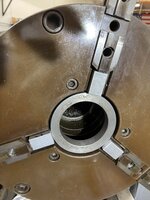


 Taper angle set on the cross slide. Thought I had a jar of Dykem around here, but no luck. McMaster will bring me some tomorrow.
 Maybe I’ll make a “fork” to use my cordless drill as a cross slide power feed in the AM while I wait from the Dykem.
RoninB4
Well-known member
-A wide Sharpie will work, I often prefer it to Dykem as it leaves a thinner coat and less mess to clean off. You're the boss.
I thought about that, but only have regular and super fine on hand. I usually do use sharpie. But wanted more coverage on this so I might be able to see better while turning.-A wide Sharpie will work, I often prefer it to Dykem as it leaves a thinner coat and less mess to clean off. You're the boss.
RoninB4
Well-known member
-The variety of Sharpie's make for good, low cost aids in different operations. Not only the widths but even the colors leave a different film thickness, especially when layered. Maybe that's been more useful to me in approaching a target when surface grinding and .0001's matter. Coverage has more control too, a Dykem brush gets everywhere. I still like/use Dykem just not as much as I used to.I thought about that, but only have regular and super fine on hand. I usually do use sharpie. But wanted more coverage on this so I might be able to see better while turning.
RoninB4
Well-known member
-Any excuse will do.Kinda want a cross slide power adapter too and this will give me an excuse to make one.
-If you're like many of us I'll start the timer for how long that lasts.And my welding table is almost completely clean!
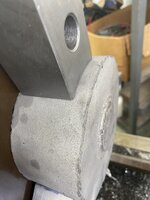
lbhsbz
Well-known member
I'm curious as to why you even need a sand casting? We used to melt lead in a soup can with a propane torch and poor them into holes drilled in wood to make weights for various things. Get a piece of pipe of the appropriate diameter, weld a cap on it with a thread for a forcing screw. Pour lead in pipe, use forcing screw to extract lead from pipe, repeat.
I made one using lost PLA investment casting. We will most likely be making like a couple hundred of these. I’m not doing it! The one I did make took two propane forges with 15kg crucibles.I'm curious as to why you even need a sand casting? We used to melt lead in a soup can with a propane torch and poor them into holes drilled in wood to make weights for various things. Get a piece of pipe of the appropriate diameter, weld a cap on it with a thread for a forcing screw. Pour lead in pipe, use forcing screw to extract lead from pipe, repeat.
The local foundry uses sand casting so that is pretty much my option. It will take a little machining afterwards, but that would be the case anyway just to clean up the sprus. It’s pretty minimal maybe 1/4” off the big end. And a set of these parts is like 75 lbs.