Zaxxn
Well-known member
Just walked through HD last night and saw these on the shelves and on the display. Wondering if anyone has any experience with these - seem like a good deal with 18,000 Lumen and dimmable.
TIA,
Zax
TIA,
Zax


review seems to say draw around 170W
is this W per lumen ratio good?
That looks amazing, @ctgoodman - the main space of the shop I am building is 46x28x14h, and it seems like I'd be well lit with 6 of them in there! Somehow that sounds more appealing than wiring dozens of conventional LED 4' shop fixtures and suspension mounting them...
Thanks for the pics!
No. By today's standards it's very poor.
CD
What would be a good watt per lumen ratio? What are some fixtures available that achieve that?
Sent from my iPhone using The Garage Journal mobile app
Yes, now now LED linear high bay can be made over 130lm/w, and it is DLC premium listed, saving more energy and qualified to get more rebate
What would be a good watt per lumen ratio? What are some fixtures available that achieve that?
[/url]
Similar products with higher efficiency and lower cost:
https://www.ledlightingwholesaleinc.com/LED-High-Bays-LED-Low-Bays-s/150.htm
https://greenlightdepot.com/collections/led-linear-high-bays
Just in case there are any home automation gurus around, or anyone that has more intimate knowledge of the 0-10V dimming: It seems that the hookup for it are just 2 low voltage wires, so the dimmer itself will have to supply it's own power for the 0-10V dimming signal - can I just use any power supply independent from the light's driver? Meaning, is the 0-10V input just looking for any kind of voltage between 0-10VDC from whichever source?
If that's the case, it would be rather simple to integrate them into e.g. Z-Wave control, since there is a company now that makes a Z-Wave 0-10V dimmer.
Thanks,
Zax

Well that diagram is just plain wrong. Just run the violet and grey wires fixture to fixture and connect to dimmer. That's all there is to it.Hmmmm...if I look at the wiring diagram on a PDF of the aforementioned lights (https://www.ledlightingwholesaleinc.com/v/vspfiles/Erythin/559620104.pdf) they show the dimmer being fed by line voltage and then the 0-10V output of the dimmer connected to the DIM+ and DIM- leads.
Hmmmm...if I look at the wiring diagram on a PDF of the aforementioned lights (https://www.ledlightingwholesaleinc.com/v/vspfiles/Erythin/559620104.pdf) they show the dimmer being fed by line voltage and then the 0-10V output of the dimmer connected to the DIM+ and DIM- leads.
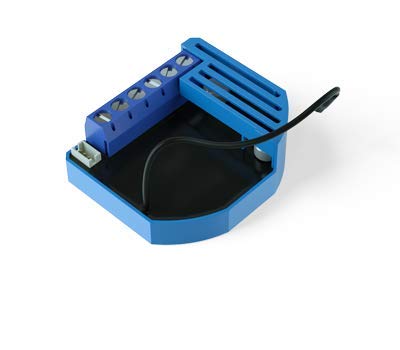
That is exactly the one I was contemplating, but I don't think it would work with these kinds of lights. The vendor (who is in Poland) answered my inquiry stating that these are made for lights that are hooked up to an external led driver and wouldn't work with lights that just have a 0-10V 2-Wire hookup?Google search shows this -
Image inked to Amazon





Lutron/Leviton does make a 0-10V wifi/bluetooth smart system (I'm unsure if it is Z-Wave)...
Speaking of Z-Wave - I actually did order one of those 0-10V dimmers from above. I looked into it a bit more, and they might actually work with the lights. Ordered one to try. I plan to program a few pistons in WebCore that do things like dim/brighten the lights depending on available daylight in the space and so on, as well as the lights in each bay turning on at a lower level when someone parks a car at night and such. We'll see if it works out!
--Zax
Lutron uses their own protocol.
Leviton makes lots of devices that use either EnOcean protocol, Z-wave Plus or Bluetooth LE. Of course, they still make some X10 stuff, too.
CD
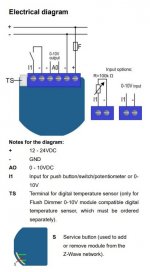
Very nice, looking at the diagram from the dimmer it looks straightforward for the 0-10V circuit, but you will have to get 24V DC to it:
It looks like most controllers can pull power off of the device it is controlling, but 0-10V isn't going to have input that can power it. Would you typically use a small 120VAC to 24VDC transformer?*
Thanks, I need to do more research on protocols and available hardware before selecting for my use. My initial intent was to have full control of the barn from my phone including garage doors, entry door lock (and give temporary access if someone needed to borrow something). Looking at switches that were capable of 0-10V and smart connected yielded nothing. A separate controller was required outside of the switch and the costs added up along with the connected switches.*
*Sorry for the hijack, I stopped my research when I was not seeing smart control in my 2018 budget. I need to dig back in again.
Very nice, looking at the diagram from the dimmer it looks straightforward for the 0-10V circuit, but you will have to get 24V DC to it:
*Sorry for the hijack, I stopped my research when I was not seeing smart control in my 2018 budget. I need to dig back in again.
Thanks for the info, Platonic Solid and cybrdyke - bummer, guess no way of easily integrating the dimming into the rest of the houses home automation since there are at this point no other 0-10V Z-Wave compatible dimmers around. Would have been nice for all kinds of shenanigans like light level setting depending on the available outside light (what comes into the windows) and so on, but I can still at least switch them with a Z-Wave switch and just use a dimmer to control the brightness manually. I am sure there will be a suitable Z-Wave dimmer at some point.
Thanks again,
Zax
Wow. That's a lot of really good information! Thanks so much. I'll definitely check that out when I get home. Glad I am not the only one thinking along those lines and it's not completely out there to want to make this happen!That Qubino needs 12-24V to run the Zwave, microprocessor..etc. I use a few Mimolites for window automation..same idea. You can run them from a 12volt wall wart. The 0-10V side would be referenced from the LED driver.
Zax, I do dynamic ambient dimming in my home via smarthings and this app: https://community.smartthings.com/t/auto-dimmer-smartapp-sept-2015-v2-update/8336/7
...works great, however I'm just using smart bulbs (mostly HUE) and have not attempted a 0-10V solution. That app might give you some ideas though.
In my tests, dimming HUE and GE smart bulbs 50% also cuts power use by about 50%. Using 0-10V dimming combined with light sensors can be done for about $8 it appears:
https://www.lightup.com/daylight-harvesting-sensor-1-10v-dimming-function-by-lumegen.html
At my commercial site, we use ceiling motion sensors that hold off banks of lights depending on ambient, but they can't "intelligently" dim them. I love the idea of LED lights that individually auto-dim based on ambient light.
Here is one more 0-10V solution based on Zigbee that is referenced as working in Smarthings (google it): https://eucontrols.com/LCM-LV-ZB.html . Check the last post in this thread: https://community.smartthings.com/t/any-0-10v-dimmers-supported/17379/22 I do like the fact that this dimmer is already in a metal box to be integrated much easier for new construction:
https://eucontrols.com/documents/LCM-LV-ZB.pdf
In fact, there are no behavioural changes required..other than to stop turning manual switches off. Ha.

 I sold it a few years back. It was hard to resist as values for a done up Westfalia are very high.
