I live in Tucson. There is a Amazon distribution center here. Quite often I get stuff same day, in fact I've ordered things at 4:00 and had it at my house by 8:00 p.m.I have rarely received Amazon delivers sane day or next day.
Several days to a full week is more typical.


You are using an out of date browser. It may not display this or other websites correctly.
You should upgrade or use an alternative browser.
You should upgrade or use an alternative browser.
Home Depot grumble
- Thread starter sgrammel
- Start date
I live in Tucson. There is an Amazon distribution center here. Quite often I get stuff same day, in fact I've ordered things at 4:00 and had it at my house by 8:00 p.m.
A couple years ago I ordered a DMM from Amazon at the same time I was ordering a pizza on the phone. Meter was on the porch when the pizza guy rang the doorbell.
JerseyBoatBuilder
Well-known member
Home depot and Lowes inventory system is **** their systems don't keep track of what is sold and what to replenish and where to replenish unlike other stores.
toolmiser
Well-known member
I tried to get a cordless drill battery this spring at Home Depot. It was on sale and showed stock in store. Couldn't find it so asked at Contractor Desk. They told me the inventory is always one less than actual, but they still couldn't find one. I paid and got one shipped to store but it took a couple weeks.
Beerhippie
Well-known member
But you kept a stiff upper lip, toughed it out, stayed on your feet and never showed the intense pain of it!I tried to get a cordless drill battery this spring at Home Depot. It was on sale and showed stock in store. Couldn't find it so asked at Contractor Desk. They told me the inventory is always one less than actual, but they still couldn't find one. I paid and got one shipped to store but it took a couple weeks.
The reason the inventory never matches what the website shows, at least for power tools and such, is because of repeated theft of itemsI tried to get a cordless drill battery this spring at Home Depot. It was on sale and showed stock in store. Couldn't find it so asked at Contractor Desk. They told me the inventory is always one less than actual, but they still couldn't find one. I paid and got one shipped to store but it took a couple weeks.
wolfinator
Well-known member
- Joined
- Sep 29, 2021
- Messages
- 87
It's interesting how the same company can be so different across the world. Near me, DHL deliveries are done by the absolute lowest bidder bottom-feeder contractors. They seem to have damaged, clapped-out, rusty vans that are too far gone to be allowed to host a prouder corporate logo. But they'll damage your package for DHL!Shipping was never an issue as long as they solely used DHL. Always 24 hrs to 48 hrs tops for my order to arrive. Now that they partly switched to GLS, I had two screwed up deliveries already. Both times I got fully reimbursed, but I also always bypass first level support and go directly to the higher ups.
Nobody-named-Olli
Well-known member
It's interesting how the same company can be so different across the world. Near me, DHL deliveries are done by the absolute lowest bidder bottom-feeder contractors. They seem to have damaged, clapped-out, rusty vans that are too far gone to be allowed to host a prouder corporate logo. But they'll damage your package for DHL!
Not just across the world, even across the country. Ask friends of mine in another state, or someone two towns further, serviced by another delivery hub, and they tell you how much they hate DHL. … The only constant is inconsistency.
 It’s crazy.
Kind regards,
Olli
Steel_Rain
Well-known member
- Joined
- Apr 23, 2024
- Messages
- 1,519
You shouldn't talk about Dave that way.
It's probably ok to talk about Ryobi that way.

The dog turd is in the DeWalt power tool aisle. Depending on your viewpoint, maybe that's where it belongs.
RalphInCA
Well-known member
This is not even close to true.Home depot and Lowes inventory system is **** their systems don't keep track of what is sold and what to replenish and where to replenish unlike other stores.
HD and Lowes systems are amazingly sophisticated and do great job with most of their inventory.
NORTON'S SHOP
Well-known member
I don't buy or build them either. I have and use a set that my father built back in the 50's. I'll snap a pic shortly.I don't BUY Sawhorses, I build my own. Mine are extremely strong and are still solid after 15 years.
This is not even close to true.
HD and Lowes systems are amazingly sophisticated and do great job with most of their inventory.
True. But still not accurate more often than not.
neophyte
Well-known member
I live in Philadelphia.I live in Tucson. There is a Amazon distribution center here. Quite often I get stuff same day, in fact I've ordered things at 4:00 and had it at my house by 8:00 p.m.
There are probably half a dozen or more Amazon distribution Centers within a thirty minute drive of the city and at least two in the city, with one less than a 10 minute drive from my house.
It can still take a week for items to arrive, although every once in a while something will get delivered within a day or two.
If I ordered food, I suspect things might be quicker, but I could probably walk yo a whole goods and home before the deliveries arrive.
seber
Well-known member
I am in the boonies but one or two days with Amazon Prime is a sure thing. On the other hand, any product that is not marked Prime is a third party vendor. You are at the mercy of the vendor even though Amazon does have standards.
markdtn
Well-known member
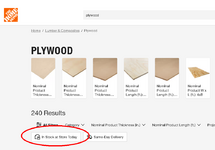
My issue with HD website is that you can't click a button to show what is on hand in the store that day. I have to wade through all the stuff that they want to drop ship. Sometimes I need it right now. Lowes site is much better for this.
finn
Well-known member
Try “sometime in the next week or two”.This thread essentially demonstrates why Amazon is taking over the retail world. Why putz with local retailers or box stores, when you can click 3 times and what you're looking for arrives on your doorstep that evening or the next morning?
finn
Well-known member
Bauhaus was a thing in Germany in 1982 when we moved there.Been to Bauhaus myself in person. I'm unsure who was first Bauhaus or Home Depot here but they bear an uncanny resemblance, down to type fonts used.
Also similar was the difficulty finding someone working the floor to answer questions. As I am essentially illiterate while in Austria it was up to Mrs. Rust to translate and the someone finally cornered was knowledgeable.
yatg
Well-known member
My issue with HD website is that you can't click a button to show what is on hand in the store that day. I have to wade through all the stuff that they want to drop ship. Sometimes I need it right now. Lowes site is much better for this.
JerseyBoatBuilder
Well-known member
Sure it is, They only think they know how many item's should be in their inventory based on what is reported being sent.This is not even close to true.
HD and Lowes systems are amazingly sophisticated and do great job with most of their inventory.
A lot of them do not even have random daily/weekly cycle counts where some one physically counts how many of an item is in the inventory to be able to adjust the numbers.
Go for something and the rack is empty, Go get some one and they say there is some up there in the overhead rack.
Some one crossed off the qty of 4 printed on the box and rewrote qty of 2. Person goes up and gets the box and there is only 1.
neophyte
Well-known member
My slow deliveries from Amazon are almost always actual Amazon stocked items, that are either Amazon sold, or “fulfilled by Amazon” items.I am in the boonies but one or two days with Amazon Prime is a sure thing. On the other hand, any product that is not marked Prime is a third party vendor. You are at the mercy of the vendor even though Amazon does have standards.
Third party items from Marketplace actually sometimes arrive quicker, with the occasional exception, when the item never arrives, and I have to try to fix the problem with Amazon
 .
.I just think way too many people in Philly order from Amazon, and unless you order regularly and frequently, Amazon has to try to fit an extra stop on their route.
Other times, items Amazon supposedly has in their warehouse gets shipped from a third party, probably because Amazon didn’t actually have the item in stock.
I swear, I get so pissed looking at the HD website that many times, I just close the tab. If you didn't know any better, you would think they are on dial up.It's just sad how much technology we have, and everything always just "almost works".
Are you shipping to a PO Box rather than an actual physical address ?I have rarely received Amazon delivers sane day or next day.
Several days to a full week is more typical.
Last edited:
Try “sometime in the next week or two”.
Amazon prime, residing in Tucson where there is a distribution center. At most 2 days for us.
cherrybomb
Well-known member
That is really neat.My post,and I will further explain,I researched and went to Home Depot to check out the saw horses.I bought the foldable,leg adjustable ones.Reason being,when my granddaughters were smaller they used shorter height ,I prefer the taller as I use a old door for a top.Each situations are different,I'm happy with mine.I don't buy or build them either. I have and use a set that my father built back in the 50's. I'll snap a pic shortly.
I also have a pair I made out of plywood that folds up,I'm covered?
bwringer
Well-known member
See, "do great job with most of their inventory." is not nearly good enough. The whole point of inventory management is to achieve a very high level of accuracy.This is not even close to true.
HD and Lowes systems are amazingly sophisticated and do great job with most of their inventory.
And that requires a lot of organizational effort and resources. You need well-trained people on the floor taking the time to frequently check inventory, with the power to correct it. Stockers need to be trained and evaluated in their accuracy so they don't just hide **** anywhere and everywhere (lookin' at YOU, Home Despot). You need a well-designed floor plan that's understandable and realistic. You need loss prevention that's on their toes (lookin' at YOU, bLowes) so stuff stops flowing out the door or dock without being noted. You need a million little policies and procedures that prioritize accuracy (for example, being able to quickly correct stolen inventory without being "blamed").
Accurate inventory is one important piece of what allows these large retailers to closely and very accurately manage what goes where and when. For all their many faults, boring old logistics and data are the big advantages Menards and Walmart have over their competition.
Walmart's expansion into ubiquity is well-known, and it didn't happen because of low prices; it happened because they were so much better at plain old logistics and data that they were able to purchase in huge volumes, lower wasted inventory and effort, and maintain lower prices and huge inventories while still making profits. Obviously the cracks have really been showing in the last several years; Walmart is not maintaining this focus on what got them so big, and aggressive cost-cutting is leading to an overall rotten (and getting worse) consumer experience.
The same goes for Menards; they are first and foremost a logistics and data company. For example, one reason they have not expanded nationwide is logistics; they only place stores where they meet specific logistics criteria for getting goods to the stores within a certain amount of time and cost.
As another example, they have quietly pursued vertical integration for quite a few goods, and have invested heavily in buying or building US manufacturing capacity for many of the construction materials they sell (trusses, doors, decking, concrete blocks, countertops, etc.) under the Midwest Manufacturing name. And these are also strategically located in relation to the stores.
Menards also has top-shelf loss prevention. The point is, there are a lot of elements to inventory control, but it all comes down to accurate data. Some companies make this a fundamental, long-range high priority, and gosharootie, for some reason they're the ones that seem to do better in the long term.
When this fails, or the ***** MBAs focus only on the short term, the symptom we, the unwashed rabble of commoners, see is that the stuff we need is not on the shelf when and where we need it.
That irritating empty shelf at bLowes where the 1/4" copper line used to be until it was stolen and never replaced represents the end of a long chain of stupid, short-sighted corporate decisions.
Same for those tool batteries at Home Despot. These end up stolen quite a bit, yes, but for some reason the stockers at HD are the absolute kings and queens of stashing stuff in random places. Once in a while a search party will return with the saw blades I needed that were tucked behind a pile of tile sponges, but more often my order is just cancelled or I get a shrug and a blank stare. It's all a lot of wasted effort and nonsense, most likely traceable to corporate understaffing.
Meanwhile, I needed a specific 1/4-5/16 magnetic flip bit, and the Menards website told me there were two at a specific store on a specific shelf and section. And when I got there, by gum there were indeed two exactly where they were supposed to be.
Last edited:
honcho
Well-known member
Home Depot has teams in each region that do store "resets" where products are shuffled about to confuse both customers and the regular store employees. If I recall correctly, they wear different color shirts than regular store employees. If you've ever worked retail, you may be familiar with the "Plan-O-Gram" that is used to place product. Big retailers like Home Depot are forever juggling their retail floorspace to accommodate changing inventory and promotions, which often results in product being in the wrong place when the plans and the available space don't match or employees can't make it work.Same for those tool batteries at Home Despot. These end up stolen quite a bit, yes, but for some reason the stockers at HD are the absolute kings and queens of stashing stuff in random places. Once in a while a search party will return with the saw blades I needed that were tucked behind a pile of tile sponges, but more often my order is just cancelled or I get a shrug and a blank stare. It's all a lot of wasted effort and nonsense, most likely traceable to corporate understaffing.
bwringer
Well-known member
...Big retailers like Home Depot are forever juggling their retail floorspace to accommodate changing inventory and promotions, which often results in product being in the wrong place when the plans and the available space don't match or employees can't make it work.
That explains a lot.
Sounds like a big process problem; there's apparently no way for data on the physical reality of what is where to flow back into or affect the Grand Central Plan. So it boils down to some honcho from Central Planning (or whatever they call it) growling "The plan is the plan! Shut up, quit whining, and make it fit!"
And so the problem compounds. Deck chairs are rearranged to no purpose, while it's no one's job besides the "lowly" stockers to pay any attention to silly details like physical reality.
finn
Well-known member
Depends what you’re ordering. Sometimes Tucson deliveries take much longer than that for me, if it’s not stocked in Tucson and has to come from the Midwest.Amazon prime, residing in Tucson where there is a distribution center. At most 2 days for us.
My kids live in the greater Chicago and Detroit area. They often get same day deliveries.
RalphInCA
Well-known member
Well, it’s good enough for me, as I’m a realist and I know that for them to get perfect would cost them a lot more money, which would then be reflected in my prices.do great job with most of their inventory." is not nearly good enough.
I don’t want that.
neophyte
Well-known member
No, an actual address, which is a house.I swear, I get so pissed looking at the HF website that many times, I just close the tab. If you didn't know any better, you would think they are on dial up.
Are you shipping to a PO Box rather than an actual physical address ?
I just don’t routinely order from Amazon.
Nick Rivers
Well-known member
I ended up ordering some HEPA bags, but they did not fit my RIGID, then did fit a ShopVac I picked up off CL for cheap. For fine, powdery stuff I use the ShopVac.If you want to keep a shop vac running a long time, buy a HEPA filter, and keep the filter clean, and replace the filter if it looks like it has had too much use and is worn.
The Gore Cleanstream filters don’t say “HEPA” but list a similar filtration rate, so maybe Gore was trying to avoid lawsuits if the vacuums used were built with “leaky” construction.
NORTON'S SHOP
Well-known member
Promised pic.I don't buy or build them either. I have and use a set that my father built back in the 50's. I'll snap a pic shortly.

reader2580
Well-known member
You either have incredibly well stocked stores where you live, or you never buy anything that is away from the norm. I needed a new dusting brush for my Ridgid shop vac recently. Not carried in store at Home Depot. I had to order it from homedepot.com.I put up with local real retailers because Amazon is quite often not the cheapest or even close to the cheapest.
Plus, more often than not, they actually do have what I need in stock.
There is all kinds of stuff I can't buy locally so I have to order. I live in a metro area with three million residents. I suppose there is somebody somewhere that might sell what I want, but the seller might be business only, or simply not have an easy way to know they carry an item.
reader2580
Well-known member
Do you have Prime? If not, your Amazon orders are going to take extra time to be delivered. I would assume the folks getting same or next day deliveries. My parents have a Prime membership that they added me to as a household member. (No, I do not live with them.) I would not pay for Prime otherwise.It can still take a week for items to arrive, although every once in a while something will get delivered within a day or two.
If I ordered food, I suspect things might be quicker, but I could probably walk yo a whole goods and home before the deliveries arrive.
reader2580
Well-known member
Most products at major retailers these days are ordered by corporate. A lot of it is automated based on how much inventory the computer thinks is on the shelf. The local store has little influence over what gets ordered. Not having a local buyer causes these sorts of issues. I know Menards employees at least have the ability to zero out inverntory when they can't find items that are supposed to be in inventory. The system will then order more since the store is out of stock.
I worked at CompUSA back in 1993 and 1994. The store had a buyer who could order stuff that was selling well in our store, not just what corporate thought would sell.
I worked at CompUSA back in 1993 and 1994. The store had a buyer who could order stuff that was selling well in our store, not just what corporate thought would sell.
neophyte
Well-known member
Yes, I have Prime, and have had it for a decade or so.Do you have Prime? If not, your Amazon orders are going to take extra time to be delivered. I would assume the folks getting same or next day deliveries. My parents have a Prime membership that they added me to as a household member. (No, I do not live with them.) I would not pay for Prime otherwise.
I just don’t order fromAmazon much, because I usually shop for groceries in person, and buy a lot of my books from Target when ordering, because I buy groceries from Target, and there are bonus offers I can use for books on the Target website, so Amazon is used only for really good deals, or stuff not available thru Target or Barnes & Noble.
I suspect if I ordered stuff every week, I would get more prompt delivery, since a stop for my address would already be planned for.
I’ve also had stuff ordered from Amazon that was supposed to be fulfilled by Amazon, wind up being drop shipped from the manufacturer.
niget2002
Well-known member
I ordered an EVAP smoke tester this morning from Amazon. Was dropped off at my doorstep 30 minutes ago.
Home Depot's website has been hit or miss for me. What annoys me the most is that not all of the stores around here carry the same items/materials. The clear pine boards at the HD the next town over are always nicer than the 'better' pine boards that my local store carries. I've also noticed a few other quality of material differences between the two stores.
Home Depot's website has been hit or miss for me. What annoys me the most is that not all of the stores around here carry the same items/materials. The clear pine boards at the HD the next town over are always nicer than the 'better' pine boards that my local store carries. I've also noticed a few other quality of material differences between the two stores.
RoninB4
Well-known member
-FYI. When ordering something on the website that has to be shipped I wouldn't expect the delivery date to be on time. As explained to me by customer service, the delivery date is just an estimate. The actual delivery date may be several days (or more) past what the website promises.
Dr.JohnnyFever
Well-known member
- Joined
- Jun 15, 2008
- Messages
- 707
Ehhh, nvm.
Last edited: