To avoid these ads, REGISTER NOW!

Home generator - Am I crazy?

JohnX14

Well-known member
Joined
Jun 2, 2014
Messages
553
Location
Boston 'burbs
Just get a 20-25k Generac and a single shed module for the A/C. Most likely it won't ever even need to shed off the A/C. It will be modern, reliable and have a warranty. The guys who supply it and install it will understand it and have no problem maintaining it if you are unable...or dead. You (or your survivors) will be hard pressed to get someone to service something you bought on Craigslist.
^^This^^

39 kW is overkill. You don't even "need" load sheds on a Generac. (logisticaly, not NEC based) Just don't cook thanksgiving or do laundry while the AC is running
 
To avoid these ads, REGISTER NOW!

Stuart in MN

Well-known member
Joined
Sep 8, 2005
Messages
23,071
Location
Minneapolis
As mentioned, if you plan on powering two houses that means two electrical services. Trying to run both from a single generator can be done but it gets a little complex.
 

FJ 432

Well-known member
Joined
Aug 2, 2010
Messages
3,730
Location
Littleton Colorado
I sell Cummins generators. Some thoughts:

The liquid cooled Kohler that you pointed out is not a bad choice. It's helpful that you understand the engine.

The other part of the Kohler is the generator and if that has issues it can be costly. You might want to check out where your service technician is located.

The real issue is the capability of powering two houses. It will require some clever wiring with one ATS.

Depending on the size of house that you're building a 39kw may or may not be overkill. I don't think you mentioned that and you may be building something in the range of 3,000sf or larger. I see customers choosing this size when they have money and they are not interested in load managing.
 

jblnut

ALLIANCE MEMBER
Joined
Jan 17, 2015
Messages
6,990
Location
In the Middle of MN
If I move into a hog building I'll keep that in mind.
My chicken barn has a generator in it that is by far the most maintained thing on my property. If it fails when there are birds in the barn they won’t have long to live if they’re ready to go out and it’s hot outside. The “company” has a dozen portable generators they can have to any barn in 45 minutes if something goes wrong with a stationary one. Birds will start to die in a matter or hours or less. It’s a big deal.

How long is the weekly exercise?

At 1/2 hour that's 26hrs a year, 1100 hours is over 40 years...
I run mine for roughly 1/2hr a week and when I clean the barn out for roughly 6hrs every 8 weeks. In the summer it gets a workout with all the fans running and will draw around 85a or around half its rated load. I have a 50kw PTO generator I use when the power goes out for the rest of the farm and it’s way overkill. I have an 18kw PTO genny as well as a backup backup. The 50kw can do the chicken barn if needed and the 18kw can do the rest of the farms essentials any time of the year.

I wrote generator hrs down this morning in the barn and at 8yrs old it’s got just shy of 500hrs on it.
 

logical

Well-known member
Joined
Aug 31, 2005
Messages
2,449
Location
Northern fringe of the Motor City Suburbs
My chicken barn has a generator in it that is by far the most maintained thing on my property. If it fails when there are birds in the barn they won’t have long to live if they’re ready to go out and it’s hot outside. The “company” has a dozen portable generators they can have to any barn in 45 minutes if something goes wrong with a stationary one. Birds will start to die in a matter or hours or less. It’s a big deal.
I understand, but the OP didn't mention pigs or chickens.
 

jblnut

ALLIANCE MEMBER
Joined
Jan 17, 2015
Messages
6,990
Location
In the Middle of MN
I understand, but the OP didn't mention pigs or chickens.
The guy you quoted did. The OP is looking at a used genny setup. @Bert_ was offering a view into a world of used generators that had to have very reliable machines as they were tied to the lives of hogs. Thus a used generator is, in his eyes, a good option. Just yet another opinion on the big internet.

I merely added info (likely too much as I tend to do from time to time) about my own setups.
 

finn

Well-known member
Joined
Mar 27, 2005
Messages
16,217
Location
The UP, God's country
The things sound like maintenance nightmares from what you guys are saying.

At what point are you working for your tools rather than vice versa? What I’m hearing is that maintaining a large generator takes more time in one year than I have been without power in five or ten years, and that doesn’t include buying oil, filters, etc and disposal.

Crazy.
 
Last edited:

BurtEggley

Well-known member
Joined
Oct 8, 2024
Messages
861
I wish grandad and grandad were here to tell me how they got thru the weather in NW Arkansas and Eastern KY before electricity. One raised hogs, and the other helped get tyson chicken going with huge barns of chickens. There was no ac in those barns, the only rule was one had to put on special slippers over the feet to not track in diseases.
 

Lassen Forge

Well-known member
Joined
Apr 26, 2014
Messages
15,116
Location
The romantic hills of central Umbria, Italy,
If the power is out, do you REALLY need to use your welder?
This is GJ. Yes he does, along with running an air compressor.

You forgot the drill press, lathe, hot water heater, and forge blower... When you lose popwer for a week or 3, you don't have the option od shutting down the farm. Or business. Or the wife's b**ch barn.

Case in point - Had to rebuild and weld up a snowthrower in the middle of such an outage, AND we had company staying with us, so yeah...
 

finn

Well-known member
Joined
Mar 27, 2005
Messages
16,217
Location
The UP, God's country
Where are you getting that from?
1/2 hour per week “ while cleaning out the barn“ is 26 hours per year., and you’re not getting a half hour of barn cleaning in by the time you do the start up routine, check the oil, shutdown, etc.

Plus, how many clean a barn anyway. Maybe 2% of the population?

Having to babysit a generator each and every week is a huge drag on your time, with almost no payback. You become a slave to your possessions

I have a few portable generators. I start them once every spring if I’m lucky. Haven’t used them in a power outage since 2017. Most power outages are an hour or two. Not long enough to warrant firing up a generator. .
 

mike93lx

ALLIANCE MEMBER
Joined
Dec 9, 2013
Messages
37,479
Location
Richmond, VA
1/2 hour per week “ while cleaning out the barn“ is 26 hours per year., and you’re not getting a half hour of barn cleaning in by the time you do the start up routine, check the oil, shutdown, etc.

Plus, how many clean a barn anyway. Maybe 2% of the population?

Having to babysit a generator each and every week is a huge drag on your time, with almost no payback. You become a slave to your possessions

I have a few portable generators. I start them once every spring if I’m lucky. Haven’t used them in a power outage since 2017. Most power outages are an hour or two. Not long enough to warrant firing up a generator. .
It's not a 1/2 hour of maintenance. It's a 1/2 hr of running

No one is checking the oil every week
 

theoldwizard1

Well-known member
Joined
Feb 22, 2011
Messages
43,132
Location
SE MI
You forgot the drill press, lathe, hot water heater, and forge blower... When you lose power for a week or 3, you don't have the option of shutting down the farm. Or business. Or the wife's b**ch barn.
A farm with animals or a business is a TOTALLY DIFFERENT SCENARIO !

It's your money !
 
To avoid these ads, REGISTER NOW!

dcg9381

Well-known member
Joined
Jun 20, 2018
Messages
11,708
Location
Austin, TX
I could install something like a generac 20kw with a bunch of load shed modules. However, I already have a few ford 300 engines laying around and a ton of parts. I like the idea of staying on that engine platform. I also like hearing 1,800 rpm. Kohler makes 39kw unit with that for motor. 45rs62

I can get a low hour 39kw for about the price of a new generac 20kw. Fuel consumption per kw is comparable. The smaller unit is about 5% more efficient. If I go with the bigger unit, I won’t have to install load shed modules. That is an added bonus. They have been problematic in my experience.

My electrician says I’m crazy. Am I?
You're not crazy. A 39kw generator is big overkill, but if it "costs the same" the only issue is going to be moving it and the additional cost (probably a lot more) of an ATS that can support it. I can move my 20kW generac with 4 people. You'll need heavy equipment for 39kW.

The big advantage of the 39kw is that it's probably liquid cooled and much better built than the air-cooled generac. I've had zero problems in 4+ years with an "already used" generac, but it's total run time isn't that much.

Designing for 2 "homes" is not a big deal, just depends on the electrical layout. You can have two mains or you could breaker the ADU off the main house, but it DOES make a difference on where you place the ATS.

I got one hell of a deal on a "used" 20kW generac, but that's probably the way I was going anyway.

We use load shed modules, but if I look at our actual power consumption (Emporia Vue) we've never hit 19kW. I have one AC unit on a load-shed. And our ADU is on a load shed. I've had to replace 2 of the Generac load-shed devices, but the new ones seem to be much more reliable and apparently operate (now) as normally closed instead of normally open.

Our shop has it's own generator with a manual interlock. If the power goes down there, I have to roll out the 9kW generator and plug it in.
 

thammel

Well-known member
Joined
Oct 3, 2005
Messages
2,243
Location
Maryland
Before we moved to our house in 2004, my wife wanted a standby generator. We are on a well. Women don't do well without water! So I bought a 6kw trifuel Winco generator. I did all of the install and electrical work except for connecting to our buried 500 gallon propane tank. We also have 200 amp service. This 6kw unit has served us very well. We have 2 refrigerators, a freezer, wine cooler and bar fridge. Add a powered vent propane water heater and many other items. It might be easier to list what I don't have powered by the generator: heat pumps, electric oven and electric clothes dryer. It's truly been a godsend many times!!!
 

GrayFlattop

Well-known member
Joined
Jan 18, 2018
Messages
1,039
Location
Chicago
You forgot the drill press, lathe, hot water heater, and forge blower... When you lose popwer for a week or 3, you don't have the option od shutting down the farm. Or business. Or the wife's b**ch barn.

Case in point - Had to rebuild and weld up a snowthrower in the middle of such an outage, AND we had company staying with us, so yeah...
Well, that answered that question.

Of course you could choose a ng water heater, a gasoline engine welder, etc. ..

But if your power utility is that unreliable, then overkill may be justified.
 
Last edited:

TheFixer

Well-known member
Joined
Jan 29, 2014
Messages
99
If you're looking for a bulletproof (pun intended) high capacity home generator, take a look at the ex-military diesel units (which will also run on heating oil). You can buy them at govt auctions, and there's also some specialists. I've got an MEP003a which runs the house, well pump, sewer lift and AC units and just chugs away at 1800 RPM. We've had several multi-day outages and it's only once missed a beat (that was due to mice making a home). I automated it with a PLC so it will auto-start (pre-heat, pump prime etc), and have an Emerson auto transfer switch in the house.

Here's a video I made of a test start under load.
 

Firebrick43

Well-known member
Joined
May 12, 2015
Messages
14,018
Location
West central Indiana
I wish grandad and grandad were here to tell me how they got thru the weather in NW Arkansas and Eastern KY before electricity. One raised hogs, and the other helped get tyson chicken going with huge barns of chickens. There was no ac in those barns, the only rule was one had to put on special slippers over the feet to not track in diseases.
The barns don't have AC, they have ventilation. Tyson started in WW2, soon after the rural electrification was completed, well before any of the barns were big enough that need forced ventilation. The ones your grandfather helped in where a fraction of the size of modern quads.

Modern barns exchange the need for much less labor handling everything from the feed, animals, and especially the manure, in exchange for the need of constant ventilation although many have roll up curtains that are lowered in the summer and if there is any breeze what so ever it can provide most of the ventilation.

There are still natural ventilation barns being built, but they are not common nor do companies like Tyson usually allow them as they have lower gain rates/higher feed bills, and small lot sizes that they hate to schedule at the slaughter plant. Most hog and chicken barns the "farmer" doesn't own the livestock, or pay for the feed. They just lease the barns and provide the labor on contract, and do it the way that the animals owners(the packing company) wants it done. All the "Big" 1960's and 1970's barns around here have been abandoned or just raise show pigs, they are way too small. The farm I grew up on was a large chicken farm post ww2 and the chicken house were absolutely tiny in comparison to todays barns. Hell, a 6' tall man couldn't stand up straight in them.
 
Last edited:

jblnut

ALLIANCE MEMBER
Joined
Jan 17, 2015
Messages
6,990
Location
In the Middle of MN
I wish grandad and grandad were here to tell me how they got thru the weather in NW Arkansas and Eastern KY before electricity. One raised hogs, and the other helped get tyson chicken going with huge barns of chickens. There was no ac in those barns, the only rule was one had to put on special slippers over the feet to not track in diseases.
I live in Central MN where it can get in the upper 90’s with really high humidity levels and down to -30f sometimes. The barn is insulated and power ventilated 100% of the year. Most barns in your area were not power ventilated in the era of grandad and grandad. A lot are still natural ventilation year around in the warmer parts of the country. So no need for electricity. Just open the curtains a little more.

1/2 hour per week “ while cleaning out the barn“ is 26 hours per year., and you’re not getting a half hour of barn cleaning in by the time you do the start up routine, check the oil, shutdown, etc.
The generator exercise cycle runs it about 1/2hr per week. It runs at no load for 5min, full load for 20min, no load for 5min and shuts down. I push the “Start Test” button and go do chores. It finishes before I’m done and the alarm calls me to inform me the generator has shut down so I get to test the alarm as well.

A full barn cleaning between flocks takes roughly 30 man hours between de-dusting, washing fans vents and curtains and removing the cake. Another 4hrs to level fresh shavings and blend with the old stuff. Another hour to get it ready to preheat. Around 8 man hours to get it set back up for baby chicks again.
Plus, how many clean a barn anyway. Maybe 2% of the population?
2% of what population ? The general population or the population that own/operate barns ? I don’t have a generator in the barn so I can run it to keep it clean or whatever you were trying to get at there. It’s in the barn so the birds don’t overheat when the power ventilated cycles cannot run because there is no power.


Having to babysit a generator each and every week is a huge drag on your time, with almost no payback. You become a slave to your possessions.
I push a button and walk away. That’s not true. I push AND HOLD a button for a few seconds and walk away. Not a big deal really. Takes less time than you spent typing up your post.

I have a few portable generators. I start them once every spring if I’m lucky. Haven’t used them in a power outage since 2017. Most power outages are an hour or two. Not long enough to warrant firing up a generator. .
When you have systems designed to work on electricity and the electricity shuts off the animal don’t get to decide what they are going to do when the power goes out. It’s up to us to provide for them and keep them happy and safe. I run my PTO gennys each in the spring and fall to exercise them. I hook my 18kw unit behind my lawnmower if I need a portable somewhere lol. It’s on wheels and it’s portable.

And the generator exercise is done automatically, it requires no input from the owner.
Not at all true. I have to push AND HOLD a button once a week for 2 seconds. And write down that I did the test, hour readings and oil level. My generator log has a spot by each test date for a drop of oil. I pull the stick, touch it and dab it on the test paper. It’s neat seeing all the different little spots.
 

finn

Well-known member
Joined
Mar 27, 2005
Messages
16,217
Location
The UP, God's country
I live in Central MN where it can get in the upper 90’s with really high humidity levels and down to -30f sometimes. The barn is insulated and power ventilated 100% of the year. Most barns in your area were not power ventilated in the era of grandad and grandad. A lot are still natural ventilation year around in the warmer parts of the country. So no need for electricity. Just open the curtains a little more.


The generator exercise cycle runs it about 1/2hr per week. It runs at no load for 5min, full load for 20min, no load for 5min and shuts down. I push the “Start Test” button and go do chores. It finishes before I’m done and the alarm calls me to inform me the generator has shut down so I get to test the alarm as well.

A full barn cleaning between flocks takes roughly 30 man hours between de-dusting, washing fans vents and curtains and removing the cake. Another 4hrs to level fresh shavings and blend with the old stuff. Another hour to get it ready to preheat. Around 8 man hours to get it set back up for baby chicks again.

2% of what population ? The general population or the population that own/operate barns ? I don’t have a generator in the barn so I can run it to keep it clean or whatever you were trying to get at there. It’s in the barn so the birds don’t overheat when the power ventilated cycles cannot run because there is no power.


I push a button and walk away. That’s not true. I push AND HOLD a button for a few seconds and walk away. Not a big deal really. Takes less time than you spent typing up your post.


When you have systems designed to work on electricity and the electricity shuts off the animal don’t get to decide what they are going to do when the power goes out. It’s up to us to provide for them and keep them happy and safe. I run my PTO gennys each in the spring and fall to exercise them. I hook my 18kw unit behind my lawnmower if I need a portable somewhere lol. It’s on wheels and it’s portable.


Not at all true. I have to push AND HOLD a button once a week for 2 seconds. And write down that I did the test, hour readings and oil level. My generator log has a spot by each test date for a drop of oil. I pull the stick, touch it and dab it on the test paper. It’s neat seeing all the different little spots.
2% of the general population. I agree that in your case a good generator would be a must. Just like a hospital.

Our Walmart has a couple of large Diesel or NG generators, but they still shut the store down when the power goes out. The generators are presumably there to keep the freezers and refrigerators running, and the boilers operating. If the power goes out they lose the cash registers.

This particular thread wasn’t, best I can recall, discussing commercial operation generators. We had jiant Caterpillar CoGen units, mostly for peak shaving, though. I think the plant shut down during typical brief storm related power outages.
 

Lassen Forge

Well-known member
Joined
Apr 26, 2014
Messages
15,116
Location
The romantic hills of central Umbria, Italy,
It wasn't... I'm afraid that's my fault, when I spoke of my overkill so I could keep the house and shop runnable during our extended power outages, because, well, this IS Garage Journal, so I figured keeping the garage lit and powered and having things like lathes and mills and grinders and forges (note the name) going when the power is out for 3 weeks, not running a business or farm (or in my case, MY B**CH BARN, 'cuz it twern't no "She-Shed")....

When I put in our system, I wanted to make sure if I needed to, be able to run the well, ALL our house and ALL my "garage" off it. Since that wasn;t the norm, we normally only used like 1/8th of the genset's capacity at any given time, but when I needed to plug in the welder or turn something down I COULD, and not slow down because PG&E (Pilfer, Gouge, and Extort) had killed our power because they got gunshy after the Paradise Lost scenario...

Sorry about that.
 

Bert_

Well-known member
Joined
Dec 24, 2016
Messages
9,716
Location
NW Iowa
1/2 hour per week “ while cleaning out the barn“ is 26 hours per year., and you’re not getting a half hour of barn cleaning in by the time you do the start up routine, check the oil, shutdown, etc.

Plus, how many clean a barn anyway. Maybe 2% of the population?

Having to babysit a generator each and every week is a huge drag on your time, with almost no payback. You become a slave to your possessions

I have a few portable generators. I start them once every spring if I’m lucky. Haven’t used them in a power outage since 2017. Most power outages are an hour or two. Not long enough to warrant firing up a generator. .

Most of them exercise automatically. You don't do anything except program the schedule once when it gets installed.

I would not exercise it that often for a house.
 

Bert_

Well-known member
Joined
Dec 24, 2016
Messages
9,716
Location
NW Iowa
I wish grandad and grandad were here to tell me how they got thru the weather in NW Arkansas and Eastern KY before electricity. One raised hogs, and the other helped get tyson chicken going with huge barns of chickens. There was no ac in those barns, the only rule was one had to put on special slippers over the feet to not track in diseases.

Grandad couldn't put 4000 pigs in a building and do the chores in a couple hours. Nobody's air-conditioning a building, they have fans to provide temperature control and fresh air.
 

mike93lx

ALLIANCE MEMBER
Joined
Dec 9, 2013
Messages
37,479
Location
Richmond, VA

logical

Well-known member
Joined
Aug 31, 2005
Messages
2,449
Location
Northern fringe of the Motor City Suburbs
I live in Central MN where it can get in the upper 90’s with really high humidity levels and down to -30f sometimes. The barn is insulated and power ventilated 100% of the year. Most barns in your area were not power ventilated in the era of grandad and grandad. A lot are still natural ventilation year around in the warmer parts of the country. So no need for electricity. Just open the curtains a little more.


The generator exercise cycle runs it about 1/2hr per week. It runs at no load for 5min, full load for 20min, no load for 5min and shuts down. I push the “Start Test” button and go do chores. It finishes before I’m done and the alarm calls me to inform me the generator has shut down so I get to test the alarm as well.

A full barn cleaning between flocks takes roughly 30 man hours between de-dusting, washing fans vents and curtains and removing the cake. Another 4hrs to level fresh shavings and blend with the old stuff. Another hour to get it ready to preheat. Around 8 man hours to get it set back up for baby chicks again.

2% of what population ? The general population or the population that own/operate barns ? I don’t have a generator in the barn so I can run it to keep it clean or whatever you were trying to get at there. It’s in the barn so the birds don’t overheat when the power ventilated cycles cannot run because there is no power.


I push a button and walk away. That’s not true. I push AND HOLD a button for a few seconds and walk away. Not a big deal really. Takes less time than you spent typing up your post.


When you have systems designed to work on electricity and the electricity shuts off the animal don’t get to decide what they are going to do when the power goes out. It’s up to us to provide for them and keep them happy and safe. I run my PTO gennys each in the spring and fall to exercise them. I hook my 18kw unit behind my lawnmower if I need a portable somewhere lol. It’s on wheels and it’s portable.


Not at all true. I have to push AND HOLD a button once a week for 2 seconds. And write down that I did the test, hour readings and oil level. My generator log has a spot by each test date for a drop of oil. I pull the stick, touch it and dab it on the test paper. It’s neat seeing all the different little spots.
Any Generac or similar unit made for residential automatic stand-by generator runs a few minutes weekly all by itself. If there are any diagnostic issues during the run or maintenance due it can let you know by wi-fi phone app. This has been how most stand by residential units have operated for about a quarter century.
 
Last edited:

GrayFlattop

Well-known member
Joined
Jan 18, 2018
Messages
1,039
Location
Chicago
It wasn't... I'm afraid that's my fault, when I spoke of my overkill so I could keep the house and shop runnable during our extended power outages, because, well, this IS Garage Journal, so I figured keeping the garage lit and powered and having things like lathes and mills and grinders and forges (note the name) going when the power is out for 3 weeks, not running a business or farm (or in my case, MY B**CH BARN, 'cuz it twern't no "She-Shed")....

When I put in our system, I wanted to make sure if I needed to, be able to run the well, ALL our house and ALL my "garage" off it. Since that wasn;t the norm, we normally only used like 1/8th of the genset's capacity at any given time, but when I needed to plug in the welder or turn something down I COULD, and not slow down because PG&E (Pilfer, Gouge, and Extort) had killed our power because they got gunshy after the Paradise Lost scenario...

Sorry about that.
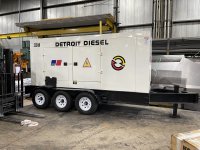
Several years ago, we bought one of these at work in case of a prolonged outage:
1767734896386.jpeg
It was a good news / bad news situation.

The good news is that it was relatively inexpensive, started right away and that we never really needed it. Power outages were at most only a few hours in length and were rare.

The bad news is that at 325 kW - 480 3-phase, it would have fallen woefully short of sustaining full operations. We could have run only one air compressor (typically 200 - 250 HP each), lighting and a few presses, but no chance could this make up for our 2 x 3,000 A services (one located at each end of our main building). It would have allowed us to meet emergency orders, but...

Anyway, not my problem anymore since retiring, but it is / was an impressive piece of contingency planning.
 

theoldwizard1

Well-known member
Joined
Feb 22, 2011
Messages
43,132
Location
SE MI
You don't even "need" load sheds on a Generac. (logisticaly, not NEC based)
My buddy had a whole house generator installed a couple of years ago. They got around the "load shedding" requirement with some "interesting" wiring !

A/C had a separate meter (discounted "interruptible" service) so the generator was not going to run it anyway. They installed DPDT safety switch AFTER the A/C meter. One side went to the PoCo meter, the other went to a breaker in the main panel ! Effectively a manual load shed.
 

Stuart in MN

Well-known member
Joined
Sep 8, 2005
Messages
23,071
Location
Minneapolis
Not at all true. I have to push AND HOLD a button once a week for 2 seconds. And write down that I did the test, hour readings and oil level. My generator log has a spot by each test date for a drop of oil. I pull the stick, touch it and dab it on the test paper. It’s neat seeing all the different little spots.
I suppose it depends on how the generator was specified. I designed many standby power systems during my career for commercial and municipal applications, and all of them had a fully automated exercise function. Either way, the amount of operator interaction is a lot less than the person who posted earlier envisioned.
 

jblnut

ALLIANCE MEMBER
Joined
Jan 17, 2015
Messages
6,990
Location
In the Middle of MN
I suppose it depends on how the generator was specified. I designed many standby power systems during my career for commercial and municipal applications, and all of them had a fully automated exercise function. Either way, the amount of operator interaction is a lot less than the person who posted earlier envisioned.
Yeah that came off a lot different than I meant it lol. I meant it with a giggle and a thick coat of sarcasm lol. But yes, I have an automated option but I want to be in the barn when it does its test so I do it manually. I have an alarm clock setup to go off every seven days at 6:45am so it’s buzzing when I go in there once a week and have to shut it off and it reminds me to do the test.
 

dcg9381

Well-known member
Joined
Jun 20, 2018
Messages
11,708
Location
Austin, TX
My buddy had a whole house generator installed a couple of years ago. They got around the "load shedding" requirement with some "interesting" wiring !

A/C had a separate meter (discounted "interruptible" service) so the generator was not going to run it anyway. They installed DPDT safety switch AFTER the A/C meter. One side went to the PoCo meter, the other went to a breaker in the main panel ! Effectively a manual load shed.
That's one way to do it.

Generac's load shed devices are remarkably simple. They're simple contactors/relays on a timer where you can set the delay so they don't all close at once after a power disconnect. If they detect low frequency (low RPM) or low voltage they disconnect. No fancy wiring needed.

According to "load calc" I'd need 30kW or more. But Emporia Vue (actual measuring of load) shows that we've never hit beyond 18kW.

YMMV. I'd do the more modern Generac load shed devices in a new project... They seem to have fixed the board problems and now they "fail closed" (as I understand it).
 

Stuart in MN

Well-known member
Joined
Sep 8, 2005
Messages
23,071
Location
Minneapolis
That's one way to do it.

Generac's load shed devices are remarkably simple. They're simple contactors/relays on a timer where you can set the delay so they don't all close at once after a power disconnect. If they detect low frequency (low RPM) or low voltage they disconnect. No fancy wiring needed.

According to "load calc" I'd need 30kW or more. But Emporia Vue (actual measuring of load) shows that we've never hit beyond 18kW.

YMMV. I'd do the more modern Generac load shed devices in a new project... They seem to have fixed the board problems and now they "fail closed" (as I understand it).
The load calc may be taking into account motor starting which momentarily requires more power. Your 18kw measurement is probably steady state load.
 

jblnut

ALLIANCE MEMBER
Joined
Jan 17, 2015
Messages
6,990
Location
In the Middle of MN
Yeah, a Vue is not measuring peak starting loads properly.
For funsies here is a 5hp motor a starting and running a grain auger. I’d agree the Vue isn’t all that sensitive from what this shows. Although the motor is oversized to the application and isn’t under a very large load of any kind when it starts. I have seen the Vue show large spikes with things start under load but not usually on this circuit. I don’t have the patience to scroll back far enough to find another example but it will pick up high startup current if the motor starts under a load.
IMG_5430.png
 
To avoid these ads, REGISTER NOW!
Top Bottom