To avoid these ads, REGISTER NOW!

Home Irrigation (Sprinkler System DIY)

mayday0017

Well-known member
Joined
Oct 20, 2010
Messages
1,715
Location
Houston Texas
I recently did my own sprinkler system on my property and I am very happy with the results so I thought I would share what learned while doing it.

1. Don't listen to your tool rental place, just because they constantly rent out trencher X to local irrigation companies does not mean you want to use that one. I followed their advice and regretted it for several reason, biggest one being that it wasn't self propelled. When you dig 800ft of trenches with a machine you are dragging around you feel like a slave. Which goes back to why I believe the sprinkler companies rent this machine, it is cheaper, and the guy paying for it isn't dragging it around. Here in Houston we have very cheap Hispanic labor so I have a good feeling that has something to do with which machine is used too....

2. Don't listen to your local irrigation "professionals", I have a friend who owns a Pool & Landscape company and was going to let me use the company he uses at cost. It sounded cheap $250 per zone is what they charged, and he said I might save $100 doing it myself if that, so I had them come out and quote the yard. They quoted 7 zones using 42 heads plus the cost of the controller of my choice (about another $200) and tax. I took the quote and put it on a shelf as I wasn't quite ready to pull the trigger and spent more time thinking and 7 zones sounded crazy for my little yard. So I sketched up my property and send the info over to Toro to get a free design. Waited a couple weeks and got my design from them. They designed with 4 zones including the flowerbed so for apples to apples they designed with 3 zones and about 65 heads. I converted everything to Hunter product as I didn't want to use Toro, went to Sprinklerwarehouse.com which is about 2 miles from my house and had a materials quote put together. Then I called another irrigation company to come out and quote and talked to the owner who came out and did the design and quote. He quoted 6 zones using 35 heads for $2,800+ tax and I showed him my design from Toro and he argued that it would not work, that it was way too many heads per zone that you should never have more then 6. This made me a little nervous because I wasn't about to pay him $2,800 and I planned on using the design from Toro for the most part. But I am an engineer and I believe more in an engineer approach to design (what Toro did) then a "pro" who has been doing it for 15 years using his own rule of thumb. So I figured I will follow the Toro design, make a couple modifications that I wanted to make and built in a contingency plan to break the back yard into 2 zones if needed before I closed up the final trench. Looks like Irrigation pro's and HVAC pro's have a lot in common, they both do their job and things work, but 90% of them do things off of a rule of thumb rather than learning how to calculate and do the job right.

3. Make sure you have some reliable help. I had a friend who was going to have 3 days he could help me on the system and well long story short he came up with an excuse last minute and I had to do almost all of it by myself. Which leads to number 4

4. Check your weather, and keep a VERY close eye on it, if you have trenches open and it rains it can really make finishing difficult. It rained here for 2 weeks almost every day and I had only filled in the trenches in my front yard. It is VERY VERY hard to back fill with your dirt after it has been rained on a few times, the top gets crusty and hard, and the lower part gets muddy and doesn't rake out of the grass very well. If it is going to rain, do whatever you can to either cover the fill dirt, or fill all of the trenches you are confident are right and can be filled.

5. Take some time one evening to read/watch YouTube and play with your sprinklers. Learn how to adjust your rotors and pop up heads before you install the system. I didn't do this and it made final adjustment take much longer then it would of had I known the adjustment method when I was installing. Pop-up's it really didn't make any difference, but the rotors I swear almost every one of them sprayed 100% fence and when it was about to start spraying grass would start going back the other direction and spraying fence again LOL :)

6. Use swing joints for every connection. Once you add up the cost of all of the fittings to do solid joints, I think building your own swing joints is cheaper or about the same. But the value it adds is what really makes it worthwhile. I don't know how many times I had to dig a little more trench out trying to get the solid joints low enough. I did use some swing joints and they made life so easy. They also are much less likely to break from anything driving over them. Another nice thing is if you need to move one over you can do so easily....


So all and all I used 1,000ft of pipe and decided to use 1" class 200 for everything that wasn't under constant pressure instead of 3/4". It doesn't cost much and it sure is nice to not need both 3/4" and 1" fittings. I used Hunter PGP rotors and Hunter Pro-Spray pop-up's along with Hunter valves. I tapped into my main right at the box and ran a dedicated line to the backflow preventer and put a valve right at the main. I could not be happier with how everything turned out. I still have some trenches to fill in but other than that coverage looks perfect and everything works exactly as it should. I highly recommend doing your own system over paying someone. It is nice to know how it is laid out and where everything is exactly. Plus if you ever have problems with any of it, it should only take minutes to fix the problem because you will know how it was installed and how every component works. I highly recommend sprinklerwarehouse.com I checked prices everywhere and they can't be beat. I recommend the Toro design service as well; it is free, quick, and accurate. I also recommend deciding your goals before you do anything. A professional design will make sure 100% of your yard gets water and gets the exact same amount of water. This requires many many heads and makes the design complicated. For me I want to do things right so I went this route, but really now I don't think it is a matter of right or wrong. If you are happy with the coverage you get dragging a sprinkler around your lawn then save yourself a ton of hassle and make a simple design yourself that covers "good enough" I am willing to bet you would be very happy with it as well.

Any questions feel free to shoot me a PM I will be glad to answer anything I can or point you to the resources I used for my project.
 
To avoid these ads, REGISTER NOW!

niget2002

Well-known member
Joined
Oct 2, 2012
Messages
11,133
Location
Josephine, TX
A neighbor and I used the following site to help design the system we put in his yard:

http://www.irrigationtutorials.com/sprinkler00.htm

The design needs to take into account your actual water pressure and flow.

In the end, as long as you have full coverage and you're happy, that's all that matters.

What I don't like is that the city requires permits to install an irrigation system here.
 
OP
M

mayday0017

Well-known member
Joined
Oct 20, 2010
Messages
1,715
Location
Houston Texas
A neighbor and I used the following site to help design the system we put in his yard:

http://www.irrigationtutorials.com/sprinkler00.htm

The design needs to take into account your actual water pressure and flow.

In the end, as long as you have full coverage and you're happy, that's all that matters.

What I don't like is that the city requires permits to install an irrigation system here.

Yes Pressure, and Gallons Per minute, along with Supply size, & supply line material were all taken into consideration with my design. The problem I found is that the "Professionals" that will come install a system for you don't do this. Neither of the people who quoted me had a pressure gauge or a bucket. They didn't even open the meter box and look at what size the supply line was. Toro or any of the other free design services require this information so they can design the system correctly. The other guys just use a method of 6 heads per zone, kinda like HVAC people who size tons by square footage instead of doing proper calculations.
 

4EyedTurd

Well-known member
Joined
Oct 3, 2009
Messages
595
Location
Texas
Thanks for the advice, I'm about to start ordering parts and tackle this before summer hits. What's the common spot to mount your control box for people that don't have a garage.
 

SD_R/T

Active member
Joined
Mar 15, 2012
Messages
30
The other guys just use a method of 6 heads per zone, kinda like HVAC people who size tons by square footage instead of doing proper calculations.

As you found out, there are a bunch of different factors that go into designing a system. Any guy who makes a generalization like that should be ignored immediately. Kudos to you for seeing through the BS.

(That being said, the general rule of keeping water speed under 5ft/second IS something that should be followed)

I've designed systems with DOZENS of heads on them - and they worked beautifully.

No pictures?? Show us some action shots :bounce:
 
OP
M

mayday0017

Well-known member
Joined
Oct 20, 2010
Messages
1,715
Location
Houston Texas
I mounted my control box in my laundry room. It just happend to be located where I wanted my valves outside. You can buy exterior boxes too if you want, they even have battery powered ones so you don't have to provide power.

I will see if I can come up with an action shot or two :)
 
OP
M

mayday0017

Well-known member
Joined
Oct 20, 2010
Messages
1,715
Location
Houston Texas
Sorry, my cost was $1,000 including rental of the trencher and I used more sprinklers then they were going to use. Plus I have several sprinklers left over and boxes of fittings left over.
 

KissMyWhiteSS

Well-known member
Joined
Jul 24, 2012
Messages
79
Location
Summerville, SC
I second doing irrigation yourself. Do tons of research first before tackling such a tremendous job. At our old house I planned out an irrigation system that would cover our front yard only. We lived on a cul-de-sac so our front yard was very odd shaped. After considered all kinds of different sprinklers and sprinkler heads I found some that caught my eye on Amazon for $4 less than what big box was selling them for.

I took a screen shot of my yard with Google Maps from over head and I measure my yard from various points...then transferred those points to my picture. I drew arcs that represented the distance I needed to cover the yard making sure each arc overlapped. I found that all I needed was 3 heads to get "sufficient" coverage. Sufficient meaning I knew my yard was getting wet without excess runoff.

Here is the difference in mine though. I didn't install a back-flow prevention system, I didn't install valves, and I didn't have to run any wires to a timer in my house.

I dug a trench 16 inches deep down the middle of my yard, laid the PVC in where I wanted it, and ran a 90 degree elbow up out of the ground right next to my water spigot. I attached a PVC hose fitting and ran a 2' section of hose into a timer attached to the spigot.

Sounds cheap, red neck or ghetto, but it cost me less than $100 and after 6 months of using it my lawn was 10X better than it ever was in the 5 years prior to.

Some of you may think this is dumb, but I look at it like this...

In places where you get freezing temperatures, you have to flush out your system with an air compressor, then turn off your back flow and your water sources. In the event you have a pipe burst it's like a fire hydrant went off in your yard and it cannot be shut off until the city comes....I know, it happened to me before.

Plus, I didn't have to worry about my valves going bad from a bad wire, or having my back-flow prevention system inspected every year...which is costly...even if you aren't using your irrigation system.

Essentially I had a PCV water hose buried in my ground with 3 pop up sprinklers...that is it.

It may not work for everybody, but it is definitely cheaper, easier solution in the long run.
Our new house already had an irrigation system in it...and I already replaced a zone valve.
 

ntoole

New member
Joined
Jan 3, 2018
Messages
1
Location
USA
Thank you for sharing this advice. But if you are beginner and confusion about your sprinkler and installing guide then you can check solution here.
 

matt_i

Well-known member
Joined
Mar 14, 2008
Messages
10,728
Location
SE Michigan
Its been a few years since I did one, I used a Fertigator...liquid fertilizer injector (and backflow preventer!) plus added a rain sensor, mainly so the sprinklers weren't working during an active rainstorm :) But also used Hunter. I forget whose controller now but it was a big rotary dial with one position for each function that seemed very intuitive. And Sprinkler Warehouse...at the time even shipped the large zone boxes for free due to the large order (!)
 

Partsguy57

Banned
Joined
Jan 19, 2016
Messages
456
I recently did my own sprinkler system on my property and I am very happy with the results so I thought I would share what learned while doing it.

1. Don't listen to your tool rental place, just because they constantly rent out trencher X to local irrigation companies does not mean you want to use that one. I followed their advice and regretted it for several reason, biggest one being that it wasn't self propelled. When you dig 800ft of trenches with a machine you are dragging around you feel like a slave. Which goes back to why I believe the sprinkler companies rent this machine, it is cheaper, and the guy paying for it isn't dragging it around. Here in Houston we have very cheap Hispanic labor so I have a good feeling that has something to do with which machine is used too....

2. Don't listen to your local irrigation "professionals", I have a friend who owns a Pool & Landscape company and was going to let me use the company he uses at cost. It sounded cheap $250 per zone is what they charged, and he said I might save $100 doing it myself if that, so I had them come out and quote the yard. They quoted 7 zones using 42 heads plus the cost of the controller of my choice (about another $200) and tax. I took the quote and put it on a shelf as I wasn't quite ready to pull the trigger and spent more time thinking and 7 zones sounded crazy for my little yard. So I sketched up my property and send the info over to Toro to get a free design. Waited a couple weeks and got my design from them. They designed with 4 zones including the flowerbed so for apples to apples they designed with 3 zones and about 65 heads. I converted everything to Hunter product as I didn't want to use Toro, went to Sprinklerwarehouse.com which is about 2 miles from my house and had a materials quote put together. Then I called another irrigation company to come out and quote and talked to the owner who came out and did the design and quote. He quoted 6 zones using 35 heads for $2,800+ tax and I showed him my design from Toro and he argued that it would not work, that it was way too many heads per zone that you should never have more then 6. This made me a little nervous because I wasn't about to pay him $2,800 and I planned on using the design from Toro for the most part. But I am an engineer and I believe more in an engineer approach to design (what Toro did) then a "pro" who has been doing it for 15 years using his own rule of thumb. So I figured I will follow the Toro design, make a couple modifications that I wanted to make and built in a contingency plan to break the back yard into 2 zones if needed before I closed up the final trench. Looks like Irrigation pro's and HVAC pro's have a lot in common, they both do their job and things work, but 90% of them do things off of a rule of thumb rather than learning how to calculate and do the job right.

3. Make sure you have some reliable help. I had a friend who was going to have 3 days he could help me on the system and well long story short he came up with an excuse last minute and I had to do almost all of it by myself. Which leads to number 4

4. Check your weather, and keep a VERY close eye on it, if you have trenches open and it rains it can really make finishing difficult. It rained here for 2 weeks almost every day and I had only filled in the trenches in my front yard. It is VERY VERY hard to back fill with your dirt after it has been rained on a few times, the top gets crusty and hard, and the lower part gets muddy and doesn't rake out of the grass very well. If it is going to rain, do whatever you can to either cover the fill dirt, or fill all of the trenches you are confident are right and can be filled.

5. Take some time one evening to read/watch YouTube and play with your sprinklers. Learn how to adjust your rotors and pop up heads before you install the system. I didn't do this and it made final adjustment take much longer then it would of had I known the adjustment method when I was installing. Pop-up's it really didn't make any difference, but the rotors I swear almost every one of them sprayed 100% fence and when it was about to start spraying grass would start going back the other direction and spraying fence again LOL :)

6. Use swing joints for every connection. Once you add up the cost of all of the fittings to do solid joints, I think building your own swing joints is cheaper or about the same. But the value it adds is what really makes it worthwhile. I don't know how many times I had to dig a little more trench out trying to get the solid joints low enough. I did use some swing joints and they made life so easy. They also are much less likely to break from anything driving over them. Another nice thing is if you need to move one over you can do so easily....


So all and all I used 1,000ft of pipe and decided to use 1" class 200 for everything that wasn't under constant pressure instead of 3/4". It doesn't cost much and it sure is nice to not need both 3/4" and 1" fittings. I used Hunter PGP rotors and Hunter Pro-Spray pop-up's along with Hunter valves. I tapped into my main right at the box and ran a dedicated line to the backflow preventer and put a valve right at the main. I could not be happier with how everything turned out. I still have some trenches to fill in but other than that coverage looks perfect and everything works exactly as it should. I highly recommend doing your own system over paying someone. It is nice to know how it is laid out and where everything is exactly. Plus if you ever have problems with any of it, it should only take minutes to fix the problem because you will know how it was installed and how every component works. I highly recommend sprinklerwarehouse.com I checked prices everywhere and they can't be beat. I recommend the Toro design service as well; it is free, quick, and accurate. I also recommend deciding your goals before you do anything. A professional design will make sure 100% of your yard gets water and gets the exact same amount of water. This requires many many heads and makes the design complicated. For me I want to do things right so I went this route, but really now I don't think it is a matter of right or wrong. If you are happy with the coverage you get dragging a sprinkler around your lawn then save yourself a ton of hassle and make a simple design yourself that covers "good enough" I am willing to bet you would be very happy with it as well.

Any questions feel free to shoot me a PM I will be glad to answer anything I can or point you to the resources I used for my project.
Good grief... It's simple pressure and flow...buy a gauge, then figure flow, ( gallon bucket is fine) head down to the"sprinker" shop get the specs on the spray heads, measure yard and set up accordingly...I've do all my apartments, my homes etc.. Holy smokes you can't get a much simpler project then this.....
( I didn't bother to read much of this thread so if not mentioned run the system in a loop equal pressures at all heads)
Sent from my SM-G920R4 using Tapatalk
 
Last edited:

Milton Shaw

Well-known member
Joined
Feb 11, 2011
Messages
4,839
One word of warning. This will be the wettest summer you have ever seen. You will not need to water your yard all summer. Just like washing a car makes it rain, putting sprinkler system in will make it rain just about every day. I put one in 25 years ago and didn't need it all that summer. Did finally need it two summers later and then forgot to winter rise it and valves cracked and finally just gave up on having a really nice yard. Its clay and on a slope with a 50" 150 foot tall oak in the middle so it doesn't grow anything but crab grass anyway. Water bills were also much larger than I wanted them to be. Here they charge sewage on all water usage and "make an adjustment " at the end of the summer that really isn't the extra you paid over normal usage. In Nashville, where we once lived, the water bill for the summer months is the monthly average of your Oct to April bills the previous winter. Don't let your neighbors and friends know that you are the one that ruined the summer outdoors and boating season for them. Are you sure you didn't do this earlier and are the one responsible for Harvey in Texas.
 
Last edited:

JD3020

Well-known member
Joined
May 11, 2016
Messages
91
Location
Dayton, Ohio
Original post is from 2013, interested to hear if its still working alright. My family has been in the lawn irrigation business in Ohio for 30+ years, and we've lost track of how many service calls we've been on where the homeowner did it themself and butchered it. Almost as bad as going with the cheapest bid. Hell anymore we do very very little install work because people are too cheap and theres plenty of guys that will go out and cut corners and use $8/hr labor and come in at 50% of our bid. Works out good for us though because we'll make $85/hr a few years down the road fixing the mistakes.


Now saying that, lawn irrigation is VERY simple. No different than building a house or fixing a car, comes down to using quality products(not stuff you buy at Lowes), and understanding what you're trying to do.
 

scottmoyer

Well-known member
Joined
Mar 7, 2017
Messages
118
Location
Central FL
I used to work for Toro Corporate in Minneapolis and learned how to design the zones and calculating for heads. One thing to consider is sectioning your yard into rectangles or squares. See pic.

attachment.php


Once you section the areas, you can determine how many heads are needed to cover that section based on the heads specifications. Take the section to the left of the driveway in my pic. That area is narrow, so you would want pop up sprayers. Sprayers use a lot of gallons per minute (gpm), so you need to be careful not to overload a zone. So a 15'/90* pop up sprayer might use 1.2gpm, 2 gpm at 180*, etc. If you only get 20gpm from your source, you'll quickly realize that you need multiple zones to cover that area. I don't remember what my home in MN was providing in gpm, but I overloaded that zone and should have made it 2. The red section was another zone made up of four 90* PGP style heads. The backyard had 16 heads in it. Four rows of 4 heads, again PGP style. I can't remember if I had 3 or 4 zones here. The orange section was small enough that I was able to add the section between the sidewalk and the street. Again, these were the pop up sprayers that use a lot of water and require only about 15 minutes of runtime. The last zone was the green section, Again, these were PGP style heads, but the distance they needed to cover was smaller than the back yard, so I was able to have more heads per zone. This are was two zones. One down the edge of the property line, and the other along the edge of the driveway.

All heads should completely overlap the adjacent heads for full coverage. You then base how long each zone needs to run, based on the coverage the zone provides.

One thing I did in my backyard design was to used the 4 heads that made up the middle of the yard as 1 zone. My reason for this was because they were all 360* rotators, so it was easy to calculate the run time for that zone. All of the rest in the back yard were 90 or 180*.

Having too many zones is always better than not enough. My 1/3 acre lot in MN had 9 zones and I needed a 10th because I overloaded zone 1. My home in Florida was put in by the builder and I have a 1/2 acre, but only 6 zones. I do not get enough coverage here.

In MN, I used a vibratory plow to pull 1" black PVC pipe thru the yard with minimal damage. It pulled the pipe in about a foot below grade and only sliced thru the sod, leaving only a cut line. I then installed all of the heads using the Toro flex pipe option, which allows the heads to float. This made it easy to move a head if needed, add a head f needed, etc.

Lastly, NEVER install pop up sprayers on the same zone as PGP style stream heads. You'll flood the sprayer area, while the stream head is trying to cover a full 180* over time.
 

Attachments

  • sprinklerzones.jpg
    sprinklerzones.jpg
    46.6 KB · Views: 442

engineer2

Well-known member
Joined
Dec 13, 2009
Messages
11,804
Location
Chicago burbs
Had one in my first house and loved it.
Put a fitting on the line so I could blow it out with compressed air every fall.
It tested the limits of my muni water supply until I found and replaced a restrictive fitting on the main water line.
A nice lawn can get you a $300/mo water bill.
They are not maintenance-free. Heads need to be adjusted, every once in a while your lawnmower will chop off a pop-up head.
At least if you DIY, you know where all you lines are.
We had odd-even address odd-even day watering restrictions. Mentioned this to the Rainbird people and they were like "Huh??" Probably a feature on today's controllers.
Guy I sold the house to was clueless, so I wouldn't be surprised if he let the system freeze.
 
To avoid these ads, REGISTER NOW!

wkearney99

Well-known member
Joined
Oct 10, 2012
Messages
323
Location
Bethesda, MD USA
If you want a recommendation for a good controller, I've been very pleased with my Rachio setup. It's internet cloud-based so it gets actively updated weather info without using sensors at your location. Which saves money/maintenance on rain collectors and such. You tell it soil and plant types and it automagically figures out watering schedules. If you plug in accurate flow rates it'll give you pretty close estimates on water consumption.
 

AZ Pete

Well-known member
Joined
Aug 15, 2011
Messages
625
Location
Central Arizona
+1 for flex pipe to your heads. If anyone steps on a head that is threaded into pvc, the pvc will break underground....flex pipe will not. I use to have to replace heads every week, after the "yard kid" mowed. Installed flex pipe, and not one head or supply line has been damaged.


Sent from my iPad using Tapatalk
 

yeldogt

Well-known member
Joined
Jan 2, 2012
Messages
18,184
I did one for my first big home gut rehab back in the 80's -- back then they were less common and followed more basic plumbing rules. All my trenches were deep -- drains under rotary hubs -- buried lawn hydrants / central valves. You could walk around my properties sidewalks and patios and never get wet. laws and beds got different GPH coverage.

Today, most systems spray all over the place ... the contractors use general rules for head numbers per zone.. etc. The valves are scattered all over the property .. and the pipe is very close to the surface.

The pipe is cheap -- it's the fittings that add up. Using the three section swing at each head makes for easy adjustment .. but requires careful lay out. Lots of contractors use the flex pipe or the funny tube .. because ... it's easier.

There is a lot of information available -- it's actually a fair amount of work.
 

scottmoyer

Well-known member
Joined
Mar 7, 2017
Messages
118
Location
Central FL
Connecting the Toro funny pipe of flex pipe is not easier. You need to install a saddle over the 1" pipe, then use a tool to cut the hole in the pipe for the water to flow thru, then you need to connect the flex pipe and fittings to the saddle and the sprinkler head.

The easier install is using the white pipe with a threaded "T" and install a riser and the sprinkler head. It's more work using the flex pipe, but I thought it was a much better solution for allowing you move the heads around without needing to touch the main pipe.
 

wkearney99

Well-known member
Joined
Oct 10, 2012
Messages
323
Location
Bethesda, MD USA
Funny pipe? That's what they're calling black poly tubing? Um, ok then.

I ran some stuff using generic 3/4" black poly and it worked reasonably well. Where it was convenient was using it for feeding 1/4" drip irrigation systems. Just jab a hole in the poly, stab in a 1/4" fitting and snake that to wherever I needed an emitter. Great for shrubs and vegetable gardens. There's a ton of options out there for the 1/4" size.

But for lawns? The downside to the poly was the force needed to jab the barbed fittings into it and then the added expense of stainless hose clamps to keep it on there anyway. The barbs alone were not sufficient to prevent blow-outs. It was also way more expensive than gluing up PVC. I suppose it might be "kind of" convenient to run hard PVC for most of it and then stub off using poly, but the convenience of being "able" to move/change it comes at a high cost of the added pieces. You'd still be digging to get to it, might as well just cut/couple/glue PVC again. Versus hoping the hose clamp hasn't rusted shut, that the hose will come off the barb, that the plastic won't break while you're trying to yank off the hose... etc.
 

scottmoyer

Well-known member
Joined
Mar 7, 2017
Messages
118
Location
Central FL
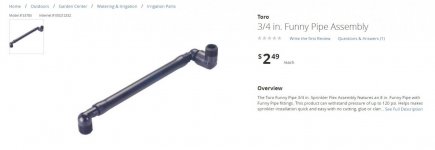
Toro "Funny Pipe" used for connecting the sprinkler head to the saddle.

s-l225.jpg


Here's the saddle I used:

100c.jpg


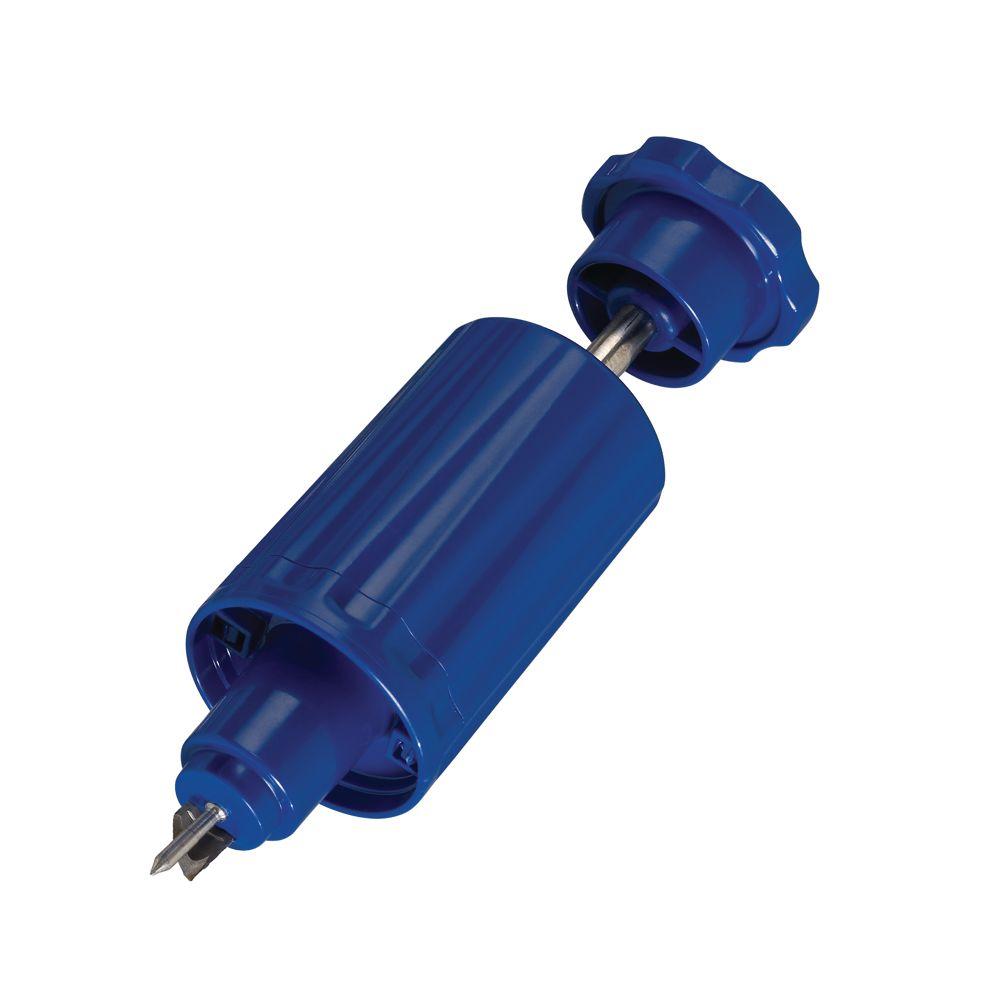
And here's the coring tool for cutting a hole in the 1" main poly line inside the saddle

blues-orbit-irrigation-parts-26301-64_1000.jpg


And the whole purpose is to give flexibility to the placement of the head, and also to provide a less stiff mounting for the head so you don't break the main line if the head gets run over. That's not an issue in Florida where we have a sand base, but in MN, the ground was very hard.

sprinkler-funny-b.jpg
 
Last edited:

wkearney99

Well-known member
Joined
Oct 10, 2012
Messages
323
Location
Bethesda, MD USA
Why bother with the saddle? Just cut the line, glue in a tee with threaded socket and go from there. The saddle seems like added expense for little value.
 

Git

Well-known member
Joined
May 18, 2008
Messages
6,894
Location
S Cal
That is what is commonly used in S Cal

You install a T or a 90 (if it is at the end of a run) in your branch line - so that the opening is parallel with the ground. Then you screw in the single fitting, which will allow you to raise or lower the other end that gets screwed into the sprinkler. The two 90 fittings allow you to position the sprinkler straight up and down. Afterwards you can easily adjust the sprinkler

attachment.php
 

Attachments

  • SNAG-579.jpg
    SNAG-579.jpg
    41.3 KB · Views: 157

scottmoyer

Well-known member
Joined
Mar 7, 2017
Messages
118
Location
Central FL
Not sure how well glue will hold with poly, but...The point of the saddle was to minimize leak points in the main line. You keep the entire main line intact. I guess you could do it your way, but I preferred doing it the recommended way.
 

wkearney99

Well-known member
Joined
Oct 10, 2012
Messages
323
Location
Bethesda, MD USA
Not sure how well glue will hold with poly, but...The point of the saddle was to minimize leak points in the main line. You keep the entire main line intact. I guess you could do it your way, but I preferred doing it the recommended way.

Recommended by people that want to sell you an overpriced fitting. Not sure that's the wisest path to follow...

The only upside I could see to using a saddle, and it's a stretch, would be to avoid having to thread their funky-looking extension into a fixed fitting. But you could just as easily thread it onto the tee before glue-up.

And I'm not talking about gluing poly. I'm talking about putting a PVC tee into the existing PVC line and threading whatever you want into a threaded socket in that tee. The glue would hold just fine as that's what all the rest of the PVC was likely bonded with.

Like one of these:
402-007-3.jpg
 

scottmoyer

Well-known member
Joined
Mar 7, 2017
Messages
118
Location
Central FL
You're showing a PVC T that gets used with PVC line. I'm talking about using the saddle over a poly 1" pipe, not PVC. As I mentioned earlier, I used a large roll of 1" poly and pulled it thru my yard with a vibratory plow, not trenching. The saddle gets tightened down enough to make a water tight seal, you use the core cutter to open a hole inside the saddle, then add your elbows.

The poly is fully flexible and doesn't require being run in straight lines.

The cost of the saddles was very minimal to me since I worked at Toro at the time!

1420714993336.jpeg
 
Last edited:

JD3020

Well-known member
Joined
May 11, 2016
Messages
91
Location
Dayton, Ohio
Poly ***** IME, my dad did poly when he first started in the '80s and we've done a few here and there where it was demanded for whatever reason, but we are 100% PVC. Majority is schedule 40 1". We do carry some poly fittings on the trucks, but just enough to adapt to PVC to make the repair. We can pull in PVC as tight of a circle as our plow will turn, and drop wire at the same time when needed. Then from the secondary/station lines we use 3/8" swing pipe, aside from athletic fields where we use PVC swing joints which are a ***** and a half when it comes time to raise/straighten/service.

Although that picture Scott posted scares the hell out of me if thats wire wrapped around the chain, at least for being in our area where it varies from sand to hard pack clay and shale.
 

scottmoyer

Well-known member
Joined
Mar 7, 2017
Messages
118
Location
Central FL
I don't think that's wire wrapped around the chain. I have always kept my valves together in one central location and ran the pipe from there, so no wire is needed out into the yard. Not sure if poly has gone by the wayside, but I did use it back in the mid 90's in MN. I bought my home in Orlando in '02 and it was all done with PVC. The yard wasn't completed when it got trenched, so PVC was fine, but in MN, on an established lawn, I didn't want to trench.
 

yeldogt

Well-known member
Joined
Jan 2, 2012
Messages
18,184
They don't use poly around here (mid-atlantic) -- the did before the wide use of white PVC. But that was a long time ago.

The common way is to use S40 1" up to the valves and whatever they call the thin wall pipe after -- there is no constant pressure on the pipe after the valve. I use mostly 1" .... but 3/4 also ....depending on what I'm doing (drip flowerbed is fine with 3/4)

Years ago you had to assemble all the parts for the slip fitting to the head from the main pipe now you can buy various remade assemblies. That funny pipe assembly above is sort of a hybrid and I have used them.
 

LS1-IROC

Well-known member
Joined
Aug 6, 2011
Messages
177
Location
Grand Rapids MI
Good discussion guys, I'm planning on tackling an irrigation project this spring. Our ground is very sandy so it should be easy digging.
 

ard

Well-known member
Joined
Feb 16, 2015
Messages
4,391
Location
Sierra Foothills... California
Irrigation is amazingly location dependent. Both in terms of need and design, as well as construction norms.

Where I live, it doesnt rain from generally April/May through to Sept/Oct. If you dont irrigate, you dont have landscaping (or you have natural/xeriscape)

I am 100% drip irrigated, except for the lawns. 3 of them have pop-up sprinklers, and two have sub-surface drip (!). Netafim. (Im redoing two more as we speak.) With the subsurface system, you save a ton of water, plus you can irrigate any time and you dont get water on concrete decks, paths, etc.

For example:

dripline-irrigation.jpg


Here in CA, the irrigation goes in when the house is built.

I only use sched 40 PVC for piping, nothing less. Sized for flow rate and pressure drop. No poly, no clamps- glue joints. In a very dry climate roots will penetrate clamps over the years....
 

Git

Well-known member
Joined
May 18, 2008
Messages
6,894
Location
S Cal
I have replaced most of my sprinklers (over 100 - but not including turf) with drip tubing and have been very pleased. I keep saying I am going to redo my front lawn with underground drip tubing like you mentioned, but have not got around to it yet.

How is that working out for you? I was probably going to go with the RainBird products, that is what I am currently using

http://www.rainbird.com/landscape/products/dripline/XFS.htm

I have seen it installed two different ways. One is to just use loops at the end and the other is to use something sort of what I would call a manifold at each end of a run
 

Attachments

  • SNAG-593.jpg
    SNAG-593.jpg
    115.6 KB · Views: 14

ard

Well-known member
Joined
Feb 16, 2015
Messages
4,391
Location
Sierra Foothills... California
I have replaced most of my sprinklers (over 100 - but not including turf) with drip tubing and have been very pleased. I keep saying I am going to redo my front lawn with underground drip tubing like you mentioned, but have not got around to it yet.

How is that working out for you? I was probably going to go with the RainBird products, that is what I am currently using

http://www.rainbird.com/landscape/products/dripline/XFS.htm

I have seen it installed two different ways. One is to just use loops at the end and the other is to use something sort of what I would call a manifold at each end of a run

Its been good. The lawn areas are very small- 30x20 ft max, so it doesnt matter how it is laid out. I use a modified manifold system. (A line every 12 inches, but one of the mainfold feeders every 3 of those. If you had long, 40-100 ft runs, then you would want each of these fed with one manifold tap. (Do the math, if you have a 0.9 gph dripper every 12 inches, that is 100x.9=90 gph. Or 1.5 gpm. You might be able to get two 'loops' but pretty soon you are needing to flow lot of water thought the tubing at each tap.

My first exposure to drip irrigation was in the 1970s during a visit to israel. Netafim was the inventor, it was invented in israel. As a young engineer, it was an 'aha' moment. To this day I use netafim products- hoses, emitters, filters. Make sure whatever hose you buy it is fully rated for burial under turf. Roots into the drippers can be a problem.

I had to redo a lawn with it recently. Drippers were in decent shape, the lawn had failed due to trees and shrubs nearby- took about 18 years. As you can imagine, digging up an entire lawn area isnt fun- chopping roots with a matting hoe going down 6-8 inches....
 
To avoid these ads, REGISTER NOW!
Top Bottom