To avoid these ads, REGISTER NOW!

Home Level 2 Charger Installation

cannuck

Well-known member
Joined
Nov 30, 2021
Messages
4,662
Location
Rural SK
Anyone who has read any of my related posts would conclude (accurately) that I have very low regard for EVs of any kind. I should add that our youngest daughter has a long history of doing exactly the opposite of most of what I might suggest (thus why she is quite successful at everything she does). So, of course, she bought a plug in hybrid (GLE450e) that she now wants to charge while parked in the garage. Due to my anti lithium/cobalt stand, I have no idea what is in the residential charger market.

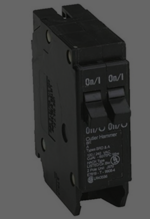
First, she needs to take power out of her already full 100A panel. It is on the wall directly beside garage - that is fully drywalled - so it will be a surface mount installation. Panel is Eaton with 40 double slots and 39 full. There are 20A and 50A large breakers that occupy 2 double slots each, but the rest of the 240V stuff is coming out of ganged breakers that are 15, 30+30, 15 with the 30s linked together. That leaves on option of taking 2 of the 15A double wides out and replacing them with a 15, 40+40, 15 pairing. Does Eaton offer anything at 40 or 50A like that? No room I can see to add another "large" double wide breaker.

That takes us to the receptacle. We don't do the clothes dryer in the garage thing up here, so can't imagine having a ground and neutral stove/dryer plug out there. Seems to me a 50A welder plug would make most sense, or do these chargers need to run a neutral back to the panel. Thinking of sales appeal as they don't usually hold onto houses, cars, trucks, etc. for very long.

Finally: in a last ditch attempt to cure my BEV ignorance, is there a preferred brand of Level 2 charger? Also: why is it/are they preferred?
 
To avoid these ads, REGISTER NOW!

Max

ALLIANCE MEMBER
Joined
Jun 16, 2018
Messages
3,357
Location
Georgia
From what I've read I think that there are significant advantages to having the charger hard wired instead of using a plug. I'm sure that the sparkies will have some good info, but let's also page @jeepxj whom I know has done a lot of this stuff...
 

jeepxj

Well-known member
Joined
Mar 2, 2008
Messages
17,906
My preference is to always hard wire these high amp devices. If you must use a plug in one then use a high quality brand of outlet like hubbel.

they dont need a N back if you hard wire. if you use a 6-50 outlet then you'll need an adapter as most of them run a 14-50.

chargepoint and clippercreek are the top brands.

medium would be emporia IMO
 

75gmck25

Well-known member
Joined
Jul 21, 2014
Messages
1,328
Location
Alexandria, VA
Hardwired is usually preferred because you don't need a GFCI breaker (charger has it) and most chargers are rated for mounting outside exposed to weather (no need for a wet weather receptacle enclosure).

You need to get a charger that has specs to match her vehicle. For example, my 2024 Toyota RAV4 Prime has a 6.6 KW charger that maxes out at 32 amps. Since the charger is a continuous draw device, you can derate a 40 amp circuit to 32 amps and it works fine. The amp setting is part of the app you use to set up the charger.

I bought a Chargepoint Flex charger from HD because I could use my military discount, and my electric company had a $120 purchase rebate and a $40 yearly credit for the first 3 years if I allowed them to monitor its usage. The Chargepoint Flex is rated for up to 80 amps, but I used 6 gauge copper and a 50 amp breaker. That gives me a little headroom if I get a car with a higher amp charger. You only need 240 volts and three wires (two hots and a ground) for direct wire of a Level 2 charger.

FYI - I find that the term "charger" is a little misleading, since the actual charging circuitry is built in to the vehicle. Basically, the charger is just smart enough to negotiate and provide the amps/volts the car needs. The car does most of the managing of the charge status, including the taper off as you near 80%, etc.
 

dave*99

Well-known member
Joined
May 5, 2009
Messages
4,289
Location
Coastal NJ
Hardwire has the following advantage:
With a plug and receptacle and the required GFCI breaker, some chargers will trip the GFCI breaker.
Read the manual before you purchase, some chargers have a warning about this in the manual.
 

mm08822

Well-known member
Joined
Jan 13, 2012
Messages
6,061
Location
NJ
First, you will need details on the existing panel. Need part number, buss bar schematic and what type of cb each stab has on it.

Depending on existing load types, 100A may not be enough....load management is key here., both for other load usage/TOD and EVSE charge rate.

Assuming you can get a 2 pole into the existing panel, I would hardwire the EVSE. otherwise, a garage receptacle (in USA) needs to be gfci protected. Also the receptacle/plug connections have been known to fail. Recently, EVSE rated recepts have become available.

I have only done Chargepoint and Tesla EVSE installs. Make sure to check the installation requirements. Some only accept copper conductors and know the max size it can handle.

Some POCOs offer rebates for installation costs and even reduced rates for EVSE consumption. I believe that also depends on which model EVSE is chosen.
 

johnre

Well-known member
Joined
Dec 1, 2016
Messages
1,060
Location
Portland, OR
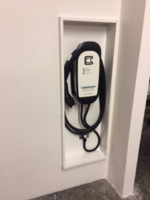
I installed a ClipperCreek HCS-50 (hardwired, 50 A model) back in 2017, just before the state of Oregon expired a 50% tax credit for the cost. Here's a photo; I recessed it into the stud space because it's tight in the garage on that side, and I didn't want to be bumping into it as I walked around the vehicle. Although a so-called 50 A unit and usable to 40 A, I used 6 AWG wire and a 50A breaker:

1750086278865.png

One significant reason I selected the ClipperCreek brand was that it was American made and used quality components inside, particularly the relay.

ClipperCreek is now called Enphase, BTW.
 

dcg9381

Well-known member
Joined
Jun 20, 2018
Messages
11,927
Location
Austin, TX
Hardwire has the following advantage
With a plug and receptacle and the required GFCI breaker, some chargers will trip the GFCI breaker.
The other advantage of hardwire is that you can push "60A" (48 continuous - 80% rule).
If you're on a plug, you install a 50A breaker (40A continuous - 80% rule).
Never had a situation where 8 amps would make a difference.

For me, the inconvenience of having a charger locked to the wall means that I don't do hardwired.

Might post a photo of your panel. The usual way to "make space" is to take your 15-20A large single slot breakers and move them over to tandem breakers.

1750086672371.png

That takes us to the receptacle. We don't do the clothes dryer in the garage thing up here, so can't imagine having a ground and neutral stove/dryer plug out there. Seems to me a 50A welder plug would make most sense, or do these chargers need to run a neutral back to the panel. Thinking of sales appeal as they don't usually hold onto houses, cars, trucks, etc. for very long.
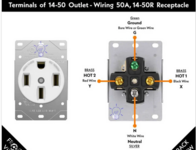
You use a 14-50R. That's the common standard compatible with most 240V EV-chargers. It's 4 wire. It's also known as the "50A RV receptacle". I would say that you want to pay more for an "EV rated" receptacle:

1750086787022.png

Finally: in a last ditch attempt to cure my BEV ignorance, is there a preferred brand of Level 2 charger? Also: why is it/are they preferred?
Meh. I don't have a preference other than "not" straight off the boat.

A big part of it depends on what you are charging. If you're charging a Tesla, you can set the "charge rate" from the car and schedule time-of-day charging. You can't do that with a Ford e-Transit, so you're locked to whatever the level 2 charger and cannot reduce the charge rate.

So how "smart" you want the Level 2 charger to be depends on how smart/dumb your EV is and if variation is necessary.

I like the ChargePoint "Flex" as a charger that I can take with me. It has settings on the charger to change the charge rate separate from the EV. You can plug it in or hard wire it.

You may want a different charger if you're taking it with you and need to do both 120V and 240V situations.
 
Last edited:

justsam

Well-known member
Joined
Aug 20, 2010
Messages
1,268
Location
Penngrove, California
Also need to determine what connector the vehicle itself has. I believe Mercedes is or has made a deal to use Tesla chargers, and the they will also use what is now becoming the standard US vehicle interface, which isTesla NACS. In the past the US standard was/is J1772. There are adapters, but best to avoid if you can.
 
To avoid these ads, REGISTER NOW!

mike93lx

ALLIANCE MEMBER
Joined
Dec 9, 2013
Messages
37,961
Location
Richmond, VA
I installed a ClipperCreek HCS-50 (hardwired, 50 A model) back in 2017, just before the state of Oregon expired a 50% tax credit for the cost. Here's a photo; I recessed it into the stud space because it's tight in the garage on that side, and I didn't want to be bumping into it as I walked around the vehicle. Although a so-called 50 A unit and usable to 40 A, I used 6 AWG wire and a 50A breaker:

1750086278865.png

One significant reason I selected the ClipperCreek brand was that it was American made and used quality components inside, particularly the relay.

ClipperCreek is now called Enphase, BTW.
That recessed install looks great
 

dcg9381

Well-known member
Joined
Jun 20, 2018
Messages
11,927
Location
Austin, TX
FYI, the "OEM" charger that came with that car (GLE450e) has 120V and 240V pig tails. I'd just let her plug into 120V. Most likely the 240V pig tail is 14-50R. Depending on how often this car is in your garage and how fast she wants to charge the battery, I might do nothing.

For part of the year, we a PHEV (BMW hybrid) in our garage. It charges on the 14-50R. Mainly because they want to take advantage of the "cheap fuel" (electricity) and have a very limited range for all electric operation (30-40 miles) and drive more than we do. When we do that, we simply charge our Tesla on 120V power. It's really going to depend on the particular situation - how fast she needs to charge or if it can sit there overnight. Our chargers "follow the car" - we don't have a dedicated EV charger in the garage. The GLE450e will reach full charge in about 23 hours from 0% charge on 120V.
 

johnre

Well-known member
Joined
Dec 1, 2016
Messages
1,060
Location
Portland, OR
That recessed install looks great
Thanks much! I thought it through pretty well and did some Sketchup design work prior to starting anything. It backed up to a stair jack and the wall was not load bearing, just a short upright to close in the stairway and support the handrail, as well as a cover skirt for the area under the stairs. I discovered it was framed with the studs at about 24" OC, not the standard 16", so I didn't have to touch any existing frame members to fit it in. But I did take advantage of this greater width available to me and made the cubby about 18" wide (with the trim included) - which turned out to be just about right.

Here's what it all looked like:

1750135815304.png

One bonus I got out of it that I didn't know would happen, is that the recess contains the coiled cable much better than if it were surface mounted, with no holster mount needed. Most people's cable winding that I've seen leaves a lot to be desired, and the cable can be run over, stepped on, tripped over, etc. pretty easily. This approach keeps it where it belongs.
 
Last edited:

mm08822

Well-known member
Joined
Jan 13, 2012
Messages
6,061
Location
NJ
Thanks much! I thought it through pretty well and did some Sketchup design work prior to starting anything. It backed up to a stair jack and since the wall was not load bearing, just a skirt for the banister and the area under the stairs, it was framed with the studs at about 22" OC, not the standard 16". I didn't have to touch any existing frame members, but did take full advantage of this width available to me and made the cubby about 18" wide (with the trim included) - which turned out to be just about right.

Here's what it all looked like:
1750135815304.png

One bonus I got out of it that I didn't know would happen, is that the recess contains the coiled cable much better than if it were surface mounted, with no holster mount needed. Most people's cable winding that I've seen leaves a lot to be desired, and the cable can be run over, stepped on, etc. pretty easily. This approach keeps it where it belongs.
That little bump out wall helps to keep traffic away from it too.
 

ALinCarolina

Well-known member
Joined
Dec 29, 2014
Messages
761
Location
NC Piedmont
Lots of good brands out there I bet. I have installed 3 Wallbox brand Pulsar Plus EVSEs and find them to be very high quality. Two were hard wired and one plug in. I actually used 4 gauge copper since Lowes sold 4 and 6 gauge THHN for the exact same price.
 

ALinCarolina

Well-known member
Joined
Dec 29, 2014
Messages
761
Location
NC Piedmont
Gotta watch, just like breakers and outlets that the EVSE will take 4ga. I know the Chargepoint that we have will not.
Good point. thanks for bringing that out. Luckily mine did accept 4 ga. I used the 4 gauge in a way to prepare for possibly more powerful charging systems in the future and I figured if someone wanted to replace it with a sub-panel in the future they could go bigger.
 
To avoid these ads, REGISTER NOW!
Top Bottom