To avoid these ads, REGISTER NOW!

Honda D series Bearings

Jagmandave

Well-known member
Joined
Nov 6, 2011
Messages
6,304
Location
Overland Park, Ks.
A friend is rebuilding a Honda D16Y8 Vtec, he's already had the head done (which was in great shape BTW) and I persuaded him that since the engine has about 200K on it, it might be a good time to go ahead and put some rings and bearings in it.

Seemed like a good idea at the time.....

There was no ring ridge at the top of the cylinders so we decided a light hone and some new rings would do the trick.

All the rod bearings looked to be in great condition, and all the mains except the center also looked terrific - the center bearing had some score marks on one side and seemed to fit just a tiny bit loosely in the cradle compared to the other 4.

Now the problem.

Since this engine is from the late 90's no Honda dealer stocks parts for it - they might be able order them but he needs some very specific info. The bearings are marked from the factory with a paint dot that gives the correct sizing - between the 5 main bearings there are 5 possible sizes that can be used in one engine. Same with the rod bearings.....however, there are no paint dots on any of the shells that we can find. So, short of pulling the crank and having it turned undersize to match an aftermarket set of bearing shells and having the rods resized the same way is there any way to figure out what bearings to use? And......where do you get them?
 
To avoid these ads, REGISTER NOW!

engineer2

Well-known member
Joined
Dec 13, 2009
Messages
11,824
Location
Chicago burbs
Not surprised there is very little ridge. Honda supposedly used more chromium in the their cast iron than US manufacturers.
As popular as the Honda D16Y8 is, I would think there are plenty of aftermarket bearing sets out there.
You would need to measure everything like with any rebuild, and then decide if you need to turn the crank.
 

Neggy

Well-known member
Joined
May 30, 2021
Messages
754
depending on how $$$$ the bearings are, you could get a few sets and plastigauge them to determine if the proper clearance was met.
 

Showkey

"MEMBER EMERITUS"
Joined
Aug 9, 2014
Messages
8,638
Location
Wausau WI
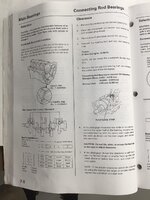
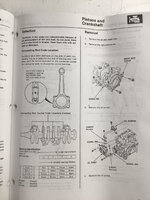
Below is the shop manual section on the block and crank marking for the factory bearing selection system. From the block and crank marking you can determine the color ( thickness of the shell) required. If the journal is slightly worn you can go with a thicker shells, checking the clearance with plastic gauge. This factory bearing selection allows the factory to get a very precise bearing fit.

Tight clearance compared to other manufacturers.
Rod to crank journal oil cleanance:
.0008-.0015” new .020- .038mm
service limits .002“ .05mm

BB17A02E-1E68-4A14-A34F-EB269482D4D8.jpeg7FF7E874-799A-46C4-8A9E-2C5329C49908.jpeg65EB422F-C385-48E3-99C8-0F97C34F7929.jpegThe bearing halves are available from the dealer…..they will very likely have to order them. There’s a separate part number for each color ( size). They are not sold in bearing sets since they are size selected for each journal. Bearing Set ( aftermarket) would compromise the sizing to and not leave much room for error as the service limit is .002”.

Some will also say grinding a Honda crank is not a good idea they are surface induction hardened. Obviously opinions will vary on this grinding topic.

NOTE manual pics are 1996-1997 Civic. Other Honda models are very similar. Use the same bearing selection system, marking, color ID etc. HONDA Bearing selection has been in use for over 60 years.
 
Last edited:

BillK

Well-known member
Joined
Aug 24, 2006
Messages
9,356
Location
Beautiful Southern Maryland
Dave,
99.999% of the time you can order a set of aftermarket "standard" bearings and they will be just fine. I simply do not know of anyone that uses the factory color coded bearings on any type of rebuild, including performance builds. Just use a good quality set of bearings. Clevite is my choice but a lot of Honda guys prefer ACL.
 

Showkey

"MEMBER EMERITUS"
Joined
Aug 9, 2014
Messages
8,638
Location
Wausau WI
Unfortunately can’t count the number of performance rebuilds gone bad with piston slap, slight knock or smoking only to find rebuild specs are well beyond new specs.

The shop bored and set piston clearance to .002-003” as that what they are always do. When they were asked to set .0008”.
Piston rattle when cold or uses a qt in 700 miles.
Same with bearing set up at .003“ oil clearance and customer says the oil pressure ***** when HOT.


The phase “good enough” or “close enough” …….is common after the fact when they are asked for the build sheet specs. That maybe ok for a ‘50 Chev inline 6.
 

matt_i

Well-known member
Joined
Mar 14, 2008
Messages
10,741
Location
SE Michigan
I believe they are using selective-fit manufacturing to air-gage the main diameters and then pick the 1 of 5 size groups which best matches to get the clearance.

Imo it would be difficult to replicate in any shop without the controlled temp and qualified gaging that the OEM has built up.

Given enough time you could buy one of each type of bearing set and plasti-gage it on all 5 locations, then determine where you need to order from there. It could be costly or not, I have no idea, but it would be costly in time.
 

Showkey

"MEMBER EMERITUS"
Joined
Aug 9, 2014
Messages
8,638
Location
Wausau WI
^^^^^^^^^^^^^
Your missing the whole point of the Honda system. The system works with no field measuring.
Even on a used engine, you use their original marking/measurements as the starting point. Dial in the clearance with plastic gauge. Given the observation of the OP even at 200k with no polishing using one size thicker shells can achieve .0008“ at not extra work or cost. Simply using plastic gauge and few trial and error checks.

If you need to say polish ( *not grind) that one journal……..you use a slightly thicker bearing shell than the chart called for from new and check the clearance.

* The selection system will not cover the amount removed if the journals need grinding.
 

CraigStu

Well-known member
Joined
May 22, 2014
Messages
4,044
Location
Blacksburg, Va
^^^^^^^^^^^^^
Your missing the whole point of the Honda system. The system works with no field measuring.
Even on a used engine, you use their original marking/measurements as the starting point. Dial in the clearance with plastic gauge. Given the observation of the OP even at 200k with no polishing using one size thicker shells can achieve .0008“ at not extra work or cost. Simply using plastic gauge and few trial and error checks.

If you need to say polish ( *not grind) that one journal……..you use a slightly thicker bearing shell than the chart called for from new and check the clearance.

* The selection system will not cover the amount removed if the journals need grinding.
Exactly. Lexus uses the same system. I realize that American cars have gotten MUCH better in the last 20 years but this system is one reason Honda etc have been better built for a LONG time. See the bearing clearance specs in the manual above. Being able to build a car w/ specs this tight is why this engine has 200,000 miles on it. I had a 2008 Civic that I didn't tighten the oil drain plug properly. The check engine light came on but no oil pressure light. I had gotten gas 20 min prior and figured the CE light was probably because I hadn't tightened the gas cap enough. It finally started making noise. When I took it apart, did my research and found out about this system, I opted to buy a short block. I was not interested in having it machined, buying aftermarket bearings and ending up w/ ,002 inch clearance when the spec is from < .001 to < .002.
 
To avoid these ads, REGISTER NOW!

BillK

Well-known member
Joined
Aug 24, 2006
Messages
9,356
Location
Beautiful Southern Maryland
Unfortunately can’t count the number of performance rebuilds gone bad with piston slap, slight knock or smoking only to find rebuild specs are well beyond new specs.

The shop bored and set piston clearance to .002-003” as that what they are always do. When they were asked to set .0008”.
Piston rattle when cold or uses a qt in 700 miles.
Same with bearing set up at .003“ oil clearance and customer says the oil pressure ***** when HOT.


The phase “good enough” or “close enough” …….is common after the fact when they are asked for the build sheet specs. That maybe ok for a ‘50 Chev inline 6.
SK,
You are talking apples vs oranges. Your example is citing crappy machining and a crankshaft that is more than likely worn out and needs grinding.

Dave is doing a quick freshen up, not a "performance build" and he needs a set of bearings. He is not grinding the crank and bets are he will not find all of the different Honda OEM bearings anytime soon. IF the crankshaft is not worn he should be just fine using a set of standard bearings from any of the name brand manufacturers. IF the crankshaft is actually worn then it needs to be reground anyway.
 

Showkey

"MEMBER EMERITUS"
Joined
Aug 9, 2014
Messages
8,638
Location
Wausau WI
Sorry………Guess we will just disagree.

Freshen up should NOT be changing the original bearings with 200k that are currently let say at .0015” buying aftermarket bearings that are one size fits all and ending with clearance at .002“-0025“. Post #8 explains the process to “freshen up“ without actually making things worse.

All this without good, bad or marginal machining.……machining just adds another layer that must be watched.
 
OP
J

Jagmandave

Well-known member
Joined
Nov 6, 2011
Messages
6,304
Location
Overland Park, Ks.
Thanks for all the replies, I recognize that it's a precision built engine and things were done differently. I also know how to check clearances carefully and make sure it's been done correctly.

The issue with finding the crank journal sizes is the engine is being rebuilt in the car - we would have to pull it to get that info off the back of the block.

I think we're going to go Bill's route - buy a set of ACL or King bearings and check it carefully - it the clearance is good we'll put it together.
 

redmondjp

Well-known member
Joined
Nov 25, 2014
Messages
2,318
Location
Redmond, WA
Honda is not the only one to do this with their main bearings; Volvo did the same thing with their 5-cylinder engines for I don't know how long (another reason why you can never find anybody who rebuilds those engines - $$$$$ to do so).

Having worked on American cars since the 1970s, and on Japanese cars since the 1990s, I can say that precise tolerances are one of the primary differences between American and Japanese cars and one that I believe explains why the Japanese-built equipment lasted so much longer, especially on engines and engine accessories (starters/alternators/water pumps etc.).

My recommendation would be to simply plastigage the existing bearings to see what the current bearing clearances are - they still may be within tolerance in which case, LEAVE THEM ALONE and put the darn thing back together. Otherwise, you are probably going to have to spend some coin and some trial-and-error finding the correct OEM bearing thicknesses in order to achieve the proper tolerances.

Having had detailed discussions with my machine shop about grinding crankshafts, they said yes, they can do it but it removes the surface hardening which dramatically increases the wear rate of the post-machine bearing journal (he quoted me the typical RC hardness #s before/after but I have forgotten them). Strongly advised that I just find another OEM crank and not to machine one.
 

Wrench97

Well-known member
Joined
Jun 23, 2018
Messages
12,146
Location
Southeastern Pa
Ford did this with the 6.6/7.8L inline 6 Diesels in the late 80's early 90's the rebuilds never did hold up as well as the original's.
 

CraigStu

Well-known member
Joined
May 22, 2014
Messages
4,044
Location
Blacksburg, Va
A short story to illustrate how good this system can be. In the mid 90s Lexus had a service bulletin for their V8 in the big sedan. W/ the radio off one could hear a very slight rhythmic clunking sound from the engine when the AC compressor came on. The fix was to drop the pan, look at the block and cap markings to determine which standard size the front most main bearing was. Order and install a bearing set that was 2 sizes smaller. That was the first time I had become aware of this system.
 

APEowner

Well-known member
Joined
Oct 2, 2009
Messages
4,166
Location
Sunny, New Mexico
Quality, standard size, aftermarket bearings will be fine in the OP's situation. He's doing an in frame bearing swap, not a rebuild and the spec he needs is better than the used bearings but not too tight. Buy a set, check the clearances, if one's too tight then install one of the used shells to gain a little clearance.

FYI, tight tolerance, select fit, color coded bearings are neither new nor exclusively Japanese. Check out the #1 main on the 1965 Police Spec 390.20210715_083039.jpg

20210715_083028.jpg

The
 

tboy

Well-known member
Joined
May 23, 2013
Messages
149
Location
Central Ohio
I freshened up a D series engine years ago and did what was suggested with a standard set of bearings and checking with plastigauge. That worked well for me for 50k miles till I sold the Civic, I assume that little mill is still serving someone today!

I always considered the process of bearing selection to be an assembly aid to eliminate variation in machining tolerances. The fact that Honda and others have used this system on their lowest cost engines leads me to believe the purpose is to get the best possible clearance for the lowest cost, not necessarily for "performance".
 

BillK

Well-known member
Joined
Aug 24, 2006
Messages
9,356
Location
Beautiful Southern Maryland
I always considered the process of bearing selection to be an assembly aid to eliminate variation in machining tolerances. The fact that Honda and others have used this system on their lowest cost engines leads me to believe the purpose is to get the best possible clearance for the lowest cost, not necessarily for "performance".
Yup. And Honda is not the only one that does it. GM does it very regularly and has for 40 years or more.
 
To avoid these ads, REGISTER NOW!
Top Bottom