To avoid these ads, REGISTER NOW!

Honda Techs . . .

Teken

Well-known member
Joined
Jan 2, 2010
Messages
8,214
Location
The Bad Lands
Working on a 1991 Acura Integra and found that the rear brakes needed to be serviced and all pads replaced.

Question: How does the rear brakes operate? When I had to replace the rear pads I noted that the piston was obviously extended to where the existing brake pads were seated.

In the front caliper, the piston is simply pushed in with a brake piston dial, or with a air gun accessories . . .

But, the rear brakes the piston must be rotated with a set of gripping pliers, or one huge aszz flat / X shaped tool.

How does the piston extend if I am actually turning this piston to go back inside? It is obviously threaded in some odd fashion as you can not push it in. What is inside of the housing that lets it retract, if I had to turn it clock wise to go back into the piston housing?

Pictures would be helpful . . .
 
To avoid these ads, REGISTER NOW!

00S4Boy

Well-known member
Joined
Feb 4, 2010
Messages
449
No he's asking how they work. IE how is the twist out piston connected to the parking brake actuator, and if there is some special fluid passages to route fluid to properly actuate the spin out caliper.
 
OP
T

Teken

Well-known member
Joined
Jan 2, 2010
Messages
8,214
Location
The Bad Lands
No he's asking how they work. IE how is the twist out piston connected to the parking brake actuator, and if there is some special fluid passages to route fluid to properly actuate the spin out caliper.

Yes, and No . . . I would like someone to draw or put up a picture so as I can see what the inside of this piston looks like.

I can't understand how its required to turn in a clock wise fashion to make this piston retract into the caliper housing, yet the piston obviously is being pushed back out from the brake fluid hydraulic action . . . :headscrat
 

tonydanzah

Well-known member
Joined
Nov 14, 2009
Messages
5,275
Location
the champagne of people
i might be wrong but i think there is wound spring in there. the fluid forces the piston to turn out far enough to touch the pad and rotor. They pulls back just enough to allow the rotor to turn freely. Its continues to slowly walk outwards as the pad and rotor wear.
 

00S4Boy

Well-known member
Joined
Feb 4, 2010
Messages
449
Ok well i'm curious as well, how hydraulic action forces out the piston as well as how the parking brake mechanism inside the caliper is dynamic enough to be able to engauge the piston at any given point in it's travel along the life of the brake pad.
 

tonydanzah

Well-known member
Joined
Nov 14, 2009
Messages
5,275
Location
the champagne of people
when you engage the parking brake I think you are manually engaging the spring. Either way, I hate those systems, they are pain in **** when they get old or rusty.

toolhorder will know the answer though.
 
Last edited:

ourkid2000

Well-known member
Joined
Jul 1, 2008
Messages
927
Location
Nova Scotia
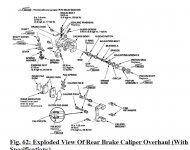
This is from an 8th gen civic, but the operation should be the same..........

I believe the rotating operation is for the parking brake. Anyways, this diagram should help. If you need more info don't hesitate to contact me
 

Attachments

  • rearbrake.jpg
    rearbrake.jpg
    100.1 KB · Views: 97

00S4Boy

Well-known member
Joined
Feb 4, 2010
Messages
449
when you engage the parking brake I think you are manually engaging the spring. Either way, I hate those systems, they are pain in **** when they get old or rusty.

I like em better, parking brake is fucked, ok it's the caliper or the brake cable.

Parking drum under rotors the shoes always get hung up under the hat and the adjuster is seized and getting the rotor off the car is a battle without destroying the parking brake shoes. And i'm just not a fan of drum brakes in general.
 

00S4Boy

Well-known member
Joined
Feb 4, 2010
Messages
449
This is from an 8th gen civic, but the operation should be the same..........

I believe the rotating operation is for the parking brake. Anyways, this diagram should help. If you need more info don't hesitate to contact me

yep i'm going to have to take one apart some day to figure out how they work.

Wait i got an Indian coming in tomorrow for rear calipers because the slide pins are siezed to **** i can just take one of those apart. Maxima but same concept.
 
OP
T

Teken

Well-known member
Joined
Jan 2, 2010
Messages
8,214
Location
The Bad Lands
I am looking at the HELM's manual so the picture is the same . . . I feel retarded, but I still don't understand how this operates to be honest.

1. Piston extends out when pressure is applied from the hydraulic system when the brake is applied.

2. Servicing: When the piston is to be retracted back into the caliper housing it must be turned in a clock wise fashion. Pushing it will do nothing. The piston feels like it is threaded, but its obviously not because it could not be pushed out if it was!

3. Parking brake: Yep, that POS is rusted to ****, and I have to remove the whole assembly. Anyone have some TIPS and suggestions before it explodes in my hands and I can't get it back on?
 

00S4Boy

Well-known member
Joined
Feb 4, 2010
Messages
449
I am looking at the HELM's manual so the picture is the same . . . I feel retarded, but I still don't understand how this operates to be honest.

1. Piston extends out when pressure is applied from the hydraulic system when the brake is applied.

2. Servicing: When the piston is to be retracted back into the caliper housing it must be turned in a clock wise fashion. Pushing it will do nothing. The piston feels like it is threaded, but its obviously not because it could not be pushed out if it was!

3. Parking brake: Yep, that POS is rusted to ****, and I have to remove the whole assembly. Anyone have some TIPS and suggestions before it explodes in my hands and I can't get it back on?

What dude the parking brake is applied via the caliper, thats the only reason it's a twist out caliper. Whats going to explode?
 

tonydanzah

Well-known member
Joined
Nov 14, 2009
Messages
5,275
Location
the champagne of people
I would just get two new calipers, and older fords i think it is actually threaded. It turns out as pressure is applied. Not sure about hondas. My 04 civic has rear drums.
 
OP
T

Teken

Well-known member
Joined
Jan 2, 2010
Messages
8,214
Location
The Bad Lands
What dude the parking brake is applied via the caliper, thats the only reason it's a twist out caliper. Whats going to explode?

The top of the spring assembly is being held by what looks like a nut, and the flex line is held by two 10 mm bolts which BTW are rusted in place. I need to remove this entire line and the spring assembly.

I can tell it will either break clean off, or explode apart once I pull it apart, so any tips.
 

00S4Boy

Well-known member
Joined
Feb 4, 2010
Messages
449
The top of the spring assembly is being held by what looks like a nut, and the flex line is held by two 10 mm bolts which BTW are rusted in place. I need to remove this entire line and the spring assembly.

I can tell it will either break clean off, or explode apart once I pull it apart, so any tips.

Never remove the spring. If your changing the caliper, you should have a horseshoe clip( i can't think of their proper name) that holds the brake cable in place and then the eyelet on the end that slides onto the caliper assembly actuation, pop the clip off and pull the parking brake cable off of the caliper. The spring assembly has stops so it will have a maximum extension point.
 
To avoid these ads, REGISTER NOW!
OP
T

Teken

Well-known member
Joined
Jan 2, 2010
Messages
8,214
Location
The Bad Lands
Many thanks to both of you above . . . That was a great video, and no I didn't have the correct tool I just used a large set of pliers to rotate the piston. One side was very easy to turn probably required about 20 lbs of force. The other one literally took about 110 lbs just to get that piston to even budge!

Something that was supposed to take maybe 30-40 minutes for a girl friend, literally took me 4 hours to get the whole thing repaired and tested.

Can't even begin to tell you guys how hard it is to work on things that are so rusted that they simply break apart, or having bolts shear clean off!

Spent two hours drilling out sheared off bolts, I couldn't even stand up for about 30 minutes because I was hunched over for so long . . .

As always I thank all of you for your feed-back and contributions!
 
OP
T

Teken

Well-known member
Joined
Jan 2, 2010
Messages
8,214
Location
The Bad Lands
This must have been one rusty rear brake!

Vehicle is almost 20 years old and in this town the lay down salt like its going out of style . . .

Had to replace 7 bolts that sheared clean off just trying to remove them. :( Even before she came we had soaked all the bolts with penetrating lube etc, even heated some of them prior for a whole day.
Didn't even make a difference . . . What a PITA, and she needed the vehicle for work the next day, can you say stress! :mad:
 

caper

Well-known member
Joined
Feb 12, 2006
Messages
3,185
Location
cape breton
That's the way 5 yr old vehicles are here.I live right on the Atlantic ocean and our highway dept puts the plows and salt trucks out from Oct till May sometimes.I was driving behind one on sunday.I wouldn't even consider doing brakes on anything more than 5-7yrs old without an acetylene torch.
 

maxipouce

Well-known member
Joined
Jan 21, 2010
Messages
180
Location
France
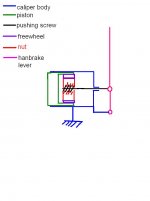
There is some kind of ratcheting system between the nut and the piston allowing the piston to travel without spinning. As the nut/screw system is not reversible it can't come back without being turned, that is why there is a *** on the brake pad back.
When you turn back the piston make sure you don't twist or tear the boot.
 

Attachments

  • handbrake.JPG
    handbrake.JPG
    31.6 KB · Views: 17

ourkid2000

Well-known member
Joined
Jul 1, 2008
Messages
927
Location
Nova Scotia
Caper........we live pretty close to each other and it's amazing the difference in climate between Cape Breton and where I live (airport area).
 

caper

Well-known member
Joined
Feb 12, 2006
Messages
3,185
Location
cape breton
The difference of a few miles from the ocean can make some big changes.I'm only a rifle shot from the sea.
 
OP
T

Teken

Well-known member
Joined
Jan 2, 2010
Messages
8,214
Location
The Bad Lands
There is some kind of ratcheting system between the nut and the piston allowing the piston to travel without spinning. As the nut/screw system is not reversible it can't come back without being turned, that is why there is a *** on the brake pad back.
When you turn back the piston make sure you don't twist or tear the boot.

I am going to take one of these things apart next week, just so I can understand how it operates. Many thanks for the image. :thumbup:
 

ourkid2000

Well-known member
Joined
Jul 1, 2008
Messages
927
Location
Nova Scotia
Hey Teken.......Let us know how it works out! I don't understand it either.

I'm curious as to how it retracts when you let off on the brake.
 
OP
T

Teken

Well-known member
Joined
Jan 2, 2010
Messages
8,214
Location
The Bad Lands
I am more interested in as to *WHY* the rear brakes must be turned, unlike the front where you simply push them in . . .

Just trying to wrap my brain as to what forces you to turn this piston in, yet it freely pushes out with out any problems from the brake system. Those Japanese Engineer's are amazing thats all I have to say!
 

00S4Boy

Well-known member
Joined
Feb 4, 2010
Messages
449
I am more interested in as to *WHY* the rear brakes must be turned, unlike the front where you simply push them in . . .

Just trying to wrap my brain as to what forces you to turn this piston in, yet it freely pushes out with out any problems from the brake system. Those Japanese Engineer's are amazing thats all I have to say!

The reason for why it has to be turned is, you pull the parking brake, the caliper push's the pad, they use a rotating mechanism to convert the pulling force of the parking brake into the pushing force of application.
 
OP
T

Teken

Well-known member
Joined
Jan 2, 2010
Messages
8,214
Location
The Bad Lands
I know you stated that before, but its either my fuzzy logic or the fact I don't have the thing in front of me to see.

I understand the e-brake part etc. What I don't understand is why it must be turned to go in? But the same turning is not required in the reverse . . . It obviously works well from concept to application.

I just need to take one apart so I can physically see how this operates. I don't have a *spacial brain* where I can just read and understand this. I have what they call a *physical brain* where I learn by doing and must have it in my hands for comprehension.

I looked long and hard at that Helms Manual and it didn't do anything for me . . . :(
 

flyingvette

Well-known member
Joined
Jun 17, 2009
Messages
92
I have an 90 acura integra. Similar thing happened to me once. Except the caliper froze while still on the wheel while the car was being driven. I replaced it with a rebuilt caliper assembly, was definitely worth saving all the time required to maybe get it fixed. My suggestion: buy another one and move on with life.

I don't recall ever having a problem with applying direct pressure to push the piston in, except the one time it froze shut (as mentioned above). It was an Ohio car and all 4 calipers were eventually replaced, so you're probably due if you haven't done it already anyways.
 
OP
T

Teken

Well-known member
Joined
Jan 2, 2010
Messages
8,214
Location
The Bad Lands
Two of them were replaced they had too many miles on them to be serviced. The reason this one unit was worked on is because for what ever reason it always seems parts for the passenger side is NEVER available!

I don't understand why that is with this model car . . . She was in a pinch, and didn't have the cash to have the whole thing replaced. I agree should have spent the cash now, because 280K plus is a lot on a caliper its going to blow sooner rather than later!
 
To avoid these ads, REGISTER NOW!
Top Bottom