OK, somebody, riddle me this... something I've always been curious about...
Why in your main box to you connect the neutral and ground together, but in a subpanel (if you have one) you have a separate ground? I'm sure there is a good reason for doing one but not the other, but I'll be darned if I know why, and was wondering if one of y'all knew...
Thats a great question. Glad u asked. Many people are confused by this.
The neutral bar is bonded in the main panel to extablish a ground fault path. Without that bond, if a live ungrounded conductor touched an EGC or grounded object such as a metal JB, building steel or metal conduit, the breaker on the offending circuit wouldnt trip.
In a subpanel, if the neutral bar is bonded, then neutral current could flow on grounded metalic pathways, especially if the neutral conductor developed a bad connection at either end, and thus create a shock potential.
This is why 3-wire feeds to detached structures were no longer allowed as of 2008 code cycle. And they were never allowed to a detached structure that has parrallel metalic pathways such as a metal gas line or metal water line...
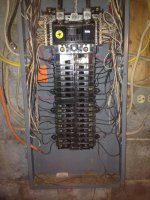
EDIT: Heres a pic that should help those who are visual learners.