I am running 3/4” airlines around my shop and my Eastwood 30/60 scroll compressor will be supplying the air. I am just about ready to install a horizontal, 1/2” copper pipe radiator I am fabricating. After reviewing lots of post about these coolers I am wondering if I am doing it wrong. The supply to and from the cooler are 3/4”. The cooler will have manifolds at each end and then four 1/2” by ten foot copper lines. The air will go from one side to the other, but not back again. The 1/2” pipe will slope down hill towards the exit line which will go to the distribution lines. The drain for condensation will be on the exit side going straight down from the manifold to a ball valve. Some of this design is caused by space available on the walls of my shop. My thinking is this is how the cross flow radiator works in my 1965 Buick. My concern is I am missing something because I can’t find a similar DIY cooler that relies on reduced air flow speed to make up for a shorter run of copper pipe. I will post pictures when the rest of the parts arrive from Home Depot, but knowing me, I will fabricate and install as soon as parts arrive. What do you think?


You are using an out of date browser. It may not display this or other websites correctly.
You should upgrade or use an alternative browser.
You should upgrade or use an alternative browser.
Horizontal air cooler lines
- Thread starter kcombs
- Start date
pcmeiners
Well-known member
Dye the pipe as dark as you can, maybe gun blue. Bright copper pipe is a good conductor of heat but a poor radiator of heat, so as dark as you can get it, black paint will do. Bare bright copper pipe only becomes a good radiator once it oxidizes to a dark color, but that takes years.
Are you sure you want to build a cooler ?, this cooler has all copper tubes with a swirl producing coils in the tubes and aluminum fins which are good radiator of heat.......
Are you sure you want to build a cooler ?, this cooler has all copper tubes with a swirl producing coils in the tubes and aluminum fins which are good radiator of heat.......
I should have asked the question here before I bought the parts and painted the tubing flat black.  Most of the post I found had the tubing going vertical and more total feet of tubing. I don’t know if I really need the cooler, just figured I would build one while plumbing the shop for compressed air. I am assuming the air slowing down and running through 10’ of copper tubing would help get rid of water. I do have a heat sensor gun from Eastwood so I can test it once I get it running and the rest of the shop plumbed.
Oh, and the air will be going through the tank on the scroll compressor before it goes into the cooler lines. And I will be using the compressor air for my blast cabinet and maybe painting a car.
Most of the post I found had the tubing going vertical and more total feet of tubing. I don’t know if I really need the cooler, just figured I would build one while plumbing the shop for compressed air. I am assuming the air slowing down and running through 10’ of copper tubing would help get rid of water. I do have a heat sensor gun from Eastwood so I can test it once I get it running and the rest of the shop plumbed. Oh, and the air will be going through the tank on the scroll compressor before it goes into the cooler lines. And I will be using the compressor air for my blast cabinet and maybe painting a car.
pcmeiners
Well-known member
If you paint a car or use a blast cabinet you need a cooler to remove water from the air supply. A cooler can remove 70% of the moisture if the surface area is sufficient. You should really plumb the cooler in the circuit before the tank.I don’t know if I really need the cooler,
As far as reduced air flow introduced by the 1/2" pipe it is minimal so the effect of going from a higher pressure to a lower pressure will have a very small cooling effect. To produce a cooling effect you would need a considerable drop in pressure. As mention above a well designed franzinator would produce a cooling effect but at the cost of pressure/volume of air. Same principle as refrigeration, refrigeration is not free neither is a franzinator.
As far as pipe diameter affecting cooling efficiency, smaller pipe is better than larger pipe, which has a price, as to lowering the volume output, thus the use of multiple smaller tubs in cooler to make up for the friction loss of smaller diameter tubes.
Last edited:
Thanks for the replies, I should have posted here before starting this project.
The compressor is portable on castors, so I don't think I can get the cooler inline before the tank. The scroll compressor does have an aluminum radiator before the tank, don't know if that makes much difference. the cool thing about the compressor is it is really quite. The air for the blast cabinet will go through the cooler I am trying out then about forty feet of airline. The airline will go uphill half way and then down hill to the outlet for the compressor. I am using a kit of flex lines and aluminum blocks with the connectors, a fairly common kit. I do have a filter from Eastwood that is currently on the compressor, but I plan to move it to the outlet for the blast cabinet.
If my home designed cooler doesn't do the job I will look into a franzinator. Problem is my compressor has just enough volume to run my blast cabinet, so that might be an issue. (The size of the compressor was dictated by in the wall and ceiling wiring I installed 15 years ago, 10 gauge copper)
The compressor is portable on castors, so I don't think I can get the cooler inline before the tank. The scroll compressor does have an aluminum radiator before the tank, don't know if that makes much difference. the cool thing about the compressor is it is really quite. The air for the blast cabinet will go through the cooler I am trying out then about forty feet of airline. The airline will go uphill half way and then down hill to the outlet for the compressor. I am using a kit of flex lines and aluminum blocks with the connectors, a fairly common kit. I do have a filter from Eastwood that is currently on the compressor, but I plan to move it to the outlet for the blast cabinet.
If my home designed cooler doesn't do the job I will look into a franzinator. Problem is my compressor has just enough volume to run my blast cabinet, so that might be an issue. (The size of the compressor was dictated by in the wall and ceiling wiring I installed 15 years ago, 10 gauge copper)
ericm
Well-known member
I should have asked the question here before I bought the parts and painted the tubing flat black.
Oh, and the air will be going through the tank on the scroll compressor before it goes into the cooler lines. And I will be using the compressor air for my blast cabinet and maybe painting a car.
You should be able to run the cooler pipes horizontal back and forth in a Z shape. Run the input to the cooler to the top and have a tee with a drain at the bottom for the outlet. You can bend the horizontal runs a little so each one is slightly down hill in the direction of air flow so water droplets that condense will run down. With the air also flowing that direction and pushing the droplets you should not need much of a slope, if any.
This way there is just one drain on the cooler and one on the inlet. You may be able to run the pipe from the tank to the cooler upwards so any condensation there runs back into the tank, eliminating that drain.
ericm
Well-known member
I think that having four 10' pipes that the air can take in parallel may not work as well as having a single pipe with a longer path. Commercial cooler radiator units usually either have flat plate type tubes with a parallel flow like you describe, or round tubes that have back and forth flow. The flat plate type tubes have a lot more surface area to radiate and convect heat to the passing air, and are also intended to be mounted in air flow like ahead of a car radiator. If you have tubes on the wall they won't have air blowing on them and they're the lower surface area round cross section. So I think they will need to be longer to compensate.
pcmeiners
Well-known member
"The flat plate type tubes have a lot more surface area to radiate and convex heat to the passing air"
They have more surface area but more friction loss but the main issue is they are not as anywhere as strong as pipe or brazed tubing. Eg the Hayden cooler I linked previously is rated at 350psi.
Smaller diameter tubing, and multiple tubes combined makes a better cooler as only a small area of air next to the inside of pipe/tubing is efficient at transferring heat. The larger the pipe, the less heat is transferred to the tube/pipe as compared to the rate of transfer with a smaller diameter pipe/tubing. Also with smaller pipe/tube the air flow speed is greater, which causes turbulence, causing more heat transfer. Look at the Hayden, it explains why they have swirl tubes within the coolers tubes.
You do not want a franzinator. Again there is a price you pay for the cooling effect, less delivered volume. Not to put down your compressor down but your compressor does not put out a lot of volume, so you do not need a franzinator to lower the volume output you have. Anyone who tells you a franzator does not lower a compressors output needs to take physic or fundamental refrigeration class.
They have more surface area but more friction loss but the main issue is they are not as anywhere as strong as pipe or brazed tubing. Eg the Hayden cooler I linked previously is rated at 350psi.
Smaller diameter tubing, and multiple tubes combined makes a better cooler as only a small area of air next to the inside of pipe/tubing is efficient at transferring heat. The larger the pipe, the less heat is transferred to the tube/pipe as compared to the rate of transfer with a smaller diameter pipe/tubing. Also with smaller pipe/tube the air flow speed is greater, which causes turbulence, causing more heat transfer. Look at the Hayden, it explains why they have swirl tubes within the coolers tubes.
You do not want a franzinator. Again there is a price you pay for the cooling effect, less delivered volume. Not to put down your compressor down but your compressor does not put out a lot of volume, so you do not need a franzinator to lower the volume output you have. Anyone who tells you a franzator does not lower a compressors output needs to take physic or fundamental refrigeration class.
Last edited:
American Locomotive
Well-known member
Your compressor already comes with a large fan cooled fin-tube radiator. I really do not think any additional cooler is necessary.
Lumpy102
Well-known member
This is the cooler I used, pretty simple install, air out of the compressor pump, into the cooler, out of the cooler, through a water separator and into the tank. Have a 220v Muffin fan to blow through the cooler, working on a shroud for it, wiring it to the motor so it starts and stops with the compressor. I'd guess at about 75% of the water out, but I don't have a method for measuring. I think you're better off cooling the air and dropping the moisture before you put the air in the tank. Just my opinion.Are you sure you want to build a cooler ?, this cooler has all copper tubes with a swirl producing coils in the tubes and aluminum fins which are good radiator of heat.......
pcmeiners
Well-known member
American Locomotive has a good point. Just pulled up a picture from the radiator end, the radiator is a fair size. A picture I saw originally was from the other end and the radiator looked smaller
I made a cooler using a bathroom vent fan and transmission cooler, plumbed the cooler between the compressor and the tank and wired the vent fan to the compressor to be on whenever it was pumping.Only used 3/8 line as all I have in the shop is a reel nothing fancy. Compressor is a hf v twin around 14 cfm.Also plumbed a water filter from the freight after the cooler before the tank.So far works great line coming from compressor will burn your hand line into tank is room temp.All the moisture seems to be getting trapped in the filter which I drain frequently.
Thanks for all the responses. I wondered if I needed a cooler at all, but it is already installed. I ran 3/4” tubing into a sharkbite manifold with four 1/2” outlets. From that manifold four 1/2” painted black copper pipes run slightly downhill ten feet to another sharkbite manifold that has two outlets. One runs straight downhill to a ball valve for drainage. The other runs straight up to a T that feeds pipes to five outlets. All pipelines are going uphill or downhill with small ball valves at the bottom of the run to be able to drain any water. I moved the Eastwood filter from the side rail of the compressor, where I had installed it, to the furthest outlet where the blast cabinet will be connected when in use. I sure hope I needed the cooler because it was a lot of work and money. And, anyone who comes in the shop will notice all my lines are not horizontal. . . .

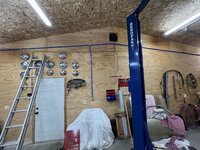
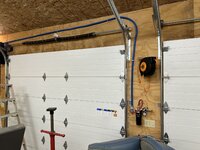
The outlet by the passage door goes through the wall to an area where I work outside. I hope I didn’t overthink this installation, it seems to work. I do have small leaks at many pipe fittings, but I don’t think it is worth redoing the installation to solve. When plumbing I usually use two wraps of teflon tape and pipe sealer, but this time I just used the tape, bad choice. I’ll fire up the blast cabinet in the next couple of days and see how it works with this new system. Oh, the only place I have seen any moisture so far is when draining the compressor’s tank and then just a little mist hits the floor.
fourjeepin
Well-known member
Each of my vertical drops goes to a tee. Straight out is a quick connect supply. Straight down is a few inches of drip leg and a valve. I don’t get much water out of them so this may not have been necessary. But I also don’t have a cooler and run regular water line pex.
racecougar
Well-known member
Same here.
Kaizen
Well-known member
I used 3/4 pipe on my last setup but instead of manifolds I used one continuous run. In your setup I would have come out of the compressor to that right wall, gone horizontal and in that piece of pipe had a drop leg with drain. then continued back and forth using 90 degree fittings but when attached to the wall slightly bend the 10foot piece so it constanlty increases grade. This means every molecule will go through 40 feet instead of 10 feet and any condensation will use gravity to get back to that drain.Constructive criticism is welcome in case I need to modify for increased flow when I connect the blast cabinet. I have tubing and some fittings leftover from the kit I bought for the install, so change is possible.
This time around I just bought a filter and decicant for when painting cars. Most of my setup is just straight air as moisture doesnt make much differnce in air tools. My last one was a husky 60gal 3hp or so and man that thing made so much water it was crazy. Using it in freezing temps my air tools would ice up before I put that loop on. My new one is an 80gallon 5hp and it barely makes any water even in humid summer days. An air filter at the gun also is good insurance.