The main floor is 32 x 40 and will hold most of our stuff and provide a warm, dry place to work on future projects.
We excavated the build site, hauled in many loads of 4inch and down rock, tied it together with rip-stop landscape fabric. A 36 inch saddle with 20 mm rebar was installed around the perimeter, 6 inches of 3300 psi concrete was supported with 10 mm rebar inside that. We added a floor drain to accommodate dripping vehicles.
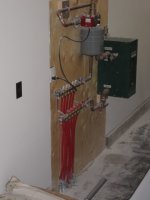
The concrete floor has 2 inch styrofoam underneath to reflect the floor heat upwards and inwards. Pressure treated 1/2 inch plywood is the barrier before the back fill. A 2 foot perimeter of 2 inch Styrofoam was placed on a 45 degree angle under the backfill to minimize heat loss outside the foundation. (And it works as the snow doesn’t melt at the base of the walls) To handle heating needs, a 5 circuit in-floor heating system was installed. The square footage determined a 12 kilowatt electric boiler would handle the heating task.
5 in-floor heat circuits, electric boiler, recirculating water pump installed in 6 inch concrete with 16 inch perimeter, 2 inch stryrofoam, 20 mm rebar saddle for the perimeter and 10 mm rebar floor re-inforcement on the rest of the floor. We put a slope and floor drain to control water run-off from any dripping vehicles.
I wasn’t planning on installing a vehicle hoist (though my 2 sons and buddy all urged me to) so I didn’t worry too much about any in-floor lag bolts. I have to admit though, that I am afraid to drill the floor to install other tools due to risk of hitting a floor heat tube. I’m hoping a thermal imager will help me accurately locate the heating lines if I need to drill in the future.
Instead of cutting the walls down to 10 foot studs we left the 2x6's at full 10 fee plus 1 bottom plate and 2 top plates totalling 10 ft 5.5 inches. This allowed for a pressure treated 2x6 baseboard below 10 feet of drywall.
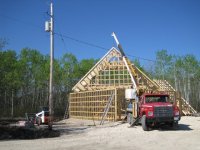
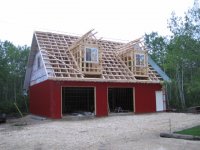
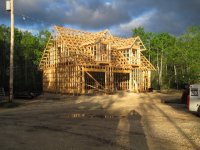
The Paslode power nailers and the crew’s many years of experience got the place framed up in a jiffy. The pre-engineered trusses were assembled on the ground for safety reasons. The trusses were built in three sections on the ground and were raised by crane. That was a bit nerve-racking as the crane was at it's limit for the mid-section containing 11 trusses!
Rick Ford from Ford Drilling brought his crane by and did a superb job of lifting and positioning the trusses right on the spot. Russell Johnson and Tyler Dey of Gimli Carpentry performed like they were from Cirque du Soleil! You'll notice these acrobats in some of the pics. The size of the shop becomes evident as it rises in the bush. Yikes! What have I done?
The main floor ceiling / loft floor is 18 inches engineered, this large hollow provided a great "cabinet" to enclose my large, floor model Cerwin Vega old-school speakers and really thump out the tunes!
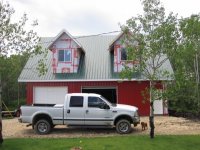
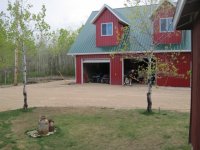
The upper loft is 16 feet by 39 with 8 foot ceiling, a couple 6x8 dormers, and 3 closets. This provides a generous “bonus room” for displaying antiques and collectibles and a party / games room.
The 2 dormers are 6 feet wide by 8 feet deep with 4x4 foot windows. One dormer will be done up with a diner style booth and table with jukebox and other novelties like you'd find back in the day. There are 4x4 windows at each gable end as well.
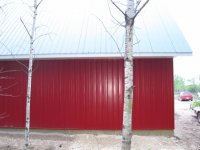
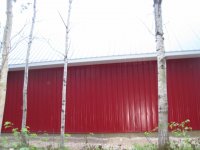
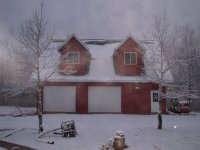
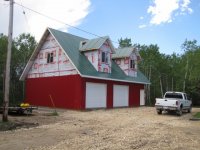
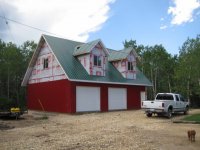
The whole place is clad with Melcher Green metal roofing and Brick Red metal siding to match the cabin, little barn and hay storage shed. White soffits, fascia and eavestroughing trim it out beautifully.
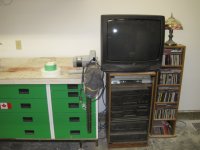
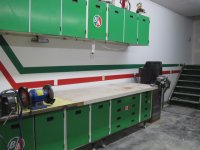
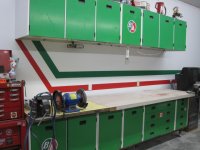
My initials are B. A. so my wife and I planned to run with the green and red now-defunct B/A (British American Oil Company) service station theme. We've been collecting various vintage B/A items for display. We had a local decal guy, Alan Wishnowski of Design Canada, cut an assortment of B/A logos for a gas pump I restored for out front and under the vintage porcelain service station light I dug up. I plan to dress up the green metal cabinets above and below my workbench as well as a funky old round-top garbage container. The green metal cabinets were reclaimed salvage from an old provincial laboratory.
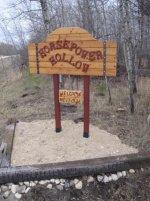
We decided to name the property "Horsepower Hollow" a play on mini-horses and hot-rods. I found some tongue and groove cedar planking and made a nice quality sign for the driveway.












![7095064[1].jpg](/forum/data/attachments/179/179421-6d78b024f2a5e768f1117ef34ff42381.jpg)
![7074867[1].jpg](/forum/data/attachments/179/179406-99c77e000be857656779d89481cc986e.jpg)
![5330992[1].jpg](/forum/data/attachments/179/179395-1afe78818a6df095fe5e45a9b9f8b2f5.jpg)