To avoid these ads, REGISTER NOW!

Hot and neutral twisted together???

fourjeepin

Well-known member
Joined
Feb 12, 2011
Messages
3,658
Location
Atlanta, GA
Any reason why this should be done? I have never seeing before, but I only replace fixtures & switches or run simple circuits myself. Picture attached below. I found this trying to cleanup the wiring in the basement of my 60 year old home. I haven't traced these wires back yet as they go into a drywalled HVAC duct enclosure.


Everything in this room and adjacent seems to work properly, though we have only lived in the house for two months. That said, I did find something else a bit strange last week. I put in a motion switch and it wouldn't work. It is only a 2-way circuit. Very simple. The two neutrals are together with a wire nut; two hot wires were on the switch. Seemed simple enough, but when I put my voltmeter between ground wire and either of the hots, I get 60 volts. How do I get 60 volts???? It explains why the more advanced switch wouldn't work, but is there an explanation of why and what should I look for to fix this?
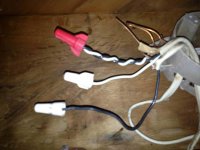
 

Attachments

  • ImageUploadedByTapatalk HD1374725273.841547.jpg
    ImageUploadedByTapatalk HD1374725273.841547.jpg
    125.4 KB · Views: 135
To avoid these ads, REGISTER NOW!

mypov

Well-known member
Joined
Aug 1, 2011
Messages
557
Could be from something that was removed? This is so that if by chance the breaker attached to that circuit was turned on it would trip right away? Else could be traveller for three way switch someone might be doing something weird?
 

VoltageDrop

Member
Joined
Dec 20, 2012
Messages
17
That's a fairly common way of wiring switches to lights. To save wire, instead of running two sets of romex down to the switch (from breaker and to light) one romex is run to the switch and the black is the hot from the breaker and the white is the switched hot back to the light. The white wire should be marked with black "stripes" to make it obvious that is not a neutral wire.
 

Speedy Petey

Well-known member
Joined
Apr 22, 2012
Messages
1,430
Location
NY State
White is not always a neutral.

That is called a switch loop. Voltage Drop in the last reply described it, only the white must be used as the feed TO the switch and the black the switched wire back to the light.
It was not always code to re-idenitfy the white wire as a "hot" conductor. Nor was it required to mark it with "stripes". Code simply says to "re-idenitfy it by some permanent means such as paint". The easiest and most typical way is a Sharpie or other permanent marker. Tape is not allowed on conductors that small, although it is also done all the time and rarely will inspectors fail a job over it.
 
To avoid these ads, REGISTER NOW!

wyliesdiesels

Well-known member
Joined
Aug 14, 2012
Messages
20,013
Location
Modesto, CA
White is not always a neutral.

That is called a switch loop. Voltage Drop in the last reply described it, only the white must be used as the feed TO the switch and the black the switched wire back to the light.
It was not always code to re-idenitfy the white wire as a "hot" conductor. Nor was it required to mark it with "stripes". Code simply says to "re-idenitfy it by some permanent means such as paint". The easiest and most typical way is a Sharpie or other permanent marker. Tape is not allowed on conductors that small, although it is also done all the time and rarely will inspectors fail a job over it.

Do u have a code cite? Just curious! Ive always re-identified sml gauge wires and never had an issue with inspectors, like u said. I thought EGCs smaller than #6 were the only wire not allowed to be re-identified...
 

Speedy Petey

Well-known member
Joined
Apr 22, 2012
Messages
1,430
Location
NY State
200.7 Use of Insulation of a White or Gray Color or with Three Continuous White Stripes.
(C) Circuits of 50 Volts or More.
The use of insulation that is white or gray or that has three continuous white stripes for other than a grounded conductor for circuits of 50 volts or more shall be permitted only as in (1) and (2).

(1) If part of a cable assembly that has the insulation permanently reidentified to indicate its use as an ungrounded conductor by marking tape, painting, or other effective means at its termination and at each location where the conductor is visible and accessible. Identification shall encircle the insulation and shall be a color other than white, gray, or green. If used for single-pole, 3-way or 4-way switch loops, the reidentified conductor with white or gray insulation or three continuous white stripes shall be used only for the supply to the switch, but not as a return conductor from the switch to the outlet.
IMO the word "permanently" eliminates typical vinyl tape, but like I said, I see it all the time.
And yes, it does even mention tape in that section. Typical NEC contradiction.

Smaller conductors do not take tape very well.
 

nehog

Well-known member
Joined
Jan 2, 2010
Messages
7,935
Location
Jaffrey, NH
IMO the word "permanently" eliminates typical vinyl tape, but like I said, I see it all the time.
And yes, it does even mention tape in that section. Typical NEC contradiction.

Smaller conductors do not take tape very well.

I've always had a black marker in my tool kit for this very reason. That meets the permanent requirement (I hate tape too, even good tape is not always going to stay put.)
 

Falcon67

Well-known member
Joined
Jun 11, 2009
Messages
18,371
Location
Merkel, TX
X14 on switch leg. I also like to use a marker, if for no other reason than I forget what the &*$ I did.
 
To avoid these ads, REGISTER NOW!
Top Bottom