Wamsutta
Well-known member
When the steel gets blue hot, it seems as though the grinding disc doesn't cut as fast; my imagination?

Well, at least you have a good imagination!Not Your imagination. . if You get the steel hot, it gets harder. Kind of like heat treating .

Not this. Steel gets softer, not harder as it gets hotter. Heat treating hardness increase comes from COOLING after heating, not heating itself. No quench or no strain, no hardening.Not Your imagination. . if You get the steel hot, it gets harder. Kind of like heat treating . If You cut steel with a torch or plasma cutter You will end up with a "hardened" edge also
THIS.The abrasive disc is heating up and "glazing" over, reducing the effectiveness of the abrasive and in turn creating more heat. Let the abrasive do the work for you, don't exert more pressure than needed to keep the disc in the cut.
Agreed. These harder products are because of chemical change to the base steel (nitride formation or certain carbide formation in alloyed steels) and doesn't result from merely heating the steel.(cutting even 'unhardenable' mild steel with an air-plasma or a gas-assist laser MAY result in a hardened dross or hardened zone on the cut. But that is usually because of nitrides forming in the steel from the nitrogen in the air or in the assist gas and not from 'classic' heat treatment hardening. That hardened nitride layer usually has to be removed if the cut piece is going to be welded or in certain sensitive/critical parts for metal fatigue considerations. That hardened nitride layer is usually only about 6 thousandths of an inch thick though. still enough to screw things up if you don't remove it.)
The grit of the disk makes a huge difference as well as the type. Type 27 are flat disks, so you grinder is held just up from horizontal. Type 29 is angled , so you can hold your grinder at a higher angle. If you have type 27 throw them in the trash and buy type 29. Go to lehigh valley abrasives online and buy blue, type 29, flap disks , with the nut, in grit 40 for heavy cutting, and 60 for a finer finish. I buy them by the case and usually use about 30-50 a month depending on the jobs in my shop.I found out what my problem was. I was using the disc too flat. I wasn't raising up the end of the grinder enough. By doing so, I thought I could make the outside diameter of the disc last longer. That might have worked, but it was heating up the disc and not doing much cutting either. By raising up the end of the grinder and putting the disc at more of an angle, it has made a huge difference in the speed of the cut.
I'm partial to 3M Cubitron or Pferd Victorgrain.The grit of the disk makes a huge difference as well as the type. Type 27 are flat disks, so you grinder is held just up from horizontal. Type 29 is angled , so you can hold your grinder at a higher angle. If you have type 27 throw them in the trash and buy type 29. Go to lehigh valley abrasives online and buy blue, type 29, flap disks , with the nut, in grit 40 for heavy cutting, and 60 for a finer finish. I buy them by the case and usually use about 30-50 a month depending on the jobs in my shop.
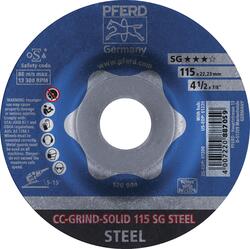
 www.menards.com
Depends on the kind of steel and how hot you get it.Mild steel can not typically be 'hardened' by quenching (which is when you get the steel 'hot' and then cool it 'quickly', where 'hot' and 'quickly' usually depend greatly on the exact specific alloy of steel you are dealing with).
Because mild steel does not have enough alloying elements in it (mainly not enough carbon) to respond to heat treatment.
But an abrasive cutting disc may heat up and "glaze" if you don't balance the pressure/force applied and the feed rate and thus will not cut as quickly or effectively as a disc used in better/optimal conditions.
Troubleshooting 4 Common Cutting Wheel Problems |
Here’s what to look for to save time and money — and reduce safety risks — with cutting wheel issues by using products properly.www.fabricatingandmetalworking.com
Tips for increasing safety and productivity when using resinoid-bonded cutting and grinding wheels | Weiler Abrasives
Whether using a cutting, grinding or combination wheel, safety is always a top priority. Safety is everyone’s responsibility, which means always keeping the guard on the tool, using cutting wheels for cutting and not grinding, resisting physically hitting the edge of a wheel to break it in and...www.weilerabrasives.com
(cutting even 'unhardenable' mild steel with an air-plasma or a gas-assist laser MAY result in a hardened dross or hardened zone on the cut. But that is usually because of nitrides forming in the steel from the nitrogen in the air or in the assist gas and not from 'classic' heat treatment hardening. That hardened nitride layer usually has to be removed if the cut piece is going to be welded or in certain sensitive/critical parts for metal fatigue considerations. That hardened nitride layer is usually only about 6 thousandths of an inch thick though. still enough to screw things up if you don't remove it.)
I've been using the 3M Cubitron II grinding disc. It only comes in Type 27 I believe. For flap discs I prefer the Type 29 like you do.The grit of the disk makes a huge difference as well as the type. Type 27 are flat disks, so you grinder is held just up from horizontal. Type 29 is angled , so you can hold your grinder at a higher angle. If you have type 27 throw them in the trash and buy type 29. Go to lehigh valley abrasives online and buy blue, type 29, flap disks , with the nut, in grit 40 for heavy cutting, and 60 for a finer finish. I buy them by the case and usually use about 30-50 a month depending on the jobs in my shop.