To avoid these ads, REGISTER NOW!

Hot water heater venting

BgBmBoo

Well-known member
Joined
Sep 25, 2015
Messages
386
Location
Kansas
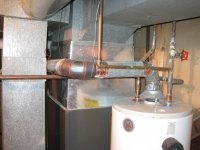
I'm in the process of cleaning up the previous owners DIY job on the hot water heater vent. Wrong materials, duck taped joints, backpitched, all sorts of fun stuff.

My water heater sits next to the furnace and the water heater exhaust joins the furnace exhaust and both exit out the roof in the same vent. Part of the problem is the furnace exhaust vent is not properly supported and has dropped down a few inches. My plan is the raise the furnace exhaust to the proper height and replace the water heater vent with all new pipe.

First of all, what is the proper way to support the vertical exhaust? Do they make a special clamp type hanger specifically for this application?

Second, what is the correct pipe material to use for the hot water heater vent? Basic single wall or do I need double wall?

Thanks for any advice. It should be a fairly simple job, I just want to make sure I use the correct materials. :thumbup:
 

Attachments

  • IMG_7080.jpg
    IMG_7080.jpg
    140.6 KB · Views: 38
  • IMG_7079.jpg
    IMG_7079.jpg
    143.4 KB · Views: 41
  • IMG_7083.jpg
    IMG_7083.jpg
    143.7 KB · Views: 34
  • IMG_7082.jpg
    IMG_7082.jpg
    142.6 KB · Views: 37
Last edited:
To avoid these ads, REGISTER NOW!

CNGsaves

Well-known member
Joined
Sep 26, 2012
Messages
13,233
Location
KS and OK
Post up some Pictures as they will tell a thousand words.

Edit your 1st post, Go Advanced, Manage Attachments, Browse, link up to 7 pictures for the 7 boxes, Upload, close this window, and finally Save.
 

Jackfre

Well-known member
Joined
Dec 26, 2010
Messages
4,411
Location
N CA
I would suggest double wall B-vent for your vent connector. CNG asks for some photos, but what is the rise and run of the furnace vent and then the water heater vent? You are limited to 1.5' of single wall per ft of vent connector. The bigger issue is the draft performance of the water heater during the period of time that the furnace is off. Frequently, common vented water heaters do not operate well in this circumstance.

Back in about '92...or so, Brookhaven Nat'l Labs did a venting study on oil fired equipment. The findings are still Appendix E of NFPA 31. In conversation with the authors of the study, I was told that regardless of vent or appliance type the single factor which most improved vent performance was an insulated vent connector
 
To avoid these ads, REGISTER NOW!
OP
B

BgBmBoo

Well-known member
Joined
Sep 25, 2015
Messages
386
Location
Kansas
Photos added. You can see the furnace is almost all rise with very little run. The water heater has 4'-5' run with maybe 1' rise. For the new hot water heater I am planning on using the same size vent as the T junction where it connects to the furnace vent. I think it is 4" instead of the current 3" that is cobbled together and shoved in the hole.

Jackfre - You bring up some interesting points. Would the draft performance of the water heater be better if I put in more than the required 1/4" per foot of slope? Say 1/2" per foot?
 
Last edited:

brewchief

Well-known member
Joined
Sep 20, 2008
Messages
2,370
Location
Michigan
The b-vent T looks like it's falling out of the main stack, might be a different brand that won't lock together.

I would say that the connection where the water heater is connected is going to be for 3" B-vent so it will be to small for 4", hard to say for sure.

I would replace the T so I could run a 4" B vent connector to the water heater, 4" single wall would be OK as well but you probably need B vent to clear that PVC pipe near the T.

Try to get some vertical rise directly on top of the water heater then 1/4" per foot the rest of the way, 12" would be ideal but I don't think you will get that, even 6" would be way better then a 90 right on top of the draft hood.

Metal plumbers strap works just fine to hang the vents.
 
OP
B

BgBmBoo

Well-known member
Joined
Sep 25, 2015
Messages
386
Location
Kansas
You are correct, the T is a little different than the main stack. It is also partially due to the lack of support so the two pieces are trying to push outward and pull apart at the joint. I'm hoping once the main stack and T are properly supported the joint will hold together better. Not sure how well it will work though.

I think I can get 4-6" of rise out of the water heater, that's a good idea.

Do you use plumbers strap to support the vertical pieces too? I'm assuming you would have to screw the strap to the pipe. Is that allowed?
 
To avoid these ads, REGISTER NOW!
Top Bottom