To avoid these ads, REGISTER NOW!

Hot Water Recirculation System Resurrection

kbuhagiar

Well-known member
Joined
Dec 27, 2005
Messages
1,747
Location
Escondido, CA
Hello folks,

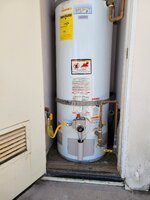
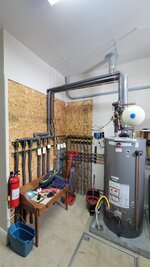
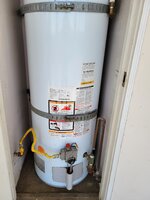
Our new-to-us home in Escondido, CA was constructed in 2000. It is approximately 3200SF on one level, with two separate water heaters (pictures attached), one at each end of the house. It take a LONG time to get hot water to the kitchen sink, and to the master bedroom sinks and showers. There are two separate hot water recirculation systems, one for each water heater, but they have been bypassed at some point, with the pumps removed and the bypass lines disconnected. We would like to revive these systems, utilizing the existing hot water return pipes that are already in place. I have no experience whatsoever using or maintaining a HWRS, so I am looking to those out there who have worked with or installed and maintained these systems for some advice.

To the experts: What's the biggest complaint about these systems? Any brand recommendations or preferences? Things to look out for when installing the new pumps? FWIW our municipal water here in Escondido is harder than average, and we deal with the usual mineral deposits from the water hardness, should that affect my choice of equipment?

On a side note, the previous owner of the house was a notorious cheapskate and would cut corners to save a buck, and it would follow suit for him to have abandoned the HWRC if it would have cost him extra when he replaced the water heaters approximately ten years ago, but still not sure why - how long do the pumps typically last? Also I'm thinking that since the water heaters may both be close to end-of-life that this may be a good time to replace them, too. Thoughts?

Thanks in advance!
 

Attachments

  • 20220424_122104.jpg
    20220424_122104.jpg
    502.5 KB · Views: 31
  • 20220424_121449.jpg
    20220424_121449.jpg
    604.3 KB · Views: 31
To avoid these ads, REGISTER NOW!

dave*99

Well-known member
Joined
May 5, 2009
Messages
4,264
Location
Coastal NJ
Since you mention replacing your water heaters - I'll offer this info.
I have 2 Navien tankless NG water heaters. They have built in recirculation pumps. My master bath is connected to them through about 70' of pipe, so they are quite helpful in my situation.
 
OP
K

kbuhagiar

Well-known member
Joined
Dec 27, 2005
Messages
1,747
Location
Escondido, CA
Since you mention replacing your water heaters - I'll offer this info.
I have 2 Navien tankless NG water heaters. They have built in recirculation pumps. My master bath is connected to them through about 70' of pipe, so they are quite helpful in my situation.
Dave,

Thanks for the reply. I appreciate the insight, but I will be sticking with conventional water heaters when the time comes to replace them.
 

Jackfre

Well-known member
Joined
Dec 26, 2010
Messages
4,410
Location
N CA
With the rebates available I’d look at the heat pump water heaters as an option. They probably disconnect the units due to increase fuel consumption. Grundfos make a nice kit for recirc that has a timer built in. With that you can adjust the operation to suit yoour typical use patterns.
 

vwpieces

Well-known member
Joined
Apr 28, 2020
Messages
5,925
Location
Hills, PA
I have a big old house with 3/4in uninsulated copper pipe supplying HW. Took forever to get HW to Kit sink and it was cold again in no time. If you are only wanting faster water at the sinks you can run a direct line of 3/8in PEX to the sinks. I did a direct run that branched off to the kitchen and 1st floor bath sinks. I also fully insulated it since the basement is unfinished and cool all year.
It's a cheap and easy option if you not looking to spend the money on pumps and the electric to have them running. Of course if your going 100+ feet you may not get HW fast enough but I am very satisfied with only needing 1/2 gallon of water before it's hot and is still hot between rinsing's.
 
OP
K

kbuhagiar

Well-known member
Joined
Dec 27, 2005
Messages
1,747
Location
Escondido, CA
With the rebates available I’d look at the heat pump water heaters as an option. They probably disconnect the units due to increase fuel consumption.
Not interested in heat pumps at this time, going to stick with conventional natural-gas units.
Grundfos make a nice kit for recirc that has a timer built in. With that you can adjust the operation to suit yoour typical use patterns.

Based on my research so far, Grundfos would be my choice also.
 
OP
K

kbuhagiar

Well-known member
Joined
Dec 27, 2005
Messages
1,747
Location
Escondido, CA
I have a big old house with 3/4in uninsulated copper pipe supplying HW. Took forever to get HW to Kit sink and it was cold again in no time. If you are only wanting faster water at the sinks you can run a direct line of 3/8in PEX to the sinks. I did a direct run that branched off to the kitchen and 1st floor bath sinks. I also fully insulated it since the basement is unfinished and cool all year.
I appreciate the input, and it sounds like a great solution for your situation, but I already have dedicated 1/2" copper bypass return pipes from each water heater to the farthest plumbing points on each circuit (i.e. kitchen and master bathroom). I want to use what is already in place.
 

2Rocky

Well-known member
Joined
Mar 31, 2023
Messages
163
With all the smart home devices out there you would think someone would invent a Bluetooth Capable recirc pump

"Alexa get my shower ready"

I did rent a house that had a button at the kitchen sink that operated recirculated back through the cold water line.
 
OP
K

kbuhagiar

Well-known member
Joined
Dec 27, 2005
Messages
1,747
Location
Escondido, CA
With all the smart home devices out there you would think someone would invent a Bluetooth Capable recirc pump

"Alexa get my shower ready"

I did rent a house that had a button at the kitchen sink that operated recirculated back through the cold water line.
Not a priority, but I'm sure I could devise a simple on/off function that was compatible with Echo/Alexa.
 

Yankeefarmer

Well-known member
Joined
Jul 25, 2011
Messages
1,182
Location
Connecticut
With all the smart home devices out there you would think someone would invent a Bluetooth Capable recirc pump

"Alexa get my shower ready"

I did rent a house that had a button at the kitchen sink that operated recirculated back through the cold water line.
I have considered installing a recirc system for our kitchen. If I did, I would set it up using a momentary switch to activate it, and a temperature sensor on the return line to shut it off once hot water had passed the kitchen. To me, using a timer would be wasteful, considering the many hours that hot water is not needed in the kitchen.
 

mike93lx

ALLIANCE MEMBER
Joined
Dec 9, 2013
Messages
37,521
Location
Richmond, VA
Before you tie anything in, I'd drain the recirc pipes and do a pressure test with air to confirm no leaks. Then flush them to make sure there isn't any nasty build up
 

dave*99

Well-known member
Joined
May 5, 2009
Messages
4,264
Location
Coastal NJ
My Navien tankless units have recirculation that can be set up with a push button. And there is a Wi-Fi add on option. I chose to use a timer that is built in. There are too many spots I’d need buttons to make that path viable in my house.
YMMV
 

rharman

Well-known member
Joined
Apr 22, 2012
Messages
8,813
Location
SoCal
We use an X-10 wireless keypad and a controlled adapter to turn our recirculating pump on/off. Turn it on a few minutes before we need it for shower/laundry/etc. and turn it off when done. Saves a TON on electricity. I added a simple porch light fixture with a green LED bulb so I can easily see if the pump is on/off. Just peek in the garage.
 

2Fast

Well-known member
Joined
Mar 20, 2020
Messages
248
Location
Southwest
OP - not sure why you're opposed to going tankless?

Do you have S Cal Gas? They have a contractor (Synergy) who installs top of the line Navien tankless water heaters with a built-in recirc pump for about $1,500 total, which includes installation, hauling away your old water heater, permits and inspection. And these water heaters are so efficient they qualify for a $300 Fed Tax Refund. Intake and exhaust vents can usually go right out a sidewall and you will free up some space

Your existing return line just gets plumbed into the hot water line going to the tankless and they add a one way valve to it


Jinks

Well-known member
Joined
Aug 28, 2012
Messages
2,885
Location
Daytona Beach
I installed a re-circulation system without the return lines. It just uses the cold water line as the return. The pump I used has a temperature sensor. When the hot water line at the pump drops below a preset temperature the pump starts. When it reaches a higher preset the pump turns off. I don't remember the temperatures, but it doesn't wait for real cold, & it stops at about 90 deg. There's always "warm" water in the line & full hot arrives in a few seconds. The pump doesn't cost much to run, & there's no loss of water. In fact, any that makes it back to the water heater is slightly warm, so it takes less energy to reheat than water from the street. With your return lines in place a similar system using only the hot water line & the return line will be more efficient & minimal cost.
 

PoorUB

Well-known member
Joined
Mar 29, 2021
Messages
11,632
Location
Fargo, ND
OP - not sure why you're opposed to going tankless?
I am not the OP, but I used to sell tankless gas water heaters. The water heater in my house? A good old fashioned standing pilot, natural draft. Why? It never needs service other than a drain a flush once a year, maybe. Dependable as a rock, no expensive parts if it fails. Last time I replaced the water heater it was $600, the old one out and the new one running in three hours.

It costs me about $25 a month to operate. If I saved 25%, (it won't), with a new high efficiency tankless it would save $6.25 a month, or $750 in 10 years, assuming no repairs.

I have been running the plain Jane water heaters for over thirty years and I had to replace a thermocouple in one, something like $10. I put in a new water heater in 1992, a second 16 years later, so around 2008. and a new one around 2020.
 
Last edited:

2Fast

Well-known member
Joined
Mar 20, 2020
Messages
248
Location
Southwest
In what year did you 'use to sell them'? Tankless have come a long ways... The newer ones can overcome some of the limitations of the earlier ones, like requiring special venting materials or no longer needing a dedicated 3/4" gas line. Why heat a tank of water 24/7 and the way things are going, the cost of natural gas or propane is only going one way - up
 
To avoid these ads, REGISTER NOW!

PoorUB

Well-known member
Joined
Mar 29, 2021
Messages
11,632
Location
Fargo, ND
Lol, so you sold tankless water heaters 2 years ago, yet you won't have one at your own home - ok....
Yes, for the reasons I mentioned earlier.

Over the life of the heater you will not see any savings over a 40 gallon gas, natural draft. The tankless comes with a higher price to buy, install and maintain that more than negates the energy savings. I sold units and sold parts to go along with them, so I feel that I have a pretty good idea how it works.
 
OP
K

kbuhagiar

Well-known member
Joined
Dec 27, 2005
Messages
1,747
Location
Escondido, CA
OP - not sure why you're opposed to going tankless?
Once again, I appreciate the response, and the information and links you have provided, but I will be sticking with conventional water heaters when the time comes to replace them. Not open for discussion.
I am not the OP, but I used to sell tankless gas water heaters. The water heater in my house? A good old fashioned standing pilot, natural draft. Why? It never needs service other than a drain a flush once a year, maybe. Dependable as a rock, no expensive parts if it fails. Last time I replaced the water heater it was $600, the old one out and the new one running in three hours.

It costs me about $25 a month to operate. If I saved 25%, (it won't), with a new high efficiency tankless it would save $6.25 a month, or $750 in 10 years, assuming no repairs.

I have been running the plain Jane water heaters for over thirty years and I had to replace a thermocouple in one, something like $10. I put in a new water heater in 1992, a second 16 years later, so around 2008. and a new one around 2020.
Sound reasoning which generally aligns with my viewpoint.
 
Last edited:

iron block

Well-known member
Joined
Jun 22, 2015
Messages
262
Location
Bay Area, CA
Is there any chance that the original system just used gravity instead of a pump? In that kind of system, the outbound hot water is routed through the attic, and the recirculation pipe at the far end of the system connects from the outbound hot water pipe in the attic to a warm water return line in the crawl space. The return line is plumbed into the hot water tank drain outlet, just like you show in your pictures.

There is sort of a siphon action caused when the water at the end of the hot water pipe cools and drops into the return line -- just enough flow to keep drawing a tiny bit of fresh hot water into the pipes and keep them slightly warm so that hot water is available very quickly when a hot tap is opened.

That is exactly the kind of system we have in our mid-century California ranch house. It works very well. So it came to mind when looking at the pictures you posted. I'm kind of curious what happens when you open the valves on the return line shown in the second picture -- worth trying to see if that circuit begins to circulate? (Though you might need to prime the return line -- you would need a flushing outlet between the two yellow-handled valves. It looks like that outlet might have been removed at some point along the way.)
 

ScaldedDog

Well-known member
Joined
Jan 15, 2008
Messages
1,065
Location
Sedalia, CO/NSB, FL
@kbuhagiar, I have a recent thread on my system you might find helpful. Also, Taco has some great training videos on Youtube that cover these systems. It's worth spending some time learning.

As others have mentioned, the first step is to make sure the return lines are leak free, and can be reconnected without issue. Is there just one loop per tank with all the fixtures on it, or are there home run loops to each area? (e.g. kitchen, bathroom(s), etc.) If the latter, you'll want to equalize the flow on each loop serviced by the same pump. No matter what, you'll want to insulate both the supply and return lines.

IMHO, Grundfos and Taco are the pump brands I'd consider. More than brand, it's important to realize that you can very easily get too large a pump, and cause failure of the copper over time. (The Taco training covers this in-depth.) There are a bunch of "smart" systems that attempt to figure out when you'll need hot water, but I think they are worthless. My suggestion would be to simply run the pump for a few minutes, then have it off for roughly twice that time, and repeat that cycle either 24/7 or during the hours of the day when you might want hot water.

My system has a single hot water heater with hot and cold home runs to the kitchen and two bathrooms, with 3/4" pex supply lines and 1/2" pex returns for the hot water recirc. From left to right you can see the returns, hot and cold lines in the photo below. The pump is at about 10 0'clock with respect to the expansion tank above the water heater.

20230422_113533.jpg

I hope this helps,

Mark
 
OP
K

kbuhagiar

Well-known member
Joined
Dec 27, 2005
Messages
1,747
Location
Escondido, CA
Is there any chance that the original system just used gravity instead of a pump? In that kind of system, the outbound hot water is routed through the attic, and the recirculation pipe at the far end of the system connects from the outbound hot water pipe in the attic to a warm water return line in the crawl space. The return line is plumbed into the hot water tank drain outlet, just like you show in your pictures.

There is sort of a siphon action caused when the water at the end of the hot water pipe cools and drops into the return line -- just enough flow to keep drawing a tiny bit of fresh hot water into the pipes and keep them slightly warm so that hot water is available very quickly when a hot tap is opened.

That is exactly the kind of system we have in our mid-century California ranch house. It works very well. So it came to mind when looking at the pictures you posted. I'm kind of curious what happens when you open the valves on the return line shown in the second picture -- worth trying to see if that circuit begins to circulate? (Though you might need to prime the return line -- you would need a flushing outlet between the two yellow-handled valves. It looks like that outlet might have been removed at some point along the way.)
Interesting - never heard of something like this before.
But I'm quite sure the recirculation system in our house was not gravity based because our house is a single-story and built on a slab (no crawl space or basement), which disqualifies it as a candidate for this sort of system.
 
OP
K

kbuhagiar

Well-known member
Joined
Dec 27, 2005
Messages
1,747
Location
Escondido, CA
@kbuhagiar, I have a recent thread on my system you might find helpful. Also, Taco has some great training videos on Youtube that cover these systems. It's worth spending some time learning.

As others have mentioned, the first step is to make sure the return lines are leak free, and can be reconnected without issue. Is there just one loop per tank with all the fixtures on it, or are there home run loops to each area? (e.g. kitchen, bathroom(s), etc.) If the latter, you'll want to equalize the flow on each loop serviced by the same pump. No matter what, you'll want to insulate both the supply and return lines.

IMHO, Grundfos and Taco are the pump brands I'd consider. More than brand, it's important to realize that you can very easily get too large a pump, and cause failure of the copper over time. (The Taco training covers this in-depth.) There are a bunch of "smart" systems that attempt to figure out when you'll need hot water, but I think they are worthless. My suggestion would be to simply run the pump for a few minutes, then have it off for roughly twice that time, and repeat that cycle either 24/7 or during the hours of the day when you might want hot water.

My system has a single hot water heater with hot and cold home runs to the kitchen and two bathrooms, with 3/4" pex supply lines and 1/2" pex returns for the hot water recirc. From left to right you can see the returns, hot and cold lines in the photo below. The pump is at about 10 0'clock with respect to the expansion tank above the water heater.

I hope this helps,

Mark
Thanks Mark, very helpful. And I will add the Taco videos to my crash course on hot water recirculation systems.
 

Innovate1

Well-known member
Joined
Jul 28, 2014
Messages
4,288
Location
Illinois near St. Louis, Missouri
There are several variations that I think have all been covered.

One of the big issues with recirc is if it is on all the time the heat loss of the pipes will increase your energy use by quite a bit. I have a small Taco pump in the return line with a swing check valve to prevent reverse flow when the pump is off - that would allow cold water to bypass the heater and cool down the hot water at the end use point. I have a push button mounted in the bathroom (the only place this is an issue) and just push it when we want hot water. The pump then runs for 45 seconds on a timer. Works well for us. I kind of like the idea of using a wireless device like has been mentioned to activate so it can be put where ever you like. It also avoids having to route wiring for it. Used a "fan control center" for the transformer to 24VAC and relay to run the line voltage pump. Used an Arduino for the timer but there are lots of time delay relays available for such things.
 
OP
K

kbuhagiar

Well-known member
Joined
Dec 27, 2005
Messages
1,747
Location
Escondido, CA
Question for those who have been through this...

Are there different sizes/capacity pumps for residential applications? If so, how do I determine which is correct for my application? I am considering a Grundfos unit (specifically, the Grundfos 98420224 UP 10-16 A PM BU/LC) but I am not sure if there are different sizing variations. I gave up on trying to use the Grundfos online resources; I'm technically inclined but their website made my head spin :LOL:.

So, are there different sizes of this pump? If so, is there a chart available that I can use to make that determination that doesn't require a Master's in Physics?

Thanks in advance.


ScaldedDog

Well-known member
Joined
Jan 15, 2008
Messages
1,065
Location
Sedalia, CO/NSB, FL
Question for those who have been through this...

Are there different sizes/capacity pumps for residential applications? If so, how do I determine which is correct for my application? I am considering a Grundfos unit (specifically, the Grundfos 98420224 UP 10-16 A PM BU/LC) but I am not sure if there are different sizing variations. I gave up on trying to use the Grundfos online resources; I'm technically inclined but their website made my head spin :LOL:.

So, are there different sizes of this pump? If so, is there a chart available that I can use to make that determination that doesn't require a Master's in Physics?

Thanks in advance.

That's the pump I have. On paper it's barely enough, but seems to work OK running 5minutes on/10off.

Too large a pump is worse than too small. Running hot chlorinated water at high flow rates for long periods of time is bad juju for both copper and pex. See one of the Taco videos I referenced earlier for details.

Mark
 

Innovate1

Well-known member
Joined
Jul 28, 2014
Messages
4,288
Location
Illinois near St. Louis, Missouri
If you are going to keep the pipe hot then a smaller pump is better. You don't need much flow rate. For an on demand system like a push button when you need water you can estimate the length of pipe from heater to end of the line. With the size of pipe you can look up how much water is in that pipe (don't use the nominal size. Use actual ID or you should be able to easily find a table with gallons/100' or such like). If you come up with 2 gallons and you want it hot in 30 seconds then you need a 4 gallon/min pump. Actually should round this up a little if it's metal pipe because it has to warm up the pipe. At that flow rate you can find the pressure drop for that length of pipe - you need to estimate bends too as they create some pressure drop. Then with flow and pressure drop you can look at the curves for the pump and see if it is close. That's how I did it. On mine the 1/2" return line was most of the pressure drop - the main line is 1"
 

ScaldedDog

Well-known member
Joined
Jan 15, 2008
Messages
1,065
Location
Sedalia, CO/NSB, FL
Question for those who have been through this...

Are there different sizes/capacity pumps for residential applications? If so, how do I determine which is correct for my application? I am considering a Grundfos unit (specifically, the Grundfos 98420224 UP 10-16 A PM BU/LC) but I am not sure if there are different sizing variations. I gave up on trying to use the Grundfos online resources; I'm technically inclined but their website made my head spin :LOL:.

So, are there different sizes of this pump? If so, is there a chart available that I can use to make that determination that doesn't require a Master's in Physics?

Thanks in advance.

BTW, Amazon is not the cheapest place to get Grundfos pumps, if you haven't ordered yet, and you don't need that particular pump unless you want to use the (IMHO worthless) auto-adapt feature. I just ordered this one for a good bit less:


Mark
 

Snip's

Well-known member
Joined
Apr 29, 2017
Messages
1,852
Location
Ohio
I have a Bell & Gossett SLC-30B hot water recirculating pump that was installed in 1983...
Still going strong for 40 years... No maintenance needed...
The pump body is made by Armstrong pumps that uses a ceramic shaft which probably contributes to long service life.
 
OP
K

kbuhagiar

Well-known member
Joined
Dec 27, 2005
Messages
1,747
Location
Escondido, CA
BTW, Amazon is not the cheapest place to get Grundfos pumps, if you haven't ordered yet, and you don't need that particular pump unless you want to use the (IMHO worthless) auto-adapt feature. I just ordered this one for a good bit less:


Mark
Mark,

Thanks for that, I haven't ordered yet.
I was wondering if that same pump was available without the auto-adapt.
 

86turbodsl

Well-known member
Joined
Jul 1, 2005
Messages
6,556
Location
Michigan
FWIW, i have owned both Grundfos and Taco. I buy Taco now. I don't think the quality of the Grundfos is worth the extra dinero, but your mileage may vary. I've never had a Taco fail either, and i have a Grundfos.
 

BillK

Well-known member
Joined
Aug 24, 2006
Messages
9,321
Location
Beautiful Southern Maryland
Hello folks,

Our new-to-us home in Escondido, CA was constructed in 2000. It is approximately 3200SF on one level, with two separate water heaters (pictures attached), one at each end of the house. It take a LONG time to get hot water to the kitchen sink, and to the master bedroom sinks and showers. There are two separate hot water recirculation systems, one for each water heater, but they have been bypassed at some point, with the pumps removed ..............

Just curious . . . . where are the actual pumps located in that type of system ? Also, do the hot water pipes go back down into the slab to get to the kitchen etc ? Hard to tell from your picture.
 
OP
K

kbuhagiar

Well-known member
Joined
Dec 27, 2005
Messages
1,747
Location
Escondido, CA
Just curious . . . . where are the actual pumps located in that type of system ? Also, do the hot water pipes go back down into the slab to get to the kitchen etc ? Hard to tell from your picture.
The pumps appear to have been located adjacent to each heater, just above (and teed into) the tank drain.
The hot water pipes go into the slab.
 

Sumboodie

Well-known member
Joined
Mar 20, 2021
Messages
10,693
Location
AK
In what year did you 'use to sell them'? Tankless have come a long ways... The newer ones can overcome some of the limitations of the earlier ones, like requiring special venting materials or no longer needing a dedicated 3/4" gas line. Why heat a tank of water 24/7 and the way things are going, the cost of natural gas or propane is only going one way - up
I hate mine.

Takes a long time to get hot water..a good 30 seconds at the bathroom which is 5ft of pipe from the heater.
Then get hot water, turn it off, wait even just 5 seconds, turn it back on, and it'll take another 30+ seconds to get hot again. It'll go hotish, warm, cold, ice cold, warm, hotish, hot.

It's brand new, and the ~7yr old one that it replaced did the same
 

Sumboodie

Well-known member
Joined
Mar 20, 2021
Messages
10,693
Location
AK

2Fast

Well-known member
Joined
Mar 20, 2020
Messages
248
Location
Southwest
I hate mine.

Takes a long time to get hot water..a good 30 seconds at the bathroom which is 5ft of pipe from the heater.
Then get hot water, turn it off, wait even just 5 seconds, turn it back on, and it'll take another 30+ seconds to get hot again. It'll go hotish, warm, cold, ice cold, warm, hotish, hot.

It's brand new, and the ~7yr old one that it replaced did the same
What brand did you buy?

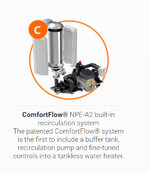
My Navien has a built-in, insulated 'buffer tank'. I have not experienced any difference between this tankless and our old 75 gallon water heater.

What your talking about sounds like a 'cold water sandwich' - google it
 

Attachments

  • buffer tank.jpg
    buffer tank.jpg
    331.7 KB · Views: 6
  • tank.jpg
    tank.jpg
    67.1 KB · Views: 7
To avoid these ads, REGISTER NOW!
Top Bottom