To avoid these ads, REGISTER NOW!

Hotter than set

bobj49f2

Banned
Joined
Nov 13, 2009
Messages
430
Location
SE Wisconsin
I know, this is supposed to be for garage related stuff but I've seen questions pertaining to houses also.

We bought a two story farm house about four years that was built in 1887 but was completely gutted in 1983 by the people we bought the house from. So basically the house is equivalent to a 40 year old house. The windows were 40 years old and didn't open and close easily and leaked air like crazy. We had all 22 windows replaced last winter, almost exactly a year ago.

We were hoping replacing the windows would help with our heating bill. So far this year we're running about the same as last years with the bad windows. We've noticed the house tends to warm up hotter than we have the thermostats set at. Last night we were very warm, I looked at the thermostat and it indicated the room temperature was 72°, I had it set at 68°. At night we have the bedroom set at 62° but during the night I can feel the room get very warm. I've checked the bedroom thermostat and it indicates the temp in the room is 62°.

The house has hot water radiant baseboard heat zoned off in six sections with each section having it's own thermostat. We replaced the three electronic thermostats right after we moved in and have replaced the batteries at least once. We leave the three mechanical thermostats set at 60° unless we are occupying those rooms. There was air in the system and I've drained them as best as I can, a lot of air came out of three of the zones. I am going to see if I can get more air out of them.

I am wonder if somehow the electronic thermostats are calling for more heat than needed.
 
To avoid these ads, REGISTER NOW!

TractorJeff

Well-known member
Joined
Dec 8, 2013
Messages
3,309
Location
Elkhorn, WI
Building Wrap? Insulation? Well sealed Walls? It all adds up!
One particular T-Stat we have overshoots due to the Stat shutting off the Gas, but the Furnace continuing to run to cool itself down. I do remember old mechanical T-Stats having an "Anticipator" resistor in them that you adjust to turn off the fuel before the set temp. Then the furnace cooling itself would bring the room to temp. I am not an Expert on modern T-Stats but I don't believe they can be programmed to do this?
 

Jackfre

Well-known member
Joined
Dec 26, 2010
Messages
4,411
Location
N CA
i would replace your old Amtrol air eliminator with a Spirovent. I had the same problems with my MA home and was surprised at how quickly the Spirovent settled the air side down. I suspect you have stat problems as well for the overshooting. I can't advise on stat choice today as I have not followed it and that market changes about daily.
 

captaindiode

Well-known member
Joined
Jul 8, 2013
Messages
371
Location
NC
I would suggest a home energy audit. Here, our electric utility will pay for it. This will tell you where you heat is leaking and if your insulation is adequate. Have you compared the thermostat reading with a known good thermometer?
 

b-boy

Well-known member
Joined
Oct 2, 2013
Messages
2,155
Location
Buffalo NY
I have the same setup as you. I live in an 1880 farmhouse.

Hot water radiant heat has a few quirks. I have a 3-zone system. I tend to run the heat a few degrees lower than I want, because the lag time between heating the area, and the thermostat picking up the temp changes can be an issue. A lot of it can depend on where your thermostat is located in regards to your baseboard heating units.

We get temperature variations on our 2nd floor. The thermostat is in the hallway, but there are no heat pipes running through the hallway. As a result, the rooms can be significantly hotter than the hallway. The way it's setup, my son's room gets ridiculously hot since the water pumps through there first. He tends to keep his door shut as well.

The first floor is more open, and overall there are no hot/cold spots.
 
OP
B

bobj49f2

Banned
Joined
Nov 13, 2009
Messages
430
Location
SE Wisconsin
Jackfire how did you know I had a Amtrol unit? Assuming they're just widely used.

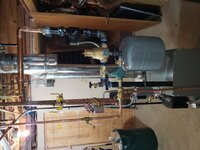
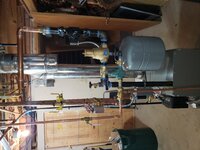
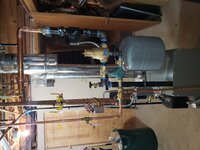
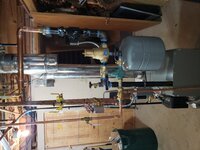
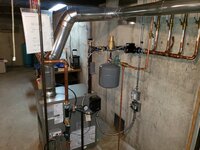
Here's my set up. According to the diagram in the instructions for the tank there should be an air vent installed above the tank. There is an air vent installed in the pressure release pipe before the pressure release valve. I get some air out of this when the system is fully pressurized. There is a marking on the tank indicating the tank was replaced in 2010. According to a Youtube video the person said these tanks should be replaced every four year or so. Also in the video the installer installed a new air vent above the tank and removed and capped off the vent on top of the furnace. I am suspecting my system isn't venting air adequately and needs a new air vent installed along with the tank.

b-boy, I'll try your suggestion of turning the thermostat on the main floor down a couple of degrees. The thermostats on the second floor control two sides of the house. There's one in the hall on the south side that has two bedrooms and a bath and is mounted in the hallway. The second is for the master on the north

View media item 99748
View media item 99750
View media item 99749
I've drained the air out of each zone and have gotten a lot of air out of four. Those four I get huge amounts of air out by using a bucket to set the end of the drain hose into so I can see the air escaping. After I get the large burps of air I still get small quantities of air bubbles. I'd bet I've dumped more than 100 gallons of water down the drain. Then later in the night I get rather loud noises of air rushing through my pipes again.
 

Unregistered Guest

New member
Joined
Dec 23, 2016
Messages
4
Location
NEPA
It sounds like you may have a leak somewhere in your system. This would cause the system to refill with fresh water, if it has an autofeed regulator. Fresh water has air in it. Do you heat your hot water with the boiler? Is your pressure high in the system? Does the relief valve seep water?
 
OP
B

bobj49f2

Banned
Joined
Nov 13, 2009
Messages
430
Location
SE Wisconsin
I have one electrically control return zone valve that drips a little, but not much. I don't think enough to call for a great amount of make up water to be brought into the boiler. I don't see leaks anywhere else. The valves are all in the basement, up in the floor joists, very visible. If there was a leak somewhere in the walls or floor between floors I'd think I'd have seen indications by now. I've had this problem pretty much since we moved in. Every year I drain the lines of water and I still have air rushing through the pipes.

Obviously I don't know much about this system but I'm suspecting it has something to do with the pressure tank and the air release valve. I just recently replaced the pressure tank in the house water system, it was filled with water and the pump was running on and off all of time. I suspect that maybe the pressure tank in the boiler system is leaking or the air eliminator isn't releasing built up air. I moved the tank around and couldn't hear any water sloshing around and seemed empty.
 

LS6 Tommy

Well-known member
Joined
Dec 27, 2013
Messages
26,162
Location
Northern NJ
What is your aquastat set at? You may just be picking up heat from the boiler. The room above the boiler room in my house runs about 2° warmer than the t-stat setpoint.

You also need to check the system settings on the t-stats. If it's not set for hydronic it may over shoot. Are the stats all on interior walls? They tend to read inaccurately on uninsulated or exterior walls.

Tommy
 

brewchief

Well-known member
Joined
Sep 20, 2008
Messages
2,370
Location
Michigan
If the only air vent you have is the little one on the boiler I can see it being tough to get the air out.

Some electronic thermostats do have an adjustable cycle rate that is like the heat anticipator on older mechanical thermostats, you may have to search out instructions for that particular stat to find out if it does and how to set it.

Your boiler uses a fill trol tank for both expansion and to control water into the boiler, personally I am not a fan and prefer a separate fill valve with a fast fill setting and a standard expansion tank.

Ideally you should add a micro bubble air elimination device, spirovent is one brand but there are plenty of options, avoid the cheap air scoops as they really don't work that good.

I normally pipe my fill and expansion tank into the bottom fitting of the spirovent(we use a different brand but it doesn't matter). The "pumping away" method is my preferred way to plumb a boiler snd and if done right it's very easy to get most of the air out and the spirovent will get the rest within a couple hours.

Sent from my SM-G965U using Tapatalk
 
To avoid these ads, REGISTER NOW!
OP
B

bobj49f2

Banned
Joined
Nov 13, 2009
Messages
430
Location
SE Wisconsin
I have Honeywell RTH241081001, all three, one on the main floor and the two on the second floor. I also have mechanical ones in the basement, which we adjust up when we're in the basement and one in an entrance hallway that we keep at about 55°. There is also a tube system in the tile floor in a four season room we keep at about 55° also.

Brewchief, what do you mean, "pumping away" method ? Below is a drawing of my current set up and the second is what I think I could change to if I install an air separator in the system. Is this what you're talking about?

View media item 99790
 

metlmunchr

Well-known member
Joined
Sep 10, 2011
Messages
1,278
Agree with brewchief's suggestions.

Also, anyone who claims a bladder type expansion tank should be replaced every 4 years is either an idiot or someone trying to sell expansion tanks. As long as the bladder remains intact, there's no reason to replace the tank. Mine was installed in 1974 when the house was built, and is still working just fine.

Typical residential boiler cold fill pressure is 12 psi. Precharge in the expansion tank should be 12 psi as well. You should be able to check this with a tire gauge on the schraeder fitting at the bottom of the tank and adjust as necessary. If you get a stream of water out of the schraeder rather than air, that's an indication of a failed bladder.

Air elimination requires water flow at the point of air separation and collection. Chances are, there's near zero flow in the area of the relief valve connection on the boiler. An air scoop and vent located as shown in the diagram you posted would be a great improvement over what you have now, and a spirovent type device would be even better.

FWIW, repeatedly draining and filling the system won't gain anything as the makeup water will have just as much air in it as the water you drain.
 
Last edited:
OP
B

bobj49f2

Banned
Joined
Nov 13, 2009
Messages
430
Location
SE Wisconsin
FWIW, repeatedly draining and filling the system won't gain anything as the makeup water will have just as much air in it as the water you drain.

That's what I was starting to wonder about after reading and watching videos on the net. I started watching videos on draining the air from the system last year. It just seams like I don't accomplish much by doing the hose in the bucket. Now I think I understand if I don't have the air separator in the inlet of the system I'm just bringing in air.

This is how the system was when we moved in and I'm assuming it's how the previous owner had it installed in the early-mid '80s when he gutted the house and had all of the systems upgraded.

I am not very familiar with this type of system. In our previous house, also an old farm house, we had the cast iron type radiators that each had their own drain valves. Every year we went around from the top most radiator down to the ground floor and cracked the valves until the air stopped and water started to come out. We could tell almost immediately a difference in the performance of the heat.
 

brewchief

Well-known member
Joined
Sep 20, 2008
Messages
2,370
Location
Michigan
Pumping away is simply the location of the circulator on the supply pushing away from the boiler with the air separator and fill just before it.

You want the air separator in the main piping of the boiler so all of the flow goes through it, ideally on the supply side so it catches air before it gets back out into the system.

Here's a few pics of how I do it.bf72b63f94a7dd4b311a4c9bb5d35484.jpga673a7463189824635445aa176bd745f.jpg549028b5d0c55f2cf50b842560031ef6.jpg

Sent from my SM-G965U using Tapatalk
 

Attachments

  • a673a7463189824635445aa176bd745f.jpg
    a673a7463189824635445aa176bd745f.jpg
    686.1 KB · Views: 0
  • 549028b5d0c55f2cf50b842560031ef6.jpg
    549028b5d0c55f2cf50b842560031ef6.jpg
    581.4 KB · Views: 0
  • bf72b63f94a7dd4b311a4c9bb5d35484.jpg
    bf72b63f94a7dd4b311a4c9bb5d35484.jpg
    616.1 KB · Views: 0

Jackfre

Well-known member
Joined
Dec 26, 2010
Messages
4,411
Location
N CA
Pumping away is simply the location of the circulator on the supply pushing away from the boiler with the air separator and fill just before it.

You want the air separator in the main piping of the boiler so all of the flow goes through it, ideally on the supply side so it catches air before it gets back out into the system.

Here's a few pics of how I do it.bf72b63f94a7dd4b311a4c9bb5d35484.jpga673a7463189824635445aa176bd745f.jpg549028b5d0c55f2cf50b842560031ef6.jpg

Sent from my SM-G965U using Tapatalk
We have a winner...with good photos to boot. How did I know you had an Amtrol? Well, because everyone does, or at least did. The Amtrol I was referencing, which you don’t have is the air separator.
 

Attachments

  • bf72b63f94a7dd4b311a4c9bb5d35484.jpg
    bf72b63f94a7dd4b311a4c9bb5d35484.jpg
    174 KB · Views: 0
  • a673a7463189824635445aa176bd745f.jpg
    a673a7463189824635445aa176bd745f.jpg
    222.6 KB · Views: 0
  • 549028b5d0c55f2cf50b842560031ef6.jpg
    549028b5d0c55f2cf50b842560031ef6.jpg
    155.2 KB · Views: 0
OP
B

bobj49f2

Banned
Joined
Nov 13, 2009
Messages
430
Location
SE Wisconsin
Fitter30 thanks for the link. I turned out it was good for the two thermostats I have on the upstairs floor but not the one in the living room. All three have the same model number, at least from what I could find on them. I called Honey well to ask them about the cycle setting and it turns out the downstairs one has a different menu. I was able to download the manual for that thermost. If you hadn't posted I wouldn't have had an idea to check into that setting.


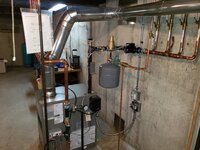
Here are a couple of pictures of my furnace. It was installed pretty tucked up next to the chimney, not a lot of room between the chimney, pump and furnace. I understand the reason to install the air separator in the return line pump but I don't have the room to install it there. If I am understanding the process if I install the combination air separator/tank in the present location of just the tank it should catch the air in the incoming fresh water. When I purge the system using a hose the replacement fresh water shouldn't have air in it, correct?

View media item 99825
View media item 99826
View media item 99827
 
OP
B

bobj49f2

Banned
Joined
Nov 13, 2009
Messages
430
Location
SE Wisconsin
Brewchief, thanks. If I use this unit I can leave the tank where it is now, correct?

I am trying to figure out the quickest way to do this modification. I would like to do it in an hour or two during the day so the house doesn't go cold. I know, I should have thought of this back in August but back then I didn't have air running through my water pipes to remind me.
 
OP
B

bobj49f2

Banned
Joined
Nov 13, 2009
Messages
430
Location
SE Wisconsin
Honeywell stats should be setup for 3 cycles an hour as per page 13 o the install manual

I woke up early this morning, 4:00 and the bedroom was 70°, thermostat set at 62°. I couldn't sleep so I walked around the house with a electronic meat thermometer (the only thermometer at the time) which probably isn't the most accurate at the lower range but it seemed close. All of the rooms were warmer than the thermostat setting, all at 62° for sleep time. I got on line and search for the logic behind cycle timing for hydronic systems. I found a few sites that mentioned 3 cycles an hour was fine for cast iron radiators, the type I have at my old house but that up to 6 cycles an hour would be better for the fin type base board units I have. They also said it's kind of a trial and error type of setting approach, set the cycle to a certain rate and then wait a few days to see how it works out.

Again, I had no idea about cycle times if it weren't for your heads up.:thumbup:
 
OP
B

bobj49f2

Banned
Joined
Nov 13, 2009
Messages
430
Location
SE Wisconsin
OK, another thanks for the heads up on thermostat setting. I recently installed a two stage gas fired radiant tube heater in my shop. I thought I had the thermostat correctly set up but I got to thinking about the settings mode and didn’t remember setting it up. Today I got the manual out for the thermostat in the shop and went into settings and found I didn’t have it set up for a two stage furnace. The furnace starts out at 100K btu until it reaches temp and then idles at 65K btu to maintain heat. I’ve noticed it took what I thought a long time to heat the shop. After setting it for two stage I can tell it’s heating faster.

You guys are going to save me a few bucks this year, thanks.
 
Last edited:
To avoid these ads, REGISTER NOW!
Top Bottom