To avoid these ads, REGISTER NOW!

House has multiple unconnected ground rods. Best fix?

ScaldedDog

Well-known member
Joined
Jan 15, 2008
Messages
1,070
Location
Sedalia, CO/NSB, FL
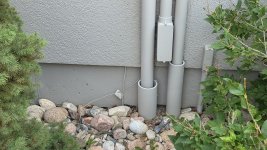
My home has two ground rods: One for the main service entry (at left in the photo below) and one installed by the fixed wireless internet provider years ago (at right in the photo below). The fixed wireless grounding block is grounded to the second rod, and I used it when I installed my Ubiquiti bridge node when we moved in six years ago.

20260804_145750 (with text).jpg

As I've been researching grounding a yet-to-be-installed Starlink antenna, I've discovered this setup is not correct, and could be dangerous. True? If so, what's the best way to resolve this?

I can think of a couple of options:

The quick and dirty way would be to just connect the two ground rods with a 10 gauge wire. Is that acceptable? (EDIT: Is is not, per post below.)

The second way would be to run longer ground wires from the grounding blocks (shown better in the photo below) to the service grounding rod (shown better in the second photo below)
20260804_145902.jpg

20260804_145832.jpg

Mark
 
Last edited:
To avoid these ads, REGISTER NOW!

bob smith1

Well-known member
Joined
Jul 2, 2026
Messages
138
It's always the IT group that makes a mess because they have no permits to pull. Yes, connecting the rods is the best strategy, but not with #10. #6 and I would like to see it in a conduit for protection. What you have now is "potential for potential"....lol Meaning likely voltage between those two rods. Just connect them.

But if I was a betting man, any of those IT guys didn't bury much of a ground rod, probably a 12" sliver to 'look' like a ground rod.
 

aggie113

Well-known member
Joined
Jul 22, 2015
Messages
496
Location
San Antonio, TX
Lol, when I had to add a grounding rod for my heat pump inverter (existing electrical pull did not have one), it was an 1/2 copper plated grounding rod that went 8ft into the ground.
 

mm08822

Well-known member
Joined
Jan 13, 2012
Messages
6,164
Location
NJ
Lol, when I had to add a grounding rod for my heat pump inverter (existing electrical pull did not have one), it was an 1/2 copper plated grounding rod that went 8ft into the ground.
That is the wrong reason to drive a grd rod.

The branch circuit needed a grd wire back to the panel. Either replace the cable or add the grd conductor into the conduit, whichever method you have.
 

wyliesdiesels

Well-known member
Joined
Aug 14, 2012
Messages
20,145
Location
Modesto, CA
It's always the IT group that makes a mess because they have no permits to pull. Yes, connecting the rods is the best strategy, but not with #10. #6 and I would like to see it in a conduit for protection. What you have now is "potential for potential"....lol Meaning likely voltage between those two rods. Just connect them.

But if I was a betting man, any of those IT guys didn't bury much of a ground rod, probably a 12" sliver to 'look' like a ground rod.

IT guys? you mean ISP guys?
 

wyliesdiesels

Well-known member
Joined
Aug 14, 2012
Messages
20,145
Location
Modesto, CA
I am pretty sure code calls for #6 copper to connect them. Thats what i would do, just run a #6 and connect them together.

not quite. code permits solid cu #8 if protected from damage. solid cu #6 can be ran without protection but in this case i would use it. you can buy solid cu #6 in FMC just for this purpose
 

wyliesdiesels

Well-known member
Joined
Aug 14, 2012
Messages
20,145
Location
Modesto, CA
Lol, when I had to add a grounding rod for my heat pump inverter (existing electrical pull did not have one), it was an 1/2 copper plated grounding rod that went 8ft into the ground.

totally incorrect. you dont need a grounding electrode for a heat pump. you need an EGC. you like many people confuse the difference between grounding electrodes and EGCs.

the grounding electrode you installed should not be used in place of an EGC. all you have done is create a dangerous potential for shock because if the metal parts of the equipment should become energized there is no low impedance fault current pathway (EGC) to allow the breaker to trip.

quite frankly you have done the worst thing you could have done in terms of grounding and bonding.

you need to disconnect the ground rod and add an EGC to the circuit or pull a new circuit.
 

aggie113

Well-known member
Joined
Jul 22, 2015
Messages
496
Location
San Antonio, TX
totally incorrect. you dont need a grounding electrode for a heat pump. you need an EGC. you like many people confuse the difference between grounding electrodes and EGCs.

the grounding electrode you installed should not be used in place of an EGC. all you have done is create a dangerous potential for shock because if the metal parts of the equipment should become energized there is no low impedance fault current pathway (EGC) to allow the breaker to trip.

quite frankly you have done the worst thing you could have done in terms of grounding and bonding.

you need to disconnect the ground rod and add an EGC to the circuit or pull a new circuit.
Didn't realize. The tech who installed the unit said it was an acceptable way to meet the requirements of the Mitsubishi heat pump to have a ground. Apparently those units are more sensitive to noise on the electrical lines that they use to communicate back to the inside unit. The line is buried but I guess it might be possible to use the existing run to pull it through, no conduit for it if I recall under the house.
 

mm08822

Well-known member
Joined
Jan 13, 2012
Messages
6,164
Location
NJ
Didn't realize. The tech who installed the unit said it was an acceptable way to meet the requirements of the Mitsubishi heat pump to have a ground. Apparently those units are more sensitive to noise on the electrical lines that they use to communicate back to the inside unit. The line is buried but I guess it might be possible to use the existing run to pull it through, no conduit for it if I recall under the house.
Tech lied or hasn't a clue what he is talking about.
"Noise on the line" if even a problem, can be eliminated/minimized through physical separation distance, using twisted cable, with or without a shield.

Tech should have told you that you need new branch circuit wiring if it were missing the equipment grounding conductor.

Post some pics of this wiring.
 

mm08822

Well-known member
Joined
Jan 13, 2012
Messages
6,164
Location
NJ
Is that bare copper going to the grd rod or come with the supply conductors?

What size cb is in the panel for the ac?
What value does the ac nameplate state for MOP?
 
To avoid these ads, REGISTER NOW!
OP
S

ScaldedDog

Well-known member
Joined
Jan 15, 2008
Messages
1,070
Location
Sedalia, CO/NSB, FL
not quite. code permits solid cu #8 if protected from damage. solid cu #6 can be ran without protection but in this case i would use it. you can buy solid cu #6 in FMC just for this purpose
I can't find the premade stuff in the right lengths locally, but it's easy enough to run it myself. Does the FMC need to be 3/4" in this case, when its only purpose is to protect a single #6 wire?

Mark
 

justsam

Well-known member
Joined
Aug 20, 2010
Messages
1,271
Location
Penngrove, California
Seems like there is a question whether a proper ECG is already existing to the mini split condenser. If it is there, just disconnect and get rid of the grounding electrode located at the condenser. No need to tie the two ground electrodes together as the condenser located ground electrode should not have been there in the first place. If there is no proper ECG it needs to be run.
 

bob smith1

Well-known member
Joined
Jul 2, 2026
Messages
138
I can't find the premade stuff in the right lengths locally, but it's easy enough to run it myself. Does the FMC need to be 3/4" in this case, when its only purpose is to protect a single #6 wire?

Mark
The protection can be nearly anything..... PVC, EMT, any size, etc, etc. It's for protection. Some AHJs are now requiring it.
 

Sumboodie

Well-known member
Joined
Mar 20, 2021
Messages
10,883
Location
AK
My ground rod is a concrete form stake with like 10 gauge wire wrapped around it.

I swear everytime I look into something it's more WHAT IN THE....
 

bob smith1

Well-known member
Joined
Jul 2, 2026
Messages
138
My ground rod is a concrete form stake with like 10 gauge wire wrapped around it.

I swear everytime I look into something it's more WHAT IN THE....
There is a lot of debating on grounding methods. Rods are not always the answer, and have very limited surface area and performance in certain soils. The inclusion of Ufer grounds has certainly helped. In high stakes industrial applications, we will dictate horizontal trench and copper plate grounds, and triangulated field testing.
 
OP
S

ScaldedDog

Well-known member
Joined
Jan 15, 2008
Messages
1,070
Location
Sedalia, CO/NSB, FL
The protection can be nearly anything..... PVC, EMT, any size, etc, etc. It's for protection. Some AHJs are now requiring it.
I got them connected with #6 wire today, though I didn't end up using conduit. I couldn't bring myself to spend $100 on metal conduit labeled "for dry location use only", and then lay it on the ground. I could put the wire in something if I ever got called on it, but there is zero chance of that happening. These posts have sat unconnected for probably 10 years - I've been here six - so I'm way ahead of where I was yesterday.

Thanks guys!!

Mark
 

BreeStephany

ALLIANCE MEMBER
Joined
May 19, 2012
Messages
865
Location
Oregon
As others have suggested, use bare 6ga solid copper to connect the 2 rods. There is no maximum distance between rods as long as your resistance to ground is less than 25 ohms or less. You can direct bury the copper in the ground, you can run it along the foundation.

When you do run the wire, run it through and past the acorn clamp at the rod closest to your main service and use a irreversible crimped grounding clamp to clamp the new wire to the wire currently running to your main service. While you are at it, I highly suggest adding a intersystem grounding bar like a Arlington GBB5250 or equivalent at the main service. These are code required for all new construction and are simply a cleaner, code compliant device that can be safely utilized by telco, wireless, satellite, LV, security, etc. installers to bond to the grounding system without having to enter the service entrance disconnect.

Just my two cents.
 

rlitman

Well-known member
Joined
Oct 18, 2010
Messages
24,725
Location
Long Island
not quite. code permits solid cu #8 if protected from damage. solid cu #6 can be ran without protection but in this case i would use it. you can buy solid cu #6 in FMC just for this purpose
I would strongly advise against any metallic "protection" for a ground wire. The wire should have enough cross section to not be vaporized should you take a lightning strike (which is why #6 is recommended). But as soon as you wrap it in something conductive, due to the skin effect, lightning will follow the FMC and not the wire. That's bad enough, but if the grounding wire isn't well bonded to the FMC on both ends, you've now created a point where lightning will arc at the unbonded end.

And in a less extreme condition than a lightning strike, a conductive sleeve on a grounding wire turns the wire into a coaxial cable, with a rather high impedance. That will prevent it from diverting surge current if you have a whole house surge suppressor.

If you have a reason that your grounding wire needs protection, stick to plastic.
 

mm08822

Well-known member
Joined
Jan 13, 2012
Messages
6,164
Location
NJ
Another problem with the resistance checks is that results can vary based on recent weather and water table in soils and sands.
You'll pass with flying colors if done right after a rain or someone accidentally spills salt in the area.
1786029362534.png

Likewise, the exact opposite problem happens when doing a perc test. Best chance to get a good rate well into the dry season, but iffy during wet weather.
 

wyliesdiesels

Well-known member
Joined
Aug 14, 2012
Messages
20,145
Location
Modesto, CA
I would strongly advise against any metallic "protection" for a ground wire. The wire should have enough cross section to not be vaporized should you take a lightning strike (which is why #6 is recommended). But as soon as you wrap it in something conductive, due to the skin effect, lightning will follow the FMC and not the wire. That's bad enough, but if the grounding wire isn't well bonded to the FMC on both ends, you've now created a point where lightning will arc at the unbonded end.

And in a less extreme condition than a lightning strike, a conductive sleeve on a grounding wire turns the wire into a coaxial cable, with a rather high impedance. That will prevent it from diverting surge current if you have a whole house surge suppressor.

If you have a reason that your grounding wire needs protection, stick to plastic.

Yes the FMC needs to be bonded at both ends so you don’t create a “choke”.

Same requirement applies to GEC or bond wire ran in EMT.
 
To avoid these ads, REGISTER NOW!
Top Bottom