To avoid these ads, REGISTER NOW!

How accurate is framing?

vavet

Well-known member
Joined
Mar 6, 2012
Messages
5,319
Location
Ashland, VA
I was always told residential framing wa supposed to be 16 inches on center. This seems to be a good rule of thumb, but it’s far from gospel.

I’ve seen a lot of variance in the small unfinished bathroom to be in our home since I’ve been working on that, but it’s a small space, so I figured that had something to do with it.

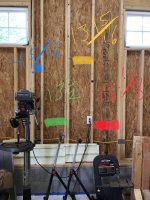
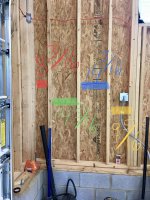
I had a detached garage (24x32) built last year by a different builder. I’ve been looking into insulating and drywalling that so I can air condition it. I started looking at the width of the cavities. It varies quite a bit from one cavity to the next. Is this just sloppy craftsmanship? Is it typical?
Batt insulation is cut to a certain width, whether it’s mineral wool or fiberglass. As I understand it, one of the advantages of mineral wool is that it has more shape to it than fiberglass so you have push it into the cavity, if the cavity is too big, then it won’t work!
I’m wondering if I just need to use blow-in insulation to make the whole thing easier.
 

Attachments

  • 2906B0C6-260B-4481-A80C-DBF2BF802FB8.jpg
    2906B0C6-260B-4481-A80C-DBF2BF802FB8.jpg
    155.3 KB · Views: 286
  • FAE1EBF0-79E7-4A5B-8EAB-15E4394AC5FA.jpg
    FAE1EBF0-79E7-4A5B-8EAB-15E4394AC5FA.jpg
    154.9 KB · Views: 246
To avoid these ads, REGISTER NOW!

CJ7VFR

Well-known member
Joined
Jan 13, 2015
Messages
2,939
Location
Central New Jersey
It is hard to tell from the picture, but how "off" are they?

In every house or building I have ever seen, the center to center distance always varies a little bit, and it is never perfectly 16 inches or 24 inches or whatever.

If you are talking about an inch or less, that is pretty normal. If you are talking about several inches off, everywhere, then that is probably just sloppy workmanship.

Jim
 

Boilerhouse

Well-known member
Joined
Mar 20, 2012
Messages
1,320
Location
Muskoka
I built my own garage on 24 inch centers, plus or minus less than 1/16 inch. I am an amateur, a pro should be able to do as well or better.
 

The Cobbler

Super Moderator
Staff member
Joined
Oct 24, 2013
Messages
25,824
Location
Niagara Region, Ontario, Canada
it should be relatively close to 16 or 24, but a bit off is acceptable. the places where the windows & doors etc are are smaller due to the king & jack studs to accomodate the window.
it looks like in a few places they doubled up the 2x so the exterior sheeting would line up to a stud.
for insulation you can always cut it and lay it horizontal to get a good fit. more work tho. or just cut strips to shim the edges is probably better solution.

also looks like some2x bracing for the gable truss that could be removed too.
 

redneckcharlie

Well-known member
Joined
Dec 26, 2009
Messages
125
From the pics you posted the framimg looks pretty decent. Dimensional lumber can vary depending on the source. Humidity makes a hige difference as well. We’re so dry its not uncommon to see a 2x6 lose a 1/2” in its dimension between delivery and being dried in. Im betting in your area they would pitch what we have to use just because of the climate difference.
 

ard

Well-known member
Joined
Feb 16, 2015
Messages
4,391
Location
Sierra Foothills... California
I
I had a detached garage (24x32) built last year by a different builder. I’ve been looking into insulating and drywalling that so I can air condition it. I started looking at the width of the cavities. It varies quite a bit from one cavity to the next. Is this just sloppy craftsmanship? Is it typical?

That looks perfectly normal.

Studs are 16"OC

Beam supports, cripples, other things in the wall can be ADDED and result in spacing other than 16 inches.
 

PelicanPines

ALLIANCE MEMBER
Joined
Apr 30, 2014
Messages
38,104
Location
New Jersey, USA, Earth, My own reality
Things do get in the way of everything being 16 or 24. Windows, doors, load points...

All that adds extra vertical timber... the resulting cavities may be split but there still should be a nailing surface every 16 or 24.
 
Last edited:

34 Ply

Well-known member
Joined
Aug 27, 2010
Messages
51
I built houses for 40 years. The framing layout should never be off 16 or 24 inch on center You need that to be right not only for insulation but for outside sheathing. If it's off a inch it's just sloppy work. Use fiberglass and fill in the wide spaces.
 

Jonny Rotten

Well-known member
Joined
Jun 14, 2018
Messages
102
Location
long island
yes it should be 16" on center. Up to 1/2" off is acceptable and insulation and more important sheetrock will still work. If one is 17 and another is 18 and 19 all over the place then that would be bad framing and will be nightmare with sheetrock and spackle.

If you mean where windows are on the wall then small cavities are normal...no way around it . Rip down insulation lengthways
 

TRWham

Well-known member
Joined
Aug 11, 2017
Messages
1,957
Location
East Cobb County, Georgia
If you find stud bays that are too big, it may be sloppy work, but stud bays will frequently be smaller because they are constrained by factors besides the ability to measure and cut 2x4s. For one, how many walls are perfectly sized to be split evenly into neat little 16" o.c. bays? Whatever is left over becomes a smaller bay. Second, any opening in a wall will usually drive one or more bays to be smaller, for the same reason. Same thing under windows, where there will usually be one bay that is smaller because the king and jack stud spacing is constrained by the size of the rough opening and the location of the window. Not to mention openings that get moved or changed on the fly. You don't reframe the whole wall just to move a window. Plus, you seem to have several studs that are doubled up for one reason or another, and that will change spacing.
 

Lelandwelds

Well-known member
Joined
Sep 6, 2017
Messages
2,443
Location
Central Texas
The stuff Grows on trees. It is never straight. Walls have a bulge in the center. Rooms are not square. Your windows are not water tight. Your drain pipes drain uphill. You have the wrong HVAC and it was installed incorrectly.

If you bought a house in a planned community, it is even worse.
 

8mpg

Well-known member
Joined
Jul 9, 2012
Messages
350
I like to mention this is considered "rough carpentry" and that is it not designed to be that accurate. Id also say 1/2-3/4" off would be considered normal. Dimensional lumber is never straight. Its warped, bowed, cupped, twisted. The longer the wood the worse it usually is.
 

Strouty

Well-known member
Joined
Mar 21, 2010
Messages
38,212
Location
Southern Maine
If it is too wide, use roxul or the like, just cut pieces and put them in horizontally, or buy 24" OC and cut lengthwise, the scraps will get used up somewhere.
 

bad_idea

Well-known member
Joined
Jun 11, 2011
Messages
4,332
Location
Pasquotank, NC
I built my own garage on 24 inch centers, plus or minus less than 1/16 inch. I am an amateur, a pro should be able to do as well or better.

I believe you framed it that tight. How long did it take you? I fit steel for a living and can fit within a 1/32 of an inch. But I don't. Takes too long. A good welder can fill a 1/8" gap easy. Why waste my time doing unnecessary work? Carpenters are the same, time is money. If they fit studs to that level of precision then build times would go up tremendously and cost would follow. You want to pay extra to have studs spaced precisely inside of a wall that is covered up on both sides?
 
OP
V

vavet

Well-known member
Joined
Mar 6, 2012
Messages
5,319
Location
Ashland, VA
In an effort to further this conversation, I took pics and measurements of each cavity along one of the 32foot walls. There are three 4 foot long transom windows spaced (roughly) evenly along the wall.
The width of the cavity (not center to center) is marked in the same color as the line indicating the width of that cavity. I’m going to try to post them in order from front to back.
 

Attachments

  • 0FF5FA15-7D66-4FBB-82C2-0DD4F94040ED.jpg
    0FF5FA15-7D66-4FBB-82C2-0DD4F94040ED.jpg
    136.4 KB · Views: 139
  • F3D2C700-D9DF-45F9-9A1E-590A61A9FBB7.jpg
    F3D2C700-D9DF-45F9-9A1E-590A61A9FBB7.jpg
    113.8 KB · Views: 150
  • 7797E81E-D5DA-47C4-B36C-991D3DE95583.jpg
    7797E81E-D5DA-47C4-B36C-991D3DE95583.jpg
    123.2 KB · Views: 153
  • E1677580-65DF-430B-9AFA-C08C3ACEBD72.jpg
    E1677580-65DF-430B-9AFA-C08C3ACEBD72.jpg
    107.7 KB · Views: 155
  • D091E479-24B5-483A-8AF8-367BFF75E0C3.jpg
    D091E479-24B5-483A-8AF8-367BFF75E0C3.jpg
    133.6 KB · Views: 164
  • B360BCD1-9094-47D1-8662-F34ED232EBB6.jpg
    B360BCD1-9094-47D1-8662-F34ED232EBB6.jpg
    110.8 KB · Views: 188
  • 051E88A3-A95C-41E3-BF79-0EBCB63E98D9.jpg
    051E88A3-A95C-41E3-BF79-0EBCB63E98D9.jpg
    142.8 KB · Views: 223
OP
V

vavet

Well-known member
Joined
Mar 6, 2012
Messages
5,319
Location
Ashland, VA
The framing under the windows in strange, and not consistently strange in the same way. Why the 3/8” gap on the one? There are places where they could’ve saved a stud if they’d spaced them evenly.
 

OccupantRJ

Well-known member
Joined
May 15, 2009
Messages
10,966
Location
Eastern North Carolina
That looks pretty normal, other than the double stud where someone likely measured wrong and then added a sister stud to have a nailing surface for the sheathing. Doing it for myself, I will spend extra effort to make sure sheet joints fall correctly, even using quick grip clamps to align a stud. The builders are not going to spend time on that.
 
Last edited:
To avoid these ads, REGISTER NOW!

Dirtydan69

Well-known member
Joined
Nov 8, 2015
Messages
847
Location
San Tan Valley, AZ
Just insulate it and rock it. You’re stressing way to much. Agreed some of those studs could have been pulled straight but I say just proceed on.
 

KenC

Well-known member
Joined
Dec 20, 2009
Messages
2,577
stud spacing is measured outside to outside of the wall. So, the first and last gap as seen from the inside is never 14 3/8 which is the normal nominal size. That can vary a bit as all lumber is not exactly the same.

It's done that way to keep the sheathing and siding as near 16 as possible. It's more expensive to cut siding than sheetrock. loosing 4-8 inches off a piece of rock is cheap, not so with siding!

Also, when you measured the gap, did you measure in the middle, top or bottom. I'd expect the middle to vary some due to bowed studs, but the top and bottom should be on the mark +-1/8" IME. Of course those could have been pulled straighter, but time is money!
 

Whitworth

Well-known member
Joined
Dec 26, 2011
Messages
2,084
A framing crew can frame quickly and within 1/8” variation consistently. If you’re off 1/4” or more it should be pulled and done again. If you’re off a bit less, but still off, the question becomes do you have the time to spend being fastidious and do you want to risk destroying a stud or joist or truss pulling it to do over.
Just my experience.
 

PelicanPines

ALLIANCE MEMBER
Joined
Apr 30, 2014
Messages
38,104
Location
New Jersey, USA, Earth, My own reality
In an effort to further this conversation, I took pics and measurements of each cavity along one of the 32foot walls. There are three 4 foot long transom windows spaced (roughly) evenly along the wall.
The width of the cavity (not center to center) is marked in the same color as the line indicating the width of that cavity. I’m going to try to post them in order from front to back.

Hate to tell you... but... that looks totally normal. Like several have said... windows, doors, load points will add vertical timber that splits cavities.

It does not appear to be bad framing but normal.
 
OP
V

vavet

Well-known member
Joined
Mar 6, 2012
Messages
5,319
Location
Ashland, VA
Hate to tell you... but... that looks totally normal. Like several have said... windows, doors, load points will add vertical timber that splits cavities.

It does not appear to be bad framing but normal.

I’m not trying to convince anyone this is a bad job. I’m asking a question so I can get educated.
I understand you have to work around certain things, like windows.
Allow me to point out some of things I’m specifically wondering about. If you who are more experienced and educated about these things would humor me and respond, I’d appreciate it.
In the 2nd picture, there is a 3/8” gap on the left and a 10-9/16” gap on the right. Why? He could’ve saved a stud if he’d spaced them more evenly.
In the 4th picture, the two outboard cavities are 5 13/16”. why not just space them more evenly and save a stud?
In the 5th picture, the cavity sizes range from 4-5/16 to 16-1/8.
The 6th picture has a really narrow cavity...1-3/4”.

Should I just assume these are the studs necessary to provide a nailer for a piece of sheathing on the outside? I could understand that so you’re not cutting a bunch of sheathing to line it up with studs on the inside with weird spacing Because of windows.
 

brewchief

Well-known member
Joined
Sep 20, 2008
Messages
2,370
Location
Michigan
I’m not trying to convince anyone this is a bad job. I’m asking a question so I can get educated.
I understand you have to work around certain things, like windows.
Allow me to point out some of things I’m specifically wondering about. If you who are more experienced and educated about these things would humor me and respond, I’d appreciate it.
In the 2nd picture, there is a 3/8” gap on the left and a 10-9/16” gap on the right. Why? He could’ve saved a stud if he’d spaced them more evenly.
In the 4th picture, the two outboard cavities are 5 13/16”. why not just space them more evenly and save a stud?
In the 5th picture, the cavity sizes range from 4-5/16 to 16-1/8.
The 6th picture has a really narrow cavity...1-3/4”.

Should I just assume these are the studs necessary to provide a nailer for a piece of sheathing on the outside? I could understand that so you’re not cutting a bunch of sheathing to line it up with studs on the inside with weird spacing Because of windows.

If you pull a measurement from one end you should have a stud every 16" on center, there will be extras at certain spots under the windows and by doors and such. The studs on 16" centers are for both the exterior sheathing and interior drywall.
 

dpv4276

Active member
Joined
Apr 13, 2016
Messages
26
After a closer look I was wrong...ill be quiet now lol
Sent from my SAMSUNG-SM-G930A using Tapatalk
 
Last edited:

PelicanPines

ALLIANCE MEMBER
Joined
Apr 30, 2014
Messages
38,104
Location
New Jersey, USA, Earth, My own reality
I’m not trying to convince anyone this is a bad job. I’m asking a question so I can get educated.
I understand you have to work around certain things, like windows.
Allow me to point out some of things I’m specifically wondering about. If you who are more experienced and educated about these things would humor me and respond, I’d appreciate it.
In the 2nd picture, there is a 3/8” gap on the left and a 10-9/16” gap on the right. Why? He could’ve saved a stud if he’d spaced them more evenly.
In the 4th picture, the two outboard cavities are 5 13/16”. why not just space them more evenly and save a stud?
In the 5th picture, the cavity sizes range from 4-5/16 to 16-1/8.
The 6th picture has a really narrow cavity...1-3/4”.

Should I just assume these are the studs necessary to provide a nailer for a piece of sheathing on the outside? I could understand that so you’re not cutting a bunch of sheathing to line it up with studs on the inside with weird spacing Because of windows.

The 3/8" gap is a result of getting the spacing to the right for 16" OC. If it was moved to the left 3/8"... he would miss the 16" nailing surface.

Now there is one gap that disturbs me... it's the gap of over 16" OC... you may need to add a stud in that space against the right stud.

The other narrow cavities again are basically a result of getting a stud to sit on the required 16" center...

ALL that said. Your framing is considered "old style" accepted framing with 2x4 studs. There is a newer technique that allows for 24" OC framing with 2x6 studs. It also eliminates the "extra studs" that end up around the windows and doors.

The issue with normal framing (which yours is)… is insulation... one the issue of random narrow gaps... and the fact that a 2x4 is rated an R1 per inch thick... so … a 4" is actually 3.5"... so R3.5 and in that air space you can add up to an R19 I believe... (sorry I don't have my notebook handy)


When you insulate... get all those spaces but DON"T STUFF pink insulation tight... make sure it's still "airy"... aka NOT PACKED IN. Use spray foam in spots too... like that 3/8" gap... the expandable kind.
 
Last edited:

Git

Well-known member
Joined
May 18, 2008
Messages
6,894
Location
S Cal
Ever hear of a 'California Corner'? It let's you get more insulation in the corners

attachment.php
 

Attachments

  • SNAG-1016.jpg
    SNAG-1016.jpg
    24.3 KB · Views: 295

The Cobbler

Super Moderator
Staff member
Joined
Oct 24, 2013
Messages
25,824
Location
Niagara Region, Ontario, Canada
those measurements (IMO) are totally acceptable. if you measure at the top & bottom plates I bet they are a lot closer. undoubtedly the 2x material has bowed slightly and caused discrepancies.
 

firebirdparts

Well-known member
Joined
Jun 8, 2016
Messages
10,585
Location
Kingsport, TN
Framing needs to be good enough to attach sheet goods to, and that really dictates what is "bad". So if you are sheet rocking this, go ahead and look where your sheets are going to break. If the spacing is no good, you may have to add some blocks or entire studs to give the sheetrock a place to land.

Such is life, basically. If it's a half inch off it gets pretty ugly. 3/4" off and you're off the sheet, obviously. Each sheet just lands on 3/4", that's all you get.
 

PelicanPines

ALLIANCE MEMBER
Joined
Apr 30, 2014
Messages
38,104
Location
New Jersey, USA, Earth, My own reality
those measurements (IMO) are totally acceptable. if you measure at the top & bottom plates I bet they are a lot closer. undoubtedly the 2x material has bowed slightly and caused discrepancies.

^^^ this is important too.

I always measured in the middle as well to notice which studs were "wonky"... right before sheeting and would take note of any place I needed to add nailers.


I was aware of that "California Corner"... it is actually how my house was done. I used 2x6 for all exterior and some inside walls. 16"oc everywhere.
 

Homerr

Well-known member
Joined
Mar 16, 2012
Messages
379
Location
Seattle, WA
I made a composite photo and drew out the wall based on your dimensions. It comes in at a little less than 32' in length. The front (overhead garage door end) and rear walls are framed full width with the side wall in question 'infilled' between them. In the graphic the upper drawn wall is as-built and the lower one is a more 'ideal' version based on truly 16" centers.

It seems that this side wall was framed by two people each starting at an opposite end and meeting in the middle since they each framed it a little different and there is a non-standard width of plywood in the middle. Ideally, it would have started at one end and been consistent to the end with any variation from the 4' standard being at the rear corner (right side of graphic).

Larger version of graphic:
https://www.dropbox.com/s/9rosjmgplol2qz4/16oc.jpg?dl=0

Reverse engineering this I'd say that the framing was barely adequate and lacked skill and consistency. It's not going to fall down, but you're seeing the PITA factor for insulation and sheetrocking.
 

Attachments

  • 16oc SMALL.jpg
    16oc SMALL.jpg
    141.7 KB · Views: 39

Parrothead

Well-known member
Joined
Apr 27, 2014
Messages
5,346
Location
Earth
In my house 16" on center is a suggestion, not a requirement. I've got anything from 14"to 18" on floor joists. Yea, not exactly well built, especially for a custom home.
 

Falcon67

Well-known member
Joined
Jun 11, 2009
Messages
18,371
Location
Merkel, TX
Last house I insulated was our old house, most of it built in 1928. You best be glad they don't build 'em like thy used to. Custom trim every single batt of insulation for every stud cavity. FWIW, I framed my shop 24" OC with double studs every 4' for nailing surface to handle HardiPanel. Same deal as noted on doors/windows - you strike off the stude locations on top and bottom plates, then plan in king, etc studs are needed for doors, windows wile making sure there is something available in all spaces at 24" OC, without regard to the closest stud or trimmer doing something else. Lots of batt trimming to insulate - just the way it is.

You should be able to hold +/- 1/8 or so, but with the lumber I get you'll have to make spacers to get the bows/warping pieces shoved into place until sheathing or strongbacks are applied. Getting those 2x12x24' joists I used to get anywhere near 24" OC was a fight. Same with the 2x6 rafter runs.

>A good framer will either insulate that void, or fill it with a 2x4.
Framer's don't insulate, and filling that gap with a full stud is a waste and provides a big conduction path inside to outside. I did my corners like "old school" and just used scraps (3 per) to space the two corner studs. The CA Corner allows more insulation into the corner and less conduction path.
 
Last edited:

8mpg

Well-known member
Joined
Jul 9, 2012
Messages
350
I made a composite photo and drew out the wall based on your dimensions. It comes in at a little less than 32' in length. The front (overhead garage door end) and rear walls are framed full width with the side wall in question 'infilled' between them. In the graphic the upper drawn wall is as-built and the lower one is a more 'ideal' version based on truly 16" centers.

It seems that this side wall was framed by two people each starting at an opposite end and meeting in the middle since they each framed it a little different and there is a non-standard width of plywood in the middle. Ideally, it would have started at one end and been consistent to the end with any variation from the 4' standard being at the rear corner (right side of graphic).

Larger version of graphic:
https://www.dropbox.com/s/9rosjmgplol2qz4/16oc.jpg?dl=0

Reverse engineering this I'd say that the framing was barely adequate and lacked skill and consistency. It's not going to fall down, but you're seeing the PITA factor for insulation and sheetrocking.

Nice!

I was going to say from just looking at the pics, the cripple studs look to be spaced at 16" on center from the wall studs beside the window Attached is my pic for reference.

Here is a great video and explains wall framing layout. Check out the video starting at 36:26
 

Attachments

  • E1677580-65DF-430B-9AFA-C08C3ACEBD72.jpg
    E1677580-65DF-430B-9AFA-C08C3ACEBD72.jpg
    104.2 KB · Views: 24
To avoid these ads, REGISTER NOW!
Top Bottom