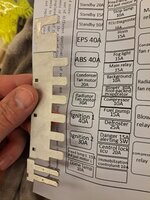
Aluminum is alloyed to reduce cracking (increase ductility), and is plated to reduce surface resistance from oxidation, but every alloy has lower conductivity than pure aluminum.It also may be an alloy and not simply aluminum.
Some sort of car/truck it appearsWhat is this bus bar from?
AutoWhat is this bus bar from?
What calculator did you use?.7mm x 19mm aluminum...11 amps max on calculator
The font on the left is very common on cheap, Chinese products. Guessing it's not something OEMWhat is this bus bar from?
It’s also got a whole lot more surface area than a piece of wire. Heat dissipation is the limiting thing for current capacity. And I bet the engineers have a good idea what the expected load is. Lots of auto loads are fused for peak load, and are nowhere near continuous.Are you positive it's aluminum?
Also, a calculator for an industrial bus bar, or even residential wiring, is not relevant at all to a bus bar inside a fuse box. The NEC doesn't apply to cars, and has a very high safety factor. You can easily shove 40+ amps through a 12 gauge wire.
And the length of the 'wire' has a lot to do with the rating. Find a general purpose calculator, not code compliant but engineering, online and play with loads, wire size and circuit length. Lots of variance from 'normal' sizing when distance is reduced to a few inches.Are you positive it's aluminum?
Also, a calculator for an industrial bus bar, or even residential wiring, is not relevant at all to a bus bar inside a fuse box. The NEC doesn't apply to cars, and has a very high safety factor. You can easily shove 40+ amps through a 12 gauge wire.
I think those can only handle 99A, they fail at 100.
As is much of the poorly translated text on the fusebox plan shown.What calculator did you use?
The font on the left is very common on cheap, Chinese products. Guessing it's not something OEM